
Peer to Peer (P2P) Lending Market Overview
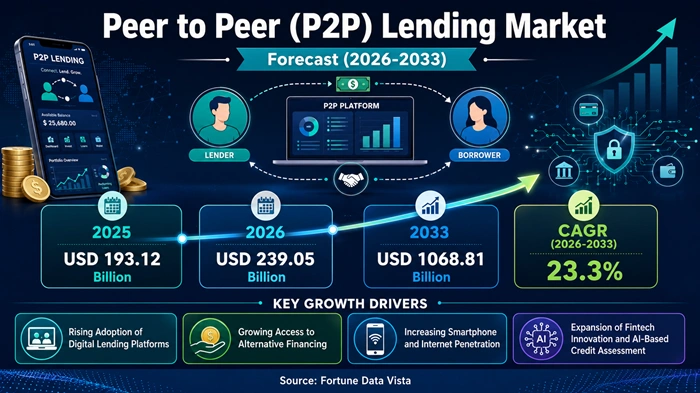
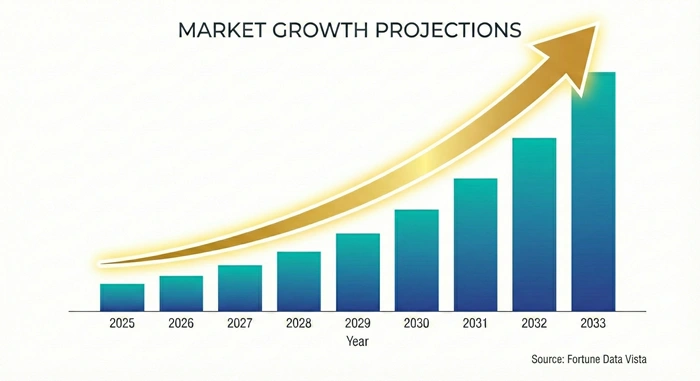
The global peer to peer (P2P) lending market size is valued at USD 193.12 billion in 2025 and is predicted to increase from USD 239.05 billion in 2026 to approximately USD 1068.81 billion by 2033, growing at a CAGR of 23.3% from 2026 to 2033.
The peer to peer lending industry — which connects borrowers directly with individual and institutional lenders through digital platforms, bypassing traditional banking intermediaries — has emerged as one of the fastest-growing and most disruptive segments of the global financial technology ecosystem. The growing preference for faster, more accessible, and more competitively priced credit products among consumers and small businesses underserved by conventional banks, the accelerating adoption of digital financial services globally, and the progressive improvement of AI-powered credit assessment and risk management capabilities are collectively powering an extraordinary growth trajectory for the P2P and marketplace lending industry through the entire forecast period.
AI Impact on the Peer to Peer (P2P) Lending Industry
Artificial Intelligence Is Fundamentally Transforming the Peer to Peer Lending Industry by Enabling More Accurate Credit Risk Assessment, Real-Time Fraud Detection, and Personalized Lending Experiences That Allow P2P Platforms to Serve Borrower Segments That Traditional Banks Cannot Assess or Price Competitively
Artificial intelligence and machine learning are delivering transformative commercial value across every dimension of the peer to peer lending business model — from borrower acquisition and credit underwriting through loan performance monitoring, default prediction, and investor portfolio management. Traditional bank credit underwriting models rely primarily on credit bureau scores, income verification, and collateral assessments that systematically exclude or price at a disadvantage the large population of creditworthy borrowers who lack established credit histories, have irregular income patterns, or seek smaller loan amounts that traditional banks cannot profitably process through manual underwriting procedures. AI credit assessment models deployed by leading P2P platforms can evaluate hundreds of alternative data variables — including digital transaction patterns, e-commerce behavior, mobile usage data, utility payment histories, and social network signals — to build highly predictive credit risk profiles for borrowers that conventional scoring models cannot adequately assess, allowing platforms to approve creditworthy borrowers that banks routinely decline and price their loans more accurately to actual risk levels.
Fraud detection is the second major AI application transforming P2P lending platform operations — with machine learning models capable of identifying fraudulent loan applications in real time by analyzing behavioral biometrics, device fingerprinting, application velocity patterns, and cross-platform identity verification signals that manual review processes cannot monitor at the speed and scale that digital lending platforms require. Real-time AI fraud scoring enables P2P platforms to process loan applications in minutes without sacrificing fraud risk control — creating the fast approval and funding experience that is one of the primary competitive advantages of digital P2P platforms over traditional bank loan processes. Companies including LendingClub, Prosper Marketplace, and Funding Circle have invested heavily in AI-enhanced underwriting and fraud detection systems that are progressively improving loan performance metrics while reducing the manual review overhead that slows digital lending operations.
Growth Factors
The Growing Demand for Fast, Accessible, and Competitively Priced Digital Credit Products, the Massive Underserved Borrower Population Excluded From Traditional Banking, and the Increasing Participation of Institutional Investors in P2P Lending Platform Portfolios Are the Primary Forces Driving the Extraordinary Growth of the Peer to Peer Lending Market
The fundamental demand driver in the peer to peer lending market is the persistent and large-scale unmet need for affordable credit among consumers and small businesses that the conventional banking system fails to serve adequately. Traditional banks — constrained by regulatory capital requirements, high operating costs, conservative underwriting models, and minimum loan size economics — systematically decline or price uncompetitively a significant proportion of creditworthy borrowing demand from individuals without prime credit histories, self-employed professionals with variable income, and small businesses without sufficient collateral or trading history for conventional bank credit assessment. P2P lending platforms address this credit gap by combining lower-cost digital operating models, AI-powered alternative credit assessment, and direct investor-to-borrower matching mechanisms that allow more flexible underwriting at competitive rates — making them an increasingly mainstream credit option for borrower segments that the banking system underserves.
The growing participation of institutional investors — including hedge funds, insurance companies, pension funds, and bank-owned investment vehicles — in P2P platform lending portfolios is providing the capital market depth needed to sustain the extraordinary loan volume growth that leading platforms are experiencing. Early P2P platforms relied exclusively on retail investor capital, which limited their loan origination capacity and created liquidity constraints in periods of investor sentiment volatility. The progressive professionalization of P2P platform capital structures — through institutional investor partnerships, securitization of P2P loan pools into asset-backed securities, and the listing of major platforms on public stock exchanges — has fundamentally transformed the capital availability dimension of the P2P lending industry, enabling platforms to scale loan origination volumes at rates that retail investor capital alone could never support. This institutionalization of P2P lending capital is a structural rather than cyclical development that permanently expands the addressable market for P2P loan origination.
Market Outlook
The Peer to Peer Lending Market Is Positioned for One of the Most Exceptional Long-Term Growth Trajectories in Global Financial Services Through 2033, Powered by Digital Financial Inclusion Imperatives, Regulatory Framework Maturation, and the Emerging Market Fintech Adoption Wave That Is Bringing P2P Lending to Billions of New Potential Borrowers and Investors
The long-term growth outlook for the peer to peer lending market is among the most compelling in global financial services, supported by structural demand drivers — including the persistent global credit gap, the digital transformation of financial services, and the growing preference for algorithm-driven credit products over relationship-based bank lending — that operate across every major geographic market with remarkable consistency. In mature markets including the United States, United Kingdom, and Australia, P2P platforms are progressively evolving beyond niche alternative lenders into mainstream financial services providers with the brand recognition, regulatory standing, and institutional capital relationships needed to compete for a substantial share of the consumer and small business credit market. This maturation process is transforming market perception from disruptive startup to established financial institution — unlocking access to lower-cost funding, broader customer acquisition channels, and partnership opportunities with incumbent financial services players.
In emerging markets across Asia Pacific, Latin America, and Africa — where the combination of large underbanked populations, rapidly growing smartphone adoption, progressive digital identity infrastructure, and expanding fintech regulatory frameworks is creating the ideal environment for P2P lending platform growth — the market opportunity is even more substantial and the growth rates potentially even higher than in developed markets. China built the world's largest P2P lending market before its regulatory restructuring, and the lessons of its development are being applied by regulators and platforms across Southeast Asia, India, and Africa to build more sustainable and better-governed P2P lending ecosystems that can serve the enormous unmet credit demand in these markets. The progressive formalization of fintech lending regulations across emerging markets — creating licensed P2P platform operating frameworks that protect borrowers and investors while enabling market development — is progressively unlocking the extraordinary long-term commercial potential of P2P lending in the world's most populous and fastest-growing economies.
Expert Speaks
-
"LendingClub has evolved from a pioneering P2P marketplace into a full-spectrum digital bank, and this evolution reflects the broader maturation of the alternative lending industry that we helped create. The peer to peer lending market continues to grow as consumers increasingly recognize the value of digital-first lending platforms that offer faster approvals, more transparent pricing, and better rates than traditional bank products — and LendingClub's combined banking and lending platform positions us strongly to capture a growing share of this expanding market." — Scott Sanborn, CEO, LendingClub
-
"Funding Circle has demonstrated that P2P and marketplace lending can be a genuinely transformative force for small businesses that are chronically underserved by traditional banks — providing the fast, accessible, and fairly priced business lending that enables small businesses to invest, hire, and grow. The small business lending segment of the peer to peer lending market is one of the most attractive and durable growth opportunities in global fintech, and we continue to expand our lending capacity, geographic reach, and product range to serve the growing needs of small business owners who deserve better financial partners." — Lisa Jacobs, CEO, Funding Circle
-
"PayPal's BNPL and consumer lending businesses are benefiting from the same fundamental shift in consumer credit preferences that is driving growth across the broader peer to peer and marketplace lending ecosystem — the preference for digital, instant, and transparent credit products over the friction-filled, paperwork-heavy lending processes that traditional banks continue to rely on. We see the digital lending market, including P2P platforms and marketplace models, continuing to grow at extraordinary rates as consumer and small business borrowers globally vote with their loan applications for better, faster, and more customer-centric credit experiences." — Alex Chriss, CEO, PayPal
Key Report Takeaways
-
North America dominates the global peer to peer lending market, accounting for approximately 35% of total global revenue in 2026, anchored by the United States' mature and well-regulated digital lending ecosystem — home to established P2P and marketplace lending platforms including LendingClub, Prosper, and Upstart that collectively originate tens of billions of dollars in personal, business, and auto loans annually through sophisticated AI-powered credit underwriting platforms that serve millions of borrowers excluded from or underserved by traditional bank credit products.
-
Asia Pacific is the fastest-growing regional market, expanding at a CAGR of approximately 26% from 2026 to 2033, driven by the enormous unbanked and underbanked population across China, India, Southeast Asia, and East Asia, the rapid adoption of smartphone-based financial services, and the progressive development of fintech-friendly regulatory frameworks that are enabling licensed P2P lending platforms to serve the region's vast unmet consumer and small business credit demand.
-
Consumer lending is the dominant type segment, contributing approximately 52% of total type-based revenue in 2026, as individual borrowers seeking personal loans for debt consolidation, home improvement, medical expenses, and major purchases represent the largest and most accessible borrower segment for P2P platform customer acquisition — with competitive interest rates and fast digital application experiences creating strong borrower adoption relative to traditional bank personal loan products.
-
Debt consolidation is the dominant application segment, accounting for approximately 38% of total application-based revenue in 2026, as borrowers using P2P platform personal loans to refinance and consolidate higher-interest credit card debt represent the most consistent and credit-quality-proven use case for consumer P2P lending — generating strong borrower demand, competitive loan performance, and compelling financial value for both borrowers seeking lower rates and investors seeking risk-adjusted yield.
-
Traditional P2P lending remains the most established business model segment, holding approximately 45% of total business model revenue in 2026, as platform-based direct matching of borrower loan requests with lender capital — the foundational model pioneered by platforms including Prosper and Zopa — remains the most widely understood and regulated P2P lending structure globally across both consumer and small business lending markets.
-
Small and medium enterprises are the fastest-growing end-user segment, projected to expand at a CAGR of approximately 27% from 2026 to 2033 and reaching approximately 32% of total end-user revenue by 2033, as the global small business credit gap — estimated at over USD 5 trillion annually by the World Bank — creates enormous and largely untapped demand for the fast, flexible, and collateral-light SME lending products that P2P and marketplace lending platforms are uniquely well-positioned to deliver.
Market Scope
| Parameter | Details |
|---|---|
| Market Size by 2033 | USD 1068.81 Billion | Market Size by 2026 | USD 239.05 Billion | Market Size by 2025 | USD 193.12 Billion | Market Growth Rate from 2026 to 2033 | CAGR of 23.3% | Dominating Region | North America | Fastest Growing Region | Asia Pacific | Segments Covered | Type, Business Model, End User, Application | Regions Covered | North America, Europe, Asia Pacific, Latin America, Middle East and Africa |
Market Dynamics
Drivers Impact Analysis
The Persistent Global Credit Gap Leaving Consumers and Small Businesses Underserved by Traditional Banks, the Accelerating Digital Financial Services Adoption Globally, and the Growing Institutional Investor Appetite for P2P Loan Asset Classes Are the Three Most Powerful Forces Propelling Explosive Growth in the Peer to Peer Lending Market
| Driver | ≈ % Impact on CAGR Forecast | Geographic Relevance | Impact Timeline |
|---|---|---|---|
| Persistent global credit gap and bank underserving of consumers and SMEs | ~30% | Global | Short to Long-Term |
| Accelerating smartphone and digital financial services adoption | ~24% | Asia Pacific, Latin America, MEA | Short to Long-Term |
| Growing institutional investor participation in P2P loan portfolios | ~18% | North America, Europe | Short to Medium-Term |
| AI-powered credit assessment enabling broader, more accurate underwriting | ~14% | North America, Europe, Asia Pacific | Short to Long-Term |
| Lower borrowing costs versus traditional bank credit products | ~10% | Global | Short to Medium-Term |
| Regulatory framework maturation creating licensed P2P operating environments | ~4% | Asia Pacific, Latin America, MEA | Medium to Long-Term |
The credit gap driver operates through a mechanism that is both economically rational and emotionally compelling for the borrowers that P2P platforms serve. When creditworthy consumers and small business owners seek personal loans, debt consolidation financing, or working capital through traditional banks, they frequently encounter minimum credit score requirements that exclude them, lengthy manual review processes that delay funding by weeks, and interest rates that reflect conservative risk pricing methodologies rather than actual borrower creditworthiness. P2P lending platforms address each of these friction points simultaneously — offering AI-based credit assessment that evaluates a broader range of data signals than traditional credit scores capture, digital application processes that provide approval decisions in minutes, and competitive interest rates that reflect the lower operating costs of platform-based lending relative to traditional bank branch networks. For the tens of millions of borrowers globally who encounter these barriers to traditional bank credit, P2P platform lending represents a genuinely superior alternative that grows in adoption as digital financial services literacy increases and P2P brand recognition expands.
The digital financial services adoption driver creates a particularly powerful long-term demand expansion mechanism in emerging markets, where the combination of large and underbanked populations, rapidly improving mobile internet infrastructure, and the leap-frog adoption of smartphone-based financial services over desktop and branch-based banking models is creating market conditions almost ideally suited to P2P platform lending growth. In markets including India, Indonesia, Vietnam, Nigeria, and Kenya — where a substantial majority of adults have mobile phone access but limited or no relationship with traditional banks — P2P and digital lending platforms can reach and serve borrower populations that conventional bank infrastructure will never reach cost-effectively through branch networks. The commercial opportunity represented by bringing accessible digital credit to the estimated 1.4 billion unbanked adults globally represents one of the largest addressable market expansions in the history of financial services — and P2P lending platforms are among the best-positioned financial technology businesses to capture this opportunity.
Restraints Impact Analysis
The Evolving and Often Restrictive Regulatory Environment for P2P Lending Platforms, the Credit Risk Management Challenges During Economic Downturns, and the Growing Competition From Neo-Banks and Digital Bank Lending Products Are the Primary Factors Constraining Faster Growth in the Peer to Peer Lending Market
| Restraint | ≈ % Impact on CAGR Forecast | Geographic Relevance | Impact Timeline |
|---|---|---|---|
| Evolving and restrictive P2P lending regulatory frameworks | ~-28% | China, Europe, Asia Pacific | Short to Long-Term |
| Credit risk and loan default management during economic downturns | ~-24% | Global | Short to Medium-Term |
| Competition from digital banks, neo-banks, and BNPL platforms | ~-22% | North America, Europe, Asia Pacific | Medium to Long-Term |
| Investor confidence risk from high-profile platform failures | ~-16% | Global | Short to Medium-Term |
| Cybersecurity and data privacy risk in digital lending operations | ~-10% | Global | Short to Medium-Term |
The regulatory restraint operates through two distinct mechanisms in the peer to peer lending market — one that limits market entry and growth in markets with restrictive frameworks, and another that creates compliance cost burdens that reduce platform profitability and slow the pace of product and market expansion in regulated environments. China's 2019–2022 regulatory shutdown of its P2P lending industry — which had grown to be the world's largest before regulatory concerns about investor protection, fraud risk, and systemic financial stability prompted authorities to effectively shut down the domestic P2P industry — stands as the most dramatic demonstration of regulatory risk in the global P2P lending market, and its lessons continue to influence regulatory approaches and investor confidence assessments in markets from Southeast Asia to Europe. While the Chinese experience represents an extreme outcome, it has heightened regulatory vigilance globally and created compliance requirements that impose meaningful cost and operational complexity on P2P platform operations in regulated markets.
Credit risk management during economic slowdowns is a structural vulnerability in the P2P lending model that creates both direct financial performance risks and secondary investor confidence risks when loan default rates rise during economic stress periods. Unlike traditional banks — which have access to central bank liquidity facilities, deposit insurance backstops, and regulatory capital frameworks that provide stability during economic downturns — P2P platforms rely on investor capital that can be rapidly withdrawn during periods of economic anxiety, potentially creating liquidity crises that force platform loan origination curtailment precisely when borrower demand may be highest. The COVID-19 economic shock tested the resilience of P2P platforms globally — revealing the vulnerability of platforms with weaker credit underwriting and insufficient liquidity reserves while demonstrating the resilience of more conservatively managed platforms that maintained credit quality and investor capital during the downturn.
Opportunities Impact Analysis
The Massive SME Lending Market Opportunity, the Commercial Potential of Cross-Border P2P Lending Platforms for Emerging Market Borrowers, and the Integration of Blockchain and Decentralized Finance Technology Into P2P Lending Operations Are Creating Significant Growth Opportunities in the Peer to Peer Lending Market
| Opportunity | ≈ % Impact on CAGR Forecast | Geographic Relevance | Impact Timeline |
|---|---|---|---|
| SME lending gap and digital business lending platform growth | ~28% | Global | Short to Long-Term |
| Emerging market digital financial inclusion and P2P lending adoption | ~24% | Asia Pacific, Latin America, MEA | Medium to Long-Term |
| Blockchain and DeFi integration enhancing P2P lending transparency | ~20% | Global | Medium to Long-Term |
| Embedded lending and API-based P2P credit integration | ~16% | North America, Europe, Asia Pacific | Short to Medium-Term |
| Cross-border P2P lending for international trade finance | ~12% | Asia Pacific, Latin America | Long-Term |
The SME lending opportunity represents the most commercially substantial and immediately addressable growth area in the global peer to peer lending market — with the World Bank estimating the unmet SME financing gap at over USD 5 trillion annually across developing economies alone, and similar structural gaps existing in developed markets where traditional bank SME lending has contracted significantly since the 2008 financial crisis. Small businesses seeking working capital, equipment financing, inventory loans, and growth capital frequently find bank credit either unavailable due to collateral requirements and credit history gaps, or available only through slow and burdensome underwriting processes that do not suit the speed of business opportunity cycles. P2P and marketplace lending platforms that specialize in SME credit — including Funding Circle, Kabbage (now part of American Express), and OnDeck — offer faster approvals, more flexible underwriting based on business revenue and cash flow data, and loan products specifically designed for small business operating needs that traditional banks do not offer in comparable form.
The integration of blockchain technology and decentralized finance principles into P2P lending operations is creating a new wave of platform innovation that addresses several of the most significant structural limitations of conventional P2P platforms — including cross-border payment friction, investor capital illiquidity, smart contract-based loan enforcement, and the transparency and auditability of loan underwriting and performance data. Blockchain-based P2P lending platforms can enable borrowers and investors in different countries to transact directly without the foreign exchange and remittance costs associated with cross-border financial transfers — opening lending market access to borrowers in emerging economies who could benefit from access to capital at rates competitive with their local informal lending market. While blockchain P2P lending remains in an early commercial stage, the pace of innovation and institutional interest in decentralized lending protocols suggests it will become a meaningful contributor to global peer to peer lending market growth over the medium to long term.
Segment Analysis
By Type: Consumer Lending
Consumer Lending Is the Dominant Type Segment in the Peer to Peer Lending Market, Anchored by the Massive and Consistent Demand for Personal Loans From Borrowers Seeking Competitive Alternatives to Traditional Bank Credit Cards and Personal Loan Products
Consumer lending accounts for approximately 52% of total type-based revenue in the peer to peer lending market in 2026, making it the largest and most commercially established segment of the industry. Individual consumers seeking personal loans for debt consolidation, medical expenses, home improvement, major purchases, and emergency financing represent the most accessible and volume-intensive borrower segment for P2P platform customer acquisition — with digital advertising, credit bureau marketing partnerships, and financial aggregator platforms enabling efficient borrower acquisition at the scale needed to sustain high-volume loan origination. The consumer lending segment within the peer to peer lending market is projected to grow at a CAGR of approximately 22% from 2026 to 2033, sustained by the growing awareness of P2P platform lending as a mainstream financial product, the competitive interest rate advantage that P2P platforms maintain relative to credit card APRs, and the progressive expansion of P2P consumer lending into new borrower segments including near-prime and thin-file borrowers that AI underwriting models can assess with greater accuracy than conventional scoring. North America is the dominant regional market for consumer P2P lending, with LendingClub (USA), Prosper Marketplace (USA), and Upstart Holdings (USA) operating the most established consumer loan origination platforms in the United States.
Asia Pacific is the fastest-growing consumer P2P lending market globally, where the combination of large underbanked consumer populations, rapid smartphone adoption, and progressive fintech regulatory frameworks is creating explosive demand for digital consumer credit products. India's digital lending ecosystem — supported by the Unified Payments Interface, Aadhaar digital identity infrastructure, and the growing credit bureau coverage of the Indian population — is enabling a new generation of P2P and digital consumer lending platforms to assess and serve borrowers that traditional Indian banks have historically declined. Leading Indian P2P platforms including Faircent (India) and LenDenClub (India) are growing rapidly within India's RBI-regulated P2P lending framework — serving the large and underserved consumer credit demand of India's young, digitally connected, and income-earning but credit-thin population that represents one of the most commercially compelling consumer P2P lending opportunities globally.
By Application: Debt Consolidation
Debt Consolidation Is the Dominant Application Segment in the Peer to Peer Lending Market, Generating the Most Consistent Borrower Demand and the Most Favorable Risk Profile That Makes It the Preferred Loan Use Case for Both P2P Platform Underwriters and Retail and Institutional Lenders
Debt consolidation represents approximately 38% of total application-based revenue in the peer to peer lending market in 2026. Borrowers using P2P platform personal loans to pay off higher-interest credit card balances — replacing revolving credit card debt carrying APRs of 20–30% with fixed-rate P2P loans at 8–16% — represent the most financially motivated, credit-quality-proven, and payment-disciplined segment of the consumer P2P lending borrower population. The debt consolidation segment is projected to grow at a CAGR of approximately 21% from 2026 to 2033, driven by the persistently high credit card interest rate environment in the United States and other developed markets — where central bank rate cycles have maintained elevated revolving credit costs that continually refresh the population of borrowers for whom P2P debt consolidation creates immediate and quantifiable financial benefit. North America is the dominant regional market for debt consolidation P2P lending, with U.S.-based platforms LendingClub (USA) and Prosper Marketplace (USA) originating the majority of their loan volume in the debt consolidation use case — reflecting the United States' unique combination of widespread credit card usage, high revolving credit balances, and a large population of financially motivated debt consolidation borrowers who represent the P2P lending market's most reliable volume source.
Europe is a growing regional market for debt consolidation P2P lending, with platforms including Zopa (U.K.) and Younited Credit (France) serving the European consumer debt consolidation borrower segment through country-specific credit underwriting models and regulatory-compliant lending frameworks. The European consumer P2P lending market has matured significantly over the past decade — with major platforms achieving regulatory authorization across multiple EU member states, developing institutional investor partnerships, and building consumer brand awareness that is progressively positioning P2P platforms as mainstream personal loan alternatives in key European markets. The debt consolidation application's combination of strong borrower motivation, high credit quality selection bias, and fixed-rate repayment structure makes it the most attractive loan use case from a credit risk management perspective — generating platform loan performance metrics that consistently attract institutional investor capital and support the ongoing scaling of P2P platform origination volume.
Regional Insights
North America: The Dominating Region
North America Leads the Global Peer to Peer Lending Market Through the United States' Mature Digital Lending Ecosystem, the Established Commercial Scale of Major P2P Platform Operators, and the Deep Institutional Investor Capital Markets That Fund Billions in Annual Platform Loan Origination Volume
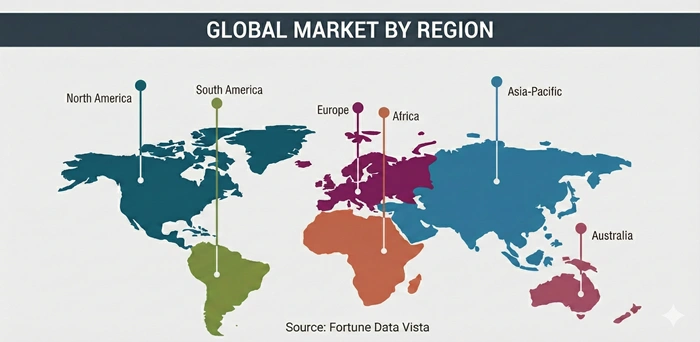
North America holds the largest regional share of the global peer to peer lending market, accounting for approximately 35% of total global revenue in 2026, with a regional CAGR of approximately 20% from 2026 to 2033. The United States is the dominant national market — home to the world's most commercially mature P2P and marketplace lending industry, with platforms including LendingClub (USA), Prosper Marketplace (USA), Upstart Holdings (USA), and Funding Circle USA (USA) collectively originating tens of billions of dollars in personal, business, and auto loans annually through AI-powered digital lending platforms that serve millions of U.S. consumers and small businesses. The U.S. P2P lending market's maturity is evidenced by LendingClub's evolution into a full-service digital bank, Upstart's AI-first credit model partnerships with bank lenders, and the widespread institutional adoption of P2P loan securitization that has deepened platform capital access and stabilized origination volumes across economic cycles.
Canada contributes a growing and increasingly regulated P2P lending market, with provincial financial services regulators progressively developing licensing frameworks for marketplace lending platforms that are building credit products for Canadian consumers and small businesses underserved by the country's highly concentrated traditional banking sector. The North American peer to peer lending market benefits from the region's advanced digital payments infrastructure, high smartphone penetration, comprehensive credit bureau systems that enable sophisticated credit underwriting, and deep capital markets that provide the institutional investor participation needed to sustain large-scale P2P loan origination — collectively creating the most enabling environment for P2P platform scale globally.
Asia Pacific: The Fastest Growing Region
Asia Pacific Is the Fastest Growing Regional Market in the Peer to Peer Lending Industry, Powered by the World's Largest Unbanked and Underbanked Population, the Most Rapid Smartphone Fintech Adoption, and Progressive Regulatory Frameworks That Are Creating Licensed Operating Environments for P2P Platforms Across the Region
Asia Pacific is the fastest-growing regional segment in the peer to peer lending market, projected to expand at a CAGR of approximately 26% from 2026 to 2033. India is the most commercially exciting growth market within the region — with the Reserve Bank of India's NBFC-P2P regulatory framework providing a licensed operating environment for P2P lending platforms that is enabling market participants including Faircent (India), LenDenClub (India), and i2ifunding (India) to grow their loan origination volumes rapidly within a compliant regulatory structure that protects both borrowers and investors. India's digital financial infrastructure — including the Aadhaar identity system, UPI payments network, and Account Aggregator framework — provides P2P platforms with the data access and payment rails needed to underwrite and disburse loans efficiently at scale across India's geographically diverse borrower population.
Southeast Asia is emerging as the next major growth frontier within the Asia Pacific peer to peer lending market — with Indonesia, the Philippines, Vietnam, and Thailand all developing fintech lending regulatory frameworks that are enabling licensed P2P and digital lending platforms to serve the enormous unmet credit demand of the region's large, young, and increasingly smartphone-connected populations. Indonesia's OJK-regulated P2P lending market — served by platforms including Kredivo (Indonesia) and Investree (Indonesia) — is already one of Southeast Asia's most commercially significant fintech lending markets, and the continued growth of Indonesian household income, e-commerce adoption, and digital financial services penetration is expected to sustain exceptional P2P market growth rates throughout the forecast period. The Asia Pacific peer to peer lending market's extraordinary growth potential reflects the region's unique combination of scale, digital adoption velocity, and the persistent structural underserving of creditworthy borrowers by traditional banking systems that makes P2P platforms indispensable financial infrastructure for the region's development.
Report Customization by Region and Country
This Peer to Peer (P2P) Lending Market Report Offers Full Region-Wise and Country-Wise Customization — Providing Geography-Specific Market Sizing, Regulatory Framework Analysis, Platform Competitive Landscape, Borrower and Lender Demand Insights, and Strategic Growth Opportunities Tailored Precisely to Every Region and Country You Need to Analyze
This Peer to Peer (P2P) Lending Market report is available with full customization by region and country, enabling organizations to access precise, geography-specific insights aligned with their strategic priorities. The report can be configured to deliver the exact regional depth and market intelligence your business needs — covering market sizing, CAGR forecasts, segment breakdowns, regulatory landscape, competitive platform analysis, borrower and investor demand trends, and actionable strategic opportunities specific to each selected geography.
North America
-
U.S. — CFPB regulatory landscape, major platform competitive profiles including LendingClub, Prosper, and Upstart, institutional investor participation trends, and consumer and SME lending market sizing and forecast through 2033
-
Canada — Provincial P2P lending regulatory framework development, domestic platform landscape, underbanked SME lending opportunity, and market sizing and CAGR
-
Mexico — Fintech law regulatory environment, digital lending adoption trends, unbanked population credit opportunity, and P2P lending market development outlook
Europe
-
U.K. — FCA regulatory framework, Zopa and Funding Circle competitive positioning, post-Brexit fintech landscape, and market sizing and growth forecast
-
Germany — BaFin P2P platform regulation, consumer and SME digital lending market, domestic platform landscape, and regional market analysis
-
France — AMF fintech lending framework, Younited Credit competitive position, consumer P2P lending adoption trends, and market sizing through 2033
-
Italy — P2P lending regulatory environment, consumer and business lending demand, domestic platform landscape, and regional market development outlook
-
Rest of Europe — Nordic fintech lending innovation, Eastern European digital lending growth, and region-wide P2P regulatory framework analysis
Asia Pacific
-
China — Post-regulatory restructuring digital lending market, surviving platform landscape, government fintech policy direction, and market sizing and growth outlook
-
India — RBI NBFC-P2P regulatory framework, leading platform competitive profiles, UPI and Aadhaar digital infrastructure impact, and market sizing and CAGR forecast
-
Japan — Financial Services Agency P2P regulation, domestic platform landscape, consumer digital lending adoption, and regional market analysis
-
South Korea — Online investment securities act P2P framework, domestic platform growth, fintech lending adoption trends, and market sizing through 2033
-
Australia — ASIC regulatory framework, domestic platform competitive landscape, SME digital lending demand, and market sizing and forecast
-
Rest of Asia Pacific — Indonesian, Philippine, Vietnamese, and Thai P2P lending market development, regulatory framework analysis, and growth opportunity assessment
Latin America
-
Brazil — Brazilian Central Bank fintech regulation, digital lending market growth, major platform landscape, and P2P lending market sizing and CAGR
-
Argentina — Digital lending regulatory environment, fintech adoption trends, and regional market development opportunity analysis
-
Rest of Latin America — Colombian, Chilean, and Mexican digital lending ecosystem growth, regulatory framework development, and P2P market opportunities
Middle East and Africa (MEA)
-
UAE — DFSA fintech regulatory sandbox, digital lending innovation hub status, and P2P lending market sizing and competitive landscape analysis
-
Saudi Arabia — Vision 2030 fintech program, SAMA fintech lending regulation, and P2P and digital lending market growth forecast through 2033
-
Rest of MEA — African mobile money and digital lending ecosystem, M-Pesa and fintech lending integration, and long-term P2P lending market development opportunity across Kenya, Nigeria, and South Africa
Each customized Peer to Peer (P2P) Lending Market report delivers targeted intelligence — including country-specific regulatory compliance analysis, platform competitive landscape mapping, borrower and investor demand trend assessment, and market entry and investment strategy guidance — providing decision-makers with the precision they need to build competitive advantages and capture growth in their target geographies.
Top Key Players
-
LendingClub Corporation (United States)
-
Prosper Marketplace Inc. (United States)
-
Upstart Holdings Inc. (United States)
-
Funding Circle Holdings plc (United Kingdom)
-
Zopa Bank Ltd. (United Kingdom)
-
Avant LLC (United States)
-
Faircent (India)
-
LenDenClub (India)
-
Younited Credit (France)
-
Mintos Marketplace AS (Latvia)
-
RateSetter (Metro Bank) (United Kingdom)
-
Kredivo (Indonesia)
Recent Developments
-
In 2025, LendingClub Corporation announced the expansion of its LendingClub Marketplace Bank product suite — adding new high-yield savings and certificates of deposit products that leverage its banking charter to attract retail deposit funding at lower cost than institutional wholesale funding, strengthening the company's funding economics and enabling more competitive personal loan pricing for its growing borrower base in the U.S. consumer peer to peer lending market.
-
In 2025, Upstart Holdings launched its new Home Equity Line of Credit product through its AI-powered credit underwriting platform — expanding beyond personal loans and auto lending into the large and growing home equity credit market — and simultaneously announced new bank lending partnerships that added over USD 3 billion in committed capital from institutional bank partners, significantly strengthening Upstart's origination capacity and geographic market coverage across the United States.
-
In 2026, Funding Circle completed a strategic restructuring of its U.K. and European small business lending operations — focusing its platform on AI-enhanced SME credit underwriting and launching a new embedded lending product that allows accountancy software platforms and business payment providers to integrate Funding Circle's SME loan products directly into their customer-facing workflows through a lending-as-a-service API partnership model.
-
In 2025, Mintos Marketplace received full European Securities and Markets Authority (ESMA) compliant authorization under the EU Crowdfunding Regulation — enabling the Latvian-headquartered P2P investment marketplace to operate as a pan-European crowdfunding service provider across all EU member states without requiring individual national regulatory approval, significantly expanding Mintos' addressable investor market across Europe and strengthening its position as the leading cross-border P2P lending investment platform in the European market.
-
In 2026, Faircent secured a major Series C funding round from a consortium of Indian and international venture investors — enabling the platform to expand its RBI-regulated P2P lending operations to 15 new Indian cities, launch AI-enhanced credit scoring models trained on Account Aggregator financial data, and introduce new loan products for the self-employed and gig economy worker segments of the Indian borrower population that represent one of the fastest-growing and largest underserved credit demand groups in the Indian P2P lending market.
Market Trends
The Institutionalization of P2P Platform Capital Structures Through Loan Securitization and Bank Partnerships, and the Emergence of Embedded Lending-as-a-Service Models That Integrate P2P Credit Into Digital Commerce and Business Software Platforms, Are the Two Most Commercially Transformative Trends Reshaping the Peer to Peer Lending Market Through 2033
The progressive institutionalization of P2P lending capital — through the securitization of P2P loan pools into investment-grade asset-backed securities, the development of bank-sponsored lending partnerships that co-originate loans with P2P platforms, and the listing of major platforms as publicly regulated financial institutions — is transforming the peer to peer lending market from an alternative finance niche into a mainstream capital market participant. This institutionalization reduces the capital cost and volatility that retail investor dependence creates, enabling platforms to grow origination volumes faster, price loans more competitively, and maintain lending programs through economic cycles without the retail investor sentiment-driven capital withdrawals that destabilized early P2P platforms. The market is also witnessing platform consolidation — as lending economics at scale favor larger operators with lower unit funding costs and better AI underwriting performance — creating a competitive landscape progressively dominated by a smaller number of well-capitalized, institutionally funded platforms with robust regulatory standing.
The embedded lending trend — in which P2P platform credit products are integrated directly into the checkout flows, accounting dashboards, payment apps, and e-commerce platforms that borrowers and businesses already use daily — is creating a new customer acquisition and loan origination paradigm that challenges the traditional direct-to-consumer platform model. Lending-as-a-service APIs enable P2P platforms to serve as white-label credit underwriting and capital deployment infrastructure for digital commerce, payroll, and accounting platform partners — originating loans at the point of need without requiring borrowers to navigate standalone lending platform application flows. This embedded model dramatically reduces customer acquisition cost, improves borrower conversion rates, and creates new distribution channels that extend P2P lending market reach to borrower populations that standalone platform marketing struggles to reach cost-effectively, positioning embedded P2P lending as one of the most commercially promising product development directions in the global peer to peer lending industry.
Segments Covered in the Report
By Type:
-
Consumer Lending
-
Business Lending
-
Real Estate Lending
-
Student Loans
-
Others
By Business Model:
-
Traditional P2P Lending
-
Marketplace Lending
-
Institutional P2P Lending
By End User:
-
Individuals
-
Small and Medium Enterprises
-
Large Enterprises
By Application:
-
Debt Consolidation
-
Home Improvement
-
Business Funding
-
Education
-
Medical
-
Others
By Region:
-
North America (U.S., Canada, Mexico)
-
Europe (U.K., Germany, France, Italy, Rest of Europe)
-
Asia Pacific (China, India, Japan, South Korea, Australia, Rest of Asia Pacific)
-
Latin America (Brazil, Argentina, Rest of Latin America)
-
Middle East and Africa (UAE, Saudi Arabia, Rest of MEA)
❝ Built for Every Level — From Startups to Industry Giants ❞
Here Is Exactly How This Report Works for You
-
Whether you are a P2P lending platform evaluating geographic expansion strategy, product development priorities, and competitive positioning against both established marketplace lenders and emerging fintech competitors; a bank or institutional investor assessing P2P loan asset class performance, platform partnership opportunities, and the long-term credit risk and return profile of marketplace lending investment; or a strategic investor or private equity firm analyzing the P2P lending platform acquisition landscape, this report delivers granular revenue forecasts by type, business model, end user, application, and region — combined with detailed platform competitive revenue analysis, regulatory landscape intelligence, borrower demand trend mapping, and credit performance benchmarking that enables confident strategic and capital decisions.
-
This report comprehensively maps the supply-demand dynamics of the global peer to peer lending ecosystem — including borrower credit demand by type and geography, investor capital supply trends and institutional participation evolution, regulatory framework development by market, AI and alternative data underwriting capability benchmarking across platforms, and how geopolitical factors including digital lending regulation divergence, cross-border data privacy legislation, and government financial inclusion policy initiatives are reshaping global P2P platform growth trajectories and competitive market structures in ways that create both material risks and compelling growth opportunities.
-
The full version provides detailed competitor revenue and origination volume breakdowns by loan type and region, P2P platform technology capability and AI underwriting benchmarking, institutional capital market access and securitization trend analysis, embedded lending-as-a-service market development assessment, and a forward-looking evaluation of SME digital lending expansion, blockchain P2P protocol adoption, and emerging market financial inclusion opportunities — delivering the strategic intelligence needed to capture the full commercial potential of one of the global financial services industry's most dynamic, disruptive, and rapidly growing market segments.
Frequently Asked Questions:
Answer: The peer to peer lending market is valued at USD 193.12 billion in 2025 and is projected to reach USD 1068.81 billion by 2033. It is expected to grow at a CAGR of 23.3% from 2026 to 2033, driven by the growing global demand for digital credit products, the large underbanked population seeking alternatives to traditional banks, and the progressive expansion of AI-powered underwriting that enables P2P platforms to serve a broader and more diverse borrower base.
Answer: Peer to peer lending connects borrowers directly with individual and institutional lenders through digital platforms — bypassing traditional bank intermediaries and their associated operating costs, regulatory capital requirements, and conservative underwriting standards that exclude many creditworthy borrowers. The P2P lending model typically offers faster loan approvals through AI-powered digital underwriting, more competitive interest rates enabled by lower operating costs, and more flexible credit assessment that considers alternative data beyond traditional credit scores — creating a materially better borrowing experience for eligible applicants.
Answer: Asia Pacific is the fastest-growing regional market in the global peer to peer lending industry, expanding at an approximate CAGR of 26% from 2026 to 2033, driven by India's RBI-regulated P2P platform ecosystem, Indonesia and Southeast Asia's rapidly growing digital lending markets, and the enormous unbanked and underbanked population across the region that creates structural demand for accessible digital credit products. North America remains the largest regional market by revenue, anchored by the U.S. marketplace lending industry led by LendingClub, Upstart, and Prosper Marketplace.
Answer: The primary investment risks in the peer to peer lending market include borrower default risk — where loan performance deteriorates during economic downturns, potentially resulting in principal and interest losses for platform lenders — platform operational risk from regulatory actions, management failures, or liquidity crises that disrupt loan servicing and investor capital access, and the relative illiquidity of P2P loan investments compared to publicly traded fixed-income securities. Investors considering P2P lending platforms should evaluate platform credit underwriting track record, regulatory authorization status, investor protection mechanisms, and secondary market liquidity options before committing capital to any P2P lending investment program.
Answer: Artificial intelligence is fundamentally transforming credit underwriting in the peer to peer lending market by enabling platforms to assess borrower creditworthiness using hundreds of alternative data variables — including digital transaction patterns, e-commerce behavior, utility payment histories, and employment data — that conventional credit bureau scoring models do not incorporate, allowing platforms to approve creditworthy borrowers that traditional lenders decline. AI underwriting also enables real-time fraud detection, continuous loan portfolio risk monitoring, and dynamic credit limit adjustments that improve both borrower experience and platform loan performance outcomes compared to the manual, static underwriting processes that traditional bank lending relies on.