
Perfume Market Overview
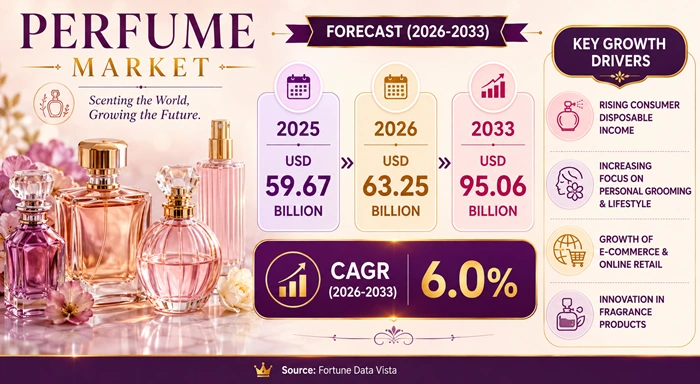
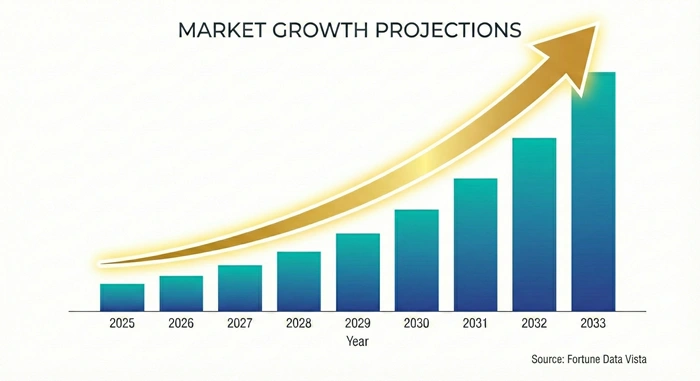
The global perfume market size is valued at USD 59.67 billion in 2025 and is predicted to increase from USD 63.25 billion in 2026 to approximately USD 95.06 billion by 2033, growing at a CAGR of 6.0% from 2026 to 2033.
The fragrance industry is one of the most culturally enduring and commercially resilient segments within the global beauty and personal care sector. Perfume — spanning categories from mass-market body sprays to ultra-luxury niche Parfum — serves simultaneously as a personal care product, a fashion accessory, a social identity signal, and a gifting tradition embedded deeply in consumer cultures across every world region. Rising disposable incomes, the premiumization of everyday personal care, the explosive growth of niche and artisan fragrances, and the expansion of online retail channels are collectively driving a new and sustained phase of growth for the global fragrance industry well into the current decade.
AI Impact on the Perfume Industry
Artificial Intelligence Is Transforming Fragrance Creation, Personalization, and the Consumer Discovery Journey — Compressing Development Timelines, Enabling Bespoke Scent Formulation, and Reshaping How the Perfume Industry Reaches and Retains Customers Globally
Artificial intelligence is arriving in the perfume industry with remarkable speed, particularly in the domain of fragrance formulation. Traditionally, developing a commercially viable new fragrance required teams of experienced perfumers — known as "noses" — working through iterative trial cycles that could span two to five years from concept to retail shelf. AI-driven molecular analysis platforms, such as those developed by Givaudan in partnership with IBM and Symrise in collaboration with Henkel, can now analyze enormous databases of historical fragrance formulas, raw material properties, and consumer scent preference data to generate novel fragrance composition recommendations that dramatically compress the development timeline. This AI-assisted approach is not replacing the master perfumer but rather expanding the creative palette and accelerating the speed at which new fragrance concepts can be evaluated, refined, and validated against target consumer preferences.
The personalization dimension of AI is equally transformative for the perfume market's consumer-facing side. Digital fragrance discovery platforms — powered by natural language processing and recommendation engine algorithms — allow consumers to describe scent preferences, emotional associations, and lifestyle context through conversational interfaces, receiving personalized fragrance recommendations that go far beyond the blunt category filters available on conventional e-commerce sites. Companies like Givaudan, IFF, and direct-to-consumer niche brands are also experimenting with AI-powered bespoke formulation services, where consumers input detailed personal preferences and receive custom-blended fragrances created specifically for them. As these personalization technologies mature and their cost to deploy declines, the ability to offer meaningful fragrance personalization at scale will become a key competitive differentiator separating market leaders from commodity fragrance brands.
Growth Factors
The Accelerating Premiumization of Consumer Fragrance Spending, the Explosive Rise of Niche and Artisan Perfumery, and the Rapid Growth of Fragrance Culture in Emerging Markets Are the Most Powerful Forces Driving Sustained Expansion Across the Perfume Market
Premiumization is the dominant structural growth driver reshaping the perfume market globally. Consumers across income segments — but most powerfully in the upper-middle and high-income brackets — are consistently trading up from everyday mass-market fragrances to premium and luxury options. This is not simply a reflection of rising incomes; it represents a deeper cultural shift in which fragrance has moved from an incidental daily grooming product to a carefully considered statement of personal identity, taste, and lifestyle. Luxury fragrance houses including Chanel, Dior, Hermès, and Tom Ford have benefited enormously from this shift, as have premium mass-market players who have successfully positioned their fragrance lines as accessible luxury experiences for aspirational consumers who may not spend on designer clothing or accessories but who are willing to invest in a signature scent.
The explosive growth of niche and independent perfumery is a second powerful driver that is expanding the total revenue ceiling of the fragrance market. Where conventional department store fragrance counters once dominated consumer purchasing, a thriving ecosystem of niche fragrance houses — including Frederic Malle, Byredo, Maison Margiela Replica, Le Labo, and hundreds of smaller artisan producers — has emerged to serve a growing segment of fragrance enthusiasts who prioritize creativity, exclusivity, storytelling, and craftsmanship over the celebrity endorsements and mass-market positioning that define mainstream fragrance marketing. These niche products carry price points two to five times higher than comparable mass-market fragrances, and the consumer community around them — particularly active on fragrance-dedicated social media platforms like Fragrantica — is highly engaged, influential, and growing rapidly, particularly among younger affluent consumers in North America, Europe, and increasingly Asia Pacific.
Market Outlook
The Perfume Market Is Set for Sustained Growth Through 2033, as the Middle East's Fragrance Culture, Asia Pacific's Rising Affluence, and the Direct-to-Consumer Niche Brand Revolution Create New Revenue Vectors Across Every Market Tier
The long-term outlook for the perfume market is consistently positive, supported by multiple diversified demand drivers that span geographies, consumer demographics, and price tiers. The Middle East — where fragrance is not merely a personal care product but a deeply embedded cultural tradition, and where Oud, Musk, and luxury Arabic fragrance formats carry enormous prestige — is both a significant existing revenue contributor and one of the fastest-growing regional markets for premium and ultra-premium perfume globally. Gulf consumers, particularly in Saudi Arabia and the UAE, spend more per capita on fragrance than virtually any other consumer population in the world, making the Middle East a critical expansion target for both established luxury houses and emerging niche brands seeking high-revenue growth markets.
Asia Pacific presents a structural growth opportunity of even greater scale over the forecast horizon. As disposable incomes rise across urban populations in China, India, South Korea, and Southeast Asia, fragrance culture — historically less embedded in daily personal care routines in many parts of Asia compared to Europe and the Middle East — is developing rapidly, driven by the influence of K-beauty and J-beauty trends, aggressive luxury brand retail expansion, and the aspirational lifestyle positioning of international fragrance brands among status-conscious urban consumers. The Chinese luxury fragrance market in particular is expanding at rates well above the global average, supported by domestic consumption, strong gifting traditions around major festivals, and a growing community of Chinese fragrance enthusiasts who are as sophisticated and brand-aware as any consumer population globally.
Expert Speaks
-
"L'Oréal's fragrance portfolio has never been more strategically important than it is today. We are seeing consumers invest in fragrance as a genuine luxury self-care experience — and the brands and formats that speak authentically to that aspiration, with the right olfactive quality and the right storytelling, are capturing remarkable consumer loyalty and spending intensity." — Nicolas Hieronimus, CEO, L'Oréal SA
-
"Estée Lauder Companies' fragrance business is performing strongly because consumers globally are investing more meaningfully in premium and luxury scent. Our brands — including Jo Malone London, Tom Ford Beauty, and Le Labo — are positioned precisely where the consumer appetite is growing fastest, and we see no slowdown in that premiumization trend." — Stéphane de La Faverie, CEO, The Estée Lauder Companies Inc.
-
"Coty's strategy in fragrance is anchored in three realities: premiumization is accelerating, Asia Pacific is a massive growth opportunity, and the niche and lifestyle fragrance segment is outgrowing the mass market. We are building our portfolio and our direct-to-consumer capabilities with exactly those realities in mind, and the results are already visible in our top-line performance." — Sue Nabi, CEO, Coty Inc.
Key Report Takeaways
-
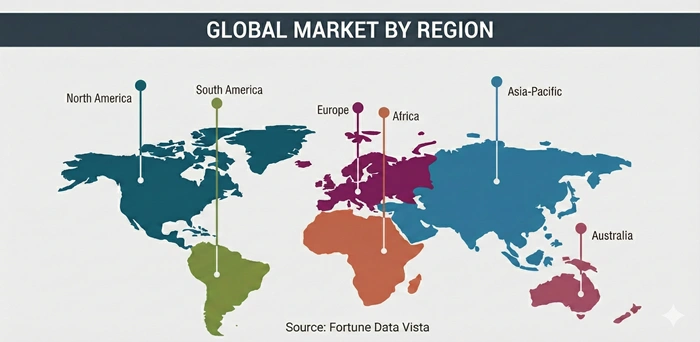
Europe dominates the global perfume market, accounting for approximately 35% of total global revenue in 2026, underpinned by the centuries-long heritage of French and Italian perfumery, the global headquarters presence of major luxury fragrance houses including Chanel, Dior, Hermès, and LVMH, and extremely high per-capita fragrance spending among European consumers for whom daily fragrance use is a deeply established personal care habit.
-
Asia Pacific is the fastest-growing regional market, expanding at a CAGR above 7% from 2026 to 2033, powered by rising disposable incomes in China and India, the premiumization of personal care spending among urban middle-class consumers, the growing cultural embrace of Western luxury fragrance brands, and the influential beauty communities in South Korea and Japan that are driving new fragrance consumption behaviors among younger demographics.
-
Women represent the largest end-user segment, contributing approximately 55% of total market revenue in 2026, reflecting the historically higher engagement of female consumers with fragrance as a personal identity and grooming essential — though the men's and unisex fragrance segments are growing at faster rates as male grooming culture and gender-neutral fragrance positioning become increasingly mainstream.
-
Eau de Parfum is the dominant product type, accounting for approximately 40% of total product-based revenue in 2026, owing to its optimal balance of fragrance concentration, longevity, and price point that satisfies both premium and aspirational consumer demand — making it the most versatile and highest-revenue format across all major fragrance brands.
-
Specialty stores remain the leading distribution channel, capturing approximately 30% of total channel revenue in 2026, as consumers making considered fragrance purchases — particularly at the premium and luxury tiers — prefer the in-store sampling, consultation, and brand experience environment that specialty fragrance retailers uniquely provide.
-
The luxury pricing segment is the fastest-growing revenue tier, projected to capture approximately 32% of total market share by 2033 at a CAGR of approximately 7.8% from 2026 to 2033, driven by the premiumization trend, the expanding global wealth base, and the explosion of niche and artisan fragrance brands that position themselves firmly in the luxury price tier as a core part of their brand identity.
Market Scope
| Parameter | Details |
|---|---|
| Market Size by 2033 | USD 95.06 Billion | Market Size by 2026 | USD 63.25 Billion | Market Size by 2025 | USD 59.67 Billion | Market Growth Rate from 2026 to 2033 | CAGR of 6.0% | Dominating Region | Europe | Fastest Growing Region | Asia Pacific | Segments Covered | Product Type, End User, Distribution Channel, Pricing, Application | Regions Covered | North America, Europe, Asia Pacific, Latin America, Middle East and Africa |
Market Dynamics
Drivers Impact Analysis
The Global Premiumization of Fragrance Spending, the Expanding Cultural Embrace of Perfume Across Asia Pacific and the Middle East, and the Rapid Growth of the Niche Perfumery Sector Are the Three Core Forces Delivering Consistent Revenue Growth to the Perfume Market
| Driver | ≈ % Impact on CAGR Forecast | Geographic Relevance | Impact Timeline |
|---|---|---|---|
| Premiumization of fragrance spending across consumer segments | ~28% | Global — highest in North America, Europe, Middle East | Short to Long-Term |
| Rapid growth of niche and artisan fragrance segment | ~22% | North America, Europe, Asia Pacific | Short to Long-Term |
| Rising fragrance culture in Asia Pacific and Middle East | ~20% | Asia Pacific, Middle East | Medium to Long-Term |
| Growth of online fragrance retail and DTC brands | ~14% | Global | Short to Medium-Term |
| Male and unisex fragrance segment expansion | ~9% | Global | Medium-Term |
| Celebrity and influencer-driven fragrance launches | ~7% | North America, Europe, Asia Pacific | Short-Term |
The premiumization trend in fragrance is not a cyclical peak — it reflects a fundamental and durable change in how consumers globally relate to scent as a personal and cultural expression. Premium and luxury fragrance formats have demonstrated consistent price elasticity even during periods of broader consumer spending caution, confirming that for the consumers who invest in them, premium fragrances occupy a discretionary spending category with particularly high emotional and identity value. This resilience makes the perfume market significantly more stable than many other consumer goods categories, and it creates a commercially reliable foundation for the sustained mid-single-digit CAGR that analysts project across the global fragrance industry through the forecast period.
The niche perfumery sector deserves specific recognition as a structural market expansion force that is adding revenue to the total market that did not previously exist, rather than simply redistributing spending among existing brands. Niche fragrance brands — characterized by unique olfactive narratives, limited distribution, premium pricing, and strong community engagement among fragrance enthusiasts — have attracted a loyal and vocal consumer base that has fueled extraordinary revenue growth over the past decade. As these brands expand their distribution globally through curated specialty retail partnerships, e-commerce, and direct-to-consumer platforms, and as they reach new consumer audiences in Asia and the Middle East who are seeking differentiation from mainstream designer fragrances, they continue to add incremental revenue at premium price points that raise the average selling price across the total market.
Restraints Impact Analysis
The High Price Sensitivity of Mass-Market Consumers, the Proliferation of Counterfeit Fragrances in Unregulated Markets, and Regulatory Restrictions on Certain Fragrance Ingredients Continue to Create Meaningful Obstacles for Sustained Global Perfume Market Growth
| Restraint | ≈ % Impact on CAGR Forecast | Geographic Relevance | Impact Timeline |
|---|---|---|---|
| Price sensitivity among mass-market consumer segments | ~-30% | Emerging markets, general consumer base | Short to Medium-Term |
| Proliferation of counterfeit fragrances in online channels | ~-24% | Global — highest in Asia, Middle East, LatAm | Long-Term |
| IFRA regulatory restrictions on fragrance ingredients | ~-20% | Europe, North America | Medium to Long-Term |
| Fragrance sensitivity and allergen awareness trends | ~-14% | Europe, North America | Medium-Term |
| High marketing and distribution costs for new brands | ~-12% | Global | Short to Medium-Term |
Price sensitivity among mass and lower-middle-income consumer segments creates a ceiling on market penetration that limits the total addressable volume for premium and luxury fragrance brands regardless of demand trends. While premiumization is real and powerful among affluent consumer segments, the majority of the world's population remains in income brackets where premium fragrance represents a meaningful discretionary stretch — particularly during periods of inflation or economic uncertainty. This bifurcation of the market between a rapidly premiumizing top tier and a more price-constrained mass base means that growth is concentrated in a relatively narrow consumer segment, and that achieving broad market penetration requires either significantly lower pricing or meaningful accessibility through alternative formats such as travel-size offerings, subscription sampling, or fragrance oil concentrates.
Regulatory restrictions on fragrance ingredients — driven primarily by the International Fragrance Association (IFRA) and the European Union's increasingly stringent cosmetics regulations — present a growing operational constraint for fragrance manufacturers. Restrictions on naturals such as oakmoss, tree moss, certain citrus molecules, and musks require reformulation of existing iconic fragrances and constrain the ingredient palette available to perfumers developing new ones. These reformulations are commercially sensitive — loyal consumers who notice changes in beloved classic fragrances react with frustration and sometimes switch brands — and the compliance cost of ingredient monitoring, testing, and reformulation places a disproportionate burden on smaller independent fragrance houses that lack the regulatory infrastructure of major multinational companies.
Opportunities Impact Analysis
The Rise of Sustainable and Clean Fragrances, the Expansion of Personalized Scent Services, and the Untapped Gifting and E-Commerce Growth Potential in Asia Pacific and the Middle East Are Creating High-Value Growth Pathways Across the Perfume Market
| Opportunity | ≈ % Impact on CAGR Forecast | Geographic Relevance | Impact Timeline |
|---|---|---|---|
| Sustainable and clean fragrance product development | ~26% | Europe, North America | Short to Long-Term |
| Personalized and bespoke fragrance services | ~22% | North America, Europe, Asia Pacific | Short to Medium-Term |
| Premium fragrance gifting tradition expansion | ~18% | Middle East, Asia Pacific | Medium to Long-Term |
| Travel retail and duty-free channel growth | ~18% | Global — Asia Pacific focus | Medium-Term |
| Subscription sampling and fragrance discovery services | ~16% | North America, Europe | Short to Medium-Term |
Sustainability is rapidly becoming a decisive purchase factor for fragrance consumers, particularly in North America and Europe where eco-conscious consumption is shifting from a niche value to a mainstream expectation. Consumers are increasingly seeking fragrances formulated with sustainably sourced natural ingredients, recyclable packaging, and clean ingredient standards that avoid synthetic musks, parabens, and phthalates. Brands including Maison Louis Marie, Commodity, and Phlur have built significant consumer followings specifically around sustainable fragrance positioning. As major houses including Chanel, LVMH, and L'Oréal deepen their sustainability commitments through programs covering raw material traceability, biodegradable packaging, and carbon-neutral manufacturing, sustainable fragrance is transitioning from a niche premium category to a mainstream quality expectation — creating both a growth opportunity for credible sustainable brands and a compliance imperative for all major market participants.
The gifting dimension of the fragrance market represents a consistently underappreciated revenue engine with significant further growth potential, particularly in Asia Pacific and the Middle East where premium product gifting is a deeply embedded social practice around major festivals and life events. Fragrance gift sets — combining perfume with complementary body care or home fragrance products in premium packaging — are among the highest-margin product offerings in a typical fragrance brand's portfolio, and their growth correlates strongly with rising middle-class incomes in high-gifting cultures. Companies that invest in dedicated gift packaging, ritual-based product storytelling, and distribution partnerships with premium gift retail channels in these high-growth geographies will capture meaningful incremental revenue that generic retail channel strategies consistently miss.
Segment Analysis
By Product Type: Eau de Parfum
Eau de Parfum Commands the Dominant Product Share in the Perfume Market Because It Delivers the Optimal Combination of Fragrance Longevity, Perceived Luxury Value, and Consumer-Friendly Price Accessibility That Drives the Highest Volume Sales Across All Market Tiers
Eau de Parfum (EDP) is the leading product type within the perfume market, accounting for approximately 40% of total product-based revenue in 2026. With a fragrance concentration typically ranging from 15% to 20%, EDP offers noticeably superior longevity and sillage compared to Eau de Toilette while remaining significantly more accessible in price than pure Parfum — a combination that satisfies both the quality expectations of premium fragrance consumers and the value-consciousness of aspirational buyers making a considered investment purchase. The format's versatility across mass-premium and luxury price tiers makes it the default product type for most major fragrance launches, and it consistently generates the highest individual SKU sales volumes within fragrance brand portfolios globally. The EDP segment within the perfume market is projected to grow at a CAGR of approximately 6.3% from 2026 to 2033, sustained by new premium brand launches, the continuing premiumization of consumer preferences, and the expansion of premium fragrance retail in fast-growing Asia Pacific markets. In Europe — the largest single regional market for the EDP format — dominant players including Chanel SA (France), LVMH (France), and Hermès International (France) drive enormous EDP volumes through both directly operated boutiques and premium department store fragrance counters.
North America is the second-largest EDP market globally, where mass-premium brands including Estée Lauder Companies (USA), Coty Inc. (USA), and Inter Parfums Inc. (USA) compete with European luxury imports across a vast specialty and department store retail network complemented by rapidly growing e-commerce fragrance channels. The Middle East is a particularly important and fast-growing EDP market, where premium and luxury EDP products are purchased as daily-use staples rather than occasional treats by a consumer base with among the world's highest per-capita fragrance spending. Major regional distributors and specialty fragrance retailers including Abdul Samad Al Qurashi and Arabian Oud stock comprehensive selections of international premium EDP brands alongside domestic Arabic fragrance offerings, serving a dual market of traditional and Western-oriented fragrance consumers.
By Distribution Channel: Online Retail
Online Retail Is the Fastest-Growing Distribution Channel in the Perfume Market, Accelerated by Direct-to-Consumer Brand Expansion, Digital Sampling Innovations, and the Explosive Growth of Fragrance Communities on Social Media Platforms
The online retail channel is the fastest-growing distribution segment within the perfume market, projected to expand at a CAGR of approximately 8.4% from 2026 to 2033, having grown from a small minority share of fragrance sales to approximately 22% of total channel revenue in 2026. Historically, fragrance was considered one of the least suitable product categories for online retail due to the fundamental inability of digital shopping interfaces to replicate the sensory scent evaluation experience that drives purchase decisions in physical stores. However, a combination of fragrance subscription sampling services — where consumers receive small samples before committing to full bottles — AI-powered scent description and recommendation tools, and the powerful influence of online fragrance communities has successfully overcome much of this barrier. Platforms like Fragrantica, Reddit's fragrance communities, and dedicated YouTube and TikTok fragrance content creators have built enormous and engaged audiences that actively drive online fragrance discovery and purchasing. Companies including Scentbird (USA), JOYA Studio (USA), and the direct-to-consumer e-commerce platforms of major luxury houses are benefiting most from this channel's growth, as is the Amazon marketplace where mass and mid-range fragrance drives significant volume.
Asia Pacific is the geographic engine of online fragrance retail growth, driven by the exceptional e-commerce penetration rates and mobile-first shopping behaviors of consumers in China, South Korea, India, and Southeast Asia. In China specifically, fragrance has emerged as one of the fastest-growing categories on major e-commerce platforms including Tmall, JD.com, and Douyin (TikTok's Chinese equivalent) — where live-streaming commerce, key opinion leader endorsements, and limited-edition exclusive launches drive purchasing intensity that physical retail simply cannot match. Alibaba Group (China) and JD.com (China) are the dominant e-commerce infrastructure providers enabling fragrance brand growth in China, and international fragrance brands are investing heavily in flagship store presences on these platforms to capture the rapidly scaling Chinese online luxury fragrance consumer base.
Regional Insights
Europe: The Dominating Region
Europe Leads the Global Perfume Market Through Its Centuries-Deep Fragrance Heritage, the World Headquarters Concentration of Luxury Perfume Houses, and Exceptionally High Per-Capita Consumer Spending on Premium and Luxury Fragrances
Europe commands the largest share of the global perfume market, accounting for approximately 35% of total global revenue in 2026, with a regional CAGR of approximately 5.2% from 2026 to 2033. France is the undisputed global epicenter of fine fragrance, home to Grasse — the world's perfume capital — and the global headquarters of the industry's most prestigious brands including Chanel SA (France), LVMH — Dior and Givenchy (France), Hermès International (France), and L'Oréal — Lancôme and Yves Saint Laurent Beauté (France). French fragrance culture is embedded at every level of the consumer market, from mass-market supermarket fragrances to ultra-luxury niche houses, and French consumers are among the world's highest per-capita fragrance spenders. The region also benefits from the dominance of European-headquartered fragrance ingredient and flavor houses — including Givaudan (Switzerland), Firmenich (Switzerland), and Symrise (Germany) — that supply the fine fragrance industry's raw material ecosystem globally.
Italy is the second major European fragrance market, particularly strong in luxury fashion house fragrances from brands including Armani, Versace, and Dolce and Gabbana, while the United Kingdom and Germany represent the largest Northern European consumer markets for both premium and mass fragrance. The European perfume market benefits from the world's most developed specialty fragrance retail ecosystem — including Sephora, Douglas, Marionnaud, and dozens of independent niche fragrance boutiques across major cities — which provides an ideal physical discovery and sampling environment that consistently drives high average transaction values and strong brand loyalty among European fragrance consumers.
Asia Pacific: The Fastest Growing Region
Asia Pacific Is the Fastest Growing Regional Market for Perfume, Fueled by Rapid Income Growth, the Premiumization of Personal Care in China and India, and the Powerful Cultural Influence of South Korean and Japanese Beauty Trends on Fragrance Adoption Across the Region
Asia Pacific is the fastest-growing regional segment within the perfume market, projected to expand at a CAGR of approximately 7.3% from 2026 to 2033 — the highest regional growth rate globally. China is the single most important national growth market, where luxury fragrance is experiencing extraordinary adoption among urban millennials and Gen Z consumers who view signature scent as an integral component of a curated personal luxury lifestyle. International luxury fragrance brands have invested heavily in China retail — opening flagship boutiques, launching China-exclusive limited editions, and building Tmall and JD.com flagship stores that generate significant digital revenue alongside physical retail. LVMH China, Hermès China, and Estée Lauder Companies China are among the most active international players capturing this rapid market expansion alongside domestic Chinese luxury fragrance brands that are beginning to gain traction with nationally proud consumers.
India represents the region's most exciting long-term growth opportunity, with a vast and rapidly expanding urban middle class, deeply embedded cultural traditions around fragrance in the form of attars and incense, and growing exposure to international premium fragrance brands through luxury retail expansion, e-commerce, and social media influence. Titan Company's Skinn fragrance brand (India) and leading international players including Coty Inc. and Interparfums are both aggressively building India distribution to capture the early-stage premium fragrance demand that is growing consistently with urban income levels. South Korea and Japan add meaningful volume as mature, sophisticated fragrance markets where domestic beauty culture is highly advanced and premium and niche fragrance consumption is deeply integrated into personal care routines.
Top Key Players
-
LVMH Moët Hennessy Louis Vuitton SE (France)
-
Chanel SA (France)
-
The Estée Lauder Companies Inc. (United States)
-
Coty Inc. (United States)
-
L'Oréal SA (France)
-
Hermès International SA (France)
-
Givaudan SA (Switzerland)
-
Symrise AG (Germany)
-
Inter Parfums Inc. (United States)
-
Puig SL (Spain)
-
Revlon Inc. (United States)
-
Shiseido Company Ltd. (Japan)
Recent Developments
-
In 2025, LVMH announced a significant expansion of its Parfums Christian Dior retail footprint across the Asia Pacific region, opening new flagship fragrance boutiques in Shanghai, Mumbai, and Seoul — positioning its J'adore, Sauvage, and Miss Dior lines to capture the rapidly accelerating premium fragrance demand among urban luxury consumers in key Asia Pacific growth markets.
-
In 2025, Coty Inc. completed the acquisition of a majority stake in the luxury niche fragrance house Infiniment Coty Paris, strengthening its credentials in the ultra-premium and artisan fragrance segment and adding exclusive niche distribution channels across major European fragrance specialty retailers to its existing mass-premium and celebrity fragrance portfolio.
-
In 2026, The Estée Lauder Companies launched its Le Labo brand in India through a combination of standalone boutique openings in Mumbai and Delhi and a dedicated brand presence on Nykaa's luxury beauty platform — marking the brand's first substantive India retail commitment and capitalizing on the Indian premium fragrance consumer segment's rapid emergence.
-
In 2025, L'Oréal expanded its fragrance portfolio through a licensing agreement with luxury Italian fashion house Valentino Beauty for a new fine fragrance range, complementing its existing Yves Saint Laurent, Lancôme, and Giorgio Armani fragrance licenses with a prestigious Italian fashion house brand that has particularly strong consumer resonance in the Asia Pacific luxury market.
-
In 2026, Givaudan unveiled its next-generation AI-assisted fragrance creation platform — developed in collaboration with a leading global technology partner — enabling perfumers to explore significantly broader molecular composition options, predict consumer preference scores for new formulas, and dramatically reduce the development-to-market timeline for new fine fragrance and functional fragrance applications.
Market Trends
The Mainstreaming of Sustainable and Clean Fragrance and the Growing Consumer Enthusiasm for Personalized and Niche Scent Experiences Are the Two Most Consequential Trends Driving Both Revenue Growth and Strategic Repositioning Across the Global Perfume Market
Sustainability has shifted from a fringe differentiator to a board-level strategic priority for every major company in the fragrance industry. Consumer expectations around transparency in ingredient sourcing, biodegradable and recyclable packaging, reduced carbon manufacturing footprints, and cruelty-free and vegan formulation standards are reshaping product development priorities at every tier of the perfume market. Leading houses including Chanel, which has invested in vertical integration of its jasmine and rose ingredient supply in Grasse, and Givaudan, which has committed to science-based climate targets across its ingredient supply chain, are setting sustainability benchmarks that are raising the standard of environmental practice industry-wide. Brands that can communicate authentic and verifiable sustainability credentials are consistently achieving stronger consumer preference scores among younger demographics — making sustainability investment directly commercially relevant rather than merely reputationally desirable.
The personalization megatrend — where consumers seek products that feel created specifically for their individual identity rather than mass-produced for a generic audience — is particularly powerful in fragrance, a category whose very essence is individual sensory experience and personal self-expression. Fragrance subscription and sampling services, AI-driven scent recommendation platforms, and bespoke perfumery services at both luxury and accessible price tiers are all capturing growing consumer enthusiasm for individualized fragrance experiences. As these services scale and become more accessible, and as digital fragrance communities continue to grow the sophistication and self-knowledge of fragrance consumers globally, the perfume market's evolution toward personalization will continue to expand both the addressable market and the average revenue per customer for brands positioned to deliver credible individualized fragrance experiences.
Segments Covered in the Report
By Product Type:
-
Eau de Parfum
-
Eau de Toilette
-
Eau de Cologne
-
Parfum / Pure Perfume
-
Others
By End User:
-
Men
-
Women
-
Unisex
By Distribution Channel:
-
Online Retail
-
Specialty Stores
-
Supermarkets and Hypermarkets
-
Department Stores
-
Duty-Free Stores
-
Others
By Pricing:
-
Mass
-
Premium
-
Luxury
By Application:
-
Personal Use
-
Gifting
-
Corporate
By Region:
-
North America (U.S., Canada, Mexico)
-
Europe (Germany, France, U.K., Italy, Rest of Europe)
-
Asia Pacific (China, India, Japan, South Korea, Rest of Asia Pacific)
-
Latin America (Brazil, Argentina, Rest of Latin America)
-
Middle East and Africa (UAE, Saudi Arabia, Rest of MEA)
❝ Built for Every Level — From Startups to Industry Giants ❞
Here Is Exactly How This Report Works for You
-
Whether you are a fragrance brand planning your next market expansion, an independent niche perfumery evaluating distribution partnerships, or an investor assessing the commercial resilience of the global perfume market, this report delivers precise revenue forecasts by product type, pricing tier, distribution channel, and region — combined with competitor revenue breakdowns, brand positioning analysis, and market entry strategies that enable confident, data-driven business decisions.
-
This report comprehensively maps the supply-demand dynamics of the fragrance industry — including ingredient supply chain sustainability pressures, IFRA regulatory compliance landscapes by region, e-commerce channel disruption, and how geopolitical factors such as luxury goods tariff regimes, travel retail policy, and regional beauty culture shifts are influencing brand strategies and distribution economics across all major global markets.
-
The full version provides detailed competitor revenue analysis, channel-level revenue source breakdowns, fragrance ingredient cost and supply risk assessments, niche brand acquisition target profiling, and a forward-looking roadmap covering personalization technology, sustainable formulation, and Asia Pacific market entry strategy — equipping decision-makers at every company level with the intelligence they need to grow profitably in one of the world's most enduring and commercially attractive consumer goods markets.
Frequently Asked Questions:
Answer: The perfume market is valued at USD 59.67 billion in 2025 and is projected to reach USD 95.06 billion by 2033. It is expected to grow at a CAGR of 6.0% from 2026 to 2033, supported by premiumization trends, the expansion of niche fragrance culture, and rapid growth in Asia Pacific and the Middle East.
Answer: Europe leads the global perfume market with approximately 35% of total revenue in 2026, driven by France's dominant position as the world's fine fragrance heritage capital and the high per-capita consumer spending on premium fragrances across the region. The presence of globally leading luxury fragrance houses — including Chanel, LVMH, and Hermès — further consolidates Europe's dominant market position.
Answer: The primary drivers include the premiumization of consumer fragrance spending, the explosive growth of niche and artisan perfumery, and the rapid expansion of fragrance culture in Asia Pacific and Middle Eastern markets. The rise of online fragrance retail, digital discovery platforms, and AI-powered personalization services are further accelerating market growth across all consumer segments.
Answer: Eau de Parfum is the dominant product type in the perfume market, accounting for approximately 40% of total product-based revenue in 2026, owing to its superior longevity-to-price ratio that resonates across both premium and aspirational consumer segments. Its broad applicability across luxury and mass-premium price tiers makes it the most widely launched and commercially successful fragrance format globally.
Answer: E-commerce is growing rapidly as a distribution channel in the perfume market, expanding at a CAGR of approximately 8.4% from 2026 to 2033, driven by sampling subscription services, AI-powered fragrance recommendation tools, and the enormous influence of digital fragrance communities on purchasing decisions. Asia Pacific — particularly China — is the fastest-growing geography for online fragrance sales, with platform live-streaming commerce and social media influencer-driven purchasing reshaping how fragrance brands reach new consumers at scale.