
Poultry Feed Market Overview
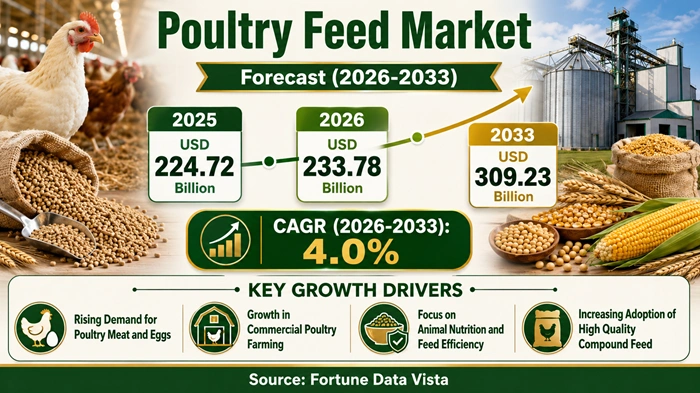
The global poultry feed market size is valued at USD 224.72 billion in 2025 and is predicted to increase from USD 233.78 billion in 2026 to approximately USD 309.23 billion by 2033, growing at a CAGR of 4.0% from 2026 to 2033.
The poultry feed industry — which supplies nutritionally balanced feed formulations for chickens, ducks, turkeys, and other farmed birds across broiler, layer, and breeder production segments — represents one of the largest and most essential segments of the global animal nutrition and agriculture supply chain. Rising global demand for affordable, high-protein poultry meat and eggs as primary dietary protein sources across both developed and emerging market populations, the intensification of commercial poultry farming operations, advancing feed science innovation, and the growing adoption of precision nutrition and feed additive solutions to improve flock performance and feed conversion efficiency are collectively sustaining broad-based and durable demand growth for the chicken feed and broader poultry nutrition industry through the full forecast period.
AI Impact on the Poultry Feed Industry
Artificial Intelligence, Precision Nutrition Technology, and Data-Driven Feed Formulation Platforms Are Transforming the Poultry Feed Industry by Enabling More Efficient Feed Conversion, Reducing Raw Material Waste, and Allowing Producers to Optimize Flock Health and Productivity at an Individual Bird Level
Artificial intelligence and data analytics are beginning to deliver meaningful and commercially significant improvements across the poultry feed industry — most practically in feed formulation optimization, flock health monitoring, and supply chain raw material procurement management. AI-powered feed formulation systems can now simultaneously optimize feed ingredient combinations across thousands of variable inputs — including nutrient content requirements, raw material price fluctuations, digestibility coefficients, and regulatory restriction parameters — to generate the lowest-cost feed formulation that meets specified nutritional targets for specific bird types, growth stages, and production objectives. This real-time least-cost feed formulation capability — which previously required teams of specialized nutritionists to update manually when raw material prices changed — is enabling feed manufacturers to respond more rapidly to commodity price movements while maintaining feed quality standards, delivering meaningful cost efficiency improvements that are increasingly important in an industry where raw material costs represent 60–70% of total feed production cost.
Precision livestock farming technology — incorporating AI-powered computer vision systems that monitor individual bird behavior, feed consumption patterns, water intake, and movement activity in real time — is creating a new demand frontier for customized feed programs tailored to the measured performance data of specific flocks rather than standardized breed-average nutritional recommendations. Integrating real-time flock performance data with AI feed recommendation engines enables poultry producers to adjust feed formulations and feeding programs in response to observed growth rates, feed conversion ratios, and health signals — reducing over-nutrition waste, preventing performance shortfalls caused by under-nutrition, and identifying flocks at risk of nutritional deficiency disorders before clinical symptoms develop. Companies including Cargill, Trouw Nutrition (Nutreco), and DSM-Firmenich are investing in connected poultry production advisory systems that combine AI flock monitoring with feed program optimization to deliver integrated performance management services that go well beyond traditional feed product supply.
Growth Factors
The Rising Global Demand for Poultry Protein, the Intensification and Scale-Up of Commercial Poultry Farming Operations Worldwide, and the Growing Adoption of Advanced Feed Additives That Improve Flock Health and Production Efficiency Are the Primary Forces Sustaining the Growth of the Poultry Feed Market
The most fundamental and durable demand driver in the poultry feed market is the sustained growth of global poultry meat and egg consumption, which is driven by the combination of rising per-capita incomes in emerging market populations, the strong health and affordability positioning of poultry protein relative to red meat alternatives, and the cultural acceptability of poultry consumption across virtually all dietary traditions globally. Poultry meat is the world's most widely consumed animal protein — with global chicken meat production exceeding 100 million metric tons annually — and the sustained growth of this production base requires a proportionally growing supply of nutritionally complete poultry feed to sustain flock performance, meet food safety standards, and achieve the feed conversion efficiency that makes commercial poultry production economically viable. As poultry consumption continues to grow in Asia, Africa, Latin America, and the Middle East — driven by urbanization, growing household incomes, and the progressive integration of poultry into the dietary patterns of populations traditionally less dependent on poultry protein — the aggregate demand for commercial poultry feed formulations will continue to expand at a consistent and broad-based rate through the 2033 forecast horizon.
The growing adoption of advanced feed additives — including feed enzymes, probiotics, organic acids, phytogenics, and precision amino acid solutions — is both expanding the commercial value of the poultry feed market and improving the feed efficiency and flock health outcomes that drive producer economics. Feed enzymes that improve the digestibility of plant-based feed ingredients — including phytase, xylanase, and protease products — can significantly reduce the total feed volume required to achieve target bird growth and egg production rates by making the nutrient content of feed ingredients more bioavailable. The progressive global phase-out of antibiotic growth promoters — driven by antimicrobial resistance concerns and regulatory restrictions across the European Union, the United States, and increasing numbers of emerging market countries — is simultaneously creating a large and growing replacement market for non-antibiotic feed additive solutions that maintain gut health, support immune function, and sustain flock performance in antibiotic-free production environments, making this one of the most dynamic and commercially valuable segments of the poultry feed additives market.
Market Outlook
The Poultry Feed Market Is Projected to Deliver Consistent and Geographically Broad-Based Revenue Growth Through 2033, Anchored by the Non-Negotiable Link Between Poultry Production Volume Growth and Feed Demand, the Advancing Feed Additive Innovation Cycle, and the Rapid Commercialization of Precision Nutrition Solutions Across Both Developed and Emerging Market Poultry Industries
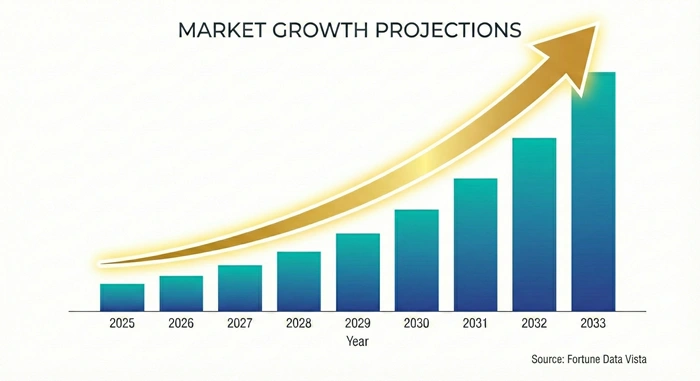
The long-term market outlook for the poultry feed industry is underpinned by the inescapable economic link between global poultry production volume and feed demand — as every metric ton of chicken meat or egg production requires a specific volume of feed to achieve at any given feed conversion ratio, making feed demand a direct and reliable function of poultry production output. With global poultry production projected to continue growing as rising populations and incomes drive higher per-capita protein consumption, the aggregate volume demand for commercial poultry feed is on a structurally sound upward trajectory that is insulated from the demand volatility that discretionary consumer markets experience. This volume growth foundation — combined with the revenue uplift opportunity from growing feed additive penetration, organic feed premiumization, and precision nutrition service adoption — creates a market growth profile that is both reliable in its base volume dynamics and enhanced by value-added product innovation that progressively increases revenue per ton of feed produced.
In emerging markets across Asia Pacific, Latin America, Africa, and the Middle East — where per-capita poultry consumption is growing rapidly from lower bases and commercial poultry farming is progressively replacing subsistence poultry production as the dominant production model — the poultry feed market is in a particularly dynamic growth phase. The transition from backyard and smallholder poultry production to commercial integrated poultry operations — which require standardized, commercially produced feed formulations rather than the farm-mixed or forage-based feeding systems of traditional subsistence production — is creating the most commercially significant volume conversion opportunity in the global poultry feed industry. As this commercial production transition accelerates across emerging market poultry sectors, the addressable market for commercial poultry feed manufacturers expands commensurately — creating sustained market growth in regions where both production volume growth and commercial feed penetration are advancing simultaneously.
Expert Speaks
-
"Cargill's animal nutrition business continues to grow consistently, driven by the fundamental and growing global demand for affordable poultry protein that makes the commercial poultry feed market one of the most reliable segments of the agricultural supply chain. We are investing in precision nutrition technology, feed enzyme innovation, and antibiotic-free production support solutions that help poultry producers improve flock performance and production economics — creating stronger, more differentiated value propositions that go beyond commodity feed supply to truly integrated nutritional partnership." — Brian Sikes, CEO, Cargill Incorporated
-
"Tyson Foods depends on a reliable, high-quality, and efficient poultry feed supply chain that delivers consistent bird performance at the feed conversion ratios that make commercial chicken production economically sustainable at our scale. The poultry feed industry's innovation in feed additives, gut health solutions, and precision nutrition is directly enabling the improvements in broiler performance, welfare, and antibiotic-free production capability that our customers and consumers are increasingly demanding — and we see continued investment in feed science and nutrition technology as essential to the long-term competitiveness of the integrated poultry industry." — Donnie King, CEO, Tyson Foods
-
"Charoen Pokphand Foods operates one of the world's most vertically integrated poultry production systems, and feed quality, efficiency, and innovation are at the absolute center of our competitive strategy across every market we serve. The global poultry feed market is being transformed by advances in feed additive science, precision nutrition, and data-driven flock management that are enabling poultry producers to achieve better performance outcomes with lower antibiotic use and reduced environmental impact — and CP Foods is investing aggressively in feed research, sustainable ingredient sourcing, and technology partnerships to lead this transformation." — Prasit Boondoungprasert, CEO, Charoen Pokphand Foods
Key Report Takeaways
-
Asia Pacific dominates the global poultry feed market, accounting for approximately 42% of total global revenue in 2026, driven by China's position as the world's largest poultry producer, the massive and growing poultry consumption markets of India, Southeast Asia, and East Asia, and the rapid scale-up of commercial integrated poultry operations across the region that require large and growing volumes of commercially manufactured, nutritionally optimized poultry feed formulations for broiler, layer, and breeder production segments.
-
Latin America is the fastest-growing regional market, expanding at a CAGR of approximately 5.8% from 2026 to 2033, powered by Brazil's dominant position as the world's largest chicken meat exporter, the rapid growth of poultry production in Argentina, Mexico, and other regional markets, and the rising per-capita poultry consumption across the Latin American population that is driving consistent growth in commercial poultry production volumes and, by direct extension, poultry feed demand across the region.
-
Broiler feed is the dominant feed type segment, contributing approximately 48% of total feed type revenue in 2026, as commercial broiler chicken production — which requires intensive, high-energy feed formulations to support the rapid growth rates and short production cycles of modern broiler breeds — represents the highest volume and fastest-growing segment of commercial poultry production globally, generating the largest and most consistent demand stream for commercial poultry feed manufacturers.
-
Pellet form is the most widely used feed form, accounting for approximately 45% of total form-based revenue in 2026, as pelleted feed offers significant practical advantages over mash and crumble forms for commercial poultry operations — including reduced feed wastage, more uniform nutrient intake across flocks, better feed conversion ratios due to reduced selective feeding behavior, improved feed storage stability, and more efficient mechanized feeding system compatibility in large-scale commercial poultry houses.
-
Feed enzymes are the fastest-growing additive segment, projected to expand at a CAGR of approximately 6.2% from 2026 to 2033, as the growing adoption of plant-based and alternative protein feed ingredients — combined with the phase-out of antibiotic growth promoters — creates expanding demand for enzyme solutions including phytase, xylanase, and protease that improve the digestibility of plant feed ingredients and reduce the total feed volume and phosphorus excretion required to achieve target poultry production performance outcomes.
-
Organic poultry feed is the fastest-growing nature segment, projected to expand at a CAGR of approximately 7.5% from 2026 to 2033 and reaching approximately 8% of total nature-based revenue by 2033, driven by the rapid growth of certified organic poultry production in North America and Europe to meet strong and growing consumer demand for organic and free-range poultry products at the retail and food service levels.
Market Scope
| Parameter | Details |
|---|---|
| Market Size by 2033 | USD 309.23 Billion | Market Size by 2026 | USD 233.78 Billion | Market Size by 2025 | USD 224.72 Billion | Market Growth Rate from 2026 to 2033 | CAGR of 4.0% | Dominating Region | Asia Pacific | Fastest Growing Region | Latin America | Segments Covered | Feed Type, Form, Nature, Additives, Animal Type, Distribution Channel | Regions Covered | North America, Europe, Asia Pacific, Latin America, Middle East and Africa |
Market Dynamics
Drivers Impact Analysis
The Non-Negotiable Link Between Global Poultry Production Volume Growth and Commercial Feed Demand, the Phase-Out of Antibiotic Growth Promoters Creating Replacement Additive Market Growth, and the Rapid Expansion of Commercial Poultry Production in Emerging Economies Are the Three Most Impactful Forces Driving the Poultry Feed Market Forward
| Driver | ≈ % Impact on CAGR Forecast | Geographic Relevance | Impact Timeline |
|---|---|---|---|
| Rising global poultry meat and egg consumption driving production volume growth | ~32% | Global | Short to Long-Term |
| Antibiotic growth promoter phase-out driving feed additive replacement demand | ~22% | North America, Europe, Asia Pacific | Short to Long-Term |
| Commercial poultry farming expansion replacing subsistence production | ~20% | Asia Pacific, Latin America, MEA | Medium to Long-Term |
| Feed additive innovation improving feed efficiency and flock health | ~14% | Global | Short to Long-Term |
| Organic and antibiotic-free poultry product demand driving premium feed adoption | ~8% | North America, Europe | Short to Medium-Term |
| Feed enzyme adoption reducing feed cost and environmental impact | ~4% | Global | Short to Medium-Term |
The poultry protein demand driver is the most structurally reliable growth mechanism in the poultry feed market — operating through the simple and inescapable production economics that every additional kilogram of poultry meat or tray of eggs produced requires a specific volume of feed to achieve. Global poultry meat consumption is growing consistently across all major markets — with particularly strong per-capita consumption growth in Asia, Africa, Latin America, and the Middle East, where rising household incomes are enabling more frequent and higher-volume poultry protein consumption. As populations grow and urbanize across these emerging market regions — transitioning from lower-protein traditional diets to more meat-inclusive consumption patterns — the aggregate volume of poultry protein demanded will continue to grow at rates that translate directly into growing commercial poultry feed production requirements for the manufacturers and ingredient suppliers that serve the global poultry industry.
The antibiotic growth promoter phase-out driver is creating an immediately commercially significant and durable demand expansion within the poultry feed additives segment, as the regulatory removal and voluntary market withdrawal of AGPs from poultry feed programs globally creates a large and growing replacement market for non-antibiotic feed solutions that can maintain gut health, support immune function, and sustain the growth performance that AGPs historically delivered. Feed additive categories including probiotics, prebiotics, phytogenics, organic acids, and medium-chain fatty acid products are all experiencing accelerating commercial adoption as antibiotic-free poultry production expands — with each category offering distinct mechanisms of action that poultry nutritionists are combining into multi-component gut health programs to replace the AGP dependency that characterized conventional poultry feed programs. This regulatory-driven additive market expansion is one of the most commercially valuable growth opportunities in the global poultry feed additives sector, benefiting specialty ingredient companies including DSM-Firmenich, Novozymes, and Alltech that have invested in scientifically validated non-antibiotic gut health solutions.
Restraints Impact Analysis
The High Volatility of Key Feed Raw Material Commodity Prices, the Complex and Increasingly Stringent Regulatory Environment for Feed Additives and Ingredients, and the Growing Pressure From Alternative Protein Sources on the Economics of Conventional Poultry Feed Formulations Are the Primary Factors Constraining Growth in the Poultry Feed Market
| Restraint | ≈ % Impact on CAGR Forecast | Geographic Relevance | Impact Timeline |
|---|---|---|---|
| High volatility of key feed ingredient commodity prices | ~-30% | Global | Short to Medium-Term |
| Regulatory complexity for feed additives and ingredient approvals | ~-24% | Europe, North America, Asia Pacific | Medium to Long-Term |
| Disease outbreaks including avian influenza disrupting production | ~-20% | Global | Short-Term |
| Environmental pressure on soy and fishmeal ingredient sourcing | ~-16% | Global | Medium to Long-Term |
| Growing competition from alternative protein feed ingredients | ~-10% | North America, Europe | Medium to Long-Term |
Raw material cost volatility is the most pervasive operational challenge in the poultry feed market — with corn, soybeans, wheat, and fishmeal collectively representing the majority of feed formulation cost, and all experiencing significant price swings driven by weather events, geopolitical trade disruptions, biofuel policy changes, and currency movements that can dramatically alter feed production economics within short time periods. For poultry producers operating on narrow margins, raw material cost spikes that cannot be quickly passed through to poultry meat or egg buyers create immediate profitability pressure that can force flock destocking, production curtailment, or operation closures — reducing poultry production volumes and, by direct extension, poultry feed demand in the affected markets. Feed manufacturers that cannot hedge raw material costs effectively through forward purchasing, futures contracts, or ingredient substitution flexibility are particularly exposed to margin compression during commodity price spike periods.
Avian influenza outbreaks represent a particularly acute and recurrent restraint on poultry feed market growth — with major HPAI outbreak events forcing large-scale compulsory flock culling that can destroy tens of millions of birds and remove substantial poultry production capacity from affected markets in short order. The 2022–2024 global HPAI outbreak cycle — which resulted in the culling of record numbers of layer hens across the United States, Europe, and Asia — demonstrated the potential for disease events to create significant short-term demand shocks in the poultry feed market by dramatically reducing the flock populations that consume feed. While poultry populations typically recover as flocks are restocked following disease clearance, the production interruption period creates meaningful revenue shortfalls for poultry feed manufacturers serving affected regions.
Opportunities Impact Analysis
The Commercial Expansion of Precision Nutrition and Connected Feed Management Technology, the Growing Sustainable and Alternative Protein Feed Ingredient Sector, and the Rapid Development of Commercial Poultry Production in Africa and the Middle East Are Creating Significant Growth Opportunities for the Poultry Feed Market
| Opportunity | ≈ % Impact on CAGR Forecast | Geographic Relevance | Impact Timeline |
|---|---|---|---|
| Precision nutrition and connected flock management technology adoption | ~28% | North America, Europe, Asia Pacific | Short to Long-Term |
| Sustainable and alternative protein feed ingredient development | ~24% | North America, Europe | Medium to Long-Term |
| African and Middle Eastern commercial poultry sector development | ~22% | MEA | Long-Term |
| Organic and antibiotic-free premium poultry feed market growth | ~16% | North America, Europe | Short to Medium-Term |
| Feed additive innovation for antibiotic replacement and gut health | ~10% | Global | Short to Medium-Term |
The sustainable feed ingredients opportunity reflects the growing pressure on conventional poultry feed ingredient sourcing — particularly soy and fishmeal — from environmental sustainability concerns, deforestation linkage risks, and ocean resource depletion that are driving both regulatory scrutiny and retail customer supply chain sustainability requirements. Alternative and more sustainable feed protein sources including insect meal, single-cell protein, algae-derived ingredients, and fermented plant proteins are attracting growing commercial investment and progressive regulatory approval across the EU and U.S. markets — with companies including Protix, Ynsect, and Calysta developing scalable production capacity for insect and single-cell protein feed ingredients that can partially replace soy and fishmeal in commercial poultry feed formulations. The commercial viability of these alternative protein ingredients is improving as production scale increases and costs fall — creating a realistic pathway to meaningful commercial adoption in premium, antibiotic-free, and sustainability-certified poultry feed segments.
The Africa and Middle East commercial poultry development opportunity represents one of the most significant long-term addressable market expansions in the global poultry feed industry — with Africa's rapidly growing population, urbanization rate, and rising middle class driving strong structural demand growth for affordable poultry protein that is currently met in large part by imports. The progressive development of domestic commercial poultry production capacity across sub-Saharan Africa and North Africa — supported by government food security programs, international agribusiness investment, and the growing availability of commercial poultry genetics and integrated production management expertise — is creating expanding demand for commercial poultry feed that domestic and international feed manufacturers are beginning to invest in serving through local production facility establishment. The combination of Africa's population growth trajectory, poultry protein consumption growth rate, and current commercial feed penetration level makes the continent one of the most compelling long-term growth markets in the global poultry feed industry.
Segment Analysis
By Feed Type: Broiler Feed
Broiler Feed Is the Dominant and Most Volume-Intensive Segment in the Poultry Feed Market, Driven by the Extraordinary Global Scale of Commercial Broiler Chicken Production and the High-Energy, Nutrient-Dense Feed Requirements of Modern Broiler Genetics That Demand Precisely Formulated Commercial Feed Programs
Broiler feed accounts for approximately 48% of total feed type revenue in the poultry feed market in 2026, making it the largest segment by a substantial margin. Modern commercial broiler breeds — developed through decades of selective breeding to achieve the fastest possible weight gain at the best achievable feed conversion ratio — require precisely formulated, high-energy, high-protein feed programs across their pre-starter, starter, grower, and finisher production phases to express their full genetic performance potential. The broiler feed segment within the global poultry feed market is projected to grow at a CAGR of approximately 4.5% from 2026 to 2033, driven by the continuous growth of global broiler meat demand, the progressive intensification of commercial broiler production operations, and the growing adoption of phase-feeding programs that use age-specific feed formulations optimized for each stage of the broiler growth cycle. North America is a major regional market for broiler feed, with integrated poultry companies including Tyson Foods (USA), Pilgrim's Pride Corporation (USA), and feed manufacturers including Cargill (USA) and Land O'Lakes (USA) supplying the large and technically sophisticated broiler feed requirements of the U.S. broiler industry.
Asia Pacific is the largest regional market for broiler feed and the fastest-growing, driven by the extraordinary scale of China's commercial broiler industry — the second-largest in the world by production volume — and the rapidly growing broiler sectors of India, Southeast Asia, and East Asia. China's integrated poultry operations — led by Charoen Pokphand Foods (Thailand), New Hope Liuhe (China), and Guangdong HAID Group (China) — consume massive volumes of commercially manufactured broiler feed annually, and the continued growth of China's broiler production capacity to meet domestic poultry protein demand is sustaining robust broiler feed volume growth in the world's largest poultry feed market. The broiler feed segment's dominant position in the poultry feed industry is reinforced by the broiler sector's intensive and fully commercialized production model — which relies entirely on commercially manufactured feed formulations rather than the mixed or forage-based feeding systems that characterize lower-intensity poultry production — making commercial feed adoption essentially total across the modern broiler industry.
By Additives: Feed Enzymes
Feed Enzymes Are the Fastest-Growing and Most Scientifically Advanced Additive Segment in the Poultry Feed Market, Delivering Proven and Quantifiable Feed Efficiency, Cost Reduction, and Environmental Impact Improvements That Make Them Indispensable Components of Modern Commercial Poultry Feed Programs
Feed enzymes hold approximately 22% of the total additives-based revenue in the poultry feed market in 2026, and the segment is growing at the highest rate among all major feed additive categories. Phytase — which breaks down phytate-bound phosphorus in plant feed ingredients to improve phosphorus digestibility and reduce inorganic phosphorus supplementation requirements — is the highest-volume individual feed enzyme product globally, delivering both feed cost savings and meaningful reductions in phosphorus excretion that benefit both producer economics and the environmental sustainability of commercial poultry production. The feed enzymes segment is projected to grow at a CAGR of approximately 6.2% from 2026 to 2033, driven by the growing adoption of carbohydrases including xylanase, beta-glucanase, and amylase that improve the digestibility of the non-starch polysaccharide fractions of corn, wheat, and soy feed ingredients — unlocking additional nutritional value from plant feed ingredients and enabling feed formulators to reduce dietary energy and protein levels without compromising bird performance. Europe is the most established regional market for feed enzyme adoption, where the early regulatory phase-out of antibiotic growth promoters created an accelerated adoption environment for feed enzyme technology — with companies including Novozymes (Denmark), DSM-Firmenich (Netherlands), and AB Enzymes (Germany) holding leading commercial positions in the European poultry feed enzyme market.
North America is a strong and growing feed enzyme market, where the voluntary and regulatory transition to antibiotic-free poultry production — driven by consumer demand for antibiotic-free poultry products and retail and food service customer requirements — is accelerating the adoption of comprehensive feed enzyme and gut health additive programs as replacement solutions for the growth-promoting antimicrobial products that were previously standard in U.S. and Canadian commercial broiler and turkey feed programs. The combination of proven economic return on investment — with phytase and carbohydrase programs consistently delivering measurable feed cost savings and performance improvements that cover their additive cost multiple times over — and growing regulatory and market acceptance pressure for antibiotic-free production practices is making comprehensive feed enzyme programs effectively standard in forward-looking commercial poultry feed formulation programs globally. This normalization of feed enzyme adoption across commercial poultry production is sustaining consistent volume growth for the feed enzyme segment of the poultry feed market through the 2033 forecast horizon and beyond.
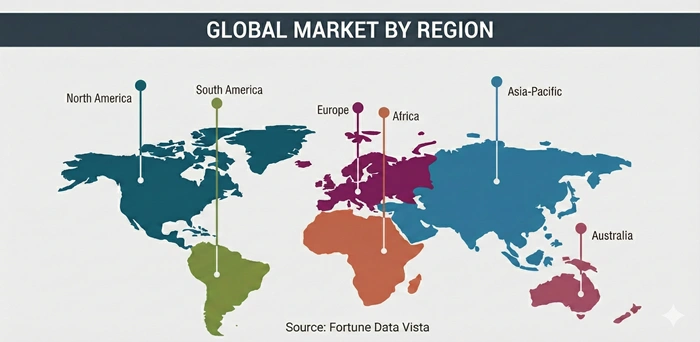
Regional Insights
Asia Pacific: The Dominating Region
Asia Pacific Dominates the Global Poultry Feed Market Through China's Position as the World's Largest Commercial Poultry Producer, the Massive and Growing Poultry Consumption Markets of India and Southeast Asia, and the Rapid Scale-Up of Vertically Integrated Commercial Poultry Operations Across the Region
Asia Pacific holds the largest regional share of the global poultry feed market, accounting for approximately 42% of total global revenue in 2026, with a regional CAGR of approximately 4.2% from 2026 to 2033. China is the dominant national market — operating the world's largest commercial poultry sector by many measures — with integrated poultry producers and feed manufacturers including New Hope Liuhe Co. Ltd. (China), Guangdong HAID Group Co. Ltd. (China), and Charoen Pokphand Foods (Thailand) operating extensive feed manufacturing and poultry production operations across the country to serve China's enormous domestic poultry protein demand. India is the fastest-growing major poultry feed market in the Asia Pacific region, with broiler and layer production expanding rapidly as rising household incomes drive growing per-capita poultry consumption across the country's large and increasingly urbanized population.
Southeast Asia — including Indonesia, Vietnam, Thailand, Malaysia, and the Philippines — contributes substantially to the Asia Pacific poultry feed market, with all of these markets experiencing significant commercial poultry industry growth driven by rising domestic demand and, in Thailand's and Vietnam's cases, substantial export-oriented poultry production. Thailand's Charoen Pokphand Foods (Thailand) is one of the world's most significant integrated poultry producers, operating feed manufacturing, poultry farming, and processed poultry product operations across Southeast Asia, China, and international markets that collectively consume millions of metric tons of commercially manufactured poultry feed annually. The Asia Pacific region's dominant position in the poultry feed market is reinforced by the region's large and growing population, the culturally established role of poultry as a primary protein source across virtually all Asian dietary traditions, and the strong government policy support for domestic poultry production as a food security priority across major producing countries.
Latin America: The Fastest Growing Region
Latin America Is the Fastest Growing Regional Market in the Poultry Feed Industry, Led by Brazil's World-Leading Chicken Export Industry and the Growing Domestic Poultry Production Sectors of Mexico, Argentina, and Other Regional Markets Driven by Both Export and Rising Domestic Demand
Latin America is the fastest-growing regional segment in the poultry feed market, projected to expand at a CAGR of approximately 5.8% from 2026 to 2033. Brazil dominates the Latin American market — as the world's largest chicken meat exporter and one of the largest producers globally — with vertically integrated poultry companies including JBS SA (Brazil), BRF SA (Brazil), and Marfrig Global Foods (Brazil) operating feed manufacturing and poultry production systems of extraordinary scale that require large and consistently growing volumes of commercial broiler and breeder feed. Brazil's competitive advantages in poultry production — including abundant and low-cost corn and soybean feed ingredient supplies, favorable climate for year-round production, and competitive labor and land costs — are sustaining its global export leadership position and supporting consistent poultry feed market revenue growth in the region.
Mexico is a significant and growing poultry feed market within Latin America, serving the world's second-largest per-capita chicken meat consumption market with a combination of domestic integrated producers and international feed manufacturers that collectively supply the country's large commercial broiler and layer sectors. Argentina's poultry sector is expanding rapidly — with government export promotion initiatives supporting growing chicken meat export volumes to regional and global markets that are driving poultry production scale-up and commensurate poultry feed demand growth. The Latin American poultry feed market's growth advantage over other regions reflects the combination of strong domestic protein demand growth, large and growing poultry export sectors, abundant and competitively priced domestic feed ingredient supplies, and favorable operating economics that make the region one of the most competitive and dynamically growing poultry production and feed manufacturing environments globally.
Report Customization by Region and Country
This Poultry Feed Market Report Offers Full Region-Wise and Country-Wise Customization — Delivering Precise, Geography-Specific Market Sizing, Feed Ingredient Landscape Analysis, Regulatory Environment Assessment, Competitive Intelligence, and Strategic Growth Opportunities Tailored to Every Region and Country Across the Globe
This Poultry Feed Market report is available with full customization by region and country, enabling organizations to access precise, geography-specific insights aligned with their strategic priorities. The report can be configured to deliver the exact regional depth and market intelligence your business needs — covering market sizing, CAGR forecasts, segment breakdowns, feed ingredient sourcing landscape, regulatory environment, competitive player profiles, and actionable strategic opportunities specific to each selected geography.
North America
-
U.S. — Commercial broiler and layer feed market sizing, antibiotic-free feed transition analysis, major integrated producer and feed manufacturer competitive profiles including Cargill, Land O'Lakes, and Tyson Foods, and market sizing and forecast through 2033
-
Canada — Commercial poultry feed market landscape, supply management system impact on feed demand, domestic feed manufacturer profiles, and regional market sizing and CAGR
-
Mexico — Domestic broiler and layer feed market analysis, leading producer competitive profiles, feed ingredient sourcing trends, and market sizing and growth forecast
Europe
-
U.K. — Post-Brexit feed ingredient regulatory changes, commercial broiler and layer feed market sizing, leading domestic feed manufacturer landscape, and market sizing and CAGR
-
Germany — EU feed additive regulatory compliance, organic poultry feed market development, Raiffeisen and ForFarmers competitive positioning, and regional market analysis
-
France — French poultry sector feed demand, antibiotic-free production transition progress, domestic feed industry landscape, and market sizing through 2033
-
Italy — Italian poultry feed regulatory environment, domestic producer and feed manufacturer landscape, and regional market development analysis
-
Rest of Europe — Eastern European poultry production growth, EU feed additive regulation impact, and region-wide commercial feed market development
Asia Pacific
-
China — New Hope Liuhe, HAID Group, and CP Foods competitive landscape, commercial feed ingredient sourcing, government poultry policy impact, and market sizing and CAGR forecast
-
India — Commercial broiler and layer feed market growth, domestic feed manufacturer profiles, feed ingredient supply chain analysis, and market forecast
-
Japan — Domestic poultry feed regulatory framework, leading feed manufacturer profiles, advanced feed additive adoption, and market sizing through 2033
-
South Korea — Commercial poultry feed market landscape, domestic producer competitive profiles, feed additive adoption trends, and regional market analysis
-
Australia — Australian feed safety regulatory framework, commercial poultry production landscape, organic feed market development, and market sizing and forecast
-
Rest of Asia Pacific — Southeast Asian commercial poultry industry growth, regional feed ingredient sourcing, and poultry feed market development across Vietnam, Indonesia, Thailand, and the Philippines
Latin America
-
Brazil — JBS, BRF, and Marfrig integrated feed and production competitive landscape, export-driven poultry sector growth, feed ingredient supply dynamics, and market sizing and CAGR
-
Argentina — Poultry export growth programs, commercial feed market development, domestic feed ingredient supply, and regional market opportunity analysis
-
Rest of Latin America — Regional commercial poultry sector development, feed ingredient sourcing trends, and poultry feed market growth opportunities across Mexico, Colombia, and Chile
Middle East and Africa (MEA)
-
UAE — Import-dependent feed market dynamics, premium poultry product demand, and commercial feed market sizing and competitive landscape
-
Saudi Arabia — Vision 2030 food security poultry programs, domestic production expansion, feed import dependency reduction, and market sizing and growth forecast through 2033
-
Rest of MEA — Sub-Saharan African commercial poultry development, domestic feed manufacturing investment, and long-term poultry feed market opportunity across Nigeria, Kenya, and South Africa
Each customized Poultry Feed Market report delivers country-specific feed ingredient landscape analysis, production regulatory compliance guidance, competitive mapping of leading producers and feed manufacturers, and market entry strategy intelligence — providing decision-makers with everything they need to maximize competitive advantage and investment returns in their target geographies.
Top Key Players
-
Charoen Pokphand Foods PCL (Thailand)
-
Cargill Incorporated (United States)
-
New Hope Liuhe Co. Ltd. (China)
-
Nutreco NV (Trouw Nutrition) (Netherlands)
-
Land O'Lakes Inc. (United States)
-
Guangdong HAID Group Co. Ltd. (China)
-
De Heus Animal Nutrition (Netherlands)
-
ForFarmers NV (Netherlands)
-
Alltech Inc. (United States)
-
ADM Animal Nutrition (United States)
-
Kent Nutrition Group (United States)
-
BRF SA (Brazil)
Recent Developments
-
In 2025, Cargill Incorporated launched its next-generation EcoPro feed optimization platform for commercial poultry producers — integrating real-time ingredient price data, nutritional database updates, and AI-powered least-cost formulation algorithms to enable feed manufacturers and integrated poultry producers to dynamically optimize their feed formulations in response to commodity price changes, delivering estimated feed cost savings of 3–7% per metric ton versus traditional periodic manual reformulation practices.
-
In 2025, Nutreco (Trouw Nutrition) completed the acquisition of Hendrix Genetics' nutritional advisory services business — expanding Trouw Nutrition's poultry genetic line-specific precision nutrition portfolio and creating an integrated genetics-plus-nutrition service model that enables commercial poultry producers to align their feed programs precisely with the nutritional requirements of the specific breeding lines they use, improving flock performance and feed conversion outcomes beyond what generalized breed-average feed programs achieve.
-
In 2026, Charoen Pokphand Foods announced a major sustainable feed ingredient investment — committing to sourcing 30% of its global soybean meal requirements from deforestation-free certified supply chains by 2027 and establishing a joint development program with Calysta to integrate single-cell protein produced from natural gas fermentation into CP Foods' commercial poultry feed formulations as a sustainable fishmeal replacement ingredient across its Asian feed manufacturing operations.
-
In 2025, Alltech Inc. launched its expanded Alltech Poultry Performance Platform — combining its Mycosorb mycotoxin binder, Actigen gut health, and Optigen rumen-protected protein products into an integrated gut health and performance solution specifically designed for antibiotic-free broiler and layer feed programs — responding to the growing commercial demand for comprehensive, scientifically validated non-antibiotic gut health programs in commercial poultry feed markets across North America, Europe, and Asia Pacific.
-
In 2026, De Heus Animal Nutrition expanded its commercial poultry feed manufacturing presence in Africa through the acquisition of a majority stake in a Nigerian poultry feed manufacturing company — establishing De Heus's first local manufacturing presence in the Nigerian market and positioning the company to serve the rapid growth of Nigeria's commercial poultry sector, which is the largest in sub-Saharan Africa and is experiencing strong demand growth driven by rising urban population and per-capita poultry protein consumption.
Market Trends
The Accelerating Transition to Antibiotic-Free Commercial Poultry Production Globally and the Growing Industry Commitment to Sustainable Feed Ingredient Sourcing Are the Two Most Commercially Significant Trends Reshaping the Poultry Feed Market Through 2033
The global antibiotic-free poultry production transition — driven by consumer preference for antibiotic-free poultry products, retail and food service chain sustainability commitments, and the progressive regulatory tightening of antibiotic use in food animal production across major markets — is the most transformative trend affecting the commercial poultry feed industry. As producers transition away from antibiotic growth promoter dependency, the feed additive formulation complexity of commercial poultry feed programs increases substantially — requiring multi-component gut health programs that combine probiotics, prebiotics, organic acids, phytogenics, feed enzymes, and immune support nutrients to replicate the performance-sustaining effects that AGPs previously delivered. This additive complexity increase represents both a significant revenue opportunity for specialty feed ingredient manufacturers and a meaningful nutritional management challenge for commercial poultry producers and feed formulators — driving growing demand for the integrated nutritional advisory services that leading feed companies provide alongside their feed products.
The sustainable feed ingredient sourcing trend reflects the growing scrutiny of the environmental footprint of commercial poultry production — particularly the deforestation and biodiversity impacts associated with soybean cultivation for animal feed, the ocean resource depletion concerns associated with fishmeal sourcing, and the greenhouse gas emissions of both feed crop agriculture and commercial poultry operations. Major poultry retailers and food service chains are progressively requiring their supplier poultry producers to demonstrate sustainable feed ingredient sourcing in their ESG and supply chain transparency disclosures — creating procurement pressure that is flowing back through the poultry value chain to feed manufacturers and ingredient suppliers. Feed companies that can credibly offer deforestation-free certified soy, alternative protein ingredients with verified sustainability advantages, and comprehensive carbon and water footprint reporting for their feed products are gaining meaningful competitive advantage in commercial contracts with sustainability-focused integrated poultry producers and major retail food service customers.
Segments Covered in the Report
By Feed Type:
-
Pre-starter and Starter
-
Grower
-
Broiler
-
Layer
By Form:
-
Mash
-
Pellets
-
Crumbles
By Nature:
-
Conventional
-
Organic
By Additives:
-
Antibiotics
-
Vitamins
-
Antioxidants
-
Amino Acids
-
Feed Enzymes
-
Feed Acidifiers
-
Others
By Animal Type:
-
Chicken
-
Ducks
-
Turkey
-
Others
By Distribution Channel:
-
Offline
-
Online
-
Veterinary Hospitals and Clinics
By Region:
-
North America (U.S., Canada, Mexico)
-
Europe (U.K., Germany, France, Italy, Rest of Europe)
-
Asia Pacific (China, India, Japan, South Korea, Australia, Rest of Asia Pacific)
-
Latin America (Brazil, Argentina, Rest of Latin America)
-
Middle East and Africa (UAE, Saudi Arabia, Rest of MEA)
❝ Built for Every Level — From Startups to Industry Giants ❞
Here Is Exactly How This Report Works for You
-
Whether you are a global poultry feed manufacturer assessing geographic expansion priorities, feed additive portfolio investment strategy, and competitive positioning against major integrated players; a specialty feed ingredient supplier evaluating commercial adoption potential for novel sustainable protein sources, antibiotic replacement additives, or precision nutrition solutions; or an integrated poultry producer seeking benchmarking data on feed conversion performance, sustainable ingredient sourcing options, and competitive feed program cost analysis — this report delivers granular revenue forecasts by feed type, form, additive, animal type, and region combined with detailed competitor revenue analysis, feed ingredient market intelligence, and regulatory environment assessment that enables confident strategic and capital allocation decisions.
-
This report comprehensively maps the supply-demand dynamics of the global poultry feed ecosystem — including feed ingredient commodity price trend analysis, commercial poultry production volume forecasts by region and animal type, feed additive adoption curve assessment across antibiotic-free and organic production segments, and how geopolitical factors including trade policy changes affecting soy and corn export flows, avian influenza outbreak management protocols, and government food security program investment are reshaping global poultry feed demand patterns and supply chain strategies in ways that create both material operational risks and significant market opportunity.
-
The full version provides detailed competitor revenue and market share analysis by feed type and region, feed additive technology capability benchmarking across leading ingredient suppliers, sustainable feed ingredient commercial adoption assessment, precision nutrition and connected poultry management technology trend analysis, and a forward-looking evaluation of African and Middle Eastern commercial poultry development opportunities — delivering the strategic intelligence needed by tier 1 feed conglomerates, specialty additive companies, and emerging market investors to capture the full commercial potential of the global poultry feed industry's consistent and broad-based growth trajectory through 2033.
Frequently Asked Questions:
Answer: The poultry feed market is valued at USD 224.72 billion in 2025 and is projected to reach USD 309.23 billion by 2033. It is expected to grow at a CAGR of 4.0% from 2026 to 2033, driven by rising global poultry meat and egg consumption, the intensification of commercial poultry farming operations, and the growing adoption of advanced feed additives that improve flock health and feed conversion efficiency.
Answer: Asia Pacific leads the global poultry feed market, accounting for approximately 42% of total global revenue in 2026, anchored by China's position as the world's largest commercial poultry producer and the rapidly growing poultry consumption markets of India, Southeast Asia, and East Asia. Major integrated players including New Hope Liuhe, Guangdong HAID Group, and Charoen Pokphand Foods operate extensive feed manufacturing operations across the region that collectively consume and produce the largest share of global commercial poultry feed volume.
Answer: Commercial poultry feed formulations are primarily composed of energy ingredients — corn, wheat, and other grains — combined with protein sources including soybean meal, fishmeal, and meat and bone meal to meet the amino acid requirements of growing birds. Key feed additives used in the poultry feed market include vitamins, minerals, feed enzymes such as phytase and xylanase, amino acids, probiotics, organic acids, phytogenics, and antioxidants — with the phase-out of antibiotic growth promoters driving growing adoption of multi-component non-antibiotic gut health programs.
Answer: The poultry feed market's organic segment is growing at approximately 7.5% CAGR from 2026 to 2033, driven by strong and growing consumer demand for certified organic and free-range poultry meat and eggs in North American and European retail markets that command significant premium prices over conventional poultry products. Certified organic poultry production requires organically sourced feed ingredients free from synthetic pesticides, GMO crops, and non-approved additives — creating a distinct and premium-priced feed supply requirement that organic-certified feed manufacturers are increasingly well-positioned to serve.
Answer: The global transition away from antibiotic growth promoters in commercial poultry feed programs is driving the rapid adoption of comprehensive non-antibiotic feed additive solutions — including feed enzymes, probiotics, prebiotics, phytogenics, and organic acids — that maintain gut health, support immune function, and sustain the performance outcomes that AGPs previously delivered in commercial broiler, layer, and turkey feed programs. Leading poultry feed manufacturers including Cargill, Trouw Nutrition, and Alltech are responding by developing scientifically validated, multi-component antibiotic-free feed programs and integrated nutritional advisory services that help commercial poultry producers make the production transition successfully while maintaining flock performance and economic competitiveness.