
PVC Pipes Market Overview
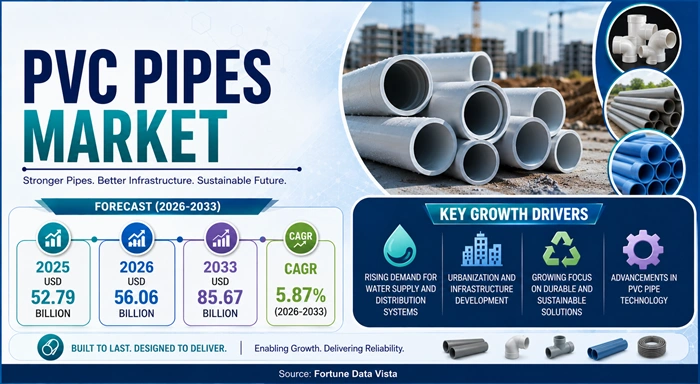
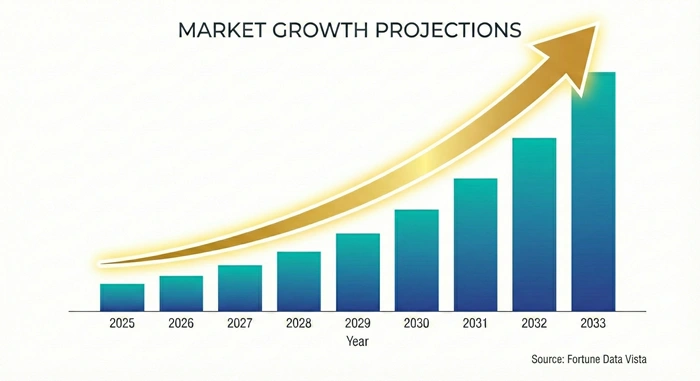
The global PVC pipes market size is valued at USD 52.79 billion in 2025 and is predicted to increase from USD 56.06 billion in 2026 to approximately USD 85.67 billion by 2033, growing at a CAGR of 5.87% from 2026 to 2033.
This steady expansion reflects the ongoing global reliance on polyvinyl chloride piping systems for water supply, sewage drainage, and agricultural irrigation networks, where affordability and corrosion resistance continue outweighing traditional metal pipe alternatives. As municipal water infrastructure ages in developed markets and new residential construction accelerates across emerging economies, demand for both rigid PVC and chlorinated PVC piping continues expanding across construction contractors, municipal utilities, and agricultural irrigation projects worldwide.
AI Impact on the PVC Pipes Industry
Artificial Intelligence Is Enhancing Extrusion Process Optimization, Accelerating Defect Detection, and Strengthening Supply Chain Demand Forecasting Across the PVC Pipes Landscape — Fundamentally Changing How Manufacturers Control Production Quality
Artificial intelligence has become an increasingly valuable tool for extrusion process optimization, with sensor-driven algorithms now capable of monitoring temperature, pressure, and material flow variables in real time to catch subtle process deviations long before they result in defective pipe batches. This precision matters considerably in an industry where wall thickness inconsistencies or material impurities can compromise pipe pressure ratings, and AI-assisted process monitoring tools are helping manufacturers reduce both scrap rates and costly production downtime. Companies building predictive process control directly into their manufacturing lines are increasingly differentiating themselves through measurably more consistent product quality.
Beyond process optimization, AI is also accelerating defect detection through computer vision systems that scan finished pipes for cracks, warping, or surface irregularities far faster and more consistently than manual visual inspection ever achieved. This capability has proven valuable for large-scale manufacturers running continuous production lines, since automated inspection reduces both labor costs and the risk of defective pipes reaching municipal or residential installation sites. As these AI-driven monitoring and inspection tools continue maturing, they are becoming an increasingly important factor shaping quality assurance across the broader PVC pipes market.
Growth Factors
Rising Municipal Water Infrastructure Investment and Growing Residential Construction Activity Continue Driving Sustained Demand
The most significant growth factor supporting the PVC pipes market is the steadily rising investment municipal governments are making in water supply and sewage infrastructure renewal, as aging pipe networks across developed markets require systematic replacement with more durable, corrosion-resistant materials. With several countries also expanding rural water access programs, this infrastructure-driven demand has become an increasingly important factor for manufacturers offering both standard PVC and specialized chlorinated PVC piping for higher-temperature applications.
A second important growth factor is the growing pace of residential and commercial construction across emerging economies, as expanding urban populations require new plumbing, drainage, and irrigation systems that increasingly favor PVC over traditional metal alternatives due to lower installation costs and longer service life. This construction-driven demand, combined with rising agricultural irrigation modernization in water-stressed regions, has broadened the addressable market for PVC pipes considerably. This combination of rising infrastructure renewal and growing construction activity continues to strengthen demand across the PVC pipes market.
Market Outlook
Expanding Agricultural Irrigation Modernization and Growing Emerging Market Urbanization Point Toward Sustained Growth Through 2033
Looking ahead through the forecast period, the PVC pipes industry is expected to benefit substantially from continued expansion of agricultural irrigation modernization programs, as farmers and government agencies increasingly replace open-channel and metal irrigation systems with more water-efficient PVC piping networks to address growing water scarcity concerns. This efficiency-focused shift is likely to reshape procurement priorities considerably as more agricultural regions invest in modern drip and pressurized irrigation infrastructure.
At the same time, expanding urbanization across emerging markets is expected to create substantial new demand, as growing city populations across Asia Pacific and Latin America require continuous expansion of municipal water and sewage networks that increasingly rely on PVC's cost and durability advantages. Companies that can deliver both consistent product quality and competitive pricing are increasingly well positioned to capture this growth. Providers combining strong manufacturing scale with broad regional distribution capability are likely to lead growth within the broader PVC pipes market through 2033.
Analyst Perspective
Rising Raw Material Price Volatility and Growing Preference for Sustainable Piping Alternatives Are Reshaping Competitive Strategy Across the Industry
From an analyst standpoint, manufacturers operating within the PVC pipes market are increasingly navigating a delicate balance between maintaining competitive pricing and managing volatile input costs, since PVC resin prices remain closely tied to broader petrochemical market fluctuations that can compress margins unexpectedly. Analysts note that companies with vertically integrated resin production capacity are generally better positioned to absorb these cost swings compared to smaller manufacturers dependent entirely on external resin suppliers, giving larger integrated players a structural advantage in pricing stability.
At the same time, analysts are closely watching how growing environmental scrutiny around PVC's chlorine content is influencing long-term material selection trends, particularly in Europe where regulatory pressure toward alternative piping materials continues building gradually. While PVC's cost and performance advantages are expected to keep it dominant across most applications through the forecast period, analysts suggest manufacturers investing early in recycling infrastructure and lower-emission production processes will likely capture disproportionate share as sustainability requirements tighten further across the broader PVC pipes market.
Key Report Takeaways
-
North America leads the global PVC pipes market, holding approximately 38% market share in 2025, supported by extensive municipal water infrastructure renewal programs and a strong base of established manufacturers
-
Asia Pacific is the fastest-growing region, projected to expand at a CAGR near 7.6% through 2033, driven by rapid urbanization and expanding government water infrastructure investment across China and India
-
Municipal utilities and government agencies represent the dominant end-user segment, accounting for roughly 44% share, given their continuous large-scale demand for water supply and sewage pipe networks
-
Water supply and distribution applications contribute the most to overall demand, reflecting the widespread use of PVC piping in both municipal and residential plumbing systems
-
Rigid PVC piping remains the most widely adopted material type, valued for its affordability and proven durability across decades of installation history
-
Chlorinated PVC piping segments will grow the fastest among material categories, holding close to 18% market share with a CAGR near 8.9% through the forecast period, driven by rising demand for higher-temperature-resistant plumbing applications
Market Scope
| Parameter | Details |
|---|---|
| Market Size by 2033 | USD 85.67 Billion | Market Size by 2026 | USD 56.06 Billion | Market Size by 2025 | USD 52.79 Billion | Market Growth Rate from 2026 to 2033 | CAGR of 5.87% | Dominating Region | North America | Fastest Growing Region | Asia Pacific | Segments Covered | Material Type, Application, End Use, Region | Regions Covered | North America, Europe, Asia Pacific, Latin America, Middle East & Africa |
Market Dynamics
Drivers Impact Analysis
Rising Municipal Infrastructure Renewal and Growing Residential Construction Remain the Two Strongest Forces Behind Market Momentum
| Driver | (≈) % Impact on CAGR Forecast | Geographic Relevance | Impact Timeline |
|---|---|---|---|
| Rising municipal water and sewage infrastructure renewal investment | ~34% | North America, Europe | Short to long-term |
| Growing residential and commercial construction activity in emerging markets | ~27% | Asia Pacific, Latin America | Medium-term |
| Expanding agricultural irrigation modernization programs | ~25% | Asia Pacific, Middle East & Africa | Medium to long-term |
| Rising preference for PVC over metal piping due to corrosion resistance | ~14% | Global | Short to medium-term |
Rising municipal water and sewage infrastructure renewal investment continues to serve as the primary engine behind sustained growth in the PVC pipes market, as aging pipe networks across developed markets require systematic replacement with materials offering longer service life and lower maintenance costs. This renewal-driven momentum has translated directly into rising procurement volumes among both municipal utilities and private infrastructure contractors.
Growing residential and commercial construction activity across emerging markets represents the second major driver, as expanding urban populations require new plumbing and drainage systems that increasingly favor PVC's affordability and installation simplicity over traditional metal alternatives. This construction-driven demand, combined with expanding agricultural irrigation modernization in water-stressed regions, continues reinforcing steady momentum across the broader PVC pipes market.
Restraints Impact Analysis
Volatile Resin Pricing and Growing Environmental Scrutiny Continue to Moderate Broader Expansion
| Restraint | (≈) % Impact on CAGR Forecast | Geographic Relevance | Impact Timeline |
|---|---|---|---|
| Volatile pricing of PVC resin tied to broader petrochemical market fluctuations | ~35% | Global | Short to medium-term |
| Growing environmental scrutiny around chlorine content and disposal concerns | ~27% | Europe, North America | Medium to long-term |
| Competition from alternative piping materials such as HDPE and PPR | ~24% | Global | Medium-term |
| Regulatory restrictions on certain PVC applications in select markets | ~14% | Europe | Short to medium-term |
The most persistent restraint facing the PVC pipes market is the volatile pricing of PVC resin, which remains closely tied to broader petrochemical market swings that can compress manufacturer margins unpredictably and create budgeting challenges for large infrastructure projects with fixed cost estimates. This pricing volatility remains particularly pronounced during periods of global oil price fluctuation and supply chain disruption.
Growing environmental scrutiny around chlorine content and end-of-life disposal concerns represents a second significant restraint, since regulatory bodies in certain European markets continue tightening restrictions on PVC use in specific applications despite the material's cost and performance advantages. Combined with rising competition from alternative piping materials such as HDPE and PPR, these restraints continue moderating how quickly broader PVC adoption expands across the global PVC pipes market.
Opportunities Impact Analysis
Recycling Infrastructure Investment and Expanding Emerging Market Urbanization Represent the Clearest Paths to Growth
| Opportunity | (≈) % Impact on CAGR Forecast | Geographic Relevance | Impact Timeline |
|---|---|---|---|
| Expanding investment in PVC recycling and lower-emission production technology | ~37% | Europe, North America | Medium to long-term |
| Growing urbanization and infrastructure investment across emerging markets | ~34% | Asia Pacific, Middle East & Africa | Medium-term |
| Rising adoption of AI-driven quality inspection and process optimization tools | ~29% | Global | Short to medium-term |
Expanding investment in PVC recycling and lower-emission production technology represents one of the most substantial opportunities within the PVC pipes market, as manufacturers investing early in circular production processes stand to benefit significantly from tightening environmental regulations and growing customer preference for sustainably produced piping materials. This sustainability-driven differentiation is expected to meaningfully reshape competitive positioning among leading manufacturers over the coming years.
Growing urbanization and infrastructure investment across emerging markets presents a second substantial opportunity, as expanding government spending across Asia Pacific and the Middle East creates demand for both standard and specialized PVC piping supporting rapidly growing urban populations. Rising adoption of AI-driven quality inspection and process optimization tools further broadens the opportunity landscape, particularly for manufacturers able to deliver improved consistency and efficiency. Companies pursuing these parallel opportunities are well positioned to capture meaningful growth within the broader PVC pipes market through the forecast period.
Segment Analysis
By Application: Water Supply and Distribution
Water Supply and Distribution Applications Continue to Anchor the Application Landscape, Reflecting Widespread Use in Municipal and Residential Plumbing
Water supply and distribution applications hold the largest share within the application segment of the PVC pipes market, accounting for approximately 39% of total segment revenue in 2025. This dominance reflects the widespread reliance on PVC piping across municipal water networks and residential plumbing systems, where corrosion resistance and lower installation costs continue outweighing traditional metal pipe alternatives across most infrastructure projects. In markets like the United States and China, municipal utilities increasingly favor larger-diameter PVC piping for main distribution lines due to its combination of durability and reduced long-term maintenance requirements. Leading suppliers such as JM Eagle, Orbia, and China Lesso continue to dominate this segment through expanded production capacity and continuous formulation improvements.
Growth within this segment remains particularly strong in North America, where extensive municipal water infrastructure renewal programs and a strong base of established manufacturers continue generating sustained demand across thousands of active utility replacement projects. The region's combination of aging infrastructure requiring systematic upgrades and strong regulatory support for durable piping materials has helped water supply applications maintain their leading position despite growing interest in alternative material categories. As global water infrastructure investment continues expanding, this application is expected to remain the dominant category within the broader PVC pipes market throughout the forecast period.
By Material Type: Chlorinated PVC
Chlorinated PVC Represents the Fastest-Growing Material Segment, Reflecting Rising Demand for Higher-Temperature-Resistant Plumbing
Chlorinated PVC represents the fastest-growing material segment within the PVC pipes market, holding close to 18% share in 2025 with a projected CAGR near 8.9% through the forecast period as builders increasingly require piping capable of withstanding higher operating temperatures without the added cost of copper or other metal alternatives. Unlike standard rigid PVC that performs well primarily in cold and moderate water applications, chlorinated PVC formulations handle hot water plumbing and certain industrial fluid handling applications considerably more reliably. This performance advantage has generated substantial interest among plumbing contractors and industrial facility operators seeking cost-effective alternatives to traditional hot water piping materials.
Growth in this segment remains especially strong in Asia Pacific, where a dense concentration of rapidly expanding residential construction and growing industrial facility development continue driving strong demand for manufacturers capable of delivering these specialized materials reliably. Companies like Astral Limited and Finolex Industries have expanded their chlorinated PVC portfolios significantly to serve this growing demand, often incorporating advanced formulation technology to improve heat resistance and pressure ratings. As demand for cost-effective hot water plumbing solutions continues rising globally, this segment is expected to remain the fastest-growing category within the broader PVC pipes market.
Regional Insights
North America
Extensive Infrastructure Renewal Programs and Strong Manufacturer Presence Keep North America Firmly in the Lead
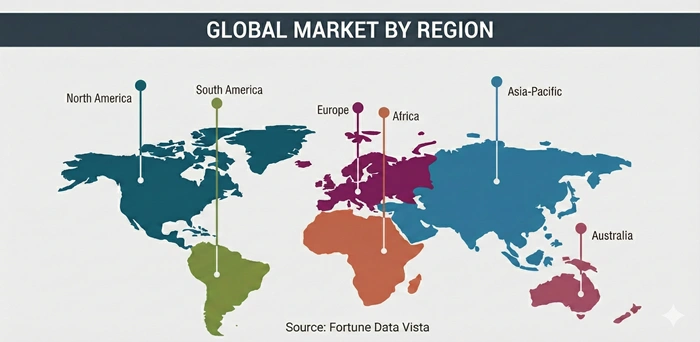
North America commands the leading position in the global PVC pipes market, holding approximately 38% share in 2025, supported by extensive municipal water infrastructure renewal programs, a strong base of established manufacturers, and well-developed distribution networks serving both municipal and residential construction segments. The United States drives the overwhelming majority of regional demand, backed by thousands of active water and sewage infrastructure replacement projects across aging urban and suburban systems. Companies with strong regional presence include JM Eagle, North American Pipe, and Advanced Drainage Systems, each maintaining deep relationships with major municipal utility procurement teams across the country.
Canada also contributes meaningfully to regional demand, supported by ongoing infrastructure modernization and growing residential construction activity across expanding suburban development areas. The region's combination of established manufacturing infrastructure, deep utility procurement relationships, and continuous production capacity expansion ensures North America's leadership position within the PVC pipes market remains firmly intact through the remainder of the forecast period.
Asia Pacific
Rapid Urbanization and Expanding Government Water Infrastructure Investment Position Asia Pacific as the Fastest-Growing Region
Asia Pacific is projected to register the fastest CAGR within the global PVC pipes market through 2033, expanding at a rate near 7.6% as rapid urbanization and expanding government water infrastructure investment create substantial new demand across the region. China and India lead much of this regional growth, supported by rapidly growing residential construction activity and expanding government programs aimed at improving rural and urban water access across both countries. Regional and international manufacturers alike have expanded their presence to serve this growing demand, often establishing local production facilities to improve material affordability and reduce import dependence.
Southeast Asian markets contribute further depth to regional growth, bringing expanding urban populations and growing government investment in municipal water and sewage infrastructure aimed at supporting rapid economic development. Growing government investment in water infrastructure across several Asia Pacific markets continues to accelerate PVC pipes adoption among expanding construction projects alike. This combination of rapid urbanization, rising government investment, and growing residential construction positions Asia Pacific as the clear growth leader within the broader PVC pipes market through the forecast period.
Customization Available for This Report
Region-Specific and Country-Specific Versions of This Report Are Available to Deliver a Sharper, More Localized View of Market Dynamics
This report can be tailored on a region-by-region and country-by-country basis, providing localized market sizing, competitive mapping, and construction demand trend analysis that a global overview alone cannot fully capture.
Clients seeking a more focused breakdown can request a customized version covering any of the following regions and countries, complete with demand forecasting, competitor landscape review, and adoption trend analysis tied specifically to the PVC pipes keyword focus:
North America
-
U.S. — Detailed review of municipal infrastructure renewal and manufacturer investment trends
-
Canada — Coverage of residential construction growth and adoption patterns
-
Mexico — Analysis of emerging infrastructure investment trends
Europe
-
U.K. — Review of infrastructure renewal and regulatory adoption trends
-
Germany — Coverage of manufacturer investment among leading providers
-
France — Insights into piping material adoption and regulatory patterns
-
Italy — Analysis of regional PVC pipes investment trends
-
Rest of Europe — Country-level view of emerging demand across Eastern Europe and the Nordics
Asia Pacific
-
China — Coverage of expanding urbanization and infrastructure material demand
-
India — Analysis of growing government water infrastructure investment
-
Japan — Review of established infrastructure modernization and adoption trends
-
South Korea — Assessment of residential construction investment and adoption
-
Australia — Insights into infrastructure material adoption trends
-
Rest of Asia Pacific — Country-level breakdown covering Thailand, Vietnam, and Indonesia
Latin America
-
Brazil — Coverage of expanding construction access and material adoption
-
Argentina — Analysis of early-stage infrastructure modernization trends
-
Rest of Latin America — Country-level sizing across Colombia, Peru, and Chile
Middle East & Africa
-
UAE — Review of large-scale infrastructure development and material investment trends
-
Saudi Arabia — Coverage of expanding national infrastructure development initiatives
-
Rest of MEA — Country-level view of African water infrastructure expansion
Top Key Players
-
Orbia Advance Corporation (Mexico)
-
Aliaxis Group (Belgium)
-
Georg Fischer AG (Switzerland)
-
JM Eagle Inc (United States)
-
China Lesso Group Holdings Limited (China)
-
Finolex Industries Limited (India)
-
Astral Limited (India)
-
Supreme Industries Limited (India)
-
Prince Pipes and Fittings Limited (India)
-
Sekisui Chemical Co Limited (Japan)
-
Advanced Drainage Systems Inc (United States)
-
Westlake Corporation (United States)
Recent Developments
-
In 2025, Orbia expanded its Wavin piping production capacity across European facilities to support growing water infrastructure demand
-
In 2025, Aliaxis strengthened its regional distribution network across Latin America through targeted acquisitions of local piping manufacturers
-
In 2026, JM Eagle deepened its production capacity in North America to support growing municipal infrastructure renewal projects
-
In 2025, China Lesso broadened its chlorinated PVC production capability to meet rising demand for higher-temperature plumbing applications
-
In 2025, Astral Limited advanced its manufacturing footprint across India through expanded facility investment to serve growing residential construction demand
Market Trends
Regional Adoption Patterns Are Shaping Distinct Growth Trajectories Across the Global PVC Pipes Market
North America Market Trends: Utilities across the region continue favoring smart piping solutions integrated with sensor technology for real-time leak detection, alongside oriented PVC-O formulations offering superior strength and hydraulic performance for aging water networks. Manufacturers are also expanding recycling practices and developing lower-emission formulations to satisfy tightening environmental standards while keeping pace with rising demand from residential construction and modernizing agricultural irrigation systems.
South America Market Trends: Brazil, Colombia, and Peru are rolling out utility-scale water schemes and lead-pipe replacement programs, pushing pipes and fittings to capture the largest share of regional plastic pipe demand. Expanding construction activity combined with growing use of PVC-based medical disposables is broadening the region's overall consumption base, even as economic volatility occasionally slows procurement timelines for larger municipal infrastructure projects.
Europe Market Trends: The region is experiencing a pronounced shift toward circular economy practices, with over 40% of producers now incorporating post-consumer recycled content into their compounding processes to align with the EU's 2030 target of 50% recycled plastic use. Rigid grades continue anchoring the majority of regional demand across pipes, profiles, and fittings, while slow but steadily increasing renewal rates for aging water and wastewater networks provide a stable, non-cyclical source of long-term consumption.
APAC Market Trends: This remains the most dynamic region, with China and India driving substantial volume growth through rapid urbanization and expanding government-backed water infrastructure programs that continue to outpace most other regions in absolute demand terms. Regional manufacturers are increasingly investing in local production capacity and advanced chlorinated formulations to serve rising residential construction and industrial fluid handling requirements across the region's fast-growing urban centers.
MEA Market Trends: Accelerating adoption is tied to large-scale urban development projects across the Gulf Cooperation Council countries, where new residential and commercial construction continues to require extensive plumbing, drainage, and irrigation networks. Growing government investment in water infrastructure modernization across several African nations is further supporting steady uptake of durable, cost-effective piping systems as an alternative to traditional metal networks.
Segments Covered in the Report
By Material Type
-
Rigid PVC
-
Chlorinated PVC
-
Unplasticized PVC
By Application
-
Water Supply and Distribution
-
Sewage and Drainage Systems
-
Agricultural Irrigation
-
Plumbing and HVAC
-
Industrial Fluid Handling
-
Cable Protection and Conduit
By End Use
-
Residential Construction
-
Commercial Construction
-
Municipal and Utilities
-
Industrial and Manufacturing
-
Agriculture
By Region
-
North America (U.S., Canada, Mexico)
-
Europe (U.K., Germany, France, Italy, Rest of Europe)
-
Asia Pacific (China, India, Japan, South Korea, Australia, Rest of Asia Pacific)
-
Latin America (Brazil, Argentina, Rest of Latin America)
-
Middle East & Africa (UAE, Saudi Arabia, Rest of MEA)
❝ Built for Every Level — From Startups to Industry Giants ❞
Here Is Exactly How This Report Works for You
-
For tier 1 companies, investors, and established market leaders, this report delivers detailed competitor revenue analysis, production capacity trend mapping, and geopolitical risk context that support confident decisions around plant expansion, pricing strategy, and long-term positioning within the PVC pipes space
-
For tier 2 and tier 3 companies, startups, and mid-sized providers, this report highlights the most commercially promising application categories and underserved regional opportunities, giving you a practical framework to compete against larger established players without overextending limited resources
-
For every decision maker across the value chain, this report explains exactly how resin price volatility, environmental regulation trends, and competitor capacity expansions are shaping market direction through 2033, equipping you to plan investment and go-to-market decisions with genuine confidence
Frequently Asked Questions:
The global PVC pipes market was valued at USD 52.79 billion in 2025 and is projected to reach USD 85.67 billion by 2033. This growth is driven largely by rising municipal infrastructure renewal and expanding residential construction activity.
Growth in the PVC pipes market is being driven by rising municipal water infrastructure investment alongside expanding residential construction in emerging markets. Growing agricultural irrigation modernization is further reinforcing this expansion.
North America currently leads the PVC pipes market with roughly 38% share, supported by extensive infrastructure renewal programs. Asia Pacific is growing the fastest, driven by rapid urbanization and government water infrastructure investment.
Water supply and distribution applications generate the largest share of revenue in the PVC pipes market, reflecting widespread municipal and residential plumbing use. Chlorinated PVC remains the fastest-growing material segment.
Leading companies in the PVC pipes market include Orbia, Aliaxis, Georg Fischer, JM Eagle, and China Lesso. These companies compete through continuous innovation in production capacity and specialized formulations.