
Quantum Computing in Healthcare Market Overview
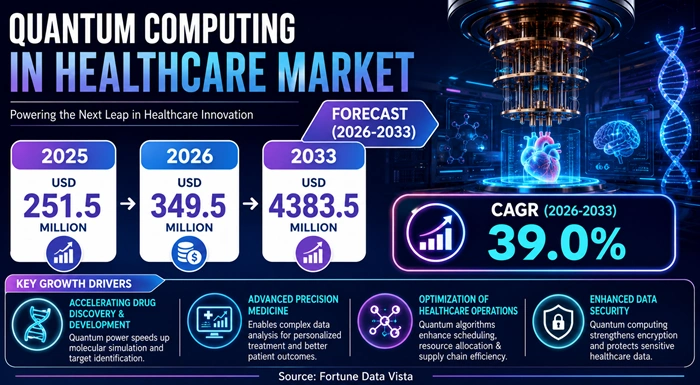
The global quantum computing in healthcare market size is valued at USD 251.5 million in 2025 and is predicted to increase from USD 349.5 million in 2026 to approximately USD 4383.5 million by 2033, growing at a CAGR of 39.0% from 2026 to 2033.
This extraordinary growth trajectory reflects the early but accelerating adoption of quantum computing technologies across pharmaceutical research, medical imaging, genomics, clinical trial optimization, and healthcare cybersecurity — as the healthcare industry begins to recognize that quantum computing's ability to process exponentially complex datasets and simulate molecular systems at unprecedented speed represents a generational leap over classical computing capabilities. The convergence of maturing quantum hardware, growing cloud-based quantum access platforms, and deepening partnerships between quantum technology companies and major pharmaceutical and healthcare organizations is progressively moving the quantum computing in healthcare market from proof-of-concept research toward early commercial deployment.
AI Impact on the Quantum Computing in Healthcare Industry
The Convergence of Artificial Intelligence and Quantum Computing Is Creating Quantum Machine Learning Platforms That Are Accelerating Drug Discovery, Enhancing Diagnostic Imaging Interpretation, and Enabling Real-Time Genomic Data Analysis at a Scale Previously Impossible With Classical Computing in Healthcare*
The integration of artificial intelligence with quantum computing is generating one of the most technically consequential convergence opportunities in the history of healthcare technology — creating quantum machine learning (QML) platforms that combine the pattern recognition power of AI with the exponential computational capacity of quantum processing. Classical AI systems used in drug discovery and genomic analysis are already pushing the boundaries of what conventional computing hardware can handle — processing petabyte-scale molecular simulation datasets, protein interaction networks, and genomic variant databases in training processes that require massive computational resources and weeks of processing time. Quantum computing addresses this limitation directly by enabling AI algorithms to operate on quantum-encoded datasets where superposition and entanglement allow far more information states to be evaluated simultaneously — dramatically reducing the computational time required for the most complex molecular modeling, protein structure prediction, and multi-omics data integration tasks that pharmaceutical researchers need to accelerate drug development pipelines. Companies including IBM, Google Quantum AI, and Microsoft Azure Quantum are actively developing quantum-enhanced machine learning frameworks specifically designed for pharmaceutical and healthcare research workloads — platforms that are beginning to deliver early demonstrations of quantum advantage in specific drug discovery applications.
In medical imaging and diagnostics, AI-quantum hybrid systems are being explored for their potential to accelerate the interpretation of high-dimensional medical imaging datasets — including MRI, CT, PET, and whole slide pathology images — by applying quantum optimization algorithms to image reconstruction and feature extraction tasks that represent significant computational bottlenecks for classical AI diagnostic systems. Quantum annealing approaches are being investigated for their potential to optimize the reconstruction algorithms used in MRI and CT image processing — potentially enabling faster scan processing, lower radiation dose through better signal extraction, and more sensitive early-stage pathology detection than classical AI diagnostic platforms can currently achieve. While full commercial deployment of quantum-enhanced medical imaging AI remains in early-stage development, the rapid maturation of quantum hardware platforms and the growing accessibility of cloud-based quantum computing services through Amazon Braket, IBM Quantum Network, and Google Cloud Quantum AI are progressively bringing these quantum-AI diagnostic capabilities within reach of leading healthcare and academic research organizations.
Growth Factors
Exploding Drug Discovery Complexity Requiring Molecular-Scale Simulation, Genomics Data Growth Overwhelming Classical Computing, Government Quantum Investment Programs, and the Rapid Maturation of Cloud Quantum Access Are the Four Core Structural Drivers of the Quantum Computing in Healthcare Market*
The most compelling and immediate growth driver in the quantum computing in healthcare market is the drug discovery industry's deepening computational crisis — where the molecular complexity of modern therapeutic targets and the scale of genomic and proteomic datasets being analyzed by pharmaceutical researchers is increasingly exceeding the practical capabilities of even the most powerful classical computing clusters. Traditional drug discovery processes require simulating the quantum mechanical behavior of drug molecules interacting with target proteins — a calculation that rapidly becomes intractable for classical computers as molecular complexity grows, requiring approximations that compromise accuracy and lead to high failure rates in clinical drug development. Quantum computers are inherently designed to simulate quantum mechanical systems — making molecular simulation a natural application domain where quantum advantage can be realized even with near-term noisy intermediate-scale quantum (NISQ) devices. Pharmaceutical giants including Roche, Pfizer, Merck, and AstraZeneca are actively investing in quantum computing partnerships with IBM, Google, and specialized quantum software companies to accelerate their computational chemistry and molecular dynamics research programs — treating quantum computing as a strategic priority for long-term pipeline productivity improvement.
The second major growth driver is the explosive growth of genomic and multi-omics data volumes generated by next-generation sequencing and precision medicine programs — creating a data processing demand that is growing faster than classical computing capacity can scale. The genomics industry is sequencing millions of patient genomes annually — generating petabytes of complex variant, expression, and epigenetic data that must be analyzed in combination with clinical, imaging, and phenotypic data to identify the molecular signatures of disease and develop individualized treatment strategies. Quantum computing's ability to handle high-dimensional data correlation problems — through quantum principal component analysis, quantum support vector machines, and variational quantum eigensolver algorithms — offers a potential path to analyzing genomic and multi-omics datasets at the combinatorial scale required for true precision medicine that classical computing cannot practically achieve. Government investment programs including the U.S. National Quantum Initiative, the EU Quantum Flagship program, China's national quantum technology investment, and the UK National Quantum Strategy are providing multi-billion dollar research funding that is accelerating both quantum hardware development and healthcare-specific quantum algorithm research — dramatically shortening the timeline to practical quantum computing applications in healthcare settings.
Market Outlook
North America's Quantum Investment Leadership, Europe's Pharmaceutical-Quantum Partnership Ecosystem, Asia Pacific's Government-Funded Quantum Program Acceleration, and the Democratization of Quantum Access Through Cloud Platforms Are Shaping the Long-Term Trajectory of the Quantum Computing in Healthcare Market*
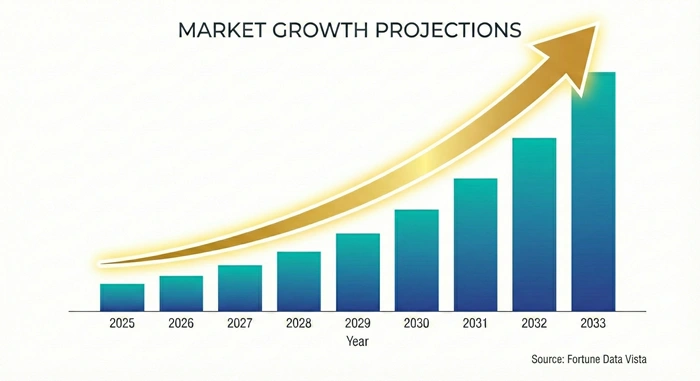
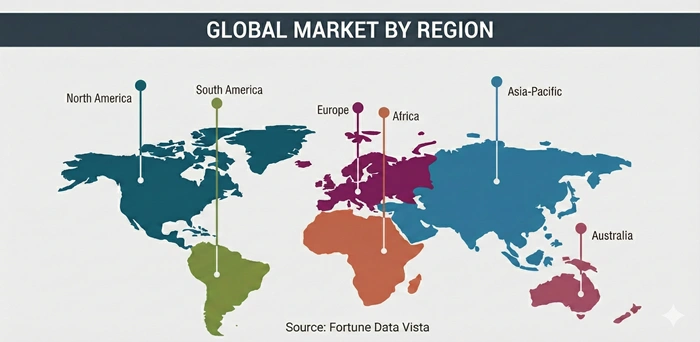
The long-term outlook for the quantum computing in healthcare market is exceptionally bullish — driven by both the extraordinary technological potential of quantum computing for healthcare applications and the rapidly accelerating investment commitment from governments, pharmaceutical companies, and healthcare technology organizations globally that is moving quantum computing from experimental research toward practical clinical and pharmaceutical deployment. North America currently dominates the global market, accounting for approximately 43.2% of global revenue in 2025, anchored by the United States' world-leading quantum technology ecosystem — home to IBM Quantum, Google Quantum AI, Microsoft Azure Quantum, IonQ, Rigetti Computing, and D-Wave Systems — and the largest pharmaceutical R&D investment of any country globally, creating the most favorable environment for quantum-healthcare research partnerships and early commercial deployments. The United States' National Quantum Initiative Act and its associated funding through the National Science Foundation, DARPA, and the National Institutes of Health is sustaining a pipeline of quantum healthcare research projects that is expected to yield the first FDA-approved quantum-assisted drug candidates within the forecast period.
Europe and Asia Pacific both represent powerful growth vectors in the quantum computing in healthcare market — though each for different reasons. Europe's strength lies in its world-leading pharmaceutical industry — anchored by Roche, Novartis, AstraZeneca, Bayer, and Sanofi — which is actively engaging quantum computing platforms through research partnerships with IBM, Google, and European quantum companies including IQM Quantum Computers and Quantinuum. Japan, China, South Korea, and Australia are each advancing government-funded national quantum programs that include specific healthcare and life sciences applications — and China's aggressive national quantum technology investment plan positions Asia Pacific as potentially the fastest-growing regional market in the quantum computing in healthcare market over the 2026–2033 forecast period. The progressive democratization of quantum computing access through cloud platforms — including Amazon Braket, IBM Quantum Network, Microsoft Azure Quantum, and Google Cloud Quantum AI — is critically important for market growth because it removes the need for healthcare organizations to purchase and operate quantum hardware directly, instead allowing pharmaceutical researchers, hospital systems, and academic research institutions to access quantum computing power on a pay-per-use basis that dramatically lowers the cost and technical barrier to entry.
Expert Speaks
-
"IBM's quantum computing platform is creating real, demonstrable value in pharmaceutical research and healthcare data analysis today — and we believe we are at an inflection point where quantum advantage in drug discovery molecular simulation and genomic data processing will move from academic demonstrations to commercial pharmaceutical deployments within this decade. The quantum computing in healthcare market is growing at a pace that reflects the genuine urgency with which pharmaceutical and healthcare organizations are seeking computational breakthroughs to address the drug discovery productivity crisis, the precision medicine data challenge, and the cybersecurity vulnerabilities of current healthcare digital infrastructure. IBM Quantum Network's growing community of pharmaceutical and healthcare partners is the clearest signal that the industry sees quantum computing as a transformational technology for healthcare, not a distant future promise." — Arvind Krishna, Chairman & CEO, IBM Corporation
-
"Google's quantum computing program is advancing at a pace that is bringing the practical realization of quantum advantage in healthcare and life sciences applications significantly closer than most industry observers anticipated just three years ago. Our Sycamore quantum processor and its successors are demonstrating capability improvements that are translating directly into more accurate molecular simulation results, more powerful quantum machine learning algorithms, and new quantum optimization approaches that are already being applied to protein folding and drug-target interaction problems in collaboration with our pharmaceutical research partners. The quantum computing in healthcare market represents one of the most socially important application domains for quantum technology — where quantum advantage translates not just into business value but into faster drug development, better diagnostics, and improved patient outcomes globally." — Sundar Pichai, CEO, Alphabet Inc. (Google)
-
"Microsoft's approach to quantum computing in healthcare is built on our belief that fault-tolerant quantum computing — enabled by topological qubit technology — will ultimately deliver the level of quantum computational power needed for the most complex drug discovery and genomic analysis problems that cannot be addressed by near-term NISQ devices. Azure Quantum is providing our pharmaceutical and healthcare customers with a hybrid quantum-classical computing platform that delivers value today through quantum-inspired optimization algorithms while the hardware matures toward fault-tolerant capability. The quantum computing in healthcare market is progressing rapidly, and Microsoft's integrated quantum technology stack — from hardware to software to cloud access — is designed to ensure that our healthcare and life sciences customers are positioned to capture quantum advantage as it becomes available across an expanding range of clinical and research applications." — **Satya Nadella, Chairman & CEO, Microsoft Corporation*
Key Report Takeaways
-
North America leads the global quantum computing in healthcare market with approximately 43.2% of global revenue in 2025, driven by the United States' world-leading concentration of quantum technology companies including IBM Quantum, Google Quantum AI, Microsoft Azure Quantum, IonQ, Rigetti Computing, and D-Wave Systems; the world's largest pharmaceutical R&D investment ecosystem with deep quantum research partnerships across Pfizer, Merck, Eli Lilly, and AbbVie; and substantial government funding through the National Quantum Initiative, NIH, and DARPA that is sustaining a robust pipeline of quantum healthcare applications in drug discovery, genomics, medical imaging, and healthcare cybersecurity.
-
Asia Pacific is the fastest-growing regional market in the quantum computing in healthcare market, projected to expand at a CAGR of approximately 42.1% from 2026 to 2033, driven by China's massive national quantum computing investment program, Japan's advanced quantum research ecosystem including Fujitsu's quantum simulator leadership, South Korea's expanding quantum pharmaceutical collaborations, and India's emerging quantum technology national mission that is beginning to attract international quantum-healthcare research partnerships and venture investment.
-
Drug discovery and development is the dominant application segment, accounting for approximately 36.4% of global application revenue in 2025, as pharmaceutical companies are the most technically prepared and financially motivated early adopters of quantum computing for molecular simulation, computational chemistry, and target-drug interaction modeling — with leading players including IBM, Google, and D-Wave actively partnering with Roche, Pfizer, Merck, and Novartis on quantum-accelerated drug discovery programs.
-
Pharmaceutical and biotechnology companies are the dominant end-user segment, contributing approximately 41.8% of global end-user revenue in 2025, because the pharmaceutical industry faces the clearest and most quantifiable computational bottleneck — drug discovery molecular simulation — that quantum computing can directly address, creating the strongest near-term commercial pull for quantum computing investment in healthcare of any end-user segment.
-
Cloud-based deployment is the fastest-growing deployment mode, expected to expand at a CAGR of approximately 41.5% from 2026 to 2033, as IBM Quantum Network, Amazon Braket, Google Cloud Quantum AI, and Microsoft Azure Quantum democratize access to quantum processing power for pharmaceutical researchers, hospital systems, and academic institutions who cannot afford or justify the capital cost of on-premise quantum hardware — making cloud-based quantum-as-a-service the primary commercial deployment model for the healthcare market.
-
Genomics and personalized medicine is the fastest-growing application segment within the quantum computing in healthcare market, projected to grow at a CAGR of approximately 43.7% from 2026 to 2033, driven by the exponential growth of multi-omics data volumes that are overwhelming classical computing capabilities in precision medicine research — and by the growing recognition that quantum computing's ability to handle high-dimensional biological data correlation problems offers a genuine path to realizing the full promise of individualized genomic medicine.
Market Scope
| Parameter | Details |
|---|---|
| Market Size by 2033 | USD 4383.5 Million | Market Size by 2026 | USD 349.5 Million | Market Size by 2025 | USD 251.5 Million | Market Growth Rate from 2026 to 2033 | CAGR of 39.0% | Dominating Region | North America | Fastest Growing Region | Asia Pacific | Segments Covered | By Offering, By Deployment Mode, By Application, By End User | Regions Covered | North America, Europe, Asia Pacific, Latin America, Middle East & Africa |
Market Dynamics
Drivers Impact Analysis
Pharmaceutical Molecular Simulation Demand, Genomics Data Explosion, Government Quantum Investment Programs, Cloud Quantum Access Democratization, and Healthcare Cybersecurity Requirements Are the Five Primary Engines Driving the Quantum Computing in Healthcare Market*
| Driver | ≈ % Impact on CAGR Forecast | Geographic Relevance | Impact Timeline |
|---|---|---|---|
| Drug discovery molecular simulation demand exceeding classical computing limits | ~33% | North America, Europe | Short to Long Term |
| Genomics and multi-omics data volume growth requiring quantum-scale processing | ~27% | North America, Europe, Asia Pacific | Short to Long Term |
| Government national quantum investment programs and healthcare research funding | ~22% | Global | Short to Long Term |
| Cloud-based quantum access democratization through Amazon, IBM, Google, Microsoft | ~13% | Global | Short to Medium Term |
| Quantum-secure cryptography demand for healthcare data protection | ~5% | North America, Europe | Medium to Long Term |
The drug discovery productivity crisis is the most immediate and commercially significant driver of quantum computing adoption in healthcare. Modern drug development has become one of the most computationally intensive research disciplines in science — requiring the accurate quantum mechanical simulation of drug molecule behavior, binding affinity to disease target proteins, off-target interaction profiles, and pharmacokinetic properties in increasingly complex molecular systems that classical computers can only approximate. Quantum computers can in principle simulate these molecular quantum mechanical interactions exactly — removing the approximation errors that cause promising drug candidates to fail in clinical trials despite positive computational predictions. Major pharmaceutical companies are investing in quantum computing research not as speculative technology exploration, but as a strategic response to their documented drug development productivity challenge — where it now takes an average of over USD 2.5 billion and more than 12 years to bring a new drug from discovery to market approval, with approximately 90% of clinical-stage drug candidates failing. The quantum computing in healthcare market is benefiting directly from this pharmaceutical industry investment imperative, as companies seek any computational advantage that could improve drug candidate success rates and shorten development timelines.
Government investment programs are the second critical demand catalyst in the quantum computing in healthcare market — providing the sustained research funding and technology development ecosystem that is accelerating quantum hardware progress and reducing the timeline to practical healthcare applications. The U.S. National Quantum Initiative has committed over USD 1.8 billion to quantum research across federal agencies including NIST, NSF, DOE, and NIH — with specific programs targeting quantum computing applications in drug discovery, medical imaging AI, and genomic data analysis. The EU Quantum Flagship has committed EUR 1 billion to quantum technology development, with life sciences applications explicitly included in the research agenda. China has invested an estimated USD 15 billion in national quantum computing infrastructure — with applications in pharmaceutical research and national healthcare data analytics among the stated strategic priorities. These government investment programs are creating the fundamental technology infrastructure — quantum hardware, error correction algorithms, quantum software development kits, and quantum talent pipelines — upon which the commercial quantum computing in healthcare market is being built.
Restraints Impact Analysis
Technical Immaturity of Current NISQ Hardware, High Implementation Cost, Shortage of Quantum Computing Expertise in Healthcare, and Regulatory Uncertainty for Quantum-Derived Clinical Data Are the Primary Barriers Restraining Faster Market Growth*
| Restraint | ≈ % Impact on CAGR Forecast | Geographic Relevance | Impact Timeline |
|---|---|---|---|
| Technical immaturity and high error rates of current NISQ quantum hardware | ~42% | Global | Short to Medium Term |
| Prohibitive capital cost of on-premise quantum computing systems | ~28% | Emerging markets, smaller organizations | Short to Long Term |
| Critical shortage of quantum computing expertise in healthcare and pharma | ~20% | Global | Short to Long Term |
| Regulatory uncertainty for quantum-derived drug discovery and diagnostic data | ~10% | North America, Europe | Short to Medium Term |
The most fundamental restraint on the quantum computing in healthcare market is the technical immaturity of current quantum hardware — particularly the high gate error rates and short coherence times of today's noisy intermediate-scale quantum (NISQ) devices, which limit the circuit depth and computational reliability of quantum algorithms that can be executed on available hardware. Current quantum processors from IBM, Google, IonQ, and Rigetti can run circuits with dozens to hundreds of qubits, but the accumulated error rates in complex quantum circuits restrict the size and complexity of molecular simulations and optimization problems that can be solved reliably — meaning that the most commercially important quantum healthcare applications such as accurate large-molecule drug discovery simulations remain beyond the practical reach of available hardware and require the development of fault-tolerant quantum computers that are still years away from commercial realization. This hardware maturity gap is the primary reason why quantum computing in healthcare remains primarily in proof-of-concept and early research deployment phases — and why the market's extraordinary forecast growth rates reflect the expected acceleration of commercial adoption as hardware capabilities improve toward fault tolerance.
The shortage of professionals with both quantum computing expertise and healthcare or pharmaceutical domain knowledge is a structural talent constraint that is slowing the practical deployment of quantum computing solutions in clinical and research settings. Quantum algorithm developers, quantum software engineers, and computational chemists with quantum programming skills are extremely scarce globally — with academic programs producing only a small fraction of the quantum talent needed to support the industry's ambitions. Healthcare organizations seeking to deploy quantum computing solutions face a dual challenge of recruiting quantum expertise and ensuring that quantum practitioners understand the specific biological, chemical, and clinical requirements of healthcare applications — a combination of skills that is extremely rare in the current talent market. While bootcamps, university program expansions, and vendor-provided quantum developer training programs are beginning to expand the talent pipeline, the quantum expertise shortage is expected to remain a meaningful constraint on the pace of quantum computing adoption in healthcare organizations through the mid-2020s.
Opportunities Impact Analysis
Fault-Tolerant Quantum Hardware Maturation, Quantum Drug Discovery Commercial Deployment, Quantum-Secure Healthcare Cryptography, and Emerging Market Quantum Research Investment Are Creating Transformational Long-Term Opportunities*
| Opportunity | ≈ % Impact on CAGR Forecast | Geographic Relevance | Impact Timeline |
|---|---|---|---|
| Maturation of fault-tolerant quantum hardware unlocking advanced drug discovery | ~36% | North America, Europe | Medium to Long Term |
| Commercial quantum drug discovery partnerships between pharma and quantum vendors | ~28% | North America, Europe | Short to Long Term |
| Quantum-secure encryption for healthcare data and EHR protection | ~22% | Global | Medium to Long Term |
| Emerging market national quantum investment creating new research ecosystems | ~14% | Asia Pacific, Middle East | Short to Long Term |
The progression from today's noisy intermediate-scale quantum devices toward fault-tolerant quantum computers — where quantum error correction allows arbitrarily deep quantum circuits to run with high fidelity — represents the most transformational near-term technology opportunity in the quantum computing in healthcare market. Error-corrected, fault-tolerant quantum computers will unlock molecular simulation capabilities at the scale of full drug-target systems with thousands of atoms — enabling pharmaceutical researchers to accurately predict drug efficacy, selectivity, and toxicity from first principles before any experimental synthesis or testing. This capability would represent a true paradigm shift in drug discovery — transforming a primarily empirical, high-failure-rate process into a computationally guided science where the most promising drug candidates are identified with far higher confidence before entering expensive clinical development programs. IBM's roadmap toward fault-tolerant quantum computing, Google's quantum error correction milestones, and Microsoft's topological qubit program are all advancing along timelines that suggest fault-tolerant quantum computing may begin to be commercially available for pharmaceutical research applications within the 2026–2033 forecast period — creating the potential for market-shaping commercial deployment of quantum drug discovery capabilities that would dramatically accelerate the quantum computing in healthcare market's growth rate.
The growing threat of quantum computing to current healthcare data encryption standards represents a simultaneous restraint and an opportunity within the quantum computing in healthcare market. Large-scale quantum computers will eventually be capable of breaking widely used public-key encryption algorithms including RSA and ECC — creating a "harvest now, decrypt later" threat where adversaries collect encrypted healthcare data today to decrypt once quantum computers become powerful enough. This quantum cryptography threat is already being recognized by U.S. NIST (which published its first post-quantum cryptography standards in 2024) and by leading healthcare and pharmaceutical organizations as a critical infrastructure security priority — driving investment in quantum-resistant cryptography solutions and quantum key distribution networks that protect healthcare data against both near-term and long-term quantum computing threats. Healthcare cybersecurity companies including ID Quantique, Quantinuum (Cambridge Quantum Computing + Honeywell Quantum Solutions), and IBM Quantum Safe are well positioned to generate growing revenue from healthcare cybersecurity quantum solutions — creating a meaningful and commercially immediate revenue segment within the broader quantum computing in healthcare ecosystem.
Segment Analysis
By Application: Drug Discovery and Development
Drug Discovery and Development Is the Dominant and Most Commercially Advanced Application in the Quantum Computing in Healthcare Market, Driven by Pharmaceutical Companies' Urgent Need for Computational Breakthroughs That Can Address the Industry's Drug Development Productivity Crisis*
Drug discovery and development holds the commanding position in the quantum computing in healthcare market by application, accounting for approximately 36.4% of global application revenue in 2025 and growing at a CAGR of approximately 38.6% from 2026 to 2033. Quantum computing's ability to simulate molecular quantum mechanical interactions with a precision that classical computers cannot match makes it uniquely suited to the computational chemistry and molecular dynamics challenges at the heart of modern pharmaceutical research. The major pharmaceutical applications of quantum computing in this segment include molecular energy calculation for drug-target binding affinity prediction, de novo drug design through quantum optimization of molecular structure searches, prediction of ADMET (absorption, distribution, metabolism, excretion, and toxicity) properties using quantum machine learning models, and quantum-accelerated virtual screening of vast compound libraries against disease targets. North America leads the drug discovery and development application segment, accounting for approximately 45.3% of global segment revenue in 2025, where companies including IBM Quantum, Google Quantum AI, and Microsoft Azure Quantum are actively partnering with major pharmaceutical clients including Pfizer, Merck, AstraZeneca, and Eli Lilly on quantum molecular simulation and drug design research programs.
Europe is the second-largest market for quantum drug discovery and development applications, driven by the region's world-leading pharmaceutical industry — including Roche, Novartis, AstraZeneca, Bayer, Sanofi, and UCB — which collectively invest over EUR 40 billion annually in pharmaceutical R&D and are actively integrating quantum computing into their computational drug discovery workflows. European quantum companies including Quantinuum (headquartered in Cambridge, UK), IQM Quantum Computers (Finland), and Multiverse Computing (Spain) are providing specialized pharmaceutical quantum software platforms that are enabling European pharmaceutical companies to access quantum chemistry simulation capabilities tailored to their specific drug development pipeline needs. Asia Pacific is the fastest-growing regional market for quantum drug discovery applications, expanding at a CAGR of approximately 43.2% from 2026 to 2033 — driven by China's national pharmaceutical and quantum technology investment programs, Japan's Fujitsu quantum simulator pharmaceutical research partnerships, and South Korea's growing quantum pharma collaboration ecosystem — positioning Asia Pacific as an increasingly important contributor to global quantum drug discovery research activity that will progressively increase the region's share of this critical application segment in the quantum computing in healthcare market.
By End User: Pharmaceutical and Biotechnology Companies
Pharmaceutical and Biotechnology Companies Are the Dominant End-User Segment in the Quantum Computing in Healthcare Market, Representing the Industry's Most Commercially Prepared, Technically Sophisticated, and Financially Motivated Early Adopters of Quantum Technology*
Pharmaceutical and biotechnology companies hold the dominant position in the quantum computing in healthcare market by end user, contributing approximately 41.8% of global end-user revenue in 2025 and growing at a CAGR of approximately 39.8% from 2026 to 2033. The pharmaceutical industry's fundamental research challenges — particularly molecular simulation accuracy, multi-target drug optimization, and genomic data analysis at clinical-trial population scale — align directly with quantum computing's most credible near-term application advantages, making pharmaceutical companies the most motivated and most commercially prepared adopters of quantum computing platforms. Global pharmaceutical leaders including Roche, AstraZeneca, Pfizer, Merck KGaA, Boehringer Ingelheim, and Bayer have all established dedicated quantum computing research programs — either through direct partnerships with quantum hardware vendors or through specialized quantum software companies — that are progressing from exploratory benchmarking toward early-stage integration into computational drug discovery workflows. North America leads the pharmaceutical and biotech end-user segment, accounting for approximately 46.1% of global segment revenue in 2025, as the United States hosts both the world's largest pharmaceutical R&D investment and the world's most comprehensive quantum technology ecosystem — creating the most direct pathway for quantum computing commercial deployment in drug discovery applications.
Biotechnology companies represent the fastest-growing sub-segment within the pharmaceutical and biotech end-user category — where venture-backed startups and specialty biologics developers are using cloud-based quantum computing access to apply quantum algorithms to novel protein-drug interaction modeling, antibody structure optimization, and mRNA therapeutic design problems that are central to the most innovative and fastest-growing areas of modern pharmaceutical development. Companies including Zapata Computing, QC Ware, and 1QBit are providing purpose-built quantum pharmaceutical software platforms that enable biotech companies to access quantum-accelerated computational chemistry through intuitive cloud interfaces — lowering the technical barrier to quantum computing adoption for biotech organizations that lack the internal quantum expertise of larger pharmaceutical companies. Europe and Asia Pacific are both growing strongly in pharmaceutical and biotech quantum computing adoption — driven by their large and innovative pharmaceutical industries and by the expanding availability of cloud-based quantum computing platforms that make quantum technology accessible to pharmaceutical organizations of all sizes across all major regions.
Regional Insights
North America: The Global Leader in Quantum Computing in Healthcare
North America Dominates the Quantum Computing in Healthcare Market With the World's Most Advanced Quantum Technology Ecosystem, the Largest Pharmaceutical R&D Investment, and the Deepest Integration of Quantum Computing Into Healthcare Research Programs*
North America holds the dominant position in the global quantum computing in healthcare market, accounting for approximately 43.2% of global revenue in 2025 and expected to maintain a CAGR of approximately 38.2% through 2033. The United States is the undisputed global leader in quantum computing technology development — hosting IBM Quantum (New York), Google Quantum AI (California), Microsoft Azure Quantum (Washington), IonQ (Maryland), Rigetti Computing (California), D-Wave Systems (Canada/U.S.), and dozens of specialized quantum software companies that collectively form the world's most advanced quantum technology commercial ecosystem. This quantum technology concentration intersects with the world's largest pharmaceutical R&D ecosystem — where U.S. pharmaceutical giants including Pfizer, Merck & Co., Eli Lilly, AbbVie, and Bristol-Myers Squibb collectively invest over USD 100 billion annually in drug research — creating the most commercially fertile environment for quantum-pharmaceutical research partnerships and early-stage commercial deployment of quantum computing in healthcare of any global region.
Canada is an important contributor to North American quantum computing in healthcare — with D-Wave Systems headquartered in Burnaby, British Columbia providing quantum annealing hardware to pharmaceutical and healthcare optimization research programs, and the University of Waterloo's Institute for Quantum Computing being one of the world's leading academic quantum research centers. The U.S. National Quantum Initiative and its successor programs, along with NIH quantum computing research grants and DARPA quantum biology programs, are sustaining a robust pipeline of federally funded quantum healthcare research that is creating the talent, the algorithms, and the validated use cases needed to support accelerating commercial adoption. North America's early and deep commitment to quantum computing investment across both the public and private sectors positions the region to maintain market leadership in quantum computing in healthcare through the entire 2026–2033 forecast period and beyond.
Asia Pacific: The Fastest-Growing Region in Quantum Computing in Healthcare
Asia Pacific Is the Fastest-Growing and Most Strategically Ambitious Regional Market for Quantum Computing in Healthcare, Driven by China's Massive National Quantum Investment, Japan's Advanced Research Ecosystem, and India's Emerging Quantum Mission*
Asia Pacific is the fastest-growing regional market in the global quantum computing in healthcare market, projected to expand at a CAGR of approximately 42.1% from 2026 to 2033, the highest regional growth rate globally. The region accounts for approximately 21.8% of global quantum computing in healthcare market revenue in 2025 and is expected to capture a significantly larger global revenue share by 2033 as national quantum investments mature into commercial healthcare deployments. China is the primary regional growth driver — where an estimated USD 15 billion in national quantum computing investment is funding quantum hardware development, quantum algorithm research, and pharmaceutical quantum computing applications at national research institutions including the University of Science and Technology of China, Tsinghua University, and the Chinese Academy of Sciences, while domestic quantum companies including Origin Quantum Computing Technology (本源量子) and SpinQ are developing accessible quantum computing platforms for pharmaceutical and life sciences research applications.
Japan is the most commercially advanced Asia Pacific market for quantum computing in healthcare — where Fujitsu's quantum simulator technology has been applied to pharmaceutical molecular simulation problems in collaboration with Merck KGaA and other pharmaceutical research partners, and where the National Institute of Advanced Industrial Science and Technology (AIST) is developing quantum computing algorithms for genomic medicine and protein structure prediction. South Korea's major pharmaceutical companies including Samsung Biologics, Celltrion, and Hanmi Pharmaceutical are beginning to explore quantum computing applications for their biosimilar and novel pharmaceutical research programs — creating growing domestic demand for quantum computing services that is attracting both domestic and international quantum technology providers. India's National Quantum Mission — with its INR 6000 crore (approximately USD 730 million) commitment over eight years — is building the academic and industrial quantum research ecosystem that is expected to translate into meaningful pharmaceutical and healthcare quantum computing adoption in the Indian market within the 2026–2033 forecast period.
Top Key Players
-
IBM Corporation (United States)
-
Google LLC (Google Quantum AI) (United States)
-
Microsoft Corporation (Azure Quantum) (United States)
-
Amazon Web Services Inc. (Amazon Braket) (United States)
-
IonQ Inc. (United States)
-
Rigetti Computing Inc. (United States)
-
D-Wave Quantum Inc. (Canada)
-
Quantinuum Ltd. (United Kingdom / United States)
-
Fujitsu Limited (Japan)
-
Origin Quantum Computing Technology Co. Ltd. (China)
-
QC Ware Corp. (United States)
-
Zapata Computing Inc. (United States)
Recent Developments
-
In February 2026, IBM unveiled its next-generation quantum processor architecture featuring 1386 qubits with significantly improved error rates compared to its predecessor — a development that brings IBM closer to achieving the fault-tolerant quantum computing milestones necessary for pharmaceutical-grade molecular simulation, with IBM announcing expanded quantum research partnerships with Pfizer and AstraZeneca focused on applying the new processor architecture to drug-target binding affinity calculations for their respective oncology pipeline programs.
-
In January 2026, IonQ announced a formal research partnership with a leading U.S. academic medical center to apply IonQ's trapped-ion quantum computing platform to genomic data analysis problems in precision oncology — developing quantum machine learning algorithms for identifying predictive biomarkers in large-scale cancer patient genomic and clinical datasets, with the partnership representing one of the first quantum computing deployments directly within a clinical healthcare research environment in North America.
-
In November 2025, Quantinuum released its System Model H2 quantum processor with 56 fully connected qubits and the highest two-qubit gate fidelity of any commercially available quantum hardware — simultaneously announcing an expanded pharmaceutical research program with Merck KGaA, Roche, and Boehringer Ingelheim focused on quantum chemistry simulations for early-stage drug discovery molecular modeling across multiple therapeutic areas.
-
In October 2025, Google Quantum AI published landmark research in Nature demonstrating quantum error correction performance using its Willow chip that achieved exponential reduction of logical error rates as more qubits were added — a scientific milestone widely recognized as a critical step toward practical fault-tolerant quantum computing, with immediate implications for the timeline to quantum advantage in pharmaceutical molecular simulation and the broader quantum computing in healthcare market.
-
In March 2026, Microsoft launched Azure Quantum Elements — a specialized cloud platform combining quantum-inspired optimization, classical high-performance computing, and early quantum hardware access specifically designed for pharmaceutical and materials science research workflows — providing pharmaceutical researchers with an integrated computational chemistry platform that enables seamless transition from classical to quantum computing as hardware capabilities advance, with early adopters including Novartis and Bayer evaluating the platform for integration into their computational drug discovery pipelines.
Market Trends
The Convergence of Quantum Computing With Classical AI Creating Quantum-AI Hybrid Platforms and the Rapid Progress Toward Fault-Tolerant Quantum Hardware Are the Two Defining Trends Reshaping the Quantum Computing in Healthcare Market*
The most strategically significant commercial trend in the quantum computing in healthcare market is the development and rapid adoption of quantum-classical hybrid computing platforms — where quantum processing units handle specific high-value computational tasks (molecular energy calculations, combinatorial optimization, quantum machine learning) while classical computers handle data preprocessing, workflow management, and post-processing — creating practical value from today's NISQ hardware without waiting for full fault-tolerant quantum capability. IBM's Qiskit Runtime, Microsoft's Azure Quantum optimization solvers, and specialized pharmaceutical quantum platforms from QC Ware and 1QBit are all implementing hybrid quantum-classical architectures that are enabling pharmaceutical researchers to extract measurable computational advantages from current quantum hardware in specific drug discovery tasks while the hardware progresses toward the fault-tolerant capability needed for the most demanding applications. This hybrid approach is critical for the near-term commercial development of the quantum computing in healthcare market — because it generates real, defensible commercial value from existing quantum technology investment while creating the organizational capabilities and quantum expertise pipelines that will be needed to capture the transformational value of fault-tolerant quantum computing when it becomes available.
The dramatic hardware progress milestone demonstrated by Google's Willow chip in late 2025 — where logical error rates decreased exponentially as the number of physical qubits per logical qubit was increased — has accelerated the entire industry's timeline expectations for fault-tolerant quantum computing and is generating a new wave of investment and partnership activity in the quantum computing in healthcare market. Pharmaceutical companies that had been taking a "wait and see" approach to quantum computing investment — pending clearer evidence of the hardware maturation trajectory — are now revisiting their quantum strategies with greater urgency, recognizing that the window for building quantum computing expertise and establishing first-mover partnerships with leading quantum vendors is narrowing. This hardware progress milestone is expected to catalyze a new wave of pharmaceutical-quantum research partnerships and quantum computing platform procurement decisions across the healthcare and life sciences industry in 2026 and 2027 — contributing meaningfully to the acceleration of the quantum computing in healthcare market's commercial growth rate during the near-term portion of the forecast period.
Segments Covered in the Report
-
By Offering:
-
Hardware
-
Quantum Processors
-
Quantum Memory
-
Quantum Network Equipment
-
-
Software
-
Quantum Development Platforms
-
Quantum Simulation Software
-
Quantum Machine Learning Software
-
-
Services
-
Consulting & Advisory Services
-
Quantum-as-a-Service (QaaS)
-
Integration & Deployment Services
-
Training & Support Services
-
-
-
By Deployment Mode:
-
On-Premise
-
Cloud-Based
-
Hybrid
-
-
By Application:
-
Drug Discovery & Development
-
Medical Imaging & Diagnostics
-
Genomics & Personalized Medicine
-
Clinical Trial Optimization
-
Protein Folding & Molecular Simulation
-
Healthcare Operations Optimization
-
Cybersecurity in Healthcare
-
Other Applications
-
-
By End User:
-
Pharmaceutical & Biotechnology Companies
-
Hospitals & Healthcare Providers
-
Research & Academic Institutions
-
Government & Defense Healthcare Organizations
-
Diagnostic Imaging Centers
-
Insurance & Healthcare Payers
-
Contract Research Organizations (CROs)
-
-
By Region:
-
North America (U.S., Canada, Mexico)
-
Europe (Germany, UK, France, Switzerland, Rest of Europe)
-
Asia Pacific (China, India, Japan, South Korea, Australia, Rest of Asia Pacific)
-
Latin America (Brazil, Argentina, Rest of Latin America)
-
Middle East & Africa (UAE, Saudi Arabia, Israel, Rest of MEA)
-
"Built for Every Level — From Startups to Industry Giants"
Here Is Exactly How This Report Works for You
-
For Tier 1 global pharmaceutical conglomerates, major quantum technology companies, Fortune 500 healthcare systems, sovereign wealth funds and institutional investors, and senior technology and R&D strategy executives, this report delivers comprehensive competitor revenue analysis by application, offering, and geography; deep intelligence on how geopolitical factors — including U.S.-China quantum technology competition and export restrictions on quantum hardware, EU Quantum Flagship funding allocation priorities for healthcare applications, China's national pharmaceutical quantum investment program, and NIST post-quantum cryptography standard implications for healthcare data security investment — are reshaping technology roadmaps, partnership strategies, and capital allocation in the quantum computing in healthcare market, providing the market intelligence needed for confident decisions on quantum technology investment, partnership prioritization, and competitive positioning.
-
For Tier 2 and Tier 3 quantum software companies, specialized pharmaceutical informatics vendors, healthcare IT system integrators, mid-market biotech companies, and regional quantum technology distributors, this report provides granular segment demand forecasts, end-user adoption velocity analysis, technology readiness timeline intelligence, and competitive landscape intelligence that reveals where the most commercially accessible revenue opportunities exist for companies seeking to build quantum computing in healthcare product lines, service practices, or distribution partnerships — enabling precise alignment of investment and commercialization strategy with the application segments and customer segments generating the fastest-growing demand in the evolving quantum healthcare ecosystem.
-
For quantum computing startups, university quantum spinout ventures, healthcare AI companies exploring quantum enhancement, clean-slate quantum drug discovery companies, and early-stage investors, this report delivers actionable competitive white space analysis identifying underserved application categories and geographies in the quantum computing in healthcare market; detailed profiling of the revenue models, commercial strategies, and technical differentiation approaches of the market's established leaders; regulatory landscape assessment for quantum-derived clinical and research data; and forward-looking scenario analysis of how fault-tolerant quantum hardware maturation will reshape competitive dynamics — providing the market intelligence needed to build differentiated, investable quantum healthcare business strategies that can succeed against both incumbent technology giants and specialist quantum competitors.
Frequently Asked Questions:
Answer: The global quantum computing in healthcare market is valued at USD 251.5 million in 2025 and is projected to reach USD 4383.5 million by 2033, growing at a CAGR of 39.0% from 2026 to 2033. This exceptional growth is driven by accelerating pharmaceutical quantum computing partnerships, growing genomics data complexity, government quantum investment programs, and the democratization of quantum access through cloud platforms.
Answer: The quantum computing in healthcare market spans applications including drug discovery and molecular simulation, medical imaging and diagnostics enhancement, genomics and personalized medicine, clinical trial optimization, protein folding simulation, healthcare operations optimization, and quantum-secure cybersecurity for patient data protection. Drug discovery and development is currently the dominant and most commercially advanced application, accounting for approximately 36.4% of global application revenue in 2025.
Answer: Leading players in the quantum computing in healthcare market include IBM, Google Quantum AI, Microsoft Azure Quantum, Amazon Braket (AWS), IonQ, Rigetti Computing, D-Wave Quantum, Quantinuum, Fujitsu, Origin Quantum, QC Ware, and Zapata Computing. These companies compete on qubit count and fidelity, quantum algorithm development, cloud platform accessibility, and healthcare-specific application partnerships with pharmaceutical and healthcare organizations.
Answer: The primary restraints in the quantum computing in healthcare market include the technical immaturity and high error rates of current NISQ quantum hardware that limit the size and reliability of healthcare quantum algorithms, the severe shortage of professionals combining quantum computing expertise with pharmaceutical or healthcare domain knowledge, and the high cost of on-premise quantum systems that limits access to well-resourced organizations. Regulatory uncertainty regarding the validation and FDA/EMA acceptance of quantum-derived drug discovery data is an additional near-term adoption barrier.
Answer: Quantum computing in healthcare drug discovery applications offer the potential to simulate molecular quantum mechanical interactions with accuracy that classical computers cannot achieve — enabling pharmaceutical researchers to predict drug-target binding affinities, ADMET properties, and molecular structure-activity relationships from first principles rather than from approximations that lead to high clinical trial failure rates. The commercialization of fault-tolerant quantum computers over the 2026–2033 forecast period is expected to make quantum molecular simulation routinely available to pharmaceutical researchers — transforming drug discovery from a primarily empirical process into a computationally guided science that could dramatically improve pipeline productivity and reduce the USD 2.5 billion average cost of new drug development.