
Resistor Market Overview
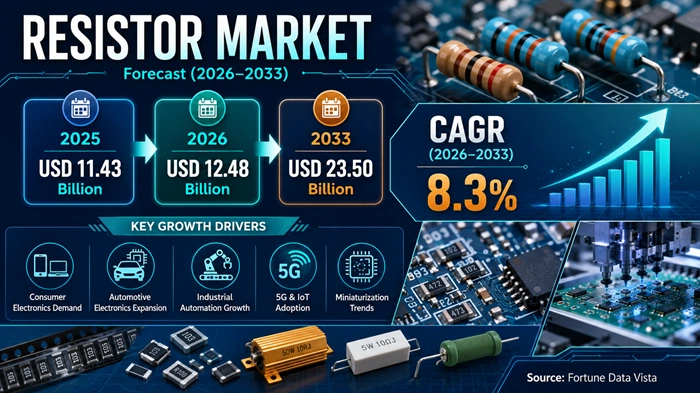
The global resistor market size is valued at USD 11.43 billion in 2025 and is predicted to increase from USD 12.48 billion in 2026 to approximately USD 23.50 billion by 2033, growing at a CAGR of 8.3% from 2026 to 2033. This steady and robust expansion is driven by accelerating demand from automotive electronics, electric vehicle powertrains, consumer electronics miniaturization, industrial automation, telecommunications infrastructure, and the rapid proliferation of connected IoT devices across virtually every sector of the global economy.
AI Impact on the Resistor Industry
Artificial Intelligence Is Redefining How Resistors Are Designed, Tested, and Manufactured — From Smart Production Lines to AI-Optimized Circuit Design in Next-Generation Electronics
Artificial intelligence is making a meaningful and growing impact on resistor manufacturing and electronic component engineering. AI-powered process control systems deployed on modern resistor production lines are monitoring thin-film deposition thickness, laser trimming accuracy, and termination coating quality in real time — making micro-level adjustments to maintain tight resistance tolerance specifications at high production speeds that would be impossible to achieve through manual process control. These systems reduce scrap rates, improve first-pass yield, and ensure that mass-produced resistors meet the increasingly stringent tolerance and temperature coefficient requirements demanded by automotive, medical, and precision instrumentation customers. Leading resistor manufacturers including Vishay Intertechnology, Yageo Corporation, and KOA Corporation are actively integrating AI-based quality inspection tools into their automated production lines, using machine vision and deep learning models to detect cosmetic defects, resistance drift, and dimensional non-conformance before components reach final packaging.
On the circuit design side, AI-assisted electronic design automation (EDA) tools are helping electronics engineers select and specify resistors more intelligently — automatically analyzing circuit topology, power dissipation requirements, noise budgets, and temperature profiles to recommend the optimal resistor type, resistance value, tolerance grade, and power rating for each design node. This capability is particularly valuable in automotive and industrial electronics design, where thousands of resistors must be specified and qualified per circuit board, and where errors in specification can create field reliability issues that are extremely costly to remediate. Generative AI tools integrated into simulation platforms are also enabling virtual prototyping of resistor network behaviors under real-world stress conditions — including thermal cycling, humidity exposure, and mechanical vibration — reducing the need for physical prototype iterations and shortening product development timelines in the resistor industry and its downstream electronics customers simultaneously.
Growth Factors
Electric Vehicle Electronics Complexity, Industrial Automation Expansion, and the Global Miniaturization Trend Are the Three Most Powerful Commercial Engines Driving Resistor Market Growth
The electric vehicle revolution is creating one of the most significant new demand pools the resistor market has seen in decades. A modern battery electric vehicle requires between 1,000 and 3,000 individual resistors across its various electronic systems — including the battery management system (BMS), motor controller inverter, onboard charger, DC-DC converter, ADAS sensor fusion modules, and vehicle body control units. As global EV production volumes scale rapidly — driven by regulatory mandates in Europe, China, and California — the automotive segment's demand for high-reliability, high-temperature, and current sensing resistors is growing at a CAGR that significantly outpaces the overall resistor market average. This demand is not limited to passenger EVs: commercial electric trucks, electric buses, and two- and three-wheeler EV platforms in Asia are each contributing incremental demand for automotive-grade resistor components. The automotive sector's increasing electronics content per vehicle — rising from an average of USD 2,000 in 2015 to an estimated USD 5,000 by 2030 — ensures that this demand driver will remain structurally active through the full 2033 forecast horizon.
Industrial automation and smart manufacturing expansion is contributing a parallel demand stream for the resistor market that is geographically broad and application-diverse. Programmable logic controllers (PLCs), variable frequency drives (VFDs), industrial robots, CNC machinery, and power distribution systems all contain resistors for voltage regulation, current sensing, signal conditioning, and thermal protection functions. As manufacturers globally invest in factory automation to address labor shortages, improve quality consistency, and reduce per-unit production costs, the installed base of resistor-containing industrial electronic equipment grows in direct proportion. The Industrial Internet of Things (IIoT) wave is additionally multiplying resistor demand by embedding sensors, microcontrollers, and wireless communication modules — each containing multiple resistors — into machinery, production equipment, and infrastructure assets that previously contained no electronics. The convergence of EV growth and industrial automation creates a broad-based, multi-sector demand foundation that makes the resistor market less vulnerable to sector-specific downturns than many other passive electronic component categories.
Market Outlook
The Resistor Market Is Positioned for Sustained Double-Digit Growth Driven by Structural Electronics Demand From Automotive, Industrial, and Telecommunications Sectors Through 2033
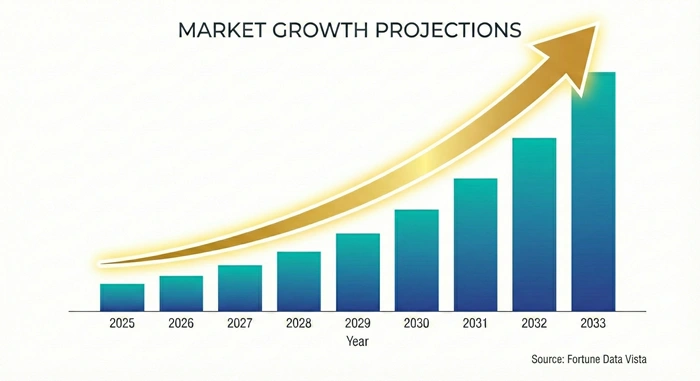
The long-term outlook for the global resistor market is consistently positive, underpinned by the near-universal penetration of electronics into every industrial and consumer application domain. Unlike many components that can be substituted or eliminated through circuit redesign, resistors serve fundamental and irreplaceable circuit functions — voltage division, current limiting, signal filtering, and impedance matching — that ensure their demand grows in direct proportion to the volume and complexity of electronic equipment manufactured globally. The shift toward more complex automotive architectures, more capable industrial control systems, and more densely integrated consumer electronics is simultaneously increasing the number of resistors required per electronic assembly and raising the average selling price as customers demand tighter tolerances, higher reliability grades, and more specialized performance characteristics.
The telecommunications sector's ongoing infrastructure evolution is adding significant growth momentum to the resistor market. The global rollout of 5G base station infrastructure, the construction of hyperscale data center facilities for AI computing, and the expansion of fiber-optic networking equipment all require large quantities of precision resistors for signal conditioning, impedance control, power management, and EMC protection functions. Semiconductor and integrated circuit testing equipment — another rapidly growing category driven by global semiconductor capacity expansion — places particularly demanding precision and stability requirements on resistors used in automated test equipment (ATE). By 2033, the resistor market is expected to be substantially larger and more technically sophisticated than today, with automotive and industrial applications collectively representing the dominant share of revenue, and with precision, thin-film, and current sensing resistor categories growing fastest.
Expert Speaks
-
"The increasing complexity of automotive electronics, particularly in electric and autonomous vehicles, is driving demand for high-precision, high-reliability resistors that can perform consistently across wide temperature ranges and demanding electrical stress conditions — and Vishay is committed to leading the industry in meeting these evolving requirements." — Gerald Paul, Former CEO, Vishay Intertechnology Inc.
-
"Yageo is strategically investing in next-generation thin-film and precision resistor technology platforms because we clearly see that automotive electrification and industrial automation are creating a structural demand uplift for high-performance passive components that will sustain above-market growth for our portfolio through the end of this decade." — Peter Chen, CEO, Yageo Corporation
-
"The passive component industry is at an exciting inflection point — miniaturization, electrification, and connectivity are simultaneously expanding both the addressable market and the average value per resistor unit, and Murata's diversified resistor portfolio is well-positioned to capture the premium end of that expanding opportunity." — Norio Nakajima, President, Murata Manufacturing Co. Ltd.
Key Report Takeaways
-
Asia Pacific dominates the global resistor market, accounting for more than 47.3% of global revenue in 2025, driven by China, Japan, South Korea, and Taiwan's position as the world's largest electronics manufacturing hubs — producing the majority of consumer electronics, automotive components, and industrial equipment that embed resistors at scale
-
North America is one of the fastest-growing regions, driven by surging demand for high-reliability resistors in aerospace, defense, automotive electronics, and medical device applications, combined with semiconductor fab capacity expansion creating growing demand for precision resistors in automated test equipment and process control systems
-
Automotive electronics end-users are the largest and fastest-growing consumer segment, driven by the rapid scale-up of EV production requiring resistors for battery management systems, motor controllers, onboard charging, and ADAS applications across both passenger and commercial vehicle platforms globally
-
Surface-mount (SMD/chip) resistors contribute the largest application and product revenue share, accounting for approximately 58.4% of total resistor market revenue in 2025, driven by their dominance in automated PCB assembly, consumer electronics, automotive ECUs, and telecommunications infrastructure equipment
-
Thick-film resistor technology remains the most widely produced resistor type globally, underpinning the chip resistor segment with cost-effective, high-volume production suited to consumer and general-purpose industrial applications, while thin-film technology commands premium pricing for precision, low-noise, and high-stability applications
-
Precision and current sensing resistors are the fastest-growing sub-segments, expected to grow at above-average CAGRs through 2033, with current sensing resistors — used in EV battery management and power conversion applications — forecast to be among the highest-growth categories in the entire resistor market, capturing an increasing share of automotive and industrial electronics procurement budgets
Market Scope
| Parameter | Details |
|---|---|
| Market Size by 2033 | USD 23.50 Billion | Market Size by 2026 | USD 12.48 Billion | Market Size by 2025 | USD 11.43 Billion | Market Growth Rate from 2026 to 2033 | CAGR of 8.3% | Dominating Region | Asia Pacific | Fastest Growing Region | North America | Segments Covered | Type, Technology, Product Form, Application, End-Use Industry, Region | Regions Covered | North America, Europe, Asia Pacific, Latin America, Middle East & Africa |
Market Dynamics
Drivers Impact Analysis
Automotive Electrification, Industrial Automation, and the Global Miniaturization of Electronics Are the Three Core Forces Driving Sustained Growth in the Resistor Market
| Driver | ≈ % Impact on CAGR Forecast | Geographic Relevance | Impact Timeline |
|---|---|---|---|
| EV production growth and automotive electronics complexity | ~29% | China, Europe, North America | Near to Long-term (2026–2033) |
| Industrial automation and IIoT sensor deployment | ~24% | Asia Pacific, North America, Europe | Near to Long-term |
| Consumer electronics miniaturization and wearable devices | ~18% | Asia Pacific, North America | Near to Medium-term (2026–2029) |
| 5G and data center telecommunications infrastructure | ~16% | North America, Asia Pacific | Near to Medium-term |
| Medical electronics and IoT device expansion | ~13% | North America, Europe | Medium to Long-term |
Automotive electrification is the most commercially significant driver of growth in the resistor market over the full 2026–2033 forecast period. The fundamental shift from internal combustion vehicles to battery electric and hybrid electric architectures requires manufacturers to redesign their entire powertrain and body electronics system, incorporating significantly more resistors for motor control, power conversion, battery monitoring, and thermal management functions than conventional vehicles. Current sensing resistors — specifically shunt resistors with extremely low resistance values and tight tolerance specifications — are particularly critical in EV battery management systems, where they must accurately measure the current flowing into and out of each cell group to prevent overcharge, over-discharge, and thermal runaway events. This application is growing at an exceptionally strong CAGR as EV production volumes scale globally, and it is shifting the automotive portion of the resistor market toward higher-value, higher-precision components that command meaningfully better average selling prices than general-purpose chip resistors.
Industrial automation and the IIoT wave are generating the second most important demand stream for resistors in terms of sheer volume growth. Every factory robot, servo drive, PLC, smart sensor, and process controller deployed in an automated manufacturing environment contains dozens to hundreds of resistors performing essential circuit functions. As global manufacturing industries — including automotive, semiconductor, pharmaceutical, food and beverage, and logistics — invest in automation to improve efficiency and address labor cost pressures, the installed base of resistor-containing industrial electronic equipment is expanding across virtually every geography and manufacturing sector simultaneously. The IIoT layer of this trend is particularly important for the resistor market's growth outlook, as the digitization of manufacturing processes is adding wireless communication modules, battery-powered sensors, and edge computing nodes to machinery that previously contained no active or passive electronic components, creating entirely new resistor demand from previously untapped equipment categories.
Restraints Impact Analysis
Raw Material Price Volatility, Intense Asian Manufacturing Competition, and Ongoing Supply Chain Disruption Risks Are the Most Significant Constraints Limiting Faster Resistor Market Growth
| Restraint | ≈ % Impact on CAGR Forecast | Geographic Relevance | Impact Timeline |
|---|---|---|---|
| Volatility in copper, nickel, and tin raw material costs | ~−3.2% | Global | Ongoing (2026–2033) |
| Intense price competition from low-cost Asian manufacturers | ~−2.7% | North America, Europe | Ongoing |
| Supply chain disruptions for specialty metals and substrates | ~−2.3% | Global | Near to Medium-term |
| Pressure on average selling prices from commodity resistors | ~−1.8% | Global | Ongoing |
| Geopolitical trade tensions affecting Asia-based production | ~−1.5% | North America, Europe | Near-term (2026–2028) |
Raw material cost volatility is the most persistent financial constraint facing the resistor market. Resistors are manufactured from a range of metallic and oxide thin-film materials — including nickel-chromium, tantalum nitride, ruthenium oxide, copper, and tin — that are each subject to commodity market price fluctuations driven by mining supply dynamics, energy costs, and geopolitical factors largely outside the control of resistor manufacturers. When key raw material costs increase significantly, manufacturers face difficult choices between absorbing margin compression, raising selling prices in competitive markets, or accepting reduced quality by substituting lower-cost material formulations. The COVID-era supply chain disruptions exposed the vulnerabilities of just-in-time component sourcing, and while the industry has taken steps to build buffer inventories, the structural dependence on a concentrated group of specialty metal and substrate suppliers continues to create cost and supply risk for resistor manufacturers globally.
Intense pricing pressure from commodity chip resistor manufacturers in Taiwan and mainland China is a structural competitive constraint that disproportionately affects Western and Japanese resistor manufacturers competing in standard resistance value segments. Companies such as Yageo, Walsin Technology, and Samsung Electro-Mechanics operate at manufacturing scales and cost levels that make price competition in standard chip resistor categories extremely challenging for smaller or geographically distant competitors. This dynamic is pushing non-Asian resistor manufacturers to focus strategically on high-precision, application-specific, and custom-engineered resistor products where technical differentiation, application engineering support, and supply security commitments justify premium pricing. While this competitive repositioning is ultimately value-positive for the industry, it creates short-term revenue pressure and requires continued investment in R&D and application engineering capabilities that smaller manufacturers may struggle to sustain.
Opportunities Impact Analysis
Precision Automotive Resistor Demand, Medical Electronics Growth, and Emerging EV Charging Infrastructure Represent the Most High-Value Opportunity Segments Within the Resistor Market
| Opportunity | ≈ % Impact on CAGR Forecast | Geographic Relevance | Impact Timeline |
|---|---|---|---|
| High-precision current sensing resistors for EV powertrains | ~+3.9% | China, Europe, North America | Near to Long-term |
| Medical electronics and wearable health monitoring devices | ~+3.4% | North America, Europe, Asia Pacific | Medium to Long-term |
| Automotive ADAS and autonomous vehicle sensor systems | ~+3.1% | North America, China, Europe | Medium to Long-term (2027–2033) |
| EV charging infrastructure and power electronics | ~+2.8% | Global | Near to Medium-term |
| Semiconductor ATE and process control precision resistors | ~+2.2% | North America, Asia Pacific | Near to Medium-term |
The EV powertrain and charging infrastructure opportunity is the single most commercially accessible high-value growth vector for resistor manufacturers that can meet automotive qualification standards. Shunt resistors used for current sensing in BMS applications must meet AEC-Q200 automotive reliability standards, maintain resistance stability across a temperature range of −40°C to +175°C, and deliver measurement accuracy within tolerances of 0.5% or better across hundreds of thousands of charge-discharge cycles. Few resistor manufacturers globally are qualified to supply these components at the volumes that major battery cell manufacturers and EV OEMs require, creating a protected market opportunity for those who invest in the necessary qualification, manufacturing precision, and supply chain infrastructure. As the global EV charging network expands toward tens of millions of installed charging points, the resistor content in charging station power electronics — including high-power shunt resistors, current limiting resistors, and EMC suppression networks — adds further commercial depth to this opportunity.
Medical electronics represents a second high-value growth opportunity for the resistor market, characterized by premium pricing, long qualification lifecycles, and sustained demand growth driven by aging populations and expanding healthcare monitoring technology. Resistors used in medical diagnostic equipment, patient monitoring devices, implantable electronics, and wearable health sensors must meet strict biocompatibility standards, offer exceptional long-term stability, and maintain performance specifications across many years of continuous operation. These requirements exclude most commodity resistor suppliers and enable precision resistor manufacturers including Vishay, Susumu, and Caddock Electronics to command pricing several multiples above commodity chip resistor levels. The rapid growth of wearable health devices, continuous glucose monitors, remote patient monitoring systems, and minimally invasive surgical equipment is expanding the medical resistor market at a consistent above-average CAGR that is expected to continue through the full 2033 forecast period.
Segment Analysis
By Type — Surface Mount (SMD/Chip) Resistors
Surface Mount Resistors Are the Backbone of the Global Resistor Market, Commanding the Largest Revenue Share Across All End-Use Applications Through Automated PCB Assembly Dominance
Surface mount (SMD) chip resistors are the largest and most commercially dominant segment in the global resistor market, accounting for approximately 58.4% of total revenue share in 2025. Their market leadership reflects the near-universal adoption of surface mount technology (SMT) in modern electronic circuit board assembly — from smartphone PCBs measuring just a few square centimeters to large automotive ECUs and industrial control boards containing thousands of resistors. The miniaturization trend in electronics has driven SMD resistor package sizes progressively smaller — from the once-standard 0805 case size through 0402 and 0201, down to the ultra-miniature 01005 case measuring just 0.4mm × 0.2mm — enabling denser PCB layouts and lighter assemblies in applications where size and weight are constrained. The segment is growing at a steady CAGR within the broader resistor market, driven by the compound effect of increasing resistor content per assembly and expanding global PCB production volumes. Asia Pacific is the dominant geography for SMD resistor production and consumption, with Taiwan-based Yageo Corporation and Walsin Technology Corporation, and South Korea's Samsung Electro-Mechanics, collectively accounting for a significant majority of global chip resistor output.
In North America and Europe, SMD resistor consumption is growing at above-average regional CAGRs driven by automotive electronics production and defense electronics procurement. European automotive Tier 1 suppliers — including Robert Bosch, Continental, and Valeo — are among the largest regional consumers of automotive-grade SMD resistors, specifying AEC-Q200 qualified components for ECU, ADAS sensor, and EV powertrain applications. North American defense electronics programs are driving demand for MIL-spec rated SMD resistors with enhanced radiation tolerance, altitude performance, and long-term stability specifications. The automotive-grade SMD segment commands pricing premiums of 30–70% over industrial-grade equivalents, making it one of the most commercially attractive sub-segments within the resistor market for manufacturers with automotive qualification investments. Companies including Vishay Intertechnology (USA) and KOA Corporation (Japan) hold strong positions in the automotive-grade SMD resistor segment, benefiting from their established AEC-Q200 qualification infrastructure and deep application engineering relationships with automotive OEMs and Tier 1 suppliers.
By End-Use Industry — Automotive
The Automotive End-Use Segment Is the Resistor Market's Fastest-Growing and Highest-Value Application Category, Powered by Electrification, ADAS Adoption, and Vehicle Electronics Complexity Growth
The automotive end-use segment is the fastest-growing and most commercially significant application category within the resistor market, contributing approximately 28.7% of total end-use revenue share in 2025 and growing at the highest sector CAGR of any end-use vertical. The fundamental architecture of a modern battery electric vehicle requires a dramatically different and significantly more resistor-intensive electronic design compared to conventional combustion engine vehicles. Battery management systems need precision low-resistance current shunts for real-time coulomb counting and state-of-charge calculation. Motor controller inverters require high-power current sensing and gate drive resistors. Onboard chargers and DC-DC converters incorporate snubber resistors, current limiting networks, and EMI filtering. ADAS systems — including radar, lidar, and camera modules — contain dozens of precision resistors per sensor unit for signal conditioning and bias network applications. Each of these automotive subsystems is either new (in the case of EVs) or growing in content per vehicle (in the case of ADAS), creating a compounding demand multiplier that is the resistor market's most important long-term growth engine.
In Asia Pacific, where China produces more EVs than any other country and continues to rapidly scale domestic EV production toward 15 million vehicles annually by 2027, the automotive resistor segment is growing at an exceptional pace. CATL's battery pack manufacturing operations alone represent one of the largest single sources of current sensing resistor demand globally. Japanese automotive electronics suppliers — including Denso, Yazaki, and Sumitomo Electric — supply resistor-containing wiring harnesses and ECUs to major OEMs across the global automotive supply chain, concentrating significant demand at their component procurement operations in Japan and Southeast Asia. In Europe, Infineon Technologies, STMicroelectronics, and NXP Semiconductors — each major suppliers of automotive power management ICs and motor controller chips — work closely with resistor manufacturers to specify and qualify current sensing and thermal protection resistors for their reference designs, creating a design-in demand pathway that converts silicon design wins into sustained resistor procurement.
Regional Insights
Asia Pacific — The Global Center of Resistor Manufacturing and Consumption
Asia Pacific's Unmatched Electronics Manufacturing Scale, Dominant EV Production, and Deep Passive Component Supply Chain Make It the Undisputed Leader in the Global Resistor Market
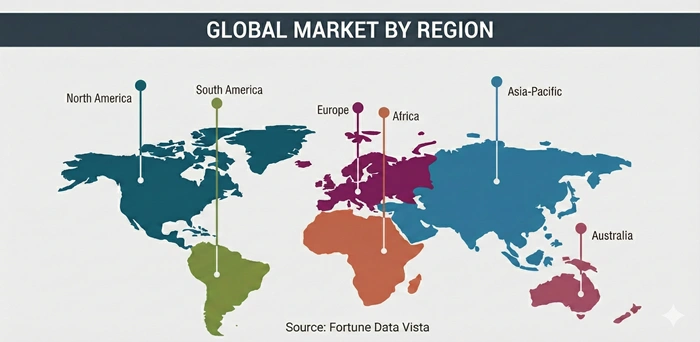
Asia Pacific is the dominant region in the global resistor market, holding more than 47.3% of global revenue share in 2025 and growing at a regional CAGR of approximately 8.8% through 2033. The region's leadership is fundamentally anchored in its role as the world's manufacturing hub for consumer electronics, automotive components, industrial equipment, and telecommunications infrastructure — all of which embed resistors at scale. Taiwan is home to two of the world's largest chip resistor manufacturers — Yageo Corporation and Walsin Technology Corporation — whose combined production capacity represents a dominant share of global chip resistor output. China's manufacturing ecosystem produces a large portion of the world's electronic assemblies, making it simultaneously one of the largest consumers of imported premium resistors and a growing producer of lower-to-mid tier resistors through domestic suppliers such as Fenghua Advanced Technology and Unihom Electronics. Japan's resistor industry — represented by world-class manufacturers including Murata Manufacturing, Panasonic Industry, KOA Corporation, and Rohm Co. Ltd. — leads in precision, thin-film, and specialty resistor technologies, supplying high-reliability components to automotive, industrial, and medical electronics customers globally.
South Korea and India are increasingly important contributors to the Asia Pacific resistor market's growth. Samsung Electro-Mechanics in South Korea is a major global chip resistor supplier, closely integrated with Samsung Electronics' consumer electronics and smartphone component ecosystem. India's growing electronics manufacturing sector — driven by the government's Production Linked Incentive (PLI) scheme and expanding smartphone, EV, and industrial electronics production — is creating a new and rapidly growing domestic resistor demand pool that international suppliers and domestic manufacturers are actively positioning to serve. The broader region's continued dominance of global electronics production, combined with rapidly growing domestic automotive electrification and industrial automation investment, ensures that Asia Pacific will maintain its leadership position in the global resistor market and likely expand its share through the full 2033 forecast horizon.
North America — The Fastest-Growing Developed Region in the Global Resistor Market
Aerospace Defense Electronics, Semiconductor ATE Demand, EV Manufacturing Scale-Up, and Medical Device Growth Are Collectively Driving North America's Accelerating Resistor Market Expansion
North America holds approximately 22.6% of the global resistor market share in 2025 and is positioned as the fastest-growing region among developed economies, with a regional CAGR of approximately 9.1% through 2033. The United States is the region's dominant market, characterized by its concentration of high-value electronics applications — aerospace and defense systems, advanced medical devices, semiconductor capital equipment, and automotive electronics R&D — that require precision, high-reliability, and application-specific resistors at premium price points. North American defense contractors including Lockheed Martin, Raytheon Technologies, and Northrop Grumman are consistent consumers of MIL-spec resistors for avionic systems, missile guidance electronics, and electronic warfare applications, creating a high-value, specification-driven demand pool that rewards technical competence and supply chain reliability above price competition. The U.S. semiconductor equipment industry — with AMAT, Lam Research, and KLA Corporation as major equipment producers — is a large and growing consumer of precision thin-film resistors for automated test equipment and process control applications.
Automotive electronics demand in North America is being significantly amplified by the regional EV manufacturing expansion enabled by the Inflation Reduction Act. Tesla's Gigafactory in Texas, GM's Ultium battery plants, Ford's BlueOval City, and numerous Tier 1 automotive electronics supplier facilities are collectively creating new regional procurement demand for automotive-grade resistors at scales not previously seen in North American electronics manufacturing. Canadian electronics manufacturing — concentrated in Ontario and British Columbia — is also growing as automotive supply chain reshoring trends favor North American component sourcing. Vishay Intertechnology (USA) and Caddock Electronics (USA) are the leading North American-headquartered resistor manufacturers, with Vishay's globally distributed manufacturing network enabling it to serve North American customers with both standard and specialty resistors at competitive lead times. The combination of defense, medical, semiconductor ATE, and automotive demand makes North America the most commercially sophisticated and premium-priced regional segment of the global resistor market.
Top Key Players
-
Vishay Intertechnology Inc. (United States)
-
Yageo Corporation (Taiwan)
-
Murata Manufacturing Co. Ltd. (Japan)
-
KOA Corporation (Japan)
-
Rohm Co. Ltd. (Japan)
-
Panasonic Industry Co. Ltd. (Japan)
-
Samsung Electro-Mechanics Co. Ltd. (South Korea)
-
Walsin Technology Corporation (Taiwan)
-
Bourns Inc. (United States)
-
TE Connectivity Ltd. (Switzerland/United States)
-
Ohmite Manufacturing Company (United States)
-
Caddock Electronics Inc. (United States)
Recent Developments
-
In May 2026, Yageo Corporation announced the acquisition of a 49% equity stake in Shibaura Electronics Co. Ltd. — a Japan-based precision thermistor and NTC temperature sensor manufacturer — for approximately JPY 7.2 billion, significantly expanding Yageo's precision sensing and medical-grade resistor product portfolio and strengthening its position in the fast-growing automotive temperature sensing and medical device segments.
-
In March 2026, Vishay Intertechnology launched its new WSBS series of ultra-low-resistance current sensing shunt resistors with four-terminal (Kelvin) construction, specifically engineered for EV battery management system applications requiring resistance values from 50 μΩ to 500 μΩ with ±1% tolerance across a −55°C to +170°C operating range — directly targeting the growing EV powertrain resistor opportunity.
-
In January 2026, KOA Corporation announced a JPY 4.5 billion capital investment in expanding its precision thin-film resistor production capacity at its Matsumoto factory in Nagano Prefecture, Japan, responding to strong order backlog growth from automotive electronics customers requiring AEC-Q200 qualified precision resistors for ADAS sensor and power management applications.
-
In October 2025, Rohm Co. Ltd. unveiled the PSR350 — the world's thinnest high-power plate shunt resistor rated at 10W continuous power in a compact 3.5mm × 3.5mm footprint — specifically designed for industrial and automotive power conversion applications where board space is constrained and thermal dissipation requirements are demanding.
-
In July 2025, Murata Manufacturing Co. Ltd. completed the integration of Bourns Inc.'s thick-film resistor network product lines into its own resistor portfolio following a technology licensing and product transfer agreement, expanding Murata's resistor array and network product coverage for complex PCB applications in telecommunications and industrial electronics.
Market Trends
Precision Miniaturization and Automotive-Grade Quality Escalation Are the Two Most Defining Trends Reshaping the Resistor Market's Technology and Commercial Landscape in 2026
The most prominent trend reshaping the resistor market in 2026 is the relentless drive toward smaller package sizes combined with stricter performance specifications — a combination that sounds contradictory but is being achieved through advanced thin-film deposition, laser trimming precision, and new substrate materials that maintain performance as physical dimensions shrink. The 01005 package (measuring 0.4mm × 0.2mm), once confined to leading-edge smartphone PCBs, is now entering automotive and wearable device applications as designers seek to maximize function-per-square-centimeter. High-density resistor networks and resistor arrays — consolidating multiple individual resistors into a single compact package — are growing strongly in telecommunications and automotive applications where board real estate is at a premium. These trends are simultaneously increasing the technical sophistication of resistor manufacturing processes and raising the barriers to entry for lower-tier manufacturers who cannot consistently produce ultra-small, tight-tolerance components at acceptable yield rates.
The second defining trend is the automotive-grade qualification escalation — the process by which resistor manufacturers must continuously invest in AEC-Q200 testing infrastructure, automotive-specific manufacturing controls, and multi-year reliability qualification programs to remain competitive in the automotive market. As automotive electronics safety and reliability requirements tighten under ISO 26262 functional safety standards and the growing complexity of ADAS and EV systems, OEMs and Tier 1 suppliers are consolidating their resistor supplier bases around a smaller number of fully qualified, financially stable, and technically capable manufacturers. This trend is steadily concentrating automotive resistor market share among the top five to seven global manufacturers — including Vishay, Yageo, KOA, Rohm, and Murata — while creating meaningful competitive challenges for smaller specialists that lack the qualification investment capacity to maintain pace with escalating automotive customer requirements. The resistor market is becoming more technically demanding, more consolidation-oriented, and more commercially rewarding for those manufacturers who successfully navigate the automotive qualification journey.
Segments Covered in the Report
-
By Type
-
Linear Resistors
-
Fixed Resistors (Carbon Film, Metal Film, Wire-Wound, Thick Film, Thin Film)
-
Variable Resistors (Potentiometers, Rheostats, Trimmers)
-
-
Non-Linear Resistors
-
Thermistors (NTC, PTC)
-
Varistors (MOV)
-
Photoresistors (LDR)
-
-
-
By Technology
-
Thin-Film
-
Thick-Film
-
Wire-Wound
-
Carbon Composition
-
Others
-
-
By Product Form
-
Surface Mount (SMD/Chip) Resistors
-
Through-Hole Resistors
-
Resistor Networks/Arrays
-
Power Resistors
-
Precision Resistors
-
Current Sensing (Shunt) Resistors
-
-
By Application
-
Voltage Division and Current Limiting
-
Signal Conditioning and Filtering
-
Current Sensing and Measurement
-
Thermal Protection and Management
-
EMC and Noise Suppression
-
Others
-
-
By End-Use Industry
-
Consumer Electronics
-
Automotive (ICE, HEV, BEV)
-
Aerospace & Defense
-
Industrial Automation & Equipment
-
Telecommunications & Data Centers
-
Healthcare & Medical Devices
-
Others
-
-
By Region
-
North America (U.S., Canada, Mexico)
-
Europe (Germany, UK, France, Italy, Netherlands)
-
Asia Pacific (China, Japan, South Korea, Taiwan, India)
-
Latin America (Brazil, Mexico)
-
Middle East & Africa (UAE, Saudi Arabia, South Africa)
-
❝ Built for Every Level — From Startups to Industry Giants ❞
Here Is Exactly How This Report Works for You
-
For Tier 1 resistor manufacturers, large electronics OEMs, and institutional investors, this report delivers granular competitor revenue analysis by product type and end-use segment, resistor supply-demand balance forecasts through 2033, and detailed assessments of how geopolitical trade tensions — particularly U.S.-China technology export controls and tariff regimes — are reshaping regional supply chains, because in a market growing from USD 12.48 billion to USD 23.50 billion by 2033, knowing which competitors are gaining or losing share in the automotive and precision resistor segments can determine whether your next capacity investment or M&A decision generates exceptional returns or destroys value.
-
For Tier 2 and Tier 3 resistor distributors, contract electronics manufacturers, and mid-market companies, this report translates the complex supply and demand dynamics of the resistor market into actionable procurement, inventory, and customer development strategies — identifying the specific product categories, geographies, and end-use customer segments where mid-market players can build competitive advantages against both large-scale Asian commodity producers and premium specialty manufacturers.
-
For electronics hardware startups, automotive electronics innovators, and early-stage investors, the forward-looking segment CAGRs, automotive qualification roadmap analysis, and competitive intelligence on how leading resistor companies are positioning their portfolios for the EV and ADAS era contained in this report provide the strategic foundation to make informed design decisions, supplier qualifications, and investment commitments that align with where the global resistor market is heading through 2033.
Frequently Asked Questions:
Answer: The global resistor market is valued at USD 11.43 billion in 2025 and is projected to reach USD 23.50 billion by 2033. It is expanding at a CAGR of 8.3% from 2026 to 2033, driven by automotive electrification, industrial automation, and growing demand for precision passive components.
Answer: The automotive end-use segment is the fastest-growing application within the resistor market, propelled by the rapid scale-up of electric vehicle production requiring high-reliability current sensing, power management, and ADAS-related resistors. Surface mount chip resistors account for the largest product revenue share, reflecting their dominance in automated PCB assembly across all major electronics manufacturing sectors.
Answer: Asia Pacific leads the global resistor market with over 47.3% of global revenue in 2025, anchored by Taiwan and Japan's world-leading chip resistor manufacturing base and China's enormous electronics assembly demand. North America is the fastest-growing developed region in the resistor market, driven by aerospace, defense, medical device, and automotive EV electronics demand at premium price points.
Answer: The resistor market faces persistent challenges from raw material cost volatility — particularly for specialty metals like nickel-chromium and ruthenium oxide used in thin-film resistors — and from intense pricing pressure from high-volume Asian chip resistor manufacturers. Geopolitical trade tensions affecting Asia-Pacific supply chains and the complexity of automotive qualification programs also present meaningful constraints for manufacturers seeking to grow their market position.
Answer: The most compelling growth opportunities in the resistor market include precision current sensing resistors for EV battery management systems, high-reliability resistors for ADAS and autonomous vehicle sensor applications, and medical-grade precision resistors for wearable health monitoring and implantable device markets. Each of these segments offers above-average growth rates and premium pricing that rewards technical specialization and quality investment over commodity production scale.