
Retail Banking Market Overview
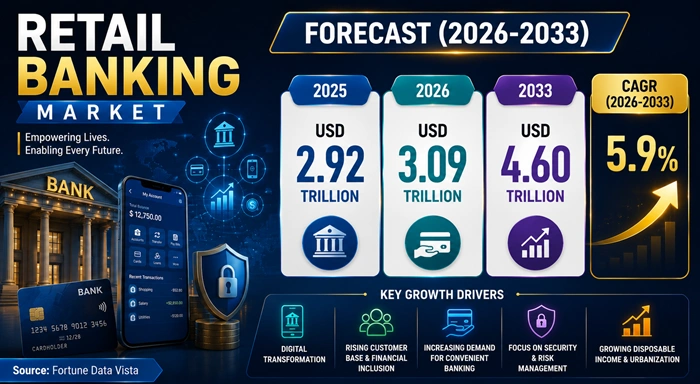
The global retail banking market size is valued at USD 2.92 trillion in 2025 and is predicted to increase from USD 3.09 trillion in 2026 to approximately USD 4.60 trillion by 2033, growing at a CAGR of 5.9% from 2026 to 2033.
Consumer banking has entered one of its most consequential transformation periods in modern financial history. The convergence of digital technology, changing consumer expectations, rising fintech competition, and progressive regulatory evolution is reshaping how people save, borrow, invest, and manage money on a daily basis. The retail banking market is responding to these forces with accelerating investment in mobile-first platforms, AI-powered customer service, open banking infrastructure, and data-driven personalization — while navigating an interest rate environment, regulatory landscape, and competitive dynamic that simultaneously creates both opportunity and margin pressure for banks of every size and geography.
AI Impact on the Retail Banking Industry
Artificial Intelligence Is Fundamentally Transforming the Retail Banking Market — from Personalized Product Recommendation and Intelligent Credit Scoring to Real-Time Fraud Detection and Conversational Banking Interfaces That Redefine the Customer Relationship
Artificial intelligence has become the most strategically important technology investment in the retail banking market, enabling banks to deliver more personalized, efficient, and secure financial services while simultaneously reducing the operational cost of serving large customer bases at scale. AI-powered credit scoring models that incorporate thousands of behavioral, transactional, and alternative data variables are allowing banks to make faster, more accurate lending decisions — approving more creditworthy borrowers who would have been declined by traditional credit bureau-dependent models while more precisely identifying high-risk applications. Natural language processing-powered virtual assistants and chatbots are now handling tens of millions of routine customer service interactions daily across banking platforms including Bank of America's Erica, JPMorgan Chase's COiN, and HSBC's Amy — deflecting the majority of inbound service volume from human agents while delivering consistent, 24/7 availability that improves customer satisfaction scores.
On the risk management side, AI and machine learning are delivering transformational improvements in fraud detection accuracy and speed that protect both banks and customers from the escalating sophistication of financial cybercrime. Machine learning models that analyze real-time transaction data against individual behavioral baselines can identify fraudulent payment card transactions with accuracy rates exceeding 99% while generating dramatically lower false positive rates than traditional rule-based detection systems — reducing both fraud losses and the customer friction caused by legitimate transactions being incorrectly declined. Predictive analytics applications powered by AI are also enabling proactive customer engagement in the retail banking market — identifying customers at risk of churn, financial distress, or refinancing decisions before those events occur, and triggering personalized retention offers, financial wellness interventions, or product recommendation communications at the moment they are most likely to be relevant and well-received.
Growth Factors
Digital Banking Adoption, the Rise of Embedded Finance and Open Banking, and the Rapid Expansion of Financial Services into Underbanked Emerging Market Populations Are the Three Primary Structural Growth Drivers of the Retail Banking Market
The progressive shift of retail banking customers from branch-dependent to digital-first interaction models is both the most visible trend and the most powerful growth catalyst in the retail banking market today. Mobile banking application usage has grown from a supplementary channel to the primary banking interface for the majority of consumers across North America, Europe, and increasingly Asia Pacific — with users in digital-leading markets averaging dozens of mobile banking interactions per month that span balance checking, payments, transfers, loan applications, and investment management without requiring any physical branch visit. This behavioral shift is both an opportunity and a competitive threat for incumbent banks: banks that have invested in superior mobile banking experiences — including JPMorgan Chase, DBS, ING, and N26 — are winning market share from competitors with inferior digital capabilities, while pure-play digital banks and neobanks including Chime, Revolut, Nubank, and Monzo are demonstrating that digitally native financial service delivery can attract and retain tens of millions of customers at acquisition costs and operating expense ratios that incumbent branch networks cannot match.
The global expansion of financial inclusion — particularly across South and Southeast Asia, Sub-Saharan Africa, and Latin America — is simultaneously creating an enormous addressable market opportunity for the retail banking market as hundreds of millions of previously unbanked or underbanked consumers gain their first access to formal financial services through mobile banking platforms. India's Unified Payments Interface (UPI) digital payments infrastructure has onboarded hundreds of millions of previously cash-dependent consumers into the formal banking ecosystem, driving dramatic increases in deposit account ownership, digital transaction volume, and demand for retail banking products including personal loans, insurance, and investment products. Similar digital financial inclusion dynamics are unfolding in Nigeria, Kenya (M-Pesa ecosystem), Brazil (PIX instant payment system), and across Southeast Asia — markets where mobile-first banking infrastructure is reaching populations that traditional physical branch banking models never served cost-effectively, creating a new and commercially significant generation of banking customers whose product adoption and revenue potential will compound progressively through the 2033 forecast horizon.
Market Outlook
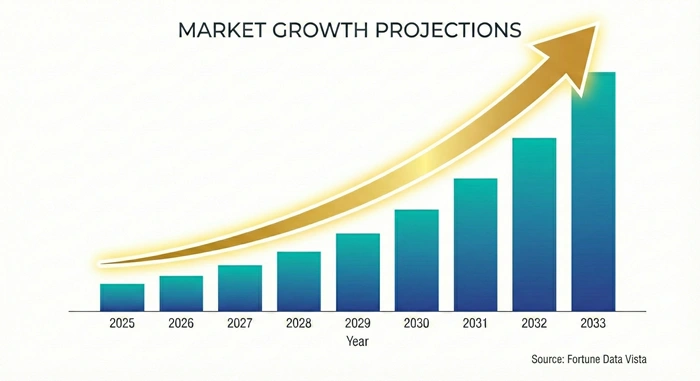
The Retail Banking Market Is Entering a Decade of Digital Consolidation and Competitive Bifurcation — Where Technologically Advanced Banks Pull Away from Digital Laggards and Open Banking Infrastructure Unlocks New Service Models That Blur the Boundary Between Banking and Daily Consumer Life
The medium-to-long-term outlook for the retail banking market is defined by the progressive acceleration of digital transformation investment by incumbent banks who understand that maintaining competitive relevance in a world of digital-native neobanks, embedded finance platforms, and AI-powered personalized services requires fundamental reinvention of their operating models — not merely the addition of a mobile app to an otherwise unchanged branch-centric business. The banks that successfully complete this transformation — rebuilding their core technology infrastructure on modern cloud-native platforms, deploying AI across customer engagement and risk management, and building open banking APIs that enable ecosystem partner integration — will emerge from the current transition period with cost structures, customer satisfaction scores, and revenue per customer metrics that create sustainable competitive advantages. Those that do not make this transition at sufficient speed and investment scale face a progressive erosion of their customer relationships to more agile digital competitors.
Looking toward 2033, the retail banking market will be profoundly shaped by the maturation of embedded finance — the integration of banking products directly into non-banking digital environments including e-commerce platforms, ride-hailing apps, social media networks, and enterprise software — that delivers banking services to consumers at the point of need without requiring them to navigate a banking application. Banks including Goldman Sachs (Apple Card, Apple Savings), JPMorgan Chase (embedded payments), and BBVA are already building embedded finance partnerships that distribute retail banking products through non-banking channels at dramatically lower customer acquisition costs than traditional marketing. As open banking regulatory frameworks mature across the EU, U.K., Australia, and progressively across Asia and North America, the connectivity between banks and third-party fintech providers will increase — enabling a financial services ecosystem where consumer data flows securely between institutions and applications to deliver a genuinely integrated, personalized financial life experience that today's fragmented account-by-account banking model does not provide.
Expert Speaks
-
"JPMorgan Chase's consumer banking business is performing exceptionally well, and the continued strength of our digital banking platform — with over 67 million active digital customers and best-in-class mobile capabilities — reflects our sustained investment in technology that our competitors are still catching up to. The combination of our physical branch network's relationship banking capabilities, our digital platform's scale and convenience, and our AI-powered personalization of financial products positions us uniquely well to serve the full range of consumer financial needs better than any other institution in the retail banking market." — Jamie Dimon, Chairman & CEO, JPMorgan Chase & Co.
-
"Bank of America has invested over USD 12 billion in technology over the past three years, and the results are evident in our digital banking metrics — 58 million active digital banking users, 2 billion digital interactions per year, and Erica, our AI-powered virtual financial assistant, now handling over 19 million customer interactions per month. Our conviction is that the banks who win the next decade of the retail banking market will be those who use technology not to replace human relationships but to make them far more informed, proactive, and valuable — and our investment strategy is built entirely around that vision." — Brian Moynihan, Chairman & CEO, Bank of America Corporation
-
"HSBC's digital banking transformation is progressing with real momentum, and the investments we are making in our mobile banking platform, AI-powered credit and risk systems, and open banking API infrastructure are delivering measurable improvements in customer satisfaction, product penetration, and operational efficiency across our retail banking operations globally. In Asia Pacific particularly, where digital financial services adoption is the most advanced in the world, our investment in digital-first retail banking capabilities is creating competitive positioning that will support sustained market share growth for years to come." — Georges Elhedery, Group CEO, HSBC Holdings plc
Key Report Takeaways
-
North America leads the global retail banking market in revenue, holding the largest regional share of approximately 34% in 2025, driven by the United States' position as the world's deepest and most commercially sophisticated consumer banking market — encompassing the five largest banks by assets (JPMorgan Chase, Bank of America, Citigroup, Wells Fargo, and U.S. Bancorp) who collectively manage trillions in retail deposits, loans, and investment assets alongside a rapidly growing neobank sector representing tens of millions of additional digital banking customers.
-
Asia Pacific is the fastest growing regional market for retail banking services, with China's massive commercial banking system, India's extraordinary digital financial inclusion expansion, and the rapidly growing banking markets of Southeast Asia collectively driving regional growth above the global average — supported by high urban population density, rising middle-class incomes, strong government digital payments infrastructure investment, and rapidly expanding mobile banking adoption that is bringing new banking customers into the formal financial system at an unprecedented rate.
-
Commercial banks represent the dominant banking type segment, accounting for approximately 80% of total retail banking market revenue in 2025, reflecting their combination of extensive branch and ATM networks, deep regulatory trust, diversified product portfolios spanning deposits, lending, payments, and investment, and the substantial technology investment capacity that allows large commercial banks to continuously improve digital banking capabilities in ways that smaller banking types cannot replicate.
-
Mobile banking applications are the fastest growing deployment channel, projected to achieve a market share exceeding 38% by 2033 and grow at a CAGR of approximately 9.2%, as smartphones become the primary — and for younger demographics, the only — banking interface through which consumers manage their financial lives, driving sustained investment in mobile banking platform development, biometric authentication, real-time notification systems, and AI-powered in-app financial guidance by banks of all sizes globally.
-
Personal loans and mortgage lending is the largest service type contributing to retail banking market revenue, as housing finance and consumer credit collectively represent the highest-revenue product categories for retail banks in every major global market — with mortgage books representing the largest single asset class on the balance sheets of consumer banks in North America, Europe, Australia, and increasingly China's major commercial banks.
-
Neobanks and digital-only banks are the fastest growing banking type segment, expected to grow at a CAGR of approximately 14.8% from 2026 to 2033 as platforms including Revolut, Nubank, Chime, N26, Monzo, and their regional equivalents capture increasing share of new account openings, digital payments volume, and personal lending from incumbent banks — driven by superior mobile UX, lower fee structures, real-time notifications, and the marketing power of their genuinely customer-aligned product design philosophies.
Market Scope
| Parameter | Details |
|---|---|
| Market Size by 2033 | USD 4.60 Trillion | Market Size by 2026 | USD 3.09 Trillion | Market Size by 2025 | USD 2.92 Trillion | Market Growth Rate from 2026 to 2033 | CAGR of 5.9% | Dominating Region | North America | Fastest Growing Region | Asia Pacific | Segments Covered | Service Type, Banking Type, Deployment Channel, End User, Technology | Regions Covered | North America, Europe, Asia Pacific, Latin America, Middle East & Africa |
Market Dynamics
Drivers Impact Analysis
The Acceleration of Digital Banking Adoption, Rising Consumer Expectations for Personalized Financial Services, and Strong Emerging Market Financial Inclusion Momentum Are Creating a Robust Multi-Layer Growth Foundation for the Retail Banking Market
| Driver | ≈ % Impact on CAGR Forecast | Geographic Relevance | Impact Timeline |
|---|---|---|---|
| Digital banking platform adoption and mobile-first consumer behavior | ~34% | Global — especially North America, Europe, Asia Pacific | Short to Long Term |
| Financial inclusion expansion in emerging markets through digital channels | ~28% | Asia Pacific, Latin America, MEA | Short to Long Term |
| Open banking regulation enabling fintech ecosystem and product innovation | ~22% | Europe, U.K., Australia, progressively Asia and North America | Medium to Long Term |
| Rising interest rates sustaining net interest margin improvement | ~16% | North America, Europe | Short to Medium Term |
The sustained investment in digital banking infrastructure by leading retail banks globally is creating a self-reinforcing growth cycle: as banks improve their mobile and online banking experiences, more customers adopt digital-first banking behaviors; as digital customer engagement deepens, banks accumulate behavioral data that powers more effective AI-driven personalization; and as personalization improves, customer satisfaction, product attachment rates, and lifetime value all increase — creating a competitive flywheel that compounds investment returns over time. Banks including DBS (Singapore), ING (Netherlands), and Nubank (Brazil) that have completed deep digital transformations are generating customer satisfaction scores, cost-to-income ratios, and product-per-customer metrics that set the standard for what digital retail banking excellence can achieve commercially — and are raising the expectations of banking consumers globally in ways that put pressure on every bank to accelerate its own digital transformation agenda.
The combination of government digital payments infrastructure investment and smartphone penetration in emerging market countries is accelerating the pace at which previously unbanked populations enter the formal retail banking ecosystem — creating a demand wave for first-time savings accounts, consumer credit, mobile insurance, and investment products that represents one of the most commercially significant and structurally durable growth opportunities in the entire retail banking market. India's UPI payment network has processed billions of digital transactions monthly, creating digital financial habits among hundreds of millions of Indians who are progressively adopting additional banking products. Brazil's PIX instant payment system has transformed that country's consumer payments landscape within just a few years of launch. These government-led digital financial infrastructure programs are creating the data trails, digital identities, and consumer financial confidence that enable retail banks and fintechs to extend credit, insurance, and investment products to previously unserved populations at commercially viable cost structures.
Restraints Impact Analysis
Cybersecurity Threats and Regulatory Compliance Costs, Net Interest Margin Compression in Low Rate Environments, and the Growing Competitive Threat from Neobanks and Big Tech Financial Services Are the Primary Constraints on Retail Banking Market Profitability and Growth
| Restraint | ≈ % Impact on CAGR Forecast | Geographic Relevance | Impact Timeline |
|---|---|---|---|
| Rising cybersecurity threats and the cost of digital banking security infrastructure | ~36% | Global — especially highly digitized banking markets | Short to Long Term |
| Regulatory compliance burden and capital requirement intensity for incumbent banks | ~34% | North America, Europe | Short to Medium Term |
| Neobank and big tech competition eroding incumbent bank customer acquisition and retention | ~30% | North America, Europe, Asia Pacific | Short to Long Term |
Cybersecurity represents one of the most significant operational and financial risks in the retail banking market, as the progressive digitalization of banking services simultaneously increases the attack surface available to cybercriminals, state-sponsored hackers, and sophisticated fraud networks. The financial sector consistently ranks as the highest-targeted industry for cyberattacks, and the consequences of a major banking platform breach — encompassing financial loss, regulatory fine, customer attrition, and reputational damage — can be severe and lasting. Incumbent banks must invest continuously in cybersecurity infrastructure, threat intelligence, and incident response capabilities that consume significant technology budget that might otherwise be directed toward customer-facing digital experience improvements or efficiency initiatives.
The competitive pressure from neobanks and digital financial platforms is intensifying across the retail banking market as digital-native competitors increasingly offer not just superior mobile experiences but competitive product economics including fee-free accounts, higher savings rates, and more favorable foreign exchange terms — creating genuine switching motivation for price-sensitive consumers beyond the switching inertia that has historically protected incumbent bank customer retention. The entry of technology companies including Apple (Apple Pay, Apple Card, Apple Savings), Google (Google Pay), and Amazon (Amazon Pay, small business lending) into financial services distribution creates an additional competitive threat, as these platforms have consumer engagement, data infrastructure, and brand trust that incumbent retail banks find extremely difficult to counter with traditional banking products and marketing approaches.
Opportunities Impact Analysis
Embedded Finance, Open Banking API Ecosystems, and the Commercial Exploitation of Banking Data for AI-Driven Personalization Represent the Three Highest-Value Strategic Growth Opportunities in the Retail Banking Market
| Opportunity | ≈ % Impact on CAGR Forecast | Geographic Relevance | Impact Timeline |
|---|---|---|---|
| Embedded finance and banking-as-a-service (BaaS) platform development | ~38% | North America, Europe, Asia Pacific | Short to Long Term |
| Open banking API ecosystems enabling fintech partnership and new revenue streams | ~34% | Europe, U.K., Australia, progressively global | Medium to Long Term |
| AI-driven hyper-personalization of financial product recommendations and advisory | ~28% | Global — especially digitally advanced markets | Short to Long Term |
Embedded finance — the distribution of banking products including credit, insurance, and payments directly through non-banking digital platforms — represents the most strategically transformative commercial opportunity for the retail banking market over the forecast period, enabling banks to acquire customers and distribute products at the point of commercial need rather than requiring consumers to navigate separate banking channels. Goldman Sachs' consumer banking partnerships with Apple and Marcus have demonstrated the revenue potential of embedded finance at scale, while Banking-as-a-Service platforms including Solarisbank, Marqeta, and Unit are enabling virtually any fintech, software company, or consumer brand to offer banking products through bank-licensed infrastructure — creating new distribution channels for retail banking products that extend far beyond the traditional branch and app-based banking models.
Open banking regulatory frameworks — requiring banks to share customer financial data with authorized third parties through standardized APIs with customer consent — are progressively creating a new financial data ecosystem that enables hyper-personalized financial services, multi-bank financial management applications, and automated financial optimization tools that were technically impossible in the closed, siloed banking data environments of the past. Banks that leverage open banking infrastructure proactively — building their own API platforms that attract fintech developers and enterprise software partners — are transforming from product-centric financial institutions into platform businesses at the center of broader consumer financial life management ecosystems. This platform transition, if successfully executed, creates revenue opportunities in data analytics services, API access fees, and co-branded product economics that supplement traditional net interest income and fee revenue with new, technology-driven income streams.
Segment Analysis
By Deployment Channel
Mobile Banking Applications Are the Dominant and Fastest Growing Delivery Channel in the Retail Banking Market, Fundamentally Shifting Consumer Engagement from Branch to Smartphone
Mobile banking applications represent the fastest growing and increasingly dominant deployment channel in the retail banking market, currently accounting for approximately 35% of total consumer banking interactions in 2025 and growing at a CAGR of approximately 9.2% through 2033. The shift from branch and ATM-centric banking to mobile-first financial management reflects a fundamental change in how consumers prefer to interact with their financial lives — checking balances, making payments, transferring funds, applying for loans, and managing investments through smartphone applications that offer the convenience of 24/7 access without physical location constraints. Asia Pacific is the global leader in mobile banking adoption, driven by markets including China (where Alipay and WeChat Pay have created mobile financial ecosystems used by over a billion people), India (where UPI and banking super-apps have driven mass mobile banking adoption), and South Korea (where Kakao Bank and Toss are leading digital-only banking adoption). Key companies investing most aggressively in mobile banking excellence within the retail banking market include DBS (ranked world's best digital bank), JPMorgan Chase, Bank of America (Erica AI assistant), ING, and the major neobanks whose entire value proposition is built around superior mobile experience.
Branch banking continues to represent a meaningful deployment channel — approximately 28% of retail banking revenue in 2025 — particularly for complex financial products including mortgages, business loans, investment advisory, and wealth management where face-to-face relationship engagement and professional guidance remain important to consumers making significant financial decisions. However, branch networks are progressively rightsizing as transaction volumes migrate to digital channels, with banks including Citibank, HSBC, Wells Fargo, and Barclays all reducing physical branch footprints while simultaneously upgrading remaining branches to higher-value relationship banking formats that focus on complex advisory interactions rather than routine transactions. North America and Europe lead this branch network rationalization, with the U.K. in particular experiencing rapid branch closure as mobile banking penetration approaches saturation among working-age adults — a dynamic that is progressively spreading to other developed markets within the retail banking market as the technology and behavioral conditions for digital-primary banking mature.
By Banking Type
Commercial Banks Dominate the Retail Banking Market While Neobanks Are the Most Disruptive and Fastest Growing Competitive Force in Consumer Financial Services
Commercial banks are the dominant banking type in the retail banking market, accounting for approximately 80% of total market revenue in 2025 and growing at a CAGR of approximately 5.2% through 2033, underpinned by their combination of regulatory trust, extensive product portfolios, multi-decade customer relationships, and the capital depth that enables them to offer the full range of retail banking services — from basic deposit accounts through home loans, credit cards, personal investment accounts, and insurance products — under a single integrated banking relationship. North America is the highest-revenue region for commercial banking, anchored by the extraordinary scale of JPMorgan Chase, Bank of America, Wells Fargo, and Citigroup — institutions that collectively manage more than USD 10 trillion in consumer assets and whose sustained technology investment is progressively widening the digital capability gap between them and less well-capitalized commercial bank competitors. The top commercial banks' investment in AI, cloud infrastructure, and mobile banking platforms is creating competitive advantages that smaller regional and community banks are finding increasingly difficult to close, driving progressive concentration of digital banking market share at the top of the commercial bank competitive hierarchy.
Neobanks and digital-only banking platforms represent approximately 8% of retail banking market revenue in 2025 but are growing at the highest segment CAGR of approximately 14.8% through 2033, driven by their superior mobile experiences, competitive fee and rate structures, and the powerful word-of-mouth growth dynamics that occur when satisfied digital banking customers enthusiastically recommend platforms to their social networks. Nubank — now the world's largest digital bank by customer count with over 100 million customers across Brazil, Mexico, and Colombia — has demonstrated that a neobank can achieve the scale, product depth, and profitability metrics to compete directly with incumbent commercial banks across the full range of retail banking products. Europe's Revolut (40+ million customers), the U.K.'s Monzo and Starling Bank, the U.S.'s Chime (35+ million customers), and Germany's N26 are all building substantial customer bases and expanding product portfolios from their initial simple banking roots toward comprehensive financial platforms that include lending, investment, insurance, and business banking — progressively challenging commercial banks' dominance of the retail banking market across every geography where neobank regulatory frameworks permit.
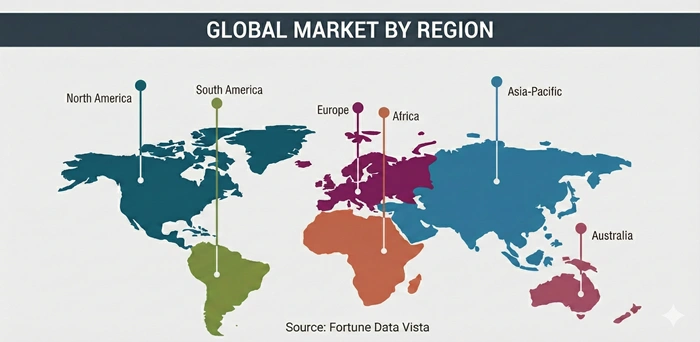
Regional Insights
North America
North America Dominates Global Retail Banking Revenue — Anchored by the World's Five Largest Banks and a Rapidly Growing Digital Banking Ecosystem That Is Setting the Standard for Technology-Driven Consumer Financial Services
JPMorgan Chase, Bank of America, and the World's Most Advanced Mobile Banking Platforms Make the United States the Commercial and Technological Center of the Global Retail Banking Market
North America holds approximately 34% of global retail banking market revenue in 2025, a dominant position built on the extraordinary scale and depth of the United States' consumer banking system — the world's largest by total assets — combined with Canada's stable and highly profitable banking sector led by the Big Five (Royal Bank of Canada, TD Bank, Scotiabank, BMO, and CIBC). The region is projected to grow at a CAGR of approximately 5.4% from 2026 to 2033, driven by sustained digital banking investment, mortgage market growth tied to housing demand, consumer credit expansion, and the progressive commercial scaling of embedded finance and open banking capabilities. Key players including JPMorgan Chase (67+ million digital banking customers), Bank of America (58+ million digital users), Wells Fargo, Citigroup, and U.S. Bancorp are investing billions annually in technology transformation that is progressively improving digital banking satisfaction scores, reducing cost-to-serve, and deepening product attachment across their massive retail customer bases. The United States also hosts the world's most commercially developed neobank ecosystem, with Chime, Current, Dave, and Ally Financial collectively serving tens of millions of digital-first banking customers and creating competitive pressure that is accelerating incumbent bank digital investment across the retail banking market.
Canada's banking market contributes a disproportionately high profitability dimension to North America's retail banking revenue, with the Big Five Canadian banks consistently generating among the highest return-on-equity metrics in the global banking industry — supported by a stable housing market, conservative lending standards, and the geographic concentration of high-income urban consumer populations in Toronto, Vancouver, and Montreal that support strong deposit and wealth management product revenues. Mexico represents the most exciting growth opportunity within the North American retail banking market, as the country's large population of underbanked adults — enabled by fintech platforms including Nubank Mexico, Clip, and Klar — are rapidly entering the formal banking ecosystem through mobile-first accounts and digital payment infrastructure that is accelerating Mexican financial inclusion at a rate that traditional bank branch expansion could never achieve.
Asia Pacific
Asia Pacific Is the Fastest Growing Regional Market in the Global Retail Banking Industry — Powered by India's Digital Financial Inclusion Revolution, China's Massive Commercial Banking Scale, and Southeast Asia's Emerging Middle-Class Banking Demand
DBS, ICBC, SBI, and the World's Fastest-Growing Neobank Ecosystems Make Asia Pacific the Most Commercially Dynamic and Strategically Important Growth Region in the Retail Banking Market
Asia Pacific is the fastest growing region in the retail banking market, with a projected CAGR of approximately 7.8% from 2026 to 2033, reflecting the region's powerful combination of demographic scale, rising prosperity, rapid digital banking adoption, and government digital financial infrastructure investment that collectively create the most favorable long-term structural growth environment of any world region. The region currently accounts for approximately 30% of global retail banking market revenue in 2025, a share that is growing consistently as China's major commercial banks (Industrial and Commercial Bank of China, China Construction Bank, Agricultural Bank of China, Bank of China) sustain massive retail banking portfolios, India's banking system undergoes a historic expansion in digital account ownership driven by Jan Dhan Yojana financial inclusion programs and UPI adoption, and Southeast Asian markets including Indonesia, Vietnam, Philippines, and Thailand rapidly develop their consumer banking ecosystems. Key regional players including DBS Bank (Singapore), ICBC (China), SBI (India), HDFC Bank (India), Maybank (Malaysia), and BCA (Indonesia) are investing heavily in digital banking transformation that is winning international recognition — with DBS consistently ranked among the world's best digital banks — and setting competitive standards that are progressively raising the bar for retail banking excellence across the entire Asia Pacific region.
India's banking transformation is the most consequential individual country development in the Asia Pacific retail banking market over the forecast horizon, combining government-mandated financial inclusion with the world's most sophisticated real-time digital payments infrastructure — the UPI system, which processes over 14 billion transactions monthly — to bring hundreds of millions of previously unbanked citizens into the formal financial system as engaged digital banking customers. The Indian government's India Stack digital public infrastructure — encompassing Aadhaar biometric identity, UPI payments, and DigiLocker document management — has created the foundational architecture for a digital banking ecosystem that allows banks and fintechs to onboard new customers remotely at near-zero cost, assess creditworthiness using alternative data, and disburse loans digitally within minutes — a transformation that is enabling retail banking penetration growth rates in India that far exceed those of any other major economy in the retail banking market.
Report Customization Available by Region and Country
Access Precise, Geography-Specific Retail Banking Market Intelligence Through Our Fully Customized Region-Wise and Country-Wise Reports — Designed to Serve the Specific Regulatory, Competitive, and Consumer Behavior Dynamics of Every Major Banking Market Worldwide
This report is available for full customization across all major global regions and individual countries, enabling commercial banks, neobanks, fintech companies, investment firms, regulatory bodies, and technology vendors serving the financial services sector to access intelligence specifically tailored to the retail banking market dynamics and competitive landscape of their target geographies. A customized report delivers country-level market sizing, digital banking adoption metrics, regulatory framework analysis, competitive bank profiling, and strategic growth opportunity identification specific to the retail banking environment of the selected region or country.
Customized retail banking market reports are available for all of the following regions and countries, offering detailed market analysis, competitor intelligence, digital banking adoption trends, regulatory environment assessment, and growth opportunity mapping tailored to each specific geography:
North America
-
U.S. — JPMorgan Chase, Bank of America, Citigroup, Wells Fargo, and U.S. Bancorp competitive profiling; neobank ecosystem analysis; open banking regulatory development; embedded finance market development; and AI investment benchmarking across major retail banks
-
Canada — Big Five bank competitive dynamics, Canadian neobank development (EQ Bank, Koho), Open Banking Canada framework development, mortgage market analysis, and digital banking adoption across English and French Canadian markets
-
Mexico — Nubank Mexico growth trajectory, Banorte and BBVA Mexico competitive landscape, digital financial inclusion development, CNBV regulatory environment, and mobile banking adoption among Mexico's underbanked population
Europe
-
U.K. — Barclays, Lloyds, HSBC, and NatWest competitive analysis; Open Banking Implementation Entity (OBIE) ecosystem development; Monzo, Revolut, and Starling neobank competitive profiles; FCA regulatory environment; and post-Brexit financial services landscape
-
Germany — Deutsche Bank and Commerzbank digital transformation analysis, N26 neobank positioning, BaFin regulatory environment, PSD2 open banking impact, and German consumer digital banking adoption
-
France — BNP Paribas and Société Générale competitive profiling, Nickel and Lydia digital banking development, French open banking ecosystem, and French consumer banking behavior analysis
-
Italy — UniCredit and Intesa Sanpaolo competitive analysis, Italian digital banking adoption challenges, regulatory environment, and fintech ecosystem development
-
Rest of Europe — Nordic digital banking leadership (Klarna, Vipps MobilePay), Eastern European neobank growth, Benelux banking market dynamics, and pan-European open banking regulatory convergence
Asia Pacific
-
China — ICBC, CCB, ABC, and BOC competitive analysis; Alipay and WeChat Pay super-app financial services ecosystem; PBOC digital yuan development; and regulatory constraints on fintech banking activities
-
India — SBI, HDFC Bank, ICICI Bank, and Axis Bank competitive profiling; UPI ecosystem commercial impact; neobank regulatory development; Jan Dhan Yojana financial inclusion progress; and digital lending market development
-
Japan — Japan Post Bank, MUFG, Sumitomo Mitsui competitive analysis; LINE Bank and Rakuten Bank digital banking development; FSA regulatory environment; and Japan's aging population impact on retail banking demand
-
South Korea — Kakao Bank and K Bank neobank competitive profiles; KB Financial, Shinhan, and Hana Bank digital transformation; FSC regulatory environment; and Korean mobile banking adoption metrics
-
Australia — Commonwealth Bank, ANZ, NAB, and Westpac competitive analysis; Australian Open Banking / Consumer Data Right implementation; neobank development (86 400, Volt); and APRA regulatory environment
-
Rest of Asia Pacific — Southeast Asia digital banking development (GXS, Sea Money, GrabFinancial), Indonesia banking digitalization, Vietnam and Thailand banking market growth, and Philippine financial inclusion progress
Latin America
-
Brazil — Nubank competitive dominance, Itaú Unibanco, Bradesco, and Banco do Brasil competitive profiles, PIX instant payment impact, Banco Central do Brasil Open Finance framework, and Brazilian neobank ecosystem
-
Argentina — Mercado Pago financial services analysis, Banco Galicia and Santander Argentina competitive landscape, economic instability impact on banking, and digital banking adoption trends
-
Rest of Latin America — Colombia fintech and banking development, Chile CMF open banking framework, Peru and Mexico banking penetration growth, and pan-regional neobank expansion strategies
Middle East & Africa (MEA)
-
UAE — Emirates NBD and FAB digital banking transformation, ADGM fintech regulatory sandbox, Dubai FinTech Summit ecosystem, and UAE Central Bank open banking framework development
-
Saudi Arabia — Saudi National Bank and Al Rajhi Bank competitive analysis, Saudi Vision 2030 financial services sector development, SAMA regulatory environment, and Saudi digital banking consumer behavior
-
Rest of MEA — South Africa FNB and Standard Bank digital banking leadership, M-Pesa mobile banking ecosystem in East Africa, Nigeria fintech and banking development, and North Africa digital banking adoption
Top Key Players
-
JPMorgan Chase & Co. (United States)
-
Bank of America Corporation (United States)
-
HSBC Holdings plc (United Kingdom)
-
Citigroup Inc. (United States)
-
Wells Fargo & Company (United States)
-
BNP Paribas S.A. (France)
-
Barclays plc (United Kingdom)
-
Industrial and Commercial Bank of China (ICBC) (China)
-
Santander Group (Spain)
-
Deutsche Bank AG (Germany)
-
DBS Group Holdings Ltd. (Singapore)
-
HDFC Bank Ltd. (India)
Recent Developments
-
In 2025, JPMorgan Chase completed the full commercial rollout of its AI-powered financial advisory platform integrated into the Chase Mobile app — delivering personalized budget analysis, savings recommendations, and investment guidance to over 67 million active digital banking customers, while simultaneously reporting its highest-ever retail banking digital engagement metrics and announcing a USD 17 billion annual technology investment commitment that underscores its determination to maintain the largest technology capability advantage in the retail banking market.
-
In 2025, HSBC accelerated its digital banking transformation by announcing the acquisition of Silicon Valley Bank UK's remaining technology assets and digital banking talent, consolidating its digital banking platform investment under a unified cloud-native architecture across its Asia Pacific, Middle East, and European retail banking operations — while simultaneously launching HSBC Zing, its international money transfer and multi-currency account product targeting the globally mobile consumer segment that traditional retail banking products do not serve well.
-
In 2024, Nubank became the world's most valuable digital bank by market capitalization, surpassing Itaú Unibanco in Brazil, and launched retail banking operations in Mexico and Colombia that collectively brought its total customer base past 100 million accounts — becoming the most significant individual proof point in the global retail banking market that a neobank can achieve commercial scale, profitability, and institutional investor confidence comparable to the largest incumbent commercial banks.
-
In 2025, Bank of America reported that its Erica AI virtual banking assistant had crossed 2 billion total customer interactions since launch, demonstrating the most commercially successful deployment of conversational AI in the retail banking industry globally — while announcing the next generation of Erica capabilities including proactive financial wellness coaching, tax optimization suggestions, and integrated investment advisory features that position Erica as a comprehensive AI-powered personal financial advisor rather than a simple customer service chatbot.
-
In 2024, Barclays completed the acquisition of Tesco Bank's retail banking and credit card portfolio in the U.K., adding approximately 2.5 million credit card customers and significant personal loan balances that strengthened Barclays' position as the U.K.'s leading credit card issuer — while simultaneously announcing a digital banking transformation program that includes a complete re-platforming of its retail banking technology infrastructure onto a modern cloud-native architecture designed to enable significantly faster product development and AI integration capability than its legacy systems supported.
Market Trends
The Open Banking Revolution, the Rise of Hyper-Personalized AI Banking, and the Commercial Scaling of Embedded Finance Are the Three Defining Strategic Trends Reshaping the Global Retail Banking Market Through 2033
From Jamie Dimon's Record Technology Investment Commitment to Nubank's 100 Million Customer Milestone and DBS's World-Leading Digital Bank Recognition, the Retail Banking Market Is Being Redefined by Data, Technology, and a New Definition of Customer Value
The most transformative structural trend in the retail banking market today is the shift from product-centric banking — where institutions design and sell standardized financial products — to relationship-centric banking, where AI-powered data analytics enable each customer to receive genuinely personalized financial product recommendations, proactive money management guidance, and customized pricing that reflects their individual risk profile, behavioral patterns, and financial goals. Banks that have built the data infrastructure and AI capabilities to deliver this personalization at scale — including JPMorgan Chase, Bank of America (Erica), DBS, and ING — are reporting measurable improvements in product attachment rates, customer satisfaction scores, and revenue per customer compared to banks still relying on mass marketing and product-push sales models. This personalization arms race is simultaneously raising consumer expectations for what good banking looks like and creating a competitive urgency for technology investment that is reshaping budget priorities across the entire industry.
The progressive maturation of open banking regulatory frameworks — building from the EU's PSD2 directive and the U.K.'s Open Banking Implementation Entity through to Australia's Consumer Data Right, Brazil's Open Finance, and the developing frameworks in India and the United States — is creating a financial data ecosystem that enables entirely new categories of retail banking product and service. Personal financial management applications that aggregate data from multiple financial institutions, automated savings and investment optimization tools, real-time credit pricing based on comprehensive financial behavior data, and seamless bank-to-bank payment switching are all becoming commercially viable through open banking infrastructure. For the retail banking market, open banking represents simultaneously a competitive threat — as customers' switching costs reduce and fintech competitors gain access to incumbent bank customer data — and a strategic opportunity for banks that embrace the ecosystem model and build compelling API-driven partnerships that extend their product reach beyond traditional banking channel boundaries.
Segments Covered in the Report
-
By Service Type
-
Savings and Checking Accounts
-
Loans and Mortgages (Home Loans, Personal Loans, Auto Loans)
-
Credit and Debit Cards
-
Investment and Wealth Management
-
Insurance Products (Bancassurance)
-
Remittances and Foreign Exchange
-
Others (Safe Deposit Boxes, Financial Advisory)
-
-
By Banking Type
-
Commercial Banks (Large National and Regional Banks)
-
Rural and Community Banks
-
Neobanks and Digital-Only Banks
-
Credit Unions and Cooperative Banks
-
Others (Microfinance Institutions, Postal Banks)
-
-
By Deployment Channel
-
Online Banking Platforms (Web/Desktop)
-
Mobile Banking Applications (iOS and Android)
-
ATM Services and Self-Service Banking
-
Branch Banking and Physical Network
-
Others (Telephone Banking, Agent Banking)
-
-
By End User
-
Individual Consumers (Mass Market, Mass Affluent, High Net Worth)
-
Small and Medium Enterprises (SMEs)
-
Micro Businesses and Self-Employed Individuals
-
-
By Technology
-
Artificial Intelligence and Machine Learning
-
Blockchain and Distributed Ledger Technology
-
Cloud Computing and Infrastructure
-
Robotic Process Automation (RPA)
-
Biometric Authentication and Security
-
Others (Open Banking APIs, RegTech)
-
-
By Region
-
North America (U.S., Canada, Mexico)
-
Europe (U.K., Germany, France, Italy, Rest of Europe)
-
Asia Pacific (China, India, Japan, South Korea, Australia, Rest of Asia Pacific)
-
Latin America (Brazil, Argentina, Rest of Latin America)
-
Middle East & Africa (UAE, Saudi Arabia, Rest of MEA)
-
❝ Built for Every Level — From Startups to Industry Giants ❞
Here Is Exactly How This Report Works for You
-
For Tier 1 commercial banks, global banking conglomerates, institutional investors managing financial sector portfolios, and private equity firms evaluating banking sector acquisitions, this report delivers competitor revenue analysis disaggregated by banking segment, product line, and geography — including net interest margin benchmarking, digital banking investment-to-return ratio analysis, and a detailed assessment of how geopolitical factors including central bank monetary policy divergence, open banking regulatory timeline variations across jurisdictions, U.S.-China financial decoupling, and emerging market sovereign risk are reshaping the competitive landscape and capital allocation priorities of the global retail banking market through 2033.
-
For Tier 2 and Tier 3 regional banks, community banks, credit unions, and banking technology vendors, the supply-demand dynamics section maps the specific digital banking investment thresholds required to maintain competitive customer retention in each major market, the segment-by-segment product gaps that neobank competitors are most aggressively exploiting, and the technology partnership and open banking API integration strategies that mid-market banking institutions can deploy to compete effectively against both large incumbent bank digital platforms and neobank challengers — without the multi-billion-dollar technology budgets of the largest global banking organizations.
-
For fintech startups developing banking-as-a-service platforms, embedded finance solutions, AI banking tools, or open banking applications, as well as venture capital and strategic investors evaluating financial technology investment opportunities, this report provides a granular technology adoption timeline by banking segment, regulatory pathway analysis across key jurisdictions, competitive patent landscape assessment, and identification of the specific retail banking market pain points — in credit underwriting, customer onboarding, fraud detection, and personalized financial advisory — where the technology innovation gap between current solutions and consumer expectations is largest, and where the commercial return on superior technology solutions is most substantial.
Frequently Asked Questions:
Answer: The global retail banking market was valued at USD 2.92 trillion in 2025 and is projected to reach approximately USD 4.60 trillion by 2033, growing at a CAGR of 5.9% from 2026 to 2033. Growth is driven by digital banking adoption, financial inclusion expansion in emerging markets, and the progressive commercialization of open banking and embedded finance models.
Answer: North America leads the global retail banking market with approximately 34% revenue share in 2025, anchored by the United States' enormous consumer banking system and the technology leadership of JPMorgan Chase, Bank of America, and Citigroup. Asia Pacific is the fastest growing regional market at a projected CAGR of approximately 7.8% from 2026 to 2033, driven by India's digital financial inclusion revolution and China's massive commercial banking scale.
Answer: Digital banking is fundamentally transforming the retail banking market by shifting consumer banking interactions from physical branches to mobile applications, enabling AI-powered personalization, and creating competitive pressure that is forcing incumbent banks to accelerate technology investment and reimagine their service delivery models. Mobile banking apps, AI virtual assistants, and open banking APIs are collectively creating a more convenient, personalized, and cost-efficient banking experience that is progressively raising consumer expectations and competitive standards across the entire industry.
Answer: Embedded finance — the integration of banking products directly into non-banking digital platforms and consumer applications — represents the largest strategic commercial opportunity in the retail banking market, enabling banks to distribute products at the point of consumer need through partner platforms without requiring customers to navigate dedicated banking applications. Open banking API ecosystems that enable fintech partnerships and AI-driven hyper-personalization of financial products are additional high-value opportunities that are creating new revenue streams and competitive differentiation advantages for banks investing in these capabilities.
Answer: The retail banking market faces a combination of rising cybersecurity threats that require sustained infrastructure investment, regulatory compliance costs that consume significant operational budgets particularly for multinational banks operating across multiple jurisdictions, and growing competitive pressure from neobanks and big tech companies that are attracting younger consumers with superior digital experiences and more competitive product economics. Net interest margin volatility tied to central bank monetary policy cycles and the increasing cost of maintaining both physical branch networks and competitive digital platforms simultaneously represent additional structural profitability challenges for retail banking institutions globally.