
Robotic Arm Market Overview
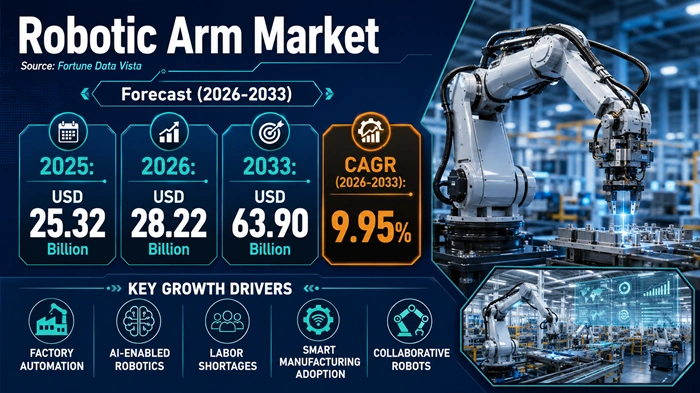
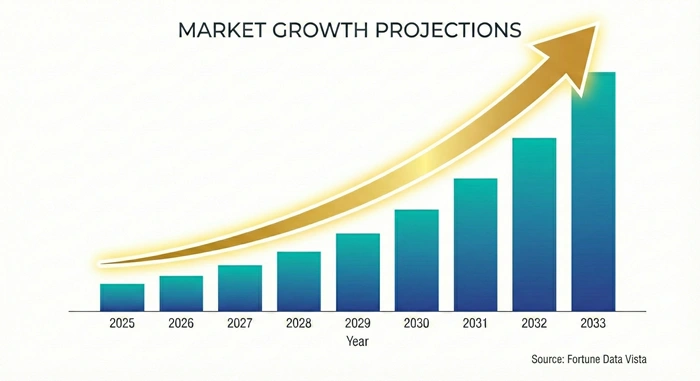
The global robotic arm market size is valued at USD 25.32 billion in 2025 and is predicted to increase from USD 28.22 billion in 2026 to approximately USD 63.90 billion by 2033, growing at a CAGR of 9.95% from 2026 to 2033.
This steady expansion reflects the rising global need for faster, more precise, and more flexible industrial automation across manufacturing, electronics, and logistics operations. Increasing labor costs, growing adoption of Industry 4.0 practices, and continuous investment in smart factory infrastructure are together pushing demand for advanced robotic arm solutions across both developed and emerging economies.
AI Impact on the Robotic Arm Industry
Artificial Intelligence Is Quietly Transforming How Factories Deploy, Train, and Rely on Robotic Arms for Precision Manufacturing
Artificial intelligence is beginning to play a meaningful role in reshaping how robotic arms sense, decide, and act on the factory floor. Machine vision systems integrated into robotic arm controllers are improving pick-and-place accuracy while simultaneously reducing error rates by analyzing complex object orientation and defect patterns that human operators may miss. AI-powered tools are also shortening average task reprogramming time, a significant improvement for manufacturers managing frequent product changeovers during high-mix production runs.
Beyond the assembly line, AI is enabling predictive maintenance modeling by processing large datasets on motor temperature, vibration patterns, and historical failure rates. Manufacturers in high-volume sectors are leveraging these tools to schedule servicing before breakdowns occur. The broader integration of AI into robotic arm fleets also supports real-time performance monitoring across multiple facilities, which strengthens operational efficiency planning, an area that has become central to production strategy following recent global supply chain disruptions.
Growth Factors
Rising Labor Costs, Expanding Automation Mandates, and Technological Breakthroughs Are Converging to Accelerate Robotic Arm Demand
The primary engine driving the robotic arm market forward is the growing global shortage of skilled factory labor. Manufacturing hubs across automotive, electronics, and packaging sectors now face rising wages and difficulty finding workers for repetitive assembly tasks, creating a direct and growing need for automation tools capable of maintaining consistent output. This labor gap creates urgent demand for robotic arms that can operate continuously with minimal supervision.
At the same time, technological innovation is making robotic arms faster, more affordable, and easier to deploy. The widespread adoption of collaborative robotic arms for small-batch production, the development of lightweight materials that reduce arm weight without sacrificing strength, and the emergence of no-code programming interfaces suitable for non-technical operators are all expanding the addressable market. Government programs in countries like China, Germany, and the United States, which include manufacturing modernization incentives and automation tax credits, are further driving institutional procurement of both articulated and collaborative robotic arm systems.
Market Outlook
Strong Institutional Investment, Reshoring Initiatives, and Emerging Market Expansion Are Setting the Stage for Sustained Long-Term Growth
The robotic arm industry is positioned for sustained long-term growth driven by several converging macroeconomic and industrial factors. As reshoring trends bring manufacturing back to North America and Europe, healthcare systems, warehouses, and factories in these regions are building automation capacity for tasks that were previously outsourced to lower-wage regions. This geographic rebalancing of the relevant market represents a significant new source of demand for robotic arm manufacturers and component suppliers.
Emerging markets will be a key battleground for growth through 2033. Countries across Southeast Asia, Latin America, and parts of Eastern Europe are investing heavily in manufacturing infrastructure, including automated assembly lines and robotic arm-equipped production facilities. International trade bodies and regional manufacturing associations continue to fund automation adoption programs that create sustained institutional procurement opportunities. Robotic arm companies that invest early in affordable, easy-to-integrate product lines suited for smaller manufacturers are likely to capture a disproportionate share of this expanding demand.
Expert Speaks
-
"Automation is no longer optional for manufacturers who want to remain competitive; robotic arms are becoming the backbone of modern production lines," said the CEO of ABB Ltd.
-
"We are seeing strong demand for collaborative robots because they let smaller businesses automate without a full factory redesign," noted the CEO of FANUC Corporation.
-
"The next wave of growth will come from AI-enabled robotic arms that can adapt to new tasks without heavy reprogramming," commented the CEO of Yaskawa Electric Corporation.
Key Report Takeaways
-
Asia Pacific leads the global robotic arm market, holding approximately 45% market share in 2025, driven by dense manufacturing bases in China, Japan, and South Korea and heavy government investment in factory automation
-
North America is the fastest-growing region, expected to expand at a CAGR of around 11.8% through 2033, fueled by reshoring initiatives and strong adoption of collaborative robotic arms among small and mid-sized manufacturers
-
Automotive manufacturers are the dominant customer base, relying heavily on robotic arms for welding, painting, and assembly line work due to consistent high-volume production needs
-
Material handling and assembly applications contribute the most to overall demand, accounting for the largest revenue share due to their repetitive nature and suitability for robotic arm precision
-
Articulated robotic arms remain the most popular process type, accounting for approximately 42% of the total product segment in 2026, prized for their flexibility across multiple industrial tasks
-
Collaborative robotic arms will grow the fastest among application segments, holding close to 28% market share with a CAGR near 14% through the forecast period, driven by rising demand from small and mid-sized manufacturers
Market Scope
| Parameter | Details |
|---|---|
| Market Size by 2033 | USD 63.90 Billion | Market Size by 2026 | USD 28.22 Billion | Market Size by 2025 | USD 25.32 Billion | Market Growth Rate from 2026 to 2033 | CAGR of 9.95% | Dominating Region | Asia Pacific | Fastest Growing Region | North America | Segments Covered | Type, Payload Capacity, Application, End User, Region | Regions Covered | North America, Europe, Asia Pacific, Latin America, Middle East & Africa |
Market Dynamics
Drivers Impact Analysis
Rising Labor Costs and Accelerating Smart Manufacturing Adoption Are Emerging as the Two Most Powerful Forces Propelling This Market Forward
| Driver | (≈) % Impact on CAGR Forecast | Geographic Relevance | Impact Timeline |
|---|---|---|---|
| Rising labor costs and skilled worker shortages | ~35% | North America, Europe, East Asia | Short to long-term |
| Adoption of smart factory and Industry 4.0 practices | ~28% | Asia Pacific, North America | Medium to long-term |
| Growth in EV and electronics production | ~20% | Asia Pacific, Europe | Short to medium-term |
| Falling component and sensor costs | ~17% | Global | Medium to long-term |
The rising global cost of skilled factory labor is without question the single most powerful demand driver in the robotic arm market. Wages in manufacturing hubs across North America, Europe, and East Asia have grown steadily over the past decade, and companies increasingly find automation cheaper than sustaining large manual assembly teams. An aging workforce in several developed economies is compounding the problem, introducing urgent demand for robotic arms that can operate continuously with minimal human oversight.
Technological advancement is the second critical driver. The transition from rigid, single-task industrial robots to flexible, AI-enabled robotic arms is enabling manufacturers to handle multiple product variants on the same production line without costly retooling. This matters commercially because shorter product cycles and mass customization trends demand equipment that can be reprogrammed quickly. As manufacturers upgrade production infrastructure globally, procurement of advanced robotic arms and associated control systems is accelerating, particularly in mid-income countries that are now bridging the gap with developed manufacturing economies.
Restraints Impact Analysis
High Upfront Investment and Integration Complexity Continue to Present Real-World Barriers to Full Market Penetration
| Restraint | (≈) % Impact on CAGR Forecast | Geographic Relevance | Impact Timeline |
|---|---|---|---|
| High upfront investment for purchase and integration | ~38% | Latin America, MEA, emerging Asia | Short to medium-term |
| Shortage of skilled technicians for programming and maintenance | ~30% | Global, notable in developing economies | Medium-term |
| Complex integration with legacy production systems | ~20% | Global | Short-term |
| Uneven demand cycles complicating supply planning | ~12% | Global | Ongoing |
The most significant structural restraint in the robotic arm market is the mismatch between where automation demand is highest and where capital budgets are most limited. Small and mid-sized manufacturers in Latin America, the Middle East, and parts of emerging Asia often lack the upfront capital needed to purchase and integrate robotic arms at scale. This creates a gap where the businesses most in need of automation are least able to afford it without financing support or leasing models.
A shortage of skilled technicians who can program, calibrate, and maintain robotic arms remains a persistent operational challenge. Many regions lack sufficient vocational training programs focused on industrial robotics, leading to costly service delays when equipment malfunctions. While simplified programming interfaces are mitigating this issue for newer collaborative units, the higher complexity of traditional industrial robotic arms still limits universal adoption among smaller manufacturers with limited technical staff.
Opportunities Impact Analysis
Non-Traditional Industry Expansion and AI-Driven Flexibility Represent the Most Commercially Significant Growth Opportunities
| Opportunity | (≈) % Impact on CAGR Forecast | Geographic Relevance | Impact Timeline |
|---|---|---|---|
| Expansion into healthcare, agriculture, and logistics | ~40% | Global, early stage in Asia Pacific | Medium to long-term |
| Falling component and AI vision system costs | ~35% | Global | Short to medium-term |
| Growth of leasing and robotics-as-a-service models | ~25% | North America, Europe | Long-term |
The expansion of robotic arm applications into non-traditional sectors such as healthcare, agriculture, and logistics represents one of the most commercially attractive opportunities in this market. These industries are only beginning to explore automation, and robotic arms designed for tasks like surgical assistance, crop sorting, and warehouse picking are opening entirely new customer segments that traditional automotive-focused manufacturers previously overlooked. As robotic arm hardware becomes more adaptable, demand from these emerging verticals is expected to rise sharply.
Falling costs for sensors, motors, and AI-based vision systems are making robotic arms more affordable and easier to deploy for smaller businesses. Robotics-as-a-service models, which allow companies to lease rather than purchase robotic arms, are also opening new distribution channels and customer segments that outright ownership models could not reach. Companies that can deliver flexible, subscription-based robotic arm solutions will find significant commercial opportunity in the procurement programs of small and mid-sized manufacturers.
Segment Analysis
By Type
Articulated Robotic Arms Lead the Product Landscape, Driven by Unmatched Flexibility and the Gold-Standard Status of Multi-Axis Designs
Articulated robotic arms hold the dominant position in the robotic arm market, accounting for approximately 42% of the total product segment in 2026. This dominance is deeply rooted in the mechanical superiority of multi-axis joint design for handling complex tasks like welding, painting, and material handling across awkward angles that other robotic arm types cannot manage easily. In high-income markets like Japan, Germany, and South Korea, automotive and electronics manufacturers have standardized articulated robotic arm workflows, creating stable, recurring demand for these systems. Leading companies such as FANUC, KUKA, and Yaskawa continue to dominate procurement in these markets through well-established distribution networks and engineering reputations.
Asia Pacific is emerging as the fastest-growing region for articulated robotic arm adoption, expanding at a CAGR exceeding 8.9% in countries like China and Japan. The region's enormous automotive and electronics manufacturing base, combined with active government investment in smart factory programs, is generating significant institutional demand for these systems. FANUC and Kawasaki Heavy Industries have strengthened their regional presence through local distribution partnerships and manufacturing tender participation. The broader shift from fixed, single-task robotic arms to flexible, multi-task articulated systems is also being led by this segment, with lighter, faster joint mechanisms gaining traction in electronics assembly plants.
By Application
Collaborative Robotic Arms Are Reshaping Small-Scale Automation, Commanding Rapid Growth Across the Robotic Arm Market
Collaborative robotic arms account for approximately 28% of the total application segment in 2026, reflecting the growing demand from smaller manufacturers seeking accessible automation. With thousands of small workshops and mid-sized factories now exploring automation for the first time, collaborative robotic arm demand represents a foundational growth driver across virtually every developing manufacturing market. Businesses in electronics, food processing, and warehousing maintain growing procurement interest in cobots due to their safety features and simplified programming. This segment operates at a CAGR of nearly 14%, well above the overall robotic arm market average, supported by ongoing demand for automation that does not require major factory redesigns.
North America is the standout growth region for collaborative robotic arms, expanding at approximately 11.8% CAGR, with the United States serving as the primary demand anchor due to reshoring initiatives and labor shortages. Recurrent hiring difficulties in American manufacturing hubs have forced businesses to scale up cobot adoption dramatically, and robotics startups have expanded their collaborative arm offerings in parallel. Companies like Universal Robots and Staubli International have deepened their presence in the region through distributor partnerships and direct sales agreements. Healthcare and logistics applications, while lower in absolute volume, represent rapidly growing application segments due to heightened demand for precision handling and sorting tasks that WHO-aligned safety standards recommend in sensitive environments.
Regional Insights
Asia Pacific
Asia Pacific's Established Manufacturing Infrastructure and Strong Government Investment in Industrial Automation Make It the Global Market Leader
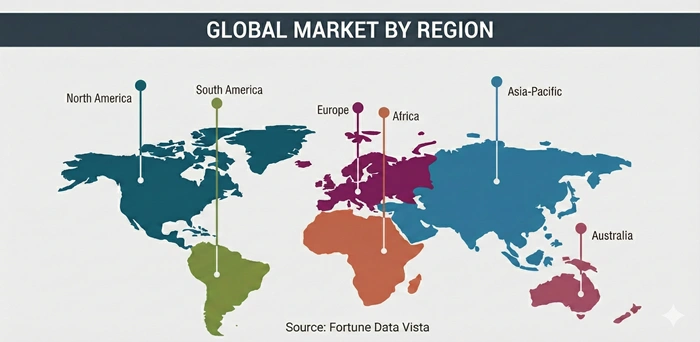
Asia Pacific holds the dominant position in the global robotic arm market with approximately 45% market share in 2025 and is growing at a CAGR of around 10.4% through 2033. China drives the majority of regional demand, supported by a highly developed manufacturing network, strong government investment in smart factory programs, and rapid adoption of articulated and collaborative robotic arm platforms. Key companies with strong Asia Pacific market presence include FANUC, Yaskawa, Kawasaki Heavy Industries, and Denso Corporation, all of which maintain direct sales infrastructure and manufacturing tender agreements in the region. Demand is further reinforced by the expansion of electronics assembly programs and growing awareness of automation benefits among small and mid-sized Chinese manufacturers.
China alone accounts for a substantial share of Asia Pacific revenue, with strong contributions from Japan and South Korea as well. Manufacturers across the region are increasingly adopting flexible, AI-enabled robotic arm solutions that reduce reliance on manual labor for time-sensitive production tasks. India and Australia contribute meaningfully to regional growth, with India investing in domestic manufacturing modernization and Australia scaling up automation capacity as part of its industrial diversification agenda. The combination of strong institutional procurement channels, favorable government incentives, and high manufacturing density ensures Asia Pacific's leadership position remains firmly intact through 2033.
North America
North America Is the Fastest-Growing Region for Robotic Arm Adoption, Powered by Reshoring Initiatives, Labor Shortages, and Aggressive Automation Investment
North America is expected to register the fastest CAGR in the global robotic arm market through 2033, with the United States growing at approximately 11.8%, well above the global average. The region is experiencing strong reshoring momentum as companies bring manufacturing back from overseas, combined with rising interest in collaborative robotic arms among small and mid-sized businesses that previously avoided automation. Companies like Universal Robots, ABB, and Staubli International are expanding their North American distribution capabilities to capture growing institutional procurement volumes. This growth is fueled by labor shortages, competitive wage pressures, and government incentives supporting domestic manufacturing revival.
The United States and Canada are the two markets to watch most closely within the region. The U.S. has seen a surge in robotics startups offering easy-to-integrate cobots, and ongoing federal manufacturing incentives are funding further automation expansion in underserved industrial areas. Canada's market, led by growing automotive supply chain integration with U.S. manufacturing hubs, is also witnessing rapid adoption of automated assembly platforms. Regional manufacturers are increasingly participating in the competitive landscape, offering cost-competitive robotic arm solutions that meet quality benchmarks while addressing affordability concerns for smaller businesses. Comau and Denso have also established distribution partnerships across select North American markets, adding to the competitive intensity in this high-growth region.
Customization Available for This Report
This report offers comprehensive region-wise and country-wise customization, providing tailored market insights, trends, competitive analysis, and opportunity assessments specific to your geography of interest.
Our team can deliver a fully customized version of this report for any of the following regions and countries, providing deep-dive market analysis, demand forecasting, regulatory landscape review, and competitive intelligence specific to the selected market and robotic arm keyword combination:
North America
-
U.S. — Detailed analysis of reshoring trends, manufacturing incentives, and robotic arm procurement patterns
-
Canada — Insights into automotive supply chain integration, provincial manufacturing investment, and cobot adoption programs
-
Mexico — Manufacturing hub expansion, public sector investment, and robotic arm deployment in maquiladora zones
Europe
-
U.K. — Advanced manufacturing automation adoption and clinical robotics research demand
-
Germany — Leading industrial robotics manufacturing landscape, regulatory environment, and engineering adoption rates
-
France — Aerospace and automotive robotic arm demand, and research institute investment
-
Italy — Growing automotive robotic arm screening in manufacturing settings, engineering-driven diagnostics demand
-
Rest of Europe — Emerging automation markets across Eastern Europe and the Baltics
Asia Pacific
-
China — Southern province manufacturing burden, government-funded automation infrastructure, and domestic manufacturer competitiveness
-
India — Manufacturing modernization network, government-funded research demand, and affordable robotic arm market
-
Japan — Advanced robotics adoption, regulatory pathway analysis, and premium product market
-
South Korea — Robotics export industry and institutional procurement
-
Australia — Mining and manufacturing automation investments in industrial territories
-
Rest of Asia Pacific — Country-level analysis covering Thailand, Vietnam, Philippines, Indonesia, and Malaysia
Latin America
-
Brazil — Growing automotive manufacturing market, federal industrial procurement, and research ecosystem
-
Argentina — Emerging automation needs and robotics market development
-
Rest of Latin America — Colombia, Mexico, Peru, and Chile country-level robotic arm market sizing
Middle East & Africa
-
UAE — Advanced automation adoption, Vision-aligned industrial investments, and imported technology screening
-
Saudi Arabia — Industrial modernization, laboratory automation, and manufacturing procurement
-
Rest of MEA — Sub-Saharan Africa automation access expansion, industrial funded programs, and NGO procurement channels
Top Key Players
-
ABB Ltd (Switzerland)
-
FANUC Corporation (Japan)
-
KUKA AG (Germany)
-
Yaskawa Electric Corporation (Japan)
-
Kawasaki Heavy Industries (Japan)
-
Denso Corporation (Japan)
-
Mitsubishi Electric Corporation (Japan)
-
Universal Robots (Denmark)
-
Staubli International AG (Switzerland)
-
Comau S.p.A. (Italy)
-
Epson Robots (Japan)
-
Omron Corporation (Japan)
Recent Developments
-
In 2025, ABB expanded its collaborative robot lineup, adding new lightweight models designed for small workshop assembly tasks and warehouse deployment
-
In 2026, FANUC announced a new AI-powered vision system to improve pick-and-place accuracy for irregular shaped objects in electronics manufacturing
-
In 2025, KUKA opened a new automation research facility focused on flexible robotic arm applications for electric vehicle production
-
In 2026, Yaskawa introduced an upgraded controller platform aimed at reducing programming time for small manufacturers adopting robotic arms
-
In 2025, Universal Robots partnered with several logistics firms to pilot cobot-based sorting systems in warehouse environments across North America
Market Trends
The Robotic Arm Market Is Rapidly Shifting Toward AI-Enabled Flexibility and Collaborative Deployment That Match the Evolving Needs of Modern Manufacturing
Two of the most consequential trends reshaping the robotic arm landscape are the move toward AI-integrated vision systems and the mainstreaming of collaborative deployment in non-traditional settings. AI-powered robotic arms that can adapt to new tasks with minimal reprogramming are replacing rigid, single-task units in well-equipped factories and warehouses. This trend is reducing setup costs per deployment, improving production flexibility, and enabling more precise quality control during high-mix manufacturing runs. Companies that offer validated AI-enabled solutions with strong performance track records are gaining market share at the expense of traditional fixed-automation manufacturers.
The second major trend is the geographic broadening of robotic arm adoption into small and mid-sized businesses across North America and Europe, which is pushing manufacturers in these regions to build automation capacity they previously considered too costly. This is opening entirely new market segments, community workshops, regional food processors, and boutique manufacturers, that historically had little need for industrial robotic arms. At the same time, the digitalization of production monitoring systems, including automated performance reporting platforms that connect robotic arm data to central factory dashboards in near real-time, is creating a new layer of service revenue for automation companies that integrate software and connectivity into their hardware.
Segments Covered in the Report
-
By Type
-
Articulated Robotic Arms
-
Six-Axis Systems
-
Multi-Axis Welding Arms
-
Heavy-Duty Industrial Arms
-
-
SCARA Robotic Arms
-
Electronics Assembly Units
-
High-Speed Pick and Place Systems
-
-
Cartesian Robotic Arms
-
Gantry Systems
-
Linear Motion Platforms
-
-
Cylindrical Robotic Arms
-
Compact Assembly Units
-
-
Delta Robotic Arms
-
High-Speed Sorting Systems
-
-
-
By Payload Capacity
-
Low Payload
-
Medium Payload
-
High Payload
-
-
By Application
-
Material Handling
-
Palletizing Systems
-
Conveyor Integration Units
-
-
Welding & Soldering
-
Arc Welding Arms
-
Spot Welding Systems
-
-
Assembly
-
Precision Assembly Units
-
Fastening Systems
-
-
Painting & Coating
-
Spray Coating Arms
-
-
Pick and Place
-
Vision-Guided Systems
-
-
Collaborative Applications
-
Small Workshop Deployment
-
Warehouse Sorting Cobots
-
-
-
By End User
-
Automotive
-
Electronics
-
Food & Beverage
-
Healthcare
-
Logistics & Warehousing
-
Others
-
-
By Region
-
North America (U.S., Canada, Mexico)
-
Europe (U.K., Germany, France, Italy, Rest of Europe)
-
Asia Pacific (China, India, Japan, South Korea, Australia, Rest of Asia Pacific)
-
Latin America (Brazil, Argentina, Rest of Latin America)
-
Middle East & Africa (UAE, Saudi Arabia, Rest of MEA)
-
❝ Built for Every Level — From Startups to Industry Giants ❞
Here Is Exactly How This Report Works for You
-
For tier 1 enterprises, investors, and high-level decision-makers, this report delivers competitor revenue analysis, detailed revenue source breakdowns, geopolitical risk assessments, and supply-demand dynamics that enable confident capital allocation, M&A targeting, and strategic market entry or expansion decisions in the robotic arm space
-
For tier 2 and tier 3 companies, mid-level businesses, and startups, this report provides a practical roadmap of the most commercially viable segments, regional opportunities, and technology investment priorities, helping you compete effectively against established players and identify white spaces before they become crowded
-
For all decision-makers across the value chain, this report explains exactly how trade policy shifts, reshoring trends, component supply funding flows, and competitor positioning are converging to shape market direction through 2033, giving you the intelligence framework to make proactive, evidence-based decisions rather than reactive ones
Frequently Asked Questions:
Answer: The global robotic arm market was valued at USD 25.32 billion in 2025 and is projected to reach USD 63.90 billion by 2033. This growth is driven by expanding factory automation and increasing investment in AI-enabled robotics infrastructure globally.
Answer: The primary drivers of the robotic arm market include rising labor costs and skilled worker shortages alongside growing adoption of smart factory practices. Advancements in AI-based vision systems and collaborative robotics are further accelerating adoption across manufacturing sectors.
Answer: Asia Pacific currently dominates the robotic arm market with approximately 45% market share, supported by dense manufacturing infrastructure and strong government investment. North America is the fastest-growing region, driven by reshoring trends and rising cobot adoption.
Answer: Articulated robotic arms account for approximately 42% of the product segment, reflecting their flexibility across multiple industrial tasks. Collaborative robotic arms are also contributing meaningfully, especially among small and mid-sized manufacturers.
Answer: Leading players in the robotic arm market include ABB, FANUC, KUKA, Yaskawa Electric, and Kawasaki Heavy Industries. These companies compete through broad product portfolios, global distribution networks, and continuous investment in AI-enabled automation innovation.