
Satellite Market Overview
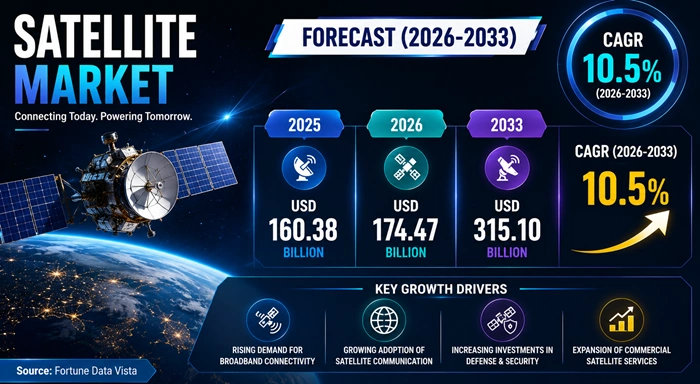
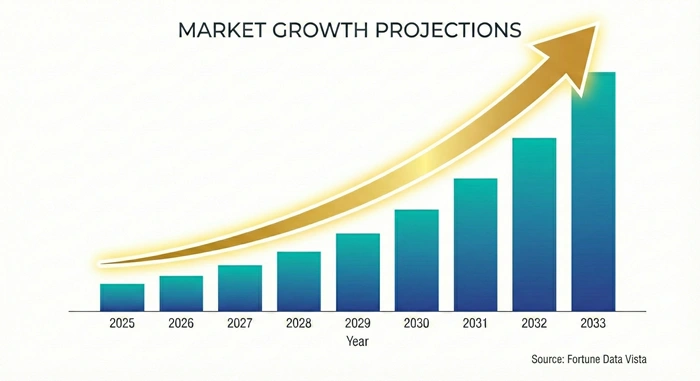
The global satellite market size is valued at USD 160.38 billion in 2025 and is predicted to increase from USD 174.47 billion in 2026 to approximately USD 315.10 billion by 2033, growing at a CAGR of 10.5% from 2026 to 2033.
Space is no longer the exclusive domain of government agencies and massive defense contractors. A broad and diverse wave of commercial investment, driven by falling launch costs, miniaturized satellite technology, and global demand for broadband connectivity, is reshaping the space and satellite industry from the ground up. The satellite market is expanding rapidly across communication, Earth observation, navigation, and defense applications as both established aerospace primes and agile NewSpace startups race to build, launch, and monetize orbital infrastructure at an unprecedented pace. With mega-constellations from SpaceX, OneWeb, and Amazon entering commercial operation alongside growing government satellite investment globally, the industry is entering one of its most commercially dynamic periods in history.
AI Impact on the Satellite Industry
Artificial Intelligence Is Transforming Every Layer of the Satellite Industry — from Autonomous Satellite Operations and Onboard Processing to Ground Segment Analytics and Earth Observation Intelligence
Artificial intelligence is fundamentally changing how satellites are designed, operated, and monetized, enabling a new generation of intelligent orbital platforms that can process data autonomously, adapt to operational conditions in real time, and communicate only the most relevant information to ground stations rather than transmitting raw data streams that require enormous bandwidth and ground-side processing infrastructure. Edge AI computing capabilities embedded in modern satellite payloads allow onboard processing of hyperspectral imagery, synthetic aperture radar data, and radio frequency intelligence without waiting for downlink and terrestrial analysis cycles — compressing the latency between satellite observation and actionable insight from hours to minutes or even seconds. This capability is transformative for time-sensitive applications including maritime vessel tracking, wildfire detection, precision agriculture monitoring, and military surveillance, where decision advantage depends on the speed of geospatial intelligence delivery.
On the ground segment side, AI and machine learning are enabling satellite operators to manage increasingly complex mega-constellation networks with operational efficiency that would be impossible through manual management at the scale of hundreds or thousands of simultaneously operating satellites. Automated conjunction analysis systems powered by machine learning continuously monitor orbital collision risks and calculate avoidance maneuvers for satellite fleets, while AI-driven spectrum management algorithms optimize frequency allocation and interference avoidance across congested orbital bands in real time. For commercial Earth observation companies including Planet Labs, Maxar, and Satellogic, AI-powered change detection and object recognition algorithms are the core value-creation layer that transforms raw satellite imagery into the intelligence products — ships detected, buildings counted, crops assessed — that end customers are actually willing to pay for. The integration of AI across the satellite market's full value chain is creating new service business models and customer value propositions that extend well beyond the traditional hardware and launch revenue streams.
Growth Factors
The Commercial LEO Broadband Revolution, Rising Government Defense and Intelligence Satellite Investment, and the Growing Commercial Earth Observation Economy Are the Three Primary Growth Engines of the Satellite Market
The deployment of low earth orbit (LEO) broadband satellite mega-constellations is the defining commercial development of the current generation of the satellite industry, and its impact on the satellite market's growth trajectory is profound. SpaceX's Starlink, which already has over 7,000 satellites in orbit as of 2026, has demonstrated that satellite internet can be delivered at consumer-competitive speeds and latency to users in rural, remote, and mobility applications that traditional terrestrial broadband cannot reach cost-effectively. Amazon's Project Kuiper, Eutelsat OneWeb, and China's Guowang constellation are all actively deploying competing LEO broadband networks, driving a multi-year surge in satellite manufacturing, launch services, and ground terminal procurement that is visible across the entire satellite supply chain. The global market for satellite broadband connectivity extends to hundreds of millions of underserved households, businesses, ships, aircraft, and cellular backhaul applications — a total addressable market that makes the commercial economics of these mega-constellations compelling for the operators who successfully achieve scale.
Rising government investment in space-based defense, intelligence, and national security capabilities is providing a second, stable, and high-value growth pillar for the satellite market across all major space-faring nations. The U.S. Space Force's proliferated LEO satellite programs — including the Proliferated Warfighter Space Architecture (PWSA) — represent multi-billion-dollar procurement programs for resilient, distributed military satellite communications and missile warning capabilities. European governments are investing in sovereign satellite capabilities through the EU Space Programme (including Galileo, Copernicus, and the emerging IRIS² LEO broadband constellation), while China, India, Japan, and South Korea are all expanding their national satellite programs across communication, reconnaissance, and navigation application domains. This parallel government demand stimulus across multiple major economies ensures that the satellite market has a deep and diversified demand foundation that insulates it from the volatility of any single application or geography's investment cycle.
Market Outlook
The Satellite Market Is Entering a Multi-Decade Growth Era — Driven by the Convergence of Falling Launch Costs, Expanding Space Economy Applications, and the Progressive Integration of Satellite Connectivity Into Every Layer of the Global Digital Infrastructure
The long-term outlook for the satellite market is exceptionally positive, anchored by the structural reality that satellite-based services address communication, observation, and navigation needs that terrestrial infrastructure physically cannot serve — and the universe of applications where satellite infrastructure is the most practical or only viable solution is expanding, not contracting, as global connectivity demand grows and new use cases from autonomous vehicles to precision agriculture to emergency response emerge. The commercial space economy — encompassing satellite manufacturing, launch services, ground systems, satellite-derived data services, and end-user applications — is transitioning from a cost-center dominated by government space agencies to a commercially driven, innovation-intensive industry that is attracting billions in private venture capital and public market investment annually.
Looking toward 2033, the satellite market's most significant commercial development will be the full commercial deployment and revenue maturation of LEO broadband constellations that are currently in their growth phase, combined with the emergence of satellite-to-cellular direct-to-device connectivity as a mainstream capability integrated into standard smartphones without requiring specialized terminals. The integration of satellite connectivity into the 5G and eventual 6G terrestrial cellular ecosystem — a development actively pursued by SpaceX, AST SpaceMobile, and major telecom operators — will transform satellite from a specialized connectivity solution into a ubiquitous network layer available to every mobile device user on Earth. This transition, if successfully commercialized within the forecast horizon, will structurally expand the total addressable market for the satellite market far beyond current projections and create a new paradigm of universal, seamless connectivity that drives exponential growth in satellite data traffic and service revenue.
Expert Speaks
-
"At Lockheed Martin, we are seeing the most dynamic period of space investment and innovation in the history of our space systems business. Defense customers are demanding more resilient, proliferated satellite architectures, commercial customers are building mega-constellations at unprecedented scale, and new applications in Earth observation, navigation, and communications are creating entirely new markets for satellite technology. Our investments in next-generation satellite production, digital engineering, and on-orbit servicing capabilities are positioning us to be the trusted partner of choice for customers navigating this extraordinarily dynamic environment in the satellite market." — James Taiclet, President & CEO, Lockheed Martin Corporation
-
"Boeing's satellite division is at an exciting inflection point as the commercial and government satellite markets both transform simultaneously. The transition to proliferated LEO architectures in defense, the rise of high-throughput commercial communication satellites serving mobility and broadband applications, and the growing strategic importance of space-based intelligence and surveillance capabilities are all creating substantial new demand for Boeing's satellite technology and systems integration expertise — and we are investing in the digital manufacturing and software-defined satellite capabilities needed to compete and win in this transformed market environment." — Kelly Ortberg, President & CEO, The Boeing Company
-
"Northrop Grumman's satellite and spacecraft portfolio sits at the intersection of the most strategically important trends in the space economy — resilient government communications, next-generation Earth observation, and commercial space infrastructure. The increasing prioritization of space as a critical national security domain by the U.S. government and its allies, combined with the commercial boom in LEO satellite deployment, is creating a sustained investment cycle in the satellite market that we expect to support multi-year revenue growth across our space systems business." — Kathy Warden, Chairman, President & CEO, Northrop Grumman Corporation
Key Report Takeaways
-
North America dominates the global satellite market, holding the largest regional revenue share of approximately 38% in 2025, underpinned by the United States' position as the world's leading satellite manufacturing, launch services, and satellite-derived data services economy — encompassing the largest concentration of commercial satellite operators, NewSpace startups, and government defense satellite procurement programs of any country globally, led by companies including SpaceX, Lockheed Martin, Boeing, Northrop Grumman, and Maxar Technologies.
-
Asia Pacific is the fastest growing regional market for satellites, with China's massive national space program and commercial satellite sector, India's rapidly expanding space industry under ISRO's commercial liberalization reforms, and the growing satellite procurement programs of Japan, South Korea, and Southeast Asian nations all contributing to a regional CAGR that substantially exceeds the global average — making Asia Pacific the most commercially significant growth geography for satellite market participants through 2033.
-
Communication satellites represent the largest application segment in the satellite market, accounting for over 45% of total revenue in 2025 as the combined demand from commercial broadband LEO constellations, traditional geostationary communication satellites serving broadcast, maritime, and aviation applications, and government military communication satellites creates the largest and most diversified application revenue pool in the entire satellite industry.
-
Low Earth Orbit (LEO) satellites are the dominant and fastest growing orbit segment, capturing the majority of new satellite investment and deployment activity globally as the economics of mass-produced, standardized small satellites in LEO constellations dramatically outcompete the traditional geostationary satellite model for broadband, Earth observation, and IoT connectivity applications at scale.
-
Small satellites and CubeSats are the most rapidly growing satellite type, driven by their dramatically lower manufacturing and launch costs compared to traditional large satellites, their suitability for constellation architectures that deliver global coverage through large numbers of low-cost nodes, and the flourishing commercial Earth observation and IoT connectivity application markets that small satellites can serve cost-effectively.
-
The Earth observation and remote sensing segment is the highest-growth application beyond communication, projected to achieve a market share exceeding 20% by 2033 at a CAGR of approximately 14.2%, driven by rapidly growing commercial demand for satellite imagery and geospatial analytics from agriculture, infrastructure monitoring, environmental assessment, defense intelligence, and urban planning customer sectors that are increasingly adopting satellite-derived data as a standard operational intelligence input.
Market Scope
| Parameter | Details |
|---|---|
| Market Size by 2033 | USD 315.10 Billion | Market Size by 2026 | USD 174.47 Billion | Market Size by 2025 | USD 160.38 Billion | Market Growth Rate from 2026 to 2033 | CAGR of 10.5% | Dominating Region | North America | Fastest Growing Region | Asia Pacific | Segments Covered | Satellite Type, Orbit Type, Application, End User, Component | Regions Covered | North America, Europe, Asia Pacific, Latin America, Middle East & Africa |
Market Dynamics
Drivers Impact Analysis
The Falling Cost of Satellite Manufacturing and Launch, Surging Global Broadband Demand, and the Strategic Militarization of Space Are Creating a Historically Unprecedented Multi-Sector Demand Environment for the Satellite Market
| Driver | ≈ % Impact on CAGR Forecast | Geographic Relevance | Impact Timeline |
|---|---|---|---|
| LEO broadband constellation deployment and commercial satellite internet demand | ~36% | Global — especially emerging markets, maritime, aviation | Short to Long Term |
| Government defense and national security satellite investment | ~28% | North America, Europe, Asia Pacific | Short to Long Term |
| Falling satellite manufacturing and launch costs enabling commercial viability | ~22% | Global — especially commercial and NewSpace sector | Short to Medium Term |
| Earth observation and geospatial analytics demand growth | ~14% | Global — agriculture, defense, infrastructure, environment | Short to Long Term |
The commercial viability of mega-constellation satellite broadband has been proven by Starlink's rapid subscriber growth — exceeding 4 million users globally by 2025 — and the subsequent acceleration of competing constellation deployment programs by Amazon, Eutelsat OneWeb, and Chinese operators. This demonstrated commercial success is driving a second wave of satellite manufacturing procurement and launch vehicle demand as operators scale from pilot deployment to global commercial rollout, creating multi-year demand visibility for satellite manufacturers, component suppliers, and launch service providers that is strengthening investment confidence across the entire satellite supply chain. The long-term addressable market for LEO broadband — serving billions of underserved people globally plus high-value mobility applications — ensures that this demand wave will sustain well into the 2030s.
The progressive reduction in satellite manufacturing and launch costs — driven by SpaceX's reusable Falcon 9 launch vehicles, the transition to mass production manufacturing techniques for small satellite components, and the growing availability of commercial launch services — is lowering the financial barrier to entry for new satellite operators and enabling business cases that would have been uneconomical with traditional launch and hardware cost structures. This democratization of satellite access is expanding the satellite market's commercial ecosystem beyond the traditional government-dominated customer base to include commercial operators across agriculture, maritime, insurance, financial services, and media — customer segments whose data and connectivity requirements create new and diversified revenue streams that reduce the market's historical dependence on government procurement cycles.
Restraints Impact Analysis
Space Debris Accumulation, Orbital Spectrum Congestion, High Capital Requirements for Constellation Deployment, and International Regulatory Complexity Are the Primary Constraints Limiting Even Faster Satellite Market Expansion
| Restraint | ≈ % Impact on CAGR Forecast | Geographic Relevance | Impact Timeline |
|---|---|---|---|
| Space debris accumulation and orbital collision risk | ~36% | Global — especially LEO operators | Medium to Long Term |
| Spectrum congestion and radio frequency interference management | ~32% | Global — GEO and LEO operators | Short to Medium Term |
| High capital requirements for large-scale constellation deployment | ~32% | Global — especially new entrant operators | Short to Medium Term |
Space debris presents one of the most significant long-term structural risks to the satellite market, as the rapid growth of LEO satellite constellations is dramatically increasing the number of orbital objects and the statistical probability of collisions that generate additional debris in a cascading effect known as the Kessler Syndrome. The United States Space Surveillance Network currently tracks over 27,000 objects in orbit, and the addition of mega-constellations by multiple operators in already-congested orbital bands is creating collision risk management challenges that require dedicated maneuvering propellant budgets, automated avoidance systems, and international coordination frameworks that add operational cost and complexity to satellite operations. Regulatory agencies including the FCC and ITU are tightening orbital debris mitigation requirements, including mandatory deorbit within five years of end-of-life for LEO satellites, which increases the lifecycle cost of constellation operations and affects business model economics.
The capital intensity of satellite constellation deployment remains a significant constraint on the pace of market development, as fully deploying a competitive LEO broadband constellation of hundreds to thousands of satellites requires billions of dollars of sustained capital investment before revenue at scale can be generated — a financial profile that limits participation to well-capitalized operators backed by either sovereign government investment or access to deep private capital markets. This capital barrier is slowing the entry of potential new competitors in emerging market countries who could benefit from developing domestic satellite capabilities, and it is creating significant balance sheet pressure on operators including Eutelsat OneWeb and Telesat Lightspeed who are simultaneously managing constellation deployment capital requirements and servicing existing debt obligations from legacy GEO satellite business models.
Opportunities Impact Analysis
Direct-to-Device Satellite Connectivity, On-Orbit Servicing and Space Logistics, and the Commercial Earth Observation Data Economy Are the Three Most Transformative Commercial Opportunities in the Satellite Market
| Opportunity | ≈ % Impact on CAGR Forecast | Geographic Relevance | Impact Timeline |
|---|---|---|---|
| Direct-to-device satellite connectivity integrated into smartphones | ~40% | Global — all mobile users | Medium to Long Term |
| On-orbit servicing, assembly, and debris removal technology commercialization | ~32% | North America, Europe, Asia Pacific | Medium to Long Term |
| Commercial Earth observation data analytics and geospatial intelligence services | ~28% | Global — agriculture, defense, infrastructure, environment | Short to Long Term |
The integration of satellite connectivity directly into standard mobile devices — without requiring specialized user terminals — represents the most commercially significant market expansion opportunity in the satellite industry. Companies including AST SpaceMobile, SpaceX (direct-to-cell Starlink), and Apple (emergency satellite messaging) are pioneering commercial direct-to-device services that allow standard smartphones to connect to satellite networks using existing cellular radio technology. If successfully commercialized at mass market price points, this capability could transform every mobile phone on Earth into a satellite-connected device — creating a subscription revenue opportunity that dwarfs the existing satellite internet market and fundamentally changes the telecommunications competitive landscape globally. The satellite market's total addressable revenue from direct-to-device services could reach hundreds of billions of dollars annually if adoption approaches the scale of global mobile subscriber penetration.
The emerging on-orbit servicing and space logistics sector represents a commercially nascent but potentially transformative opportunity for the satellite market, addressing the challenge that traditionally, satellites have been disposable systems that must be replaced at end of life regardless of whether their spacecraft bus remains operational. Companies including Northrop Grumman (Mission Extension Vehicle), Astroscale, and D-Orbit are developing and deploying commercial on-orbit servicing vehicles that can refuel, repair, reposition, and deorbit satellites — extending asset lifetimes, reducing replacement procurement costs, and addressing the growing space debris challenge simultaneously. As the commercial satellite fleet grows to thousands of assets in LEO and GEO orbits, the economics of on-orbit servicing will become increasingly compelling for satellite operators seeking to maximize the return on their orbital investments, creating a new and potentially large service revenue stream within the broader satellite market.
Segment Analysis
By Application
Communication Satellites Lead the Satellite Market in Revenue While Earth Observation Is the Fastest Growing Application Segment Driven by Commercial Data Demand
Communication is the dominant application segment in the satellite market, accounting for approximately 45% of total revenue in 2025 and growing at a CAGR of approximately 10.8% through 2033. The segment encompasses a broad and commercially diverse range of satellite communication services — from traditional geostationary broadcast and VSAT enterprise services through the rapidly growing LEO broadband constellations and mobile satellite services for maritime and aviation — all of which are experiencing demand growth driven by the global expansion of data consumption, remote work and education, and the proliferation of connected devices requiring reliable global connectivity. North America leads communication satellite revenue by a substantial margin, home to the world's largest and most commercially active satellite communication operators including SES, ViaSat, Hughes Network Systems, and Intelsat alongside SpaceX's Starlink — companies that collectively operate the most extensive commercial satellite communication capacity in the world. Asia Pacific is the fastest growing region for satellite communication demand, where the combination of underserved rural populations in India, Southeast Asia, and the Pacific Islands and rapidly growing aviation and maritime traffic volumes is creating strong incremental demand for LEO broadband services and high-throughput GEO satellite capacity.
Earth observation and remote sensing represents approximately 20% of total satellite market revenue in 2025 and is growing at the fastest application-segment CAGR of approximately 14.2% through 2033, driven by an extraordinary expansion of commercial demand for satellite imagery and geospatial analytics that is transforming Earth observation from a primarily government intelligence function into a broadly commercial data product consumed across agriculture, infrastructure, insurance, financial services, defense, environmental monitoring, and urban planning sectors. The commercial Earth observation industry has been revolutionized by the deployment of small satellite constellations by Planet Labs (over 200 daily imaging satellites), Satellogic, BlackSky, and ICEYE — companies that can provide daily or sub-daily imagery of any location on Earth at a fraction of the cost of traditional large observation satellites. Europe is a leading market for commercial Earth observation services, driven by the EU Copernicus program's open data infrastructure that stimulates commercial downstream applications, and the strong demand for precision agriculture, environmental compliance monitoring, and infrastructure inspection services from European corporate and government customers operating in the satellite market.
By End User
Government and Defense Remains the Largest Revenue-Contributing End-User Segment While the Commercial Sector Is Driving the Fastest Revenue Growth in the Satellite Market
Government and defense end users represent approximately 48% of total satellite market revenue in 2025 and are growing at a CAGR of approximately 9.5% through 2033, driven by the strategic prioritization of space as a critical national security domain and the accelerating military investment in resilient, proliferated satellite architectures that are less vulnerable to adversarial anti-satellite capabilities than traditional large GEO communication and intelligence satellites. The U.S. Space Force, U.S. Intelligence Community, European national defense agencies, and Asian military space programs are all expanding their satellite procurement budgets — developing new satellite communication constellations, missile warning systems, space domain awareness platforms, and reconnaissance assets that represent multi-billion-dollar annual procurement programs for satellite manufacturers and systems integrators. North America leads government and defense satellite spending, with the United States' Space Force and National Reconnaissance Office operating the world's most capable and extensively funded military satellite architecture — procured through Lockheed Martin, Northrop Grumman, Boeing, and L3Harris as the primary prime contractors within the broader satellite market.
The commercial end-user segment accounts for approximately 38% of total revenue in 2025 but is growing at the fastest end-user CAGR of approximately 13.7% through 2033, driven primarily by the commercial satellite internet, Earth observation, and IoT connectivity markets. The commercial satellite sector has been transformed by the entry of well-capitalized technology companies including Amazon (Project Kuiper), SpaceX (Starlink), and Apple (satellite messaging) alongside traditional operators including SES, Intelsat, and ViaSat — creating a competitive and rapidly innovating commercial ecosystem that is attracting private investment at a pace unprecedented in the satellite industry's history. Asia Pacific is the most commercially dynamic region for private satellite investment outside the United States, with Chinese commercial satellite operators including MingLiang (Guowang constellation), SatNet, and GalaxySpace raising substantial private capital and benefiting from government policy support to develop domestic commercial satellite capabilities that compete with Western operators in both domestic and international markets.
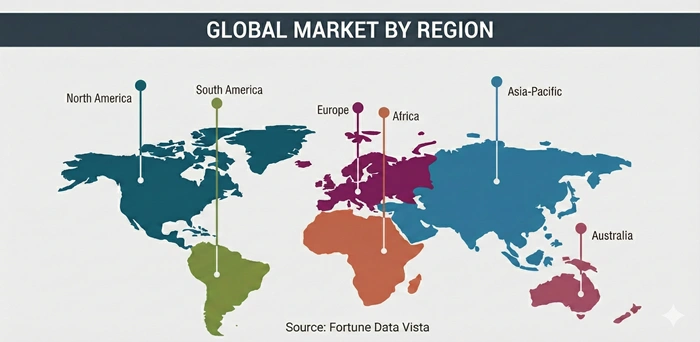
Regional Insights
North America
North America Is the Undisputed Global Leader of the Satellite Market — Home to the World's Most Advanced Satellite Technology Companies, the Largest Commercial Satellite Operators, and the Most Generously Funded Government Space Programs
The United States' Combination of SpaceX's Starlink Mega-Constellation, Department of Defense Satellite Investment, and the World's Deepest NewSpace Startup Ecosystem Makes North America the Defining Commercial and Technological Center of the Global Satellite Industry
North America commands approximately 38% of global satellite market revenue in 2025, a dominant position built on the United States' unparalleled concentration of satellite technology companies, launch service providers, commercial satellite operators, and government space program investment. SpaceX's Starlink constellation — the world's largest by satellite count — has established North America as the operational center of the LEO broadband revolution, while traditional large satellite manufacturers including Lockheed Martin, Northrop Grumman, Boeing, and L3Harris continue to execute multi-billion-dollar government defense satellite contracts that sustain a deep and technologically advanced manufacturing base. The region is projected to grow at a CAGR of approximately 10.1% from 2026 to 2033, reflecting continued robust government space investment, the commercial maturation of Starlink and Project Kuiper broadband services, and the rapid growth of commercial Earth observation, IoT connectivity, and space services companies that collectively constitute the world's most vibrant commercial space economy. Key commercial players including Maxar Technologies, Planet Labs, ViaSat, Hughes Network Systems, and Iridium complement the large prime contractors in providing a full-spectrum commercial satellite service offering.
Canada contributes a specialized and internationally respected satellite technology sector, with companies including MDA Space (formerly MacDonald, Dettwiler and Associates) providing satellite bus manufacturing, space robotics, and Earth observation capabilities that are integral to international space programs including the International Space Station's Canadarm and commercial satellite constellations. Canada's government space agency (CSA) investments in Earth observation and scientific satellites add a sovereign institutional demand layer to North America's satellite procurement base. Mexico's satellite market remains more modest in scale but is growing as the country's private sector and government invest in satellite services — particularly broadband internet and remote sensing applications — that support rural connectivity and agricultural monitoring programs aligned with national development priorities.
Asia Pacific
Asia Pacific Is the Fastest Growing Regional Satellite Market — Powered by China's Massive National Constellation Programs, India's Liberalized Commercial Space Policy, and the Growing Space Ambitions of Japan, South Korea, and Southeast Asian Nations
The Simultaneous Expansion of China's Guowang LEO Mega-Constellation, India's IN-SPACe Commercial Space Liberalization, and Multiple Asian Government Military Satellite Programs Is Creating the Most Consequential Regional Growth Story in the Global Satellite Market
Asia Pacific is the fastest growing region in the satellite market, with a projected CAGR of approximately 13.2% from 2026 to 2033, driven by a powerful and diversified combination of national government space program expansion, commercial satellite constellation deployment by Chinese operators, and India's rapidly developing space industry ecosystem following the liberalization of India's space sector under the IN-SPACe framework and the commercial successes of ISRO's commercial launch services. The region currently accounts for approximately 28% of global satellite market revenue in 2025, a share that is growing rapidly as China, India, Japan, South Korea, and Australia all accelerate their satellite investments across communication, Earth observation, and navigation domains. China's Guowang constellation — a state-backed LEO broadband mega-constellation targeting over 12,000 satellites — is the most significant single satellite program in Asia Pacific and is driving enormous domestic satellite manufacturing and launch vehicle demand that is transforming China's commercial space industrial base. Key regional companies including SatNet (China), GalaxySpace (China), iQPS (Japan), Synspective (Japan), and ISRO's commercial arm (NewSpace India Limited) are active participants in the growing Asia Pacific satellite market.
India represents the most exciting emerging commercial satellite market within Asia Pacific, combining a government policy environment that now actively encourages private sector space investment with one of the world's most talented and cost-efficient aerospace engineering workforces — factors that are attracting global satellite operators to establish Indian manufacturing and operations partnerships while simultaneously enabling Indian startups including Skyroot Aerospace, Agnikul Cosmos, and Pixxel to develop domestic satellite manufacturing and launch capabilities. Japan's JAXA and its commercial partners are advancing next-generation Earth observation, navigation augmentation, and space situational awareness satellite programs, while South Korea's defense satellite programs and commercial Earth observation ambitions are creating growing domestic and export market opportunities for Korean aerospace companies. Australia's geography — spanning remote areas ideally served by satellite broadband — and its government space agency's growing international partnerships are making the country an increasingly important satellite services market and regional hub for Asia Pacific satellite operations.
Report Customization Available by Region and Country
Access Precise, Geography-Tailored Satellite Market Intelligence Through Our Region-Wise and Country-Wise Customized Reports — Built to Serve the Specific Regulatory, Competitive, and Commercial Dynamics of Every Market You Operate In
This report is available for full customization across all major global regions and individual countries, enabling satellite manufacturers, launch service providers, satellite communication operators, Earth observation companies, government space agencies, defense contractors, and institutional investors to access intelligence tailored precisely to the satellite market dynamics and competitive landscape of their target geography. A customized report delivers country-level market sizing, application demand analysis, regulatory and licensing environment assessment, competitive landscape profiling, and strategic opportunity identification specific to the satellite market in the selected region or country.
Customized satellite market reports are available for all of the following regions and countries, providing detailed market insights, competitive intelligence, regulatory landscape analysis, and growth opportunity assessments tailored to each specific geography:
North America
-
U.S. — World's largest satellite market analysis, SpaceX Starlink commercial trajectory, DoD and Space Force procurement programs, NewSpace ecosystem investment landscape, and competitive benchmarking of Lockheed Martin, Northrop Grumman, Boeing, Maxar, and Planet Labs
-
Canada — MDA Space competitive positioning, CSA program investment analysis, Earth observation export market development, and satellite manufacturing supply chain analysis
-
Mexico — Satellite broadband adoption trajectory, rural connectivity program satellite demand, and commercial Earth observation market development
Europe
-
U.K. — OneWeb competitive positioning, Surrey Satellite Technology leadership in small satellites, national space strategy investment programs, and defense satellite procurement analysis
-
Germany — OHB SE and Airbus Defence & Space competitive profiles, European Earth observation industry analysis, Bundeswehr defense satellite program, and commercial space startup ecosystem
-
France — Airbus Group satellite systems competitive positioning, Thales Alenia Space program analysis, ArianeGroup launch services dynamics, and CNES program investment impact
-
Italy — Thales Alenia Space Italy manufacturing analysis, ASI agency program investment, satellite component export market development, and GEO satellite systems competitiveness
-
Rest of Europe — EU IRIS² LEO constellation program impact, Scandinavian Earth observation market leadership, Eastern Europe satellite services demand, and ESA program investment distribution
Asia Pacific
-
China — Guowang constellation deployment analysis, SatNet and GalaxySpace competitive profiles, government space industry support policy, and commercial Earth observation sector development
-
India — IN-SPACe liberalization impact, ISRO commercial program analysis, Skyroot and Agnikul startup ecosystem, and satellite broadband connectivity demand
-
Japan — JAXA program investment, iQPS and Synspective commercial Earth observation competitive profiles, navigation augmentation satellite demand, and defense satellite program analysis
-
South Korea — Government defense satellite programs, commercial Earth observation sector development, KARI agency investment, and Korean Aerospace Industries (KAI) satellite manufacturing
-
Australia — ASA program development, satellite broadband adoption in remote areas, geospatial intelligence services demand, and Asia Pacific regional hub development strategy
-
Rest of Asia Pacific — Southeast Asia satellite broadband demand, Singapore's commercial space hub development, and emerging national space agency investment programs
Latin America
-
Brazil — AEB space agency program analysis, domestic satellite manufacturing development, satellite broadband rural connectivity demand, and Brazilian agricultural Earth observation market
-
Argentina — INVAP satellite manufacturing competitive profile, government space program investment, and satellite broadband connectivity demand analysis
-
Rest of Latin America — Chile, Colombia, Peru satellite broadband adoption, regional Earth observation demand, and commercial space services market entry opportunity
Middle East & Africa (MEA)
-
UAE — Mohammed Bin Rashid Space Centre competitive profile, Earth observation satellite program development, commercial space investment ecosystem, and regional satellite hub ambitions
-
Saudi Arabia — Vision 2030 space industry development, government satellite communication investment, NEOM smart city satellite infrastructure requirements, and commercial Earth observation demand
-
Rest of MEA — South Africa satellite program development, Egypt NileSat GEO satellite operations, Sub-Saharan Africa satellite broadband connectivity demand, and African Space Agency program development
Top Key Players
-
SpaceX (Starlink) (United States)
-
Lockheed Martin Corporation (United States)
-
Northrop Grumman Corporation (United States)
-
The Boeing Company (United States)
-
Airbus Defence and Space (France / Germany)
-
Thales Alenia Space (France / Italy)
-
SES S.A. (Luxembourg)
-
Maxar Technologies (United States)
-
Planet Labs PBC (United States)
-
OHB SE (Germany)
-
Surrey Satellite Technology Ltd. (SSTL) (United Kingdom)
-
Eutelsat Communications (OneWeb) (France)
Recent Developments
-
In 2025, SpaceX surpassed 4 million active Starlink subscribers globally, launched the first Starlink direct-to-cell satellites providing mobile connectivity to standard smartphones through agreements with T-Mobile, Optus, and KDDI, and announced the next-generation Starlink V3 satellite design featuring dramatically increased per-satellite capacity — cementing Starlink's position as the world's largest and most commercially advanced satellite internet service while establishing the satellite market's first mass-market direct-to-device commercial service.
-
In 2024, Northrop Grumman was awarded a multi-billion-dollar contract from the U.S. Space Force for the Proliferated Warfighter Space Architecture (PWSA) Transport Layer satellite program, committing to deliver a constellation of military communication satellites in LEO designed to provide resilient, jam-resistant tactical communication capabilities to U.S. and allied warfighters — representing one of the largest single satellite procurement contracts in U.S. military space history and confirming Northrop Grumman's strategic positioning in the satellite market's highest-value government segment.
-
In 2025, Eutelsat OneWeb completed its merger integration and announced commercial service expansion to maritime and aviation customers across Asia Pacific and the Middle East, securing multi-year broadband connectivity contracts with major shipping companies and regional airlines — while simultaneously deploying the final tranches of its 648-satellite LEO constellation to achieve global coverage and begin competing directly with Starlink across commercial enterprise and mobility broadband markets.
-
In 2024, Maxar Technologies (following its acquisition by Advent International) launched its WorldView Legion constellation of high-resolution Earth observation satellites, achieving twice-daily imaging capacity of any location on Earth and launching new AI-powered change detection and geospatial analytics services that attracted major contracts from U.S. intelligence agencies, European defense customers, and commercial infrastructure monitoring enterprises — significantly strengthening Maxar's competitive position in the premium commercial Earth observation segment of the satellite market.
-
In 2025, Airbus Defence and Space was selected as the prime contractor for the European Union's IRIS² LEO broadband constellation, a 290-satellite program designed to provide sovereign European broadband connectivity and government secure communication services — valued at approximately EUR 10.6 billion over its initial phase and representing the largest single European government satellite program ever awarded, confirming Airbus's leadership in the European segment of the satellite market and providing a decade-long revenue visibility anchor for its satellite manufacturing business.
Market Trends
The LEO Mega-Constellation Era, Direct-to-Device Connectivity, and the Commercialization of Space Situational Awareness Are the Three Defining Technology and Business Trends Reshaping the Global Satellite Market
From SpaceX's Starlink Disruption to Amazon's Project Kuiper and China's Guowang Program, the Race to Build and Monetize LEO Satellite Constellations Is Defining the Most Dynamic Era in the History of the Satellite Market
The most defining trend in the satellite market today is the industrialization of satellite manufacturing and launch enabled by the mass production of standardized small satellites and reusable launch vehicles — a combination that has reduced the cost of deploying orbital capacity by orders of magnitude compared to traditional large GEO satellite programs. This cost revolution has made commercial satellite constellation deployment economically viable for private companies for the first time in history, and its implications extend well beyond broadband internet to include IoT connectivity, precision navigation augmentation, maritime and aviation surveillance, and a growing range of Earth observation and intelligence applications. The competitive intensity of the LEO mega-constellation race — with SpaceX, Amazon, OneWeb, and Chinese operators all deploying at scale simultaneously — is accelerating technical innovation, driving further cost reductions, and creating a supply-side capacity that will progressively expand the total addressable market for satellite services through lower prices and improved performance.
The convergence of satellite and terrestrial telecommunications networks — manifested in direct-to-device satellite connectivity, satellite backhaul for rural cellular towers, and the integration of satellite links into 5G network architectures — is emerging as the most commercially transformative technology development in the satellite market's near-term future. Regulatory approvals for direct-to-cell satellite services from SpaceX, AST SpaceMobile, and Lynk Global in the United States, Europe, and Japan are creating a commercial pathway for satellite connectivity to become a universal layer available on all mobile devices — eliminating the "dead zone" concept from mobile communications and creating enormous new subscription revenue opportunities for both satellite operators and the telecom carrier partners who can offer uninterrupted global coverage to their subscribers.
Segments Covered in the Report
-
By Satellite Type
-
Small Satellites and CubeSats (Below 100 kg)
-
Medium Satellites (100 kg – 1,000 kg)
-
Large Satellites (Above 1,000 kg)
-
Nano and Micro Satellites (Below 10 kg)
-
-
By Orbit Type
-
Low Earth Orbit (LEO) — Below 2,000 km
-
Medium Earth Orbit (MEO) — 2,000–35,786 km
-
Geostationary Earth Orbit (GEO) — 35,786 km
-
Highly Elliptical Orbit (HEO) and Others
-
-
By Application
-
Communication (Broadband Internet, Direct Broadcast, Mobile Satellite Services, VSAT)
-
Earth Observation and Remote Sensing
-
Navigation and Positioning (GNSS Augmentation)
-
Scientific Research and Space Exploration
-
Others (Space Situational Awareness, Technology Demonstration)
-
-
By End User
-
Commercial (Telecom, Media, Agriculture, Maritime, Aviation, Enterprise)
-
Government and Defense (Military Communication, Intelligence, Surveillance, Reconnaissance)
-
Civil (National Space Agencies, Scientific Institutions)
-
-
By Component
-
Satellite Bus (Structure, Power, Propulsion, Thermal, AOCS)
-
Payloads (Communication, Imaging, Navigation, Scientific)
-
Launch Services (Launch Vehicles, Launch Site Operations)
-
Ground Station Equipment and User Terminals
-
Others (On-Orbit Servicing, Space Insurance, Data Services)
-
-
By Region
-
North America (U.S., Canada, Mexico)
-
Europe (U.K., Germany, France, Italy, Rest of Europe)
-
Asia Pacific (China, India, Japan, South Korea, Australia, Rest of Asia Pacific)
-
Latin America (Brazil, Argentina, Rest of Latin America)
-
Middle East & Africa (UAE, Saudi Arabia, Rest of MEA)
-
❝ Built for Every Level — From Startups to Industry Giants ❞
Here Is Exactly How This Report Works for You
-
For Tier 1 satellite manufacturers, defense prime contractors, large commercial satellite operators, and institutional investors managing space sector portfolios, this report delivers a comprehensive competitor revenue analysis — including segment-by-segment revenue contribution breakdowns, program-level procurement intelligence, and a detailed assessment of how geopolitical dynamics including U.S.-China space competition, export control regulations on satellite technology, orbital spectrum allocation disputes, and allied nation space investment programs are reshaping competitive positioning and capital allocation decisions across the global satellite market through 2033.
-
For Tier 2 and Tier 3 satellite component suppliers, subsystem manufacturers, launch service providers, and regional ground segment operators, the supply-demand dynamics section maps application-specific demand growth trajectories, LEO constellation procurement program timing and volume requirements, and geographic market development opportunities where government and commercial satellite investment is creating concentrated new procurement demand — enabling your commercial teams to prioritize the highest-value programs and customer relationships ahead of intensifying NewSpace competition that is disrupting traditional supply chain relationships.
-
For NewSpace startups developing satellite technology, on-orbit servicing solutions, or space-derived data analytics platforms, as well as venture capital and PE investors evaluating space sector investment opportunities, this report provides a detailed technology commercialization timeline, competitive patent landscape assessment, regulatory pathway mapping, and identification of the strategic application segments and geographic markets where the satellite market's exceptional growth trajectory is creating the most actionable investment, partnership, and commercial scaling opportunities through 2033.
Frequently Asked Questions:
Answer: The global satellite market was valued at USD 160.38 billion in 2025 and is projected to reach approximately USD 315.10 billion by 2033. It is expected to grow at a CAGR of 10.5% from 2026 to 2033, driven by LEO broadband constellation deployment, rising government defense satellite investment, and rapidly growing commercial Earth observation demand.
Answer: The satellite market is primarily driven by the commercial deployment of LEO broadband mega-constellations — led by SpaceX Starlink and Amazon Project Kuiper — that are addressing global demand for high-speed internet connectivity in underserved geographic areas and mobility applications. Rising government defense and intelligence satellite procurement, the falling cost of satellite manufacturing and launch, and the expanding commercial Earth observation data economy are additional structural drivers sustaining exceptional growth across the satellite market through 2033.
Answer: Low Earth Orbit (LEO) is by far the fastest growing orbit segment in the satellite market, driven by the mass deployment of broadband internet constellations, Earth observation satellite networks, and IoT connectivity platforms that use LEO's low-latency characteristics and cost-effective small satellite architectures to deliver commercially competitive services. The simultaneous deployment of LEO constellations by SpaceX, Amazon, OneWeb, and Chinese operators is driving the majority of new satellite manufacturing and launch procurement activity globally.
Answer: The NewSpace revolution — characterized by the entry of commercially driven, technology-company-funded satellite operators including SpaceX, Amazon, and Planet Labs — has fundamentally disrupted the satellite market by driving down launch costs, accelerating the transition to mass-produced small satellites, and demonstrating commercial viability for satellite business models that traditional aerospace companies considered economically unworkable. This disruption is forcing established satellite industry incumbents to adapt their manufacturing processes, cost structures, and service models while simultaneously expanding the total addressable market for satellite services beyond the traditional government-dominated customer base.
Answer: The satellite market is increasingly central to global connectivity infrastructure, providing the only technically and economically practical solution for delivering broadband internet, voice communication, and IoT connectivity to remote, rural, maritime, and aviation environments that terrestrial fiber and cellular networks cannot reach cost-effectively. As LEO mega-constellations mature and direct-to-device satellite connectivity integrates into standard smartphones, the satellite market's role in global telecommunications infrastructure will expand from a specialized supplement to a ubiquitous, universal connectivity layer available to every connected device on Earth.