
Shrink Packaging Market Overview
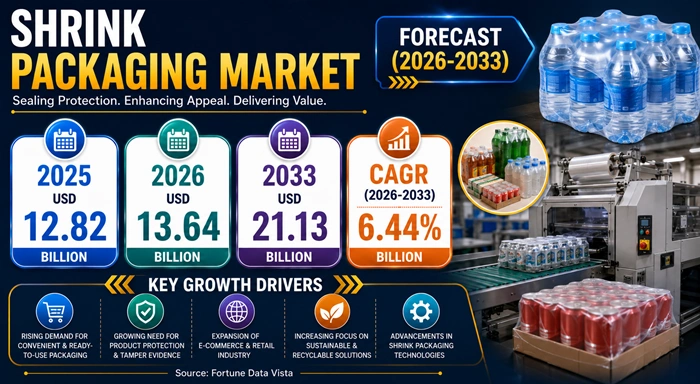
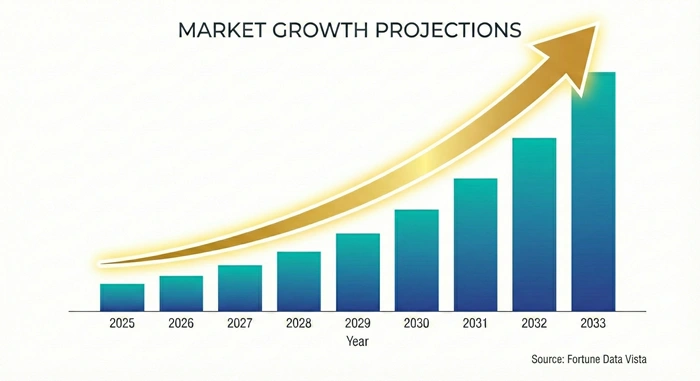
The global shrink packaging market size is valued at USD 12.82 billion in 2025 and is predicted to increase from USD 13.64 billion in 2026 to approximately USD 21.13 billion by 2033, growing at a CAGR of 6.44% from 2026 to 2033.
This sustained growth reflects the packaging industry's continued reliance on heat-shrink polymer films to secure, bundle, and protect products across food and beverage, consumer goods, and e-commerce shipping applications. As brand owners increasingly prioritize cost-effective unitization alongside strong shelf presentation, shrink packaging continues holding its position as a preferred choice for multi-packing and tamper-evident sealing across a wide range of industries.
AI Impact on the Shrink Packaging Industry
Artificial Intelligence Is Optimizing Film Formulation Modeling, Enabling Predictive Quality Control on Packaging Lines, and Strengthening Waste Reduction Efforts Across the Shrink Packaging Landscape — Fundamentally Changing How Manufacturers Approach Line Efficiency and Material Use
Artificial intelligence has increasingly found practical application in how manufacturers design shrink film formulations and monitor production line performance, particularly through predictive modeling tools that help engineers identify optimal film thickness and polymer blend combinations for specific product shapes and shrink tunnel conditions. This capability allows packaging teams to reduce costly trial-and-error testing on the production floor, since AI-driven simulation can predict how a given film will perform under different heat and tension settings before physical trial runs even begin. Manufacturers adopting these predictive tools are increasingly able to shorten new product changeover times, which matters considerably given how frequently packaging lines must adapt to different product sizes and shapes.
Beyond formulation design, AI-powered vision systems are also being deployed directly on shrink-wrapping lines to detect packaging defects such as incomplete seals, wrinkling, or misaligned graphics in real time, catching quality issues before products reach retail shelves. This proactive quality monitoring capability has become particularly valuable for high-speed production environments, where even small defect rates can translate into significant material waste and costly product returns. As these AI-driven formulation and quality monitoring tools continue maturing, they are becoming an increasingly important differentiator for suppliers and converters competing within the broader shrink packaging market.
Growth Factors
Rising E-Commerce Shipping Volume and Growing Multi-Pack Retail Demand Continue Driving Sustained Demand
The most significant growth factor supporting the shrink packaging market is the continued expansion of global e-commerce, since online retailers increasingly rely on shrink film both to secure individual items within shipping cartons and to create retail-ready multi-packs that move efficiently through fulfillment centers. As parcel volumes continue climbing year over year, the protective and cost-efficient qualities of shrink wrap have made it a staple choice for logistics operators seeking to minimize damage during transit while controlling packaging material costs.
A second important growth factor is the steady consumer preference for multi-packed goods, particularly across beverages, canned foods, and household products, where shrink-wrapped bundles allow retailers to offer convenient, value-oriented purchasing options while maintaining clear product visibility through high-clarity films. Brand owners increasingly value shrink packaging's ability to serve as a branding canvas as well, since modern printing technology allows vibrant, high-quality graphics to be applied directly onto the film surface. This combination of expanding e-commerce shipping and steady multi-pack retail demand continues to broaden consumption across the shrink packaging market.
Market Outlook
Sustainable Material Innovation and Expanding Emerging Market Manufacturing Point Toward Sustained Growth Through 2033
Looking ahead through the forecast period, the shrink packaging industry is expected to benefit substantially from continued advancement in sustainable film formulations, as manufacturers shift away from traditional PVC toward mono-material polyolefin films that are more compatible with existing plastic recycling infrastructure. This sustainability-driven innovation is likely to become an increasingly important purchasing consideration, particularly as major consumer brands commit to ambitious packaging recyclability targets that put pressure on their supply chains to adopt more circular material choices.
At the same time, the rapid expansion of manufacturing capacity across emerging economies is expected to create substantial new demand for cost-effective, high-performance shrink films that support growing consumer goods and food and beverage production. Companies that can deliver both traditional plastic-based solutions and newer fiber-based or recycled-content alternatives while maintaining consistent film quality are increasingly well positioned to capture this growth. Suppliers combining strong polymer research capabilities with expanding regional manufacturing footprints are likely to lead growth within the broader shrink packaging market through 2033.
Expert Speaks
-
"Our customers increasingly demand packaging solutions that balance strong protective performance with genuine recyclability, and we continue investing heavily in sustainable film innovation to meet that expectation." — CEO, Amcor plc
-
"As e-commerce volumes keep climbing worldwide, reliable and efficient shrink wrap solutions remain central to helping our customers protect products while controlling costs." — CEO, Sealed Air Corporation
-
"The shift toward mono-material and recycled-content films reflects our industry's broader commitment to circularity, and our packaging portfolio continues evolving to support that transition." — CEO, Berry Global Inc
Key Report Takeaways
-
Asia Pacific leads the global shrink packaging market, holding approximately 37% market share in 2025, supported by massive manufacturing output and rapidly expanding e-commerce activity across the region
-
North America is also a major growth contributor, projected to expand at a CAGR near 6% through 2033, driven by strong food and beverage sector demand
-
Food and beverage companies represent the dominant end-user segment, accounting for roughly 41% share, given their heavy reliance on shrink wrap for multi-packing and product protection
-
E-commerce packaging applications contribute significantly to overall demand, reflecting the growing reliance on protective shrink film for shipping individual and bundled products
-
Polyolefin films remain the most widely adopted material type, valued for their recyclability and strong performance across diverse product categories
-
Sustainable and recycled-content films will grow the fastest among material segments, holding close to 24% market share with a CAGR near 9% through the forecast period, driven by rising brand sustainability commitments
Market Scope
| Parameter | Details |
|---|---|
| Market Size by 2033 | USD 21.13 Billion | Market Size by 2026 | USD 13.64 Billion | Market Size by 2025 | USD 12.82 Billion | Market Growth Rate from 2026 to 2033 | CAGR of 6.44% | Dominating Region | Asia Pacific | Fastest Growing Region | Asia Pacific | Segments Covered | Product Type, Material, Application, End Use, Region | Regions Covered | North America, Europe, Asia Pacific, Latin America, Middle East & Africa |
Market Dynamics
Drivers Impact Analysis
Rising E-Commerce Shipping Demand and Growing Multi-Pack Retail Preference Remain the Two Strongest Forces Behind Market Momentum
| Driver | (≈) % Impact on CAGR Forecast | Geographic Relevance | Impact Timeline |
|---|---|---|---|
| Rapid expansion of global e-commerce shipping volume | ~34% | Global, strongest in Asia Pacific, North America | Short to long-term |
| Growing consumer preference for multi-packed retail goods | ~29% | Global | Medium to long-term |
| Rising demand for cost-effective, versatile unitization solutions | ~23% | Global | Medium-term |
| Expanding use of shrink film for branding and shelf presentation | ~14% | North America, Europe | Short to medium-term |
Rapid expansion of global e-commerce shipping volume continues to serve as the primary engine behind sustained growth in the shrink packaging market, as online retailers and logistics providers increasingly depend on protective film to secure products during transit while controlling overall packaging costs. This growing shipping volume has translated directly into rising film consumption among converters and fulfillment centers worldwide.
Growing consumer preference for multi-packed retail goods represents the second major driver, as shoppers increasingly favor value-oriented bundled products across beverages, canned foods, and household items that shrink wrap can package efficiently and affordably. This steady retail demand, combined with rising interest in shrink film as a branding and shelf presentation tool, continues reinforcing consistent growth across the broader shrink packaging market.
Restraints Impact Analysis
Environmental Scrutiny and Raw Material Price Volatility Continue to Moderate Broader Adoption
| Restraint | (≈) % Impact on CAGR Forecast | Geographic Relevance | Impact Timeline |
|---|---|---|---|
| Growing environmental scrutiny and regulatory pressure on single-use plastic films | ~35% | Europe, North America, growing globally | Short to long-term |
| Volatility in polymer raw material pricing affecting production costs | ~28% | Global | Short to medium-term |
| Limited recyclability of certain traditional PVC-based shrink films | ~23% | Global | Medium-term |
| Rising competition from alternative fiber-based packaging solutions | ~14% | North America, Europe | Medium to long-term |
The most persistent restraint facing the shrink packaging market is growing environmental scrutiny and regulatory pressure surrounding single-use plastic films, as governments and consumer advocacy groups increasingly push for reduced plastic consumption and improved end-of-life recyclability. This regulatory pressure has become particularly pronounced across Europe and parts of North America, where extended producer responsibility rules are pushing brand owners to reconsider traditional film choices.
Volatility in polymer raw material pricing represents a second significant restraint, since fluctuating petrochemical feedstock costs can squeeze converter margins and create pricing uncertainty for downstream customers planning long-term packaging contracts. Combined with limited recyclability of certain traditional PVC-based films still used across parts of the industry, these restraints continue moderating how quickly the transition toward fully sustainable material solutions spreads across the global shrink packaging market.
Opportunities Impact Analysis
Sustainable Film Innovation and Expanding Emerging Market Demand Represent the Clearest Paths to Growth
| Opportunity | (≈) % Impact on CAGR Forecast | Geographic Relevance | Impact Timeline |
|---|---|---|---|
| Advancing mono-material and recycled-content polyolefin film technology | ~37% | Global | Short to medium-term |
| Expanding manufacturing and consumer goods production across emerging economies | ~33% | Asia Pacific, Latin America | Medium to long-term |
| Growing adoption of fiber-based alternatives for select multi-packing applications | ~30% | North America, Europe | Medium-term |
Advancing mono-material and recycled-content polyolefin film technology represents one of the most substantial opportunities within the shrink packaging market, as converters developing these more sustainable formats stand to capture significant share from brand owners seeking to meet ambitious packaging recyclability commitments. This material innovation is expected to meaningfully reshape competitive positioning among leading suppliers over the coming years.
Expanding manufacturing and consumer goods production across emerging economies presents a second substantial opportunity, as countries like China and India continue building domestic production capacity that requires reliable, cost-effective packaging solutions at scale. Growing adoption of fiber-based alternatives for select multi-packing applications further broadens the opportunity landscape, particularly as some brands seek to reduce plastic use entirely for specific product categories. Companies pursuing these parallel opportunities are well positioned to capture meaningful growth within the broader shrink packaging market through the forecast period.
Segment Analysis
By Material: Polyolefin Films
Polyolefin Films Continue to Anchor the Material Landscape, Reflecting Their Strong Recyclability and Performance Balance
Polyolefin films hold the largest share within the material segment of the shrink packaging market, accounting for approximately 46% of total segment revenue in 2025. This dominance reflects the strong balance polyolefin films strike between clarity, strength, and compatibility with existing plastic recycling streams, making them an increasingly preferred alternative to traditional PVC as brand owners face mounting sustainability pressure. In markets like the United States and Germany, packaging converters increasingly favor polyolefin-based shrink films for both consumer multi-packs and industrial bundling applications. Leading suppliers such as Amcor, Berry Global, and Sealed Air continue to dominate this segment through continuous polymer formulation innovation and expanded manufacturing capacity.
Growth within this segment remains particularly strong in Asia Pacific, where rapidly expanding manufacturing output across consumer goods and food and beverage sectors continues driving demand for cost-competitive, high-performance shrink films. The region's combination of massive production scale and growing environmental awareness has helped polyolefin films maintain their leading position despite continued competition from lower-cost traditional film alternatives. As sustainability commitments continue shaping packaging purchasing decisions globally, polyolefin films are expected to remain the dominant material type within the broader shrink packaging market throughout the forecast period.
By Application: Food and Beverage
Food and Beverage Applications Remain the Leading Demand Driver, Reflecting Heavy Reliance on Shrink Wrap for Multi-Packing and Protection
Food and beverage applications account for approximately 41% of application-based revenue within the shrink packaging market, reflecting the sector's extensive reliance on shrink film for bundling beverage cans and bottles, protecting perishable items, and creating retail-ready multi-packs that streamline checkout and shelving. Manufacturers increasingly depend on these films to maintain product freshness and provide tamper-evident sealing, both of which have become critical purchasing considerations for food safety-conscious retailers and consumers. This consistent, high-volume demand has made food and beverage the anchor application for shrink film suppliers targeting large-scale consumer goods customers.
Growth in this application segment remains especially strong in North America, where established food and beverage manufacturers continue expanding multi-pack production to meet steady retail and e-commerce demand. Companies like Sealed Air and Winpak have expanded their regional film production capabilities significantly to support this growing application demand, often working closely with brand owners to optimize film performance for specific product formats. As global food and beverage production continues expanding, this application segment is expected to remain the primary demand driver within the broader shrink packaging market.
Regional Insights
Asia Pacific
Massive Manufacturing Output and Rapidly Expanding E-Commerce Keep Asia Pacific Firmly in the Lead
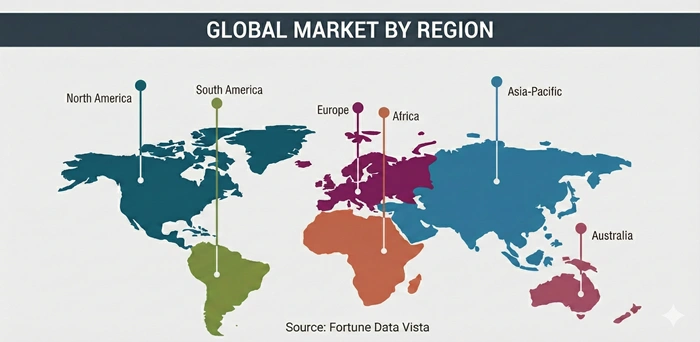
Asia Pacific commands the leading position in the global shrink packaging market, holding approximately 37% share in 2025, supported by massive manufacturing output across consumer goods, food and beverage, and electronics sectors, alongside explosive e-commerce growth across the region. China drives the overwhelming majority of regional demand, backed by a dense concentration of packaging converters and consumer goods manufacturers continuously scaling up production capacity. Companies with strong regional presence include Amcor, Berry Global, and several domestic Chinese film producers, each maintaining deep relationships with regional consumer goods manufacturers.
India and Southeast Asian markets also contribute meaningfully to regional demand, supported by rapid industrialization, a growing middle class with increasing purchasing power, and expanding domestic e-commerce infrastructure. The region's combination of strong production base, cost-competitive supply chains, and continuous capacity expansion ensures Asia Pacific's leadership position within the shrink packaging market remains firmly intact through the remainder of the forecast period.
North America
Strong Food and Beverage Sector Demand and Advanced Sustainability Adoption Keep North America a Key Growth Contributor
North America represents a significant growth contributor within the global shrink packaging market, expanding at a CAGR near 6% through 2033 as robust food and beverage sector demand and rising sustainability-driven material innovation continue reinforcing steady regional consumption. The United States drives the overwhelming majority of regional demand, backed by established consumer goods manufacturers and logistics operators continuously expanding their packaging capacity to support both retail and e-commerce fulfillment needs. Companies with strong regional presence include Sealed Air, Berry Global, and Winpak, each maintaining deep relationships with food and beverage and consumer goods customers across the country.
Canada also contributes meaningfully to regional demand, supported by growing e-commerce fulfillment infrastructure and expanding consumer goods manufacturing investment. The region's combination of strong retail infrastructure, deep supplier ecosystem, and continuous sustainable film innovation ensures North America remains a critical growth market within the shrink packaging market through the forecast period.
Customization Available for This Report
Region-Specific and Country-Specific Versions of This Report Are Available to Deliver a Sharper, More Localized View of Market Dynamics
This report can be tailored on a region-by-region and country-by-country basis, providing localized market sizing, competitive mapping, and manufacturing investment trend analysis that a global overview alone cannot fully capture.
Clients seeking a more focused breakdown can request a customized version covering any of the following regions and countries, complete with demand forecasting, competitor landscape review, and adoption trend analysis tied specifically to the shrink packaging keyword focus:
North America
-
U.S. — Detailed review of food and beverage packaging investment and e-commerce fulfillment trends
-
Canada — Coverage of consumer goods manufacturing and sustainability adoption patterns
-
Mexico — Analysis of emerging manufacturing and packaging modernization trends
Europe
-
U.K. — Review of packaging recyclability regulation and material adoption trends
-
Germany — Coverage of packaging investment among leading consumer goods manufacturers
-
France — Insights into sustainable film modernization and adoption patterns
-
Italy — Analysis of regional packaging technology investment trends
-
Rest of Europe — Country-level view of emerging demand across Eastern Europe and the Nordics
Asia Pacific
-
China — Coverage of expanding manufacturing infrastructure and e-commerce investment
-
India — Analysis of growing industrialization and packaging modernization
-
Japan — Review of established consumer goods manufacturing and adoption trends
-
South Korea — Assessment of manufacturing investment and film adoption
-
Australia — Insights into packaging regulation and adoption trends
-
Rest of Asia Pacific — Country-level breakdown covering Thailand, Vietnam, Indonesia, and Malaysia
Latin America
-
Brazil — Coverage of expanding consumer goods manufacturing investment and adoption
-
Argentina — Analysis of early-stage packaging modernization trends
-
Rest of Latin America — Country-level sizing across Colombia, Peru, and Chile
Middle East & Africa
-
UAE — Review of packaging investment and adoption trends
-
Saudi Arabia — Coverage of expanding manufacturing modernization initiatives
-
Rest of MEA — Country-level view of Sub-Saharan Africa manufacturing expansion
Top Key Players
-
Amcor plc (Switzerland)
-
Sealed Air Corporation (United States)
-
Berry Global Inc (United States)
-
Winpak Ltd (Canada)
-
Sigma Plastics Group (United States)
-
Coveris Holdings SA (United Kingdom)
-
Constantia Flexibles Group GmbH (Austria)
-
Bemis Company Inc (United States)
-
Clondalkin Group Holdings BV (Netherlands)
-
Innovia Films Ltd (United Kingdom)
-
Uflex Ltd (India)
-
Huhtamaki Oyj (Finland)
Recent Developments
-
In 2025, Amcor expanded its sustainable shrink film portfolio with new mono-material polyolefin formulations designed to improve recyclability across multi-packing applications
-
In 2025, Sealed Air strengthened its packaging materials division through expanded investment in recycled-content shrink film production capacity
-
In 2026, Berry Global deepened its investment in circular packaging technology to support growing demand for recyclable shrink wrap solutions among consumer goods brands
-
In 2025, Winpak advanced its flexible packaging offerings with enhanced barrier film technology for food and beverage shrink packaging applications
-
In 2025, Constantia Flexibles expanded its shrink film manufacturing capacity across emerging markets to support growing regional consumer goods production
Market Trends
Sustainable Material Innovation and Fiber-Based Alternative Adoption Are Reshaping Industry Standards
One of the clearest trends shaping the shrink packaging market is the accelerating shift toward mono-material polyolefin films and recycled-content formulations, as brand owners face mounting pressure to meet ambitious packaging recyclability and circularity commitments. Suppliers are investing heavily in polymer research, recognizing that sustainable material credentials are becoming an increasingly important competitive differentiator as consumer goods companies scrutinize their packaging supply chains more closely.
A second significant trend is the growing exploration of fiber-based alternatives, such as paper sleeves and corrugated clips, for certain multi-packing applications where brands seek to reduce plastic use entirely rather than simply improve recyclability. This trend toward alternative materials is particularly meaningful for beverage and consumer goods companies facing direct consumer pressure around plastic reduction, continuing to reshape how the broader shrink packaging market approaches material selection going forward.
Segments Covered in the Report
By Product Type
-
Shrink Bags
-
Shrink Films
-
Shrink Labels
-
Shrink Sleeves
By Material
-
Polyolefin
-
Polyvinyl Chloride
-
Polyethylene
-
Polypropylene
By Application
-
Multi-Packing
-
Bundling
-
Pallet Wrapping
-
Tamper-Evident Sealing
By End Use
-
Food and Beverage
-
Consumer Goods
-
Pharmaceuticals
-
Electronics
By Region
-
North America (U.S., Canada, Mexico)
-
Europe (U.K., Germany, France, Italy, Rest of Europe)
-
Asia Pacific (China, India, Japan, South Korea, Australia, Rest of Asia Pacific)
-
Latin America (Brazil, Argentina, Rest of Latin America)
-
Middle East & Africa (UAE, Saudi Arabia, Rest of MEA)
❝ Built for Every Level — From Startups to Industry Giants ❞
Here Is Exactly How This Report Works for You
-
For tier 1 companies, investors, and established market leaders, this report delivers detailed competitor revenue analysis, sustainable material trend mapping, and geopolitical risk context that support confident decisions around product expansion, pricing strategy, and long-term positioning within the shrink packaging space
-
For tier 2 and tier 3 companies, startups, and mid-sized converters, this report highlights the most commercially promising application categories and underserved regional opportunities, giving you a practical framework to compete against larger established players without overextending limited resources
-
For every decision maker across the value chain, this report explains exactly how e-commerce growth trends, regulatory developments, and competitor material innovations are shaping market direction through 2033, equipping you to plan investment and go-to-market decisions with genuine confidence
Frequently Asked Questions:
Answer: The global shrink packaging market was valued at USD 12.82 billion in 2025 and is projected to reach USD 21.13 billion by 2033. This growth is driven largely by rising e-commerce shipping volume and growing multi-pack retail demand.
Answer: Growth in the shrink packaging market is being driven by expanding e-commerce fulfillment and steady consumer preference for multi-packed retail goods. Rising demand for cost-effective unitization solutions is further reinforcing this expansion.
Answer: Asia Pacific currently leads the shrink packaging market with roughly 37% share, supported by massive manufacturing output and rapid e-commerce growth. The region is also the fastest-growing globally through 2033.
Answer: Polyolefin films generate the largest share of revenue in the shrink packaging market, reflecting their strong recyclability and performance balance. Food and beverage applications also remain the dominant end-use segment.
Answer: Leading companies in the shrink packaging market include Amcor, Sealed Air, Berry Global, Winpak, and Constantia Flexibles. These companies compete through continuous innovation in sustainable film formulations and manufacturing capacity expansion.