
Simultaneous Localization and Mapping Market Overview
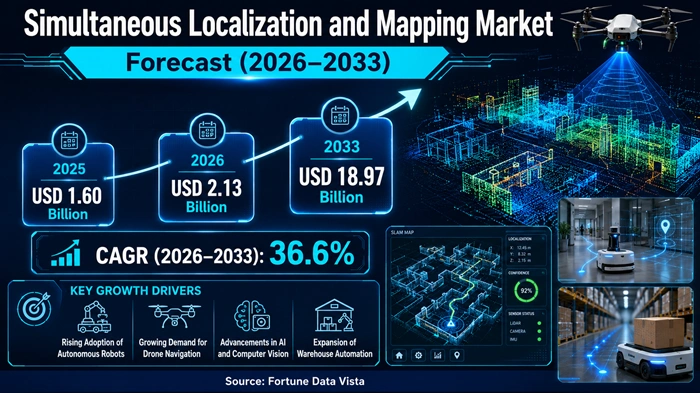
The global simultaneous localization and mapping market size is valued at USD 1.60 billion in 2025 and is predicted to increase from USD 2.13 billion in 2026 to approximately USD 18.97 billion by 2033, growing at a CAGR of 36.6% from 2026 to 2033.
SLAM technology — which enables a device to build a map of an unknown environment while simultaneously tracking its own position within that map — has become one of the most strategically important enabling technologies of the autonomous systems era. Rapidly accelerating adoption across autonomous vehicles, industrial robotics, unmanned aerial vehicles, augmented and virtual reality platforms, and smart infrastructure systems is driving extraordinary growth across the SLAM industry. Continuous advances in LiDAR sensors, depth cameras, AI-driven mapping algorithms, and edge computing hardware are simultaneously expanding both the performance envelope and the commercial accessibility of SLAM solutions across an ever-widening range of industries and applications.
AI Impact on the Simultaneous Localization and Mapping Industry
Artificial Intelligence Is Fundamentally Transforming Simultaneous Localization and Mapping by Enabling Deep Learning-Based Mapping Algorithms, Real-Time Scene Understanding, and Adaptive Navigation Capabilities That Far Exceed the Accuracy and Robustness of Classical SLAM Approaches
Artificial intelligence is perhaps the single most transformative force acting on the simultaneous localization and mapping industry today, enabling a new generation of deep learning-based SLAM algorithms that dramatically outperform classical geometric and probabilistic approaches in complex, dynamic, and visually challenging environments. Neural network-based feature extraction models can now identify and track environmental landmarks with a robustness and precision that classical visual SLAM methods — which rely on manually engineered feature descriptors — cannot achieve in low-light conditions, textureless environments, or scenes with significant dynamic object movement. End-to-end deep learning SLAM systems trained on large-scale datasets are progressively closing the performance gap with expensive LiDAR-based approaches using only camera inputs — a development that has enormous commercial significance for cost-sensitive applications in consumer robotics, mobile devices, and augmented reality where LiDAR integration is not economically practical.
The integration of AI with multi-sensor SLAM fusion architectures is further enabling the kind of reliable, real-time 3D environment mapping and localization performance that autonomous vehicle, industrial robot, and drone navigation systems require for safe operation in unstructured real-world environments. AI-powered sensor fusion algorithms can intelligently weigh and combine inputs from cameras, LiDAR, radar, IMUs, and GPS — compensating for the individual weaknesses of each sensor modality and producing more accurate, more robust, and more computationally efficient position and map estimates than any single-sensor approach can achieve. Companies including NVIDIA Corporation, Qualcomm Technologies, and Intel Corporation are making substantial investments in AI-optimized processing hardware and SLAM software development kits that enable the deployment of advanced AI-enhanced SLAM systems on embedded and edge computing platforms at the power and cost levels required for mainstream commercial adoption.
Growth Factors
The Explosive Growth of Autonomous Robotics and Self-Driving Vehicle Programs, the Rapid Expansion of Augmented Reality Platforms, and the Increasing Industrial Automation Investment Across Manufacturing and Logistics Are the Primary Forces Driving the Extraordinary Growth Trajectory of the Simultaneous Localization and Mapping Market
The autonomous robotics sector is the most immediately powerful driver of growth in the simultaneous localization and mapping market, with the global proliferation of autonomous mobile robots (AMRs) in warehouse and logistics operations — driven by the explosive growth of e-commerce fulfillment — creating enormous and rapidly scaling demand for reliable, cost-effective SLAM navigation systems. Companies including Amazon, DHL, FedEx, and major retail chains are deploying thousands of AMRs in fulfillment centers globally, and SLAM is the foundational navigation technology that enables these robots to operate safely and efficiently in the dynamic, obstacle-rich environments of modern warehouse facilities. The expansion of service robotics into healthcare, hospitality, and retail environments is adding further demand, as these applications require the kind of indoor navigation capability that SLAM uniquely provides without dependence on fixed infrastructure such as QR codes, magnetic strips, or beacon networks.
The autonomous vehicle industry adds a second, massive, and rapidly growing demand layer that is creating some of the most technically demanding and commercially valuable SLAM development programs globally. Every major autonomous vehicle development program — from passenger car robo-taxi platforms to self-driving trucks and last-mile delivery robots — relies on sophisticated multi-sensor SLAM and mapping systems as a core component of their perception and localization architecture. The race to commercialize Level 4 and Level 5 autonomous driving is driving billions of dollars of annual investment in LiDAR, camera, and radar-based SLAM technology development across the automotive and mobility technology industries. This investment is simultaneously advancing the state of SLAM technology and dramatically reducing the cost of the sensor and computing hardware components that SLAM systems depend on — creating a virtuous cycle that progressively expands the commercial viability of SLAM-based navigation across a widening range of autonomous vehicle applications and price points.
Market Outlook
The Simultaneous Localization and Mapping Market Is Positioned for One of the Fastest Growth Trajectories in the Global Technology Industry Through 2033, Driven by the Convergence of Autonomous Systems, 5G Connectivity, Edge AI Computing, and the Industrial Automation Megatrend
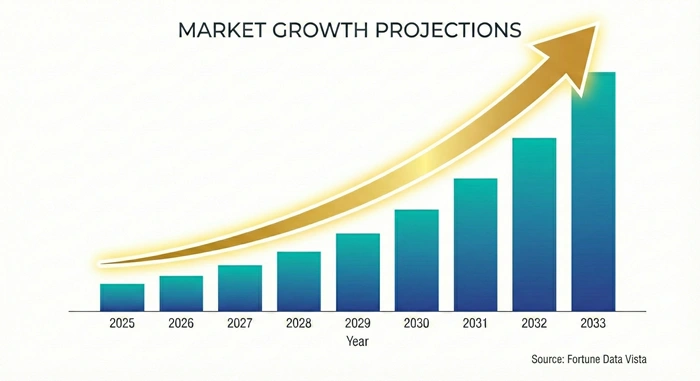
The long-term outlook for the simultaneous localization and mapping market is extraordinarily positive, with a growth trajectory that places it among the fastest-expanding segments in the global technology industry. The convergence of several major technology megatrends — autonomous systems, artificial intelligence, 5G connectivity, and edge computing — is creating a demand environment for advanced SLAM technology that is simultaneously broad across industries and deep in terms of the technical performance and commercial value being sought. In robotics, autonomous vehicles, drones, and AR/VR platforms, SLAM is not a peripheral technology but an enabling core component without which the most commercially significant autonomous system deployments are simply not achievable — creating a structural, non-substitutable demand driver that makes SLAM market growth fundamentally tied to the overall pace of autonomous technology commercialization.
The integration of 5G connectivity and cloud computing into SLAM architectures is opening a new frontier of collaborative and large-scale mapping capabilities that were not previously achievable on standalone embedded systems. Cloud SLAM platforms allow multiple devices to simultaneously contribute to and access shared high-definition maps of large environments — enabling autonomous vehicle fleets to collectively build and update city-scale maps in real time, enabling smart city infrastructure to maintain continuously current digital twins of urban environments, and enabling industrial robot fleets to share spatial intelligence across large manufacturing facilities. As 5G networks achieve broader geographic coverage and cloud SLAM platforms mature in performance and commercial availability, the addressable market for SLAM technology will expand dramatically beyond standalone robotic and vehicle navigation applications into infrastructure, smart city, and enterprise spatial intelligence domains that represent some of the most commercially significant long-term opportunities in the industry.
Expert Speaks
-
"NVIDIA's investment in AI-powered robotics platforms — including our Isaac ROS framework and Jetson edge AI computing systems — is fundamentally about enabling the kind of advanced simultaneous localization and mapping and perception capabilities that autonomous robots and vehicles require to operate safely and efficiently in real-world environments. We see the SLAM technology market as one of the most important and fastest-growing areas within the broader autonomous systems ecosystem, and our platform investments are designed to accelerate commercial deployment across the full range of robotics, automotive, and industrial automation applications." — Jensen Huang, CEO, NVIDIA Corporation
-
"Qualcomm's RB5 robotics platform and our autonomous driving computing solutions are purpose-built to bring AI-enhanced SLAM performance to mobile robots, drones, and vehicles at the power efficiency levels that battery-powered autonomous systems require. The simultaneous localization and mapping market is being transformed by the convergence of AI and dedicated edge computing hardware, and we are committed to being the silicon foundation that powers the next generation of intelligent autonomous systems globally." — Cristiano Amon, CEO, Qualcomm Technologies Inc.
-
"Intel's RealSense depth sensing technology and our industrial edge AI computing portfolio are enabling a new generation of SLAM-powered autonomous systems across robotics, logistics, healthcare, and smart infrastructure applications. We see the demand for advanced 3D perception and localization capability accelerating significantly across every major industry segment, and Intel's sensor and computing technology is designed to make high-performance SLAM accessible and cost-effective across the widest possible range of commercial deployment contexts." — Pat Gelsinger, CEO, Intel Corporation
Key Report Takeaways
-
North America dominates the global simultaneous localization and mapping market, accounting for approximately 40% of total global revenue in 2026, driven by the United States' leadership in autonomous vehicle development, industrial robotics adoption, and augmented reality platform commercialization — supported by the strong commercial presence of world-leading technology companies including NVIDIA, Qualcomm, Google, and a dense ecosystem of SLAM-specialist startups and research institutions driving continuous technology innovation.
-
Asia Pacific is the fastest-growing regional market, expanding at a CAGR of approximately 40% from 2026 to 2033, propelled by China's massive industrial robotics deployment programs, Japan's advanced automotive and precision manufacturing automation investments, South Korea's robotics and semiconductor sector growth, and India's rapidly expanding technology services and autonomous systems development ecosystem.
-
Robotic mapping and navigation is the dominant application segment, contributing approximately 42% of total application-based revenue in 2026, reflecting the enormous and rapidly scaling demand from autonomous mobile robots across e-commerce fulfillment, manufacturing, healthcare, and service robotics sectors that require reliable, infrastructure-free indoor navigation capability that SLAM uniquely provides.
-
Hardware is the dominant component segment, accounting for approximately 60% of total component-based revenue in 2026, driven by the high unit value of LiDAR sensors, depth cameras, IMUs, and embedded computing platforms that form the physical foundation of every SLAM system deployment across all application areas globally.
-
3D SLAM is the dominant type segment, holding approximately 58% of total type-based revenue in 2026, as the growing deployment of autonomous vehicles, drones, and advanced industrial robots in complex three-dimensional operating environments is driving strong and sustained demand for 3D mapping and localization capabilities that 2D SLAM approaches cannot provide.
-
Software is the fastest-growing component segment, projected to capture approximately 35% of total component revenue by 2033 at a CAGR of approximately 42% from 2026 to 2033, driven by the rapid commercialization of AI-powered SLAM algorithm platforms, cloud mapping services, and SLAM development frameworks that generate recurring subscription and licensing revenue alongside significant one-time integration project revenue.
Market Scope
| Parameter | Details |
|---|---|
| Market Size by 2033 | USD 18.97 Billion | Market Size by 2026 | USD 2.13 Billion | Market Size by 2025 | USD 1.60 Billion | Market Growth Rate from 2026 to 2033 | CAGR of 36.6% | Dominating Region | North America | Fastest Growing Region | Asia Pacific | Segments Covered | Component, Type, Application, End Use Industry | Regions Covered | North America, Europe, Asia Pacific, Latin America, Middle East and Africa |
Market Dynamics
Drivers Impact Analysis
The Explosive Commercialization of Autonomous Mobile Robots and Self-Driving Vehicles, the Rapid Growth of Augmented Reality Applications, and the Accelerating Industrial Automation Investment Across Manufacturing and Logistics Are the Three Most Consequential Drivers Powering Growth in the Simultaneous Localization and Mapping Market
| Driver | ≈ % Impact on CAGR Forecast | Geographic Relevance | Impact Timeline |
|---|---|---|---|
| Autonomous mobile robot deployment in logistics and manufacturing | ~30% | North America, Europe, Asia Pacific | Short to Long-Term |
| Autonomous vehicle development and commercialization | ~25% | North America, Europe, Asia Pacific | Short to Long-Term |
| AR/VR platform adoption in consumer and enterprise applications | ~18% | North America, Asia Pacific, Europe | Short to Medium-Term |
| Industrial automation investment and Industry 4.0 programs | ~14% | Europe, Asia Pacific, North America | Medium to Long-Term |
| UAV and drone commercialization across agriculture and defense | ~8% | Global | Medium-Term |
| Smart city and infrastructure digital twin development | ~5% | China, Middle East, Europe | Long-Term |
The autonomous mobile robot deployment driver is the most immediately visible and commercially consequential force driving the simultaneous localization and mapping market today. The e-commerce sector's explosive growth — which permanently accelerated during and after the COVID-19 pandemic — has created insatiable demand for warehouse automation solutions that can handle the volume, speed, and accuracy requirements of modern fulfillment operations without the infrastructure investment and inflexibility of fixed conveyor and racking automation systems. AMRs powered by SLAM navigation have emerged as the solution of choice for fulfillment center automation because they can operate in existing warehouse layouts without physical infrastructure modifications — enabling rapid deployment, flexible reconfiguration, and scalable expansion that meets the dynamic operational requirements of e-commerce fulfillment better than any alternative automation approach.
The autonomous vehicle driver operates on a longer commercialization timeline than warehouse robotics, but the scale of the investment programs and the technical performance demands they create for SLAM technology make them an equally important long-term growth driver. Major automotive OEMs and mobility technology companies — including Waymo, Tesla, Mobileye, Cruise, and major Chinese autonomous vehicle developers — are spending billions of dollars annually on LiDAR, camera, and radar-based SLAM and perception system development that is advancing the state of the art and reducing the cost of high-performance SLAM hardware at a pace that is making sophisticated 3D mapping and localization technology accessible to an expanding range of automotive, logistics, and mobility applications globally.
Restraints Impact Analysis
High Hardware Costs for LiDAR-Based SLAM Systems, Computational Complexity Challenges in Real-Time Large-Scale Mapping, and the Technical Difficulty of Maintaining SLAM Performance in Dynamic and Featureless Environments Are the Key Constraints Moderating Growth in the Simultaneous Localization and Mapping Market
| Restraint | ≈ % Impact on CAGR Forecast | Geographic Relevance | Impact Timeline |
|---|---|---|---|
| High cost of LiDAR and high-performance sensor hardware | ~-30% | Developing economies, cost-sensitive applications | Short to Medium-Term |
| Computational complexity of real-time 3D SLAM processing | ~-25% | Global | Short to Medium-Term |
| Performance degradation in dynamic and featureless environments | ~-20% | Global | Medium to Long-Term |
| Map drift and localization error accumulation over time | ~-14% | Global | Medium-Term |
| Cybersecurity vulnerabilities in connected SLAM system architectures | ~-11% | North America, Europe | Long-Term |
The cost of high-performance LiDAR sensors — which have historically ranged from thousands to tens of thousands of dollars per unit — has been one of the most significant barriers to the broad commercial deployment of SLAM-based autonomous systems outside of high-value automotive and industrial applications. While the cost of solid-state LiDAR units has been declining rapidly due to manufacturing scale and technology innovation, achieving the cost levels required for mass-market consumer robotics and low-cost drone applications remains a challenge that continues to constrain the addressable market for SLAM solutions in price-sensitive application segments. Camera-based visual SLAM approaches provide a lower-cost alternative, but their performance limitations in low-light and textureless environments — where visual feature extraction becomes unreliable — create technical trade-offs that reduce their applicability in the full range of operating conditions that commercial autonomous systems must handle.
The computational demands of real-time 3D SLAM processing — particularly in large-scale environments where maintaining consistent and accurate maps requires managing growing data volumes with microsecond latency — represent a fundamental technical challenge that constrains both the performance envelope of SLAM systems running on embedded hardware and the energy efficiency of battery-powered autonomous platforms. While AI-optimized edge computing hardware from NVIDIA, Qualcomm, and Intel is progressively improving the performance-per-watt of SLAM processing on embedded systems, achieving the computational density required for high-performance 3D SLAM on the power budgets of consumer-grade robots and small drones remains technically and economically challenging — creating a constraint that limits the performance level of SLAM deployable in cost-sensitive and power-constrained autonomous system applications.
Opportunities Impact Analysis
The Convergence of 5G Connectivity and Cloud SLAM Platforms, the Commercialization of Solid-State LiDAR Technology, and the Enormous Demand for SLAM in Healthcare Robotics and Agricultural Drone Navigation Are Creating High-Value New Revenue Opportunities in the Simultaneous Localization and Mapping Market
| Opportunity | ≈ % Impact on CAGR Forecast | Geographic Relevance | Impact Timeline |
|---|---|---|---|
| 5G-enabled collaborative cloud SLAM platform development | ~28% | China, North America, Europe | Short to Long-Term |
| Solid-state LiDAR commercialization expanding SLAM addressable market | ~24% | Global | Short to Medium-Term |
| Healthcare robotics adoption driving hospital navigation SLAM demand | ~18% | North America, Europe, Asia Pacific | Medium to Long-Term |
| Agricultural drone and robot navigation SLAM applications | ~16% | Asia Pacific, Latin America, North America | Medium-Term |
| Smart city digital twin and infrastructure mapping programs | ~14% | China, Middle East, Europe | Long-Term |
The emergence of 5G-enabled collaborative cloud SLAM platforms represents one of the most transformative commercial opportunities in the simultaneous localization and mapping market. By offloading computationally intensive mapping and localization processing from individual device hardware to cloud infrastructure connected via ultra-low-latency 5G links, cloud SLAM architectures enable the deployment of high-performance SLAM capabilities on lighter, lower-power, and more cost-effective autonomous platforms than traditional edge-computing approaches permit — while simultaneously enabling collaborative mapping across fleets of devices that collectively build and benefit from shared environmental intelligence. China's massive 5G infrastructure investment and its government's explicit prioritization of smart manufacturing and intelligent logistics as national strategic industries make it the most advanced near-term market for 5G-enabled collaborative SLAM deployment globally.
Healthcare robotics represents a fast-growing and high-value application opportunity for SLAM technology that is still in relatively early stages of commercialization. Autonomous hospital service robots — performing tasks including medication delivery, supply transport, disinfection, and patient room service — require reliable indoor navigation capabilities in complex, dynamic, and people-populated hospital environments where fixed-infrastructure navigation approaches are both impractical and clinically undesirable. The global expansion of hospital automation investment, driven by healthcare labor cost pressures, infection control requirements, and the aging demographics of healthcare worker populations, is creating growing commercial demand for SLAM-powered hospital navigation systems that companies including Mobile Industrial Robots (MiR), Omron Adept Technologies, and InVia Robotics are actively commercializing through expanding hospital deployment programs globally.
Segment Analysis
By Component: Hardware
Hardware Dominates the Simultaneous Localization and Mapping Market as the Highest-Value Component Category, Encompassing the LiDAR Sensors, Depth Cameras, and Embedded Computing Platforms That Form the Physical Foundation of Every Commercial SLAM System Deployment
Hardware holds the dominant position within the simultaneous localization and mapping market by component, accounting for approximately 60% of total component-based revenue in 2026. The hardware segment encompasses the full range of physical sensing and computing components that SLAM systems depend on — including LiDAR sensors, RGB-D depth cameras, stereo cameras, inertial measurement units (IMUs), GPS modules, and the embedded computing platforms that run SLAM algorithms in real time. The high unit value of premium LiDAR sensors and the embedded computing hardware required for 3D SLAM processing makes hardware the dominant revenue contributor by a significant margin, even as software and services revenue grows at faster rates driven by the scaling of cloud SLAM platform and SLAM algorithm licensing businesses. The hardware segment within the simultaneous localization and mapping market is projected to grow at a CAGR of approximately 32% from 2026 to 2033, driven by both the expanding volume of SLAM-equipped autonomous system deployments and the growing trend toward multi-sensor hardware configurations that combine multiple sensing modalities for improved robustness. In North America, the leading hardware suppliers for SLAM applications include Velodyne Lidar (USA), Ouster Inc. (USA), Intel RealSense (USA), and NVIDIA Corporation (USA) — all of which serve the automotive, robotics, and drone application segments through direct sales and distribution channels.
Asia Pacific is the fastest-growing regional hardware market, driven by China's enormous industrial robotics manufacturing base and the country's aggressive investment in autonomous vehicle development — both of which require SLAM hardware components at a scale that no other national market can currently match. Chinese SLAM hardware companies including Robosense Technology (China) and Hesai Technology (China) have emerged as globally competitive LiDAR manufacturers, offering high-performance solid-state and spinning LiDAR products at cost structures that are enabling the broader commercialization of LiDAR-based SLAM systems in cost-sensitive application segments including logistics robots and agricultural drones. Japan and South Korea are important hardware markets for precision SLAM applications in manufacturing automation and consumer electronics, with companies including Sony Corporation (Japan) and Samsung Electronics (South Korea) developing depth sensing and embedded AI computing hardware that supports SLAM deployment in consumer and industrial contexts.
By Application: Robotic Mapping and Navigation
Robotic Mapping and Navigation Is the Dominant Application Segment in the Simultaneous Localization and Mapping Market, Powered by the Explosive Deployment of Autonomous Mobile Robots in Warehouse Logistics, Manufacturing, and Service Environments That Depend on SLAM for Infrastructure-Free Navigation
Robotic mapping and navigation represents the largest application segment within the simultaneous localization and mapping market, accounting for approximately 42% of total application-based revenue in 2026. The rapid adoption of autonomous mobile robots across e-commerce fulfillment, pharmaceutical logistics, automotive manufacturing, electronics assembly, and service robotics sectors is generating the most immediate and commercially significant demand for SLAM navigation systems — as robots in these environments require the ability to navigate dynamically changing spaces, avoid human workers and other obstacles, and reconfigure their navigation maps in response to environmental changes without requiring costly infrastructure reconfigurations. The robotic mapping and navigation segment is projected to grow at a CAGR of approximately 38% from 2026 to 2033, driven by the continued expansion of e-commerce logistics automation and the progressive broadening of service robotics deployments into healthcare, hospitality, and retail environments. Leading companies serving this segment include iRobot Corporation (USA), Boston Dynamics (USA), Mobile Industrial Robots — MiR (Denmark), and Fetch Robotics (USA) — all of which have deployed SLAM-powered autonomous robot fleets across logistics and industrial customer applications globally.
Asia Pacific is the fastest-growing regional market for robotic mapping and navigation applications, driven by China's position as the world's largest industrial robotics market and its government's active promotion of intelligent manufacturing and logistics automation through major national programs. The simultaneous localization and mapping capabilities deployed in Chinese logistics automation — led by companies such as Geek+ (China) and Quicktron (China) — represent some of the world's largest and most commercially advanced AMR deployments, with thousands of robots operating simultaneously in single fulfillment facilities using collaborative SLAM navigation to manage traffic, share map updates, and coordinate pick-and-place operations at speeds and accuracy levels that exceed manual fulfillment by substantial margins. In Japan and South Korea, robotic navigation SLAM is being deployed in advanced manufacturing automation environments where precision positioning requirements demand the highest available levels of SLAM accuracy and map consistency — creating demand for the most technically sophisticated SLAM products in the market.
Regional Insights
North America: The Dominating Region
North America Leads the Global Simultaneous Localization and Mapping Market Through the United States' Unmatched Autonomous Vehicle and Robotics Technology Ecosystem, Its World-Leading AI and Semiconductor Industry, and Its Position as the Primary Commercial Deployment Market for Advanced SLAM Applications
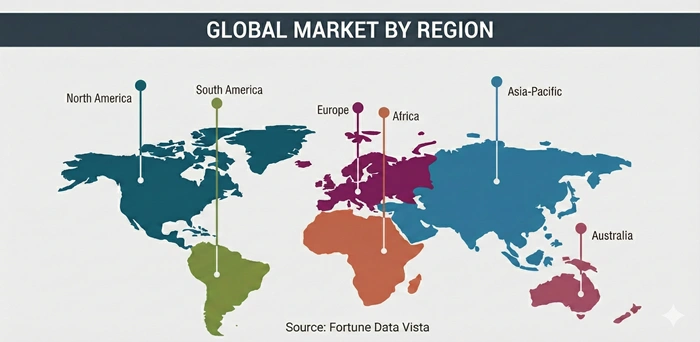
North America holds the largest share of the global simultaneous localization and mapping market, accounting for approximately 40% of total global revenue in 2026, with a regional CAGR of approximately 34% from 2026 to 2033. The United States is the dominant force within the region and globally, anchored by the world's most advanced autonomous vehicle development ecosystem — encompassing Waymo, Tesla, Mobileye, Cruise, and Nuro — the world's largest e-commerce logistics robotics deployment market led by Amazon Robotics, and the world's strongest AI research and semiconductor ecosystem including NVIDIA Corporation (USA), Qualcomm Technologies (USA), and Intel Corporation (USA) that develops the computing hardware on which advanced SLAM systems run. The concentration of technology capital, research talent, and commercial deployment scale in the United States creates a self-reinforcing innovation and commercialization dynamic that sustains North America's position at the frontier of the global simultaneous localization and mapping technology industry.
Canada contributes meaningfully to the regional market through its strong university robotics research programs and its growing autonomous vehicle testing and commercialization ecosystem, while Mexico's manufacturing sector expansion is driving growing AMR adoption in automotive and electronics assembly environments that require SLAM navigation. North America's position is further reinforced by the region's lead in augmented reality platform commercialization — with companies including Apple, Google, and Meta all developing AR headset and platform technologies that incorporate SLAM as the foundational spatial understanding technology — creating an additional and rapidly growing consumer and enterprise AR application market that adds diversification to the region's SLAM demand base.
Asia Pacific: The Fastest Growing Region
Asia Pacific Is the Fastest Growing Regional Market in the Simultaneous Localization and Mapping Industry, Powered by China's World-Scale Industrial Robotics and Autonomous Vehicle Deployment Programs, Japan's Precision Manufacturing Automation, and India's Emerging Technology Services and Autonomous Systems Development Ecosystem
Asia Pacific is the fastest-growing regional segment within the simultaneous localization and mapping market, projected to expand at a CAGR of approximately 40% from 2026 to 2033 — the highest regional growth rate globally. China is the dominant national market within the region, representing the world's largest industrial robotics deployment market and one of the most heavily funded autonomous vehicle development ecosystems — with companies including Geek+ (China), DJI (China), Baidu Apollo (China), and Robosense Technology (China) driving SLAM technology development and commercial deployment at a scale that places China at the forefront of the global SLAM industry alongside the United States. The Chinese government's Made in China 2025 program and subsequent intelligent manufacturing initiatives have made robotics automation a national strategic priority, directly accelerating the deployment of SLAM-powered AMRs across Chinese manufacturing and logistics facilities at a pace that is generating some of the world's most commercially significant SLAM application deployments.
Japan and South Korea represent the most technically advanced SLAM markets within Asia Pacific outside of China, with Japan's robotics industry — including companies such as FANUC Corporation (Japan), Yaskawa Electric (Japan), and Honda Research Institute (Japan) — developing sophisticated precision SLAM applications for manufacturing, healthcare, and service robotics that demand the highest performance levels available in the commercial SLAM market. India is emerging as a significant growth market, with its rapidly expanding e-commerce sector, growing manufacturing automation investment, and strong technology services industry creating demand for SLAM navigation solutions across logistics robotics, warehouse automation, and autonomous vehicle testing applications. As India's regulatory framework for autonomous systems matures and domestic technology investment accelerates, it is positioned to become one of the most commercially significant national markets in the Asia Pacific SLAM ecosystem over the forecast period.
Report Customization by Region and Country
This Simultaneous Localization and Mapping Market Report Offers Full Region-Wise and Country-Wise Customization — Delivering Precise, Geography-Specific Market Sizing, Technology Adoption Trends, Competitive Landscapes, and Strategic Opportunities Tailored to Every Region and Country Worldwide*
This Simultaneous Localization and Mapping Market report is available with full customization by region and country, enabling organizations to access precise, geography-specific insights tailored to their strategic focus. The report can be configured to deliver the exact regional depth and market intelligence your business requires — covering market sizing, CAGR forecasts, segment breakdowns, regulatory environment analysis, key player profiles, and actionable strategic opportunities specific to each selected geography.
North America
-
U.S. — Autonomous vehicle development programs, e-commerce logistics robotics deployment scale, AI and semiconductor ecosystem, and SLAM startup landscape
-
Canada — University robotics research programs, autonomous vehicle testing ecosystems, and AMR adoption in manufacturing environments
-
Mexico — Automotive and electronics assembly AMR adoption, manufacturing automation investment trends, and regional market growth outlook
Europe
-
U.K. — Autonomous vehicle testing programs, logistics robotics adoption, AR/VR technology commercialization, and defense SLAM applications
-
Germany — Automotive industry SLAM adoption, precision manufacturing robotics, and Industry 4.0 automation program investment
-
France — Aerospace and defense SLAM applications, logistics automation, and research ecosystem for autonomous navigation technology
-
Italy — Manufacturing sector robotics adoption, agricultural drone SLAM applications, and domestic technology company landscape
-
Rest of Europe — Scandinavian robotics innovation, Eastern European manufacturing automation, and regional SLAM market growth outlook
Asia Pacific
-
China — Industrial robotics deployment scale, autonomous vehicle ecosystem, government smart manufacturing programs, and domestic SLAM hardware manufacturer landscape
-
India — E-commerce logistics automation, manufacturing AMR adoption, technology services ecosystem, and emerging autonomous vehicle market
-
Japan — Precision manufacturing robotics, healthcare robot navigation, automotive SLAM technology, and leading domestic robotics company profiles
-
South Korea — Semiconductor and electronics manufacturing automation, robotics innovation, and autonomous systems development investment
-
Australia — Mining automation SLAM applications, agricultural drone navigation, and defense robotics programs
-
Rest of Asia Pacific — Southeast Asian logistics automation growth, regional manufacturing robotics adoption, and emerging SLAM market opportunities
Latin America
-
Brazil — Agricultural drone SLAM applications, logistics automation growth, and manufacturing sector robotics adoption trends
-
Argentina — Agricultural automation, technology startup ecosystem, and regional market development outlook
-
Rest of Latin America — Regional logistics robotics demand, manufacturing automation investment, and emerging SLAM technology adoption across Colombia, Chile, and Mexico
Middle East and Africa (MEA)
-
UAE — Smart city and digital twin programs, logistics automation in free zones, and defense robotics SLAM applications
-
Saudi Arabia — Vision 2030 automation programs, industrial robotics adoption, and smart infrastructure SLAM investment
-
Rest of MEA — African agricultural drone automation, mining robotics SLAM applications, and long-term market development opportunity across the broader MEA region
Each customized Simultaneous Localization and Mapping Market report delivers targeted intelligence — including country-specific technology adoption rates, key application deployment programs, competitive landscapes, regulatory frameworks, and market entry strategies — providing decision-makers with everything they need to assess market entry, prioritize investment, and build lasting competitive advantages in their chosen SLAM markets across every region and country worldwide.
Top Key Players
-
NVIDIA Corporation (United States)
-
Qualcomm Technologies Inc. (United States)
-
Intel Corporation (United States)
-
Google LLC (United States)
-
Apple Inc. (United States)
-
Velodyne Lidar Inc. (United States)
-
Ouster Inc. (United States)
-
Mobile Industrial Robots (MiR) (Denmark)
-
Boston Dynamics Inc. (United States)
-
Geek+ Inc. (China)
-
DJI Technology Co. Ltd. (China)
-
Robosense Technology Co. Ltd. (China)
Recent Developments
-
In 2025, NVIDIA Corporation launched the Isaac ROS 3.0 framework — a major update to its Robot Operating System development platform that integrates native support for deep learning-based visual SLAM algorithms and multi-sensor fusion mapping capabilities — significantly accelerating the deployment of AI-enhanced SLAM navigation systems on NVIDIA Jetson edge computing hardware across robotics and autonomous vehicle developer ecosystems globally.
-
In 2025, Qualcomm Technologies announced the Robotics RB6 platform — its most powerful autonomous robotics computing solution to date — incorporating dedicated AI processing units optimized for real-time 3D SLAM processing, multi-sensor fusion, and simultaneous localization and mapping at power efficiency levels specifically designed for battery-powered mobile robot and drone applications.
-
In 2026, Velodyne Lidar was acquired by a major autonomous driving technology consortium, combining Velodyne's industry-leading spinning and solid-state LiDAR sensor portfolio with advanced SLAM algorithm software capabilities — creating an integrated hardware-software SLAM solution platform that is expected to accelerate commercialization across autonomous vehicle, logistics robotics, and infrastructure mapping application segments.
-
In 2025, Geek+ Inc. expanded its autonomous mobile robot fleet deployment to over 50 countries globally — a landmark commercial achievement driven by the company's proprietary multi-robot collaborative SLAM navigation system that enables thousands of AMRs to share real-time map updates and coordinate navigation across large warehouse facilities with demonstrated reliability and throughput performance.
-
In 2026, Mobile Industrial Robots (MiR) launched the MiR1350 — the company's highest-payload autonomous mobile robot to date — incorporating a next-generation SLAM navigation system with 360-degree LiDAR mapping, AI-powered dynamic obstacle detection, and cloud-connected fleet management that collectively deliver the navigation performance and operational flexibility required for heavy-payload logistics automation in automotive and industrial manufacturing environments.
Market Trends
The Shift Toward AI-Enhanced Deep Learning SLAM Algorithms and the Growing Commercial Deployment of 5G-Connected Collaborative Mapping Platforms Are the Two Most Significant Technology Trends Defining the Future Trajectory of the Simultaneous Localization and Mapping Market Through 2033
The transition from classical probabilistic SLAM algorithms — such as Extended Kalman Filter and Particle Filter-based approaches — toward deep learning and neural network-enhanced SLAM systems represents the most technically significant and commercially consequential trend reshaping the simultaneous localization and mapping market. AI-enhanced SLAM systems offer substantially better performance in challenging conditions — including dynamic environments with moving obstacles, low-texture spaces where classical feature extraction fails, and lighting variations that degrade visual SLAM reliability — compared to classical approaches. As deep learning SLAM algorithm performance continues to advance and AI-optimized edge computing hardware becomes progressively more affordable, the adoption of AI-enhanced SLAM systems is accelerating across the full range of robotic, automotive, and AR/VR application segments, progressively displacing classical SLAM approaches in commercial deployments and creating strong demand for AI-enabled SLAM software platforms and development tools.
The commercialization of 5G-connected cloud SLAM architectures is simultaneously opening an entirely new dimension of SLAM capability — collaborative multi-device mapping — that is expected to become one of the most commercially significant technology developments in the simultaneous localization and mapping market over the forecast period. By enabling multiple robots, vehicles, or devices to simultaneously contribute sensor data to and access position estimates from shared cloud-hosted SLAM maps over 5G low-latency connections, collaborative cloud SLAM transforms what individual autonomous systems can achieve with limited onboard sensing and computing resources — enabling a class of large-scale, environment-aware autonomous operation that no standalone device SLAM architecture can replicate. China is leading global deployment of 5G collaborative SLAM in smart factory and logistics environments, and its early commercial experience is establishing proof-of-concept deployments that are building the evidence base for broader global adoption.
Segments Covered in the Report
By Component:
-
Hardware
-
Software
-
Services
By Type:
-
2D SLAM
-
3D SLAM
By Application:
-
Robotic Mapping and Navigation
-
Augmented Reality and Virtual Reality (AR/VR)
-
Autonomous Vehicles
-
UAVs and Drones
-
Others
By End Use Industry:
-
Automotive
-
Healthcare
-
Construction
-
Agriculture
-
Retail
-
Defense
-
Others
By Region:
-
North America (U.S., Canada, Mexico)
-
Europe (U.K., Germany, France, Italy, Rest of Europe)
-
Asia Pacific (China, India, Japan, South Korea, Australia, Rest of Asia Pacific)
-
Latin America (Brazil, Argentina, Rest of Latin America)
-
Middle East and Africa (UAE, Saudi Arabia, Rest of MEA)
❝ Built for Every Level — From Startups to Industry Giants ❞
Here Is Exactly How This Report Works for You
-
Whether you are a robotics technology company evaluating SLAM platform opportunities across industrial automation and logistics markets, an autonomous vehicle technology startup benchmarking your navigation system strategy against leading global competitors, or an institutional investor assessing the long-term commercial trajectory of the simultaneous localization and mapping market, this report delivers granular revenue forecasts by component, type, application, end use, and region — combined with detailed competitor revenue analysis, technology roadmap benchmarking, and application-specific deployment trend analysis that enables confident strategic and investment decision-making.
-
This report comprehensively maps the supply-demand dynamics of the SLAM technology ecosystem — including autonomous vehicle development program timelines by country, logistics robotics deployment scaling trends by region, AI chip and LiDAR sensor cost reduction trajectory analysis, and how 5G infrastructure rollout and cloud SLAM platform commercialization are creating divergent growth patterns across geographic markets that require geographically differentiated go-to-market strategies for technology suppliers, platform developers, and systems integrators.
-
The full version provides detailed competitor revenue breakdowns by application and region, SLAM hardware cost curve projections, AI algorithm performance benchmarking, collaborative cloud SLAM platform adoption forecasting, and a forward-looking assessment of healthcare robotics, agricultural drone, and smart city digital twin SLAM opportunities — equipping decision-makers at technology companies, automotive OEMs, robotics manufacturers, investors, and enterprise technology buyers with the strategic intelligence needed to capture growth, navigate competitive complexity, and build lasting advantages in one of the global technology industry's fastest-growing and most strategically consequential markets.
Frequently Asked Questions:
Answer: The simultaneous localization and mapping market is valued at USD 1.60 billion in 2025 and is projected to reach USD 18.97 billion by 2033. It is expected to grow at a CAGR of 36.6% from 2026 to 2033, driven by the explosive growth of autonomous mobile robots, self-driving vehicle development programs, and AR/VR platform commercialization globally.
Answer: North America dominates the simultaneous localization and mapping market, accounting for approximately 40% of total global revenue in 2026, anchored by the United States' world-leading autonomous vehicle development ecosystem, massive e-commerce logistics robotics deployment, and the concentration of leading AI, semiconductor, and robotics technology companies. The region's combination of technology innovation leadership, commercial deployment scale, and deep capital markets makes it the most strategically important geography in the global SLAM industry.
Answer: Robotic mapping and navigation is the dominant application, accounting for approximately 42% of total application revenue in 2026, driven by the massive global deployment of autonomous mobile robots in warehouse, manufacturing, and service environments that require SLAM for reliable, infrastructure-free navigation. Autonomous vehicle development, AR/VR platform integration, and drone navigation represent the three next most commercially significant application areas, each growing at above-market rates and collectively representing the primary long-term growth drivers for the simultaneous localization and mapping market.
Answer: AI is transforming the simultaneous localization and mapping market by enabling deep learning-based SLAM algorithms that significantly outperform classical probabilistic approaches in challenging real-world conditions — including dynamic environments, low-texture spaces, and variable lighting conditions where traditional feature extraction methods fail. AI-powered sensor fusion architectures are also enabling more robust and accurate multi-sensor SLAM systems that intelligently combine LiDAR, camera, radar, and IMU inputs to produce mapping and localization performance levels required for the safety-critical autonomous vehicle and industrial robotics applications driving the market's most significant revenue growth.
Answer: The most significant growth opportunities in the simultaneous localization and mapping market include the commercialization of 5G-enabled collaborative cloud SLAM platforms, the cost-reduction-driven market expansion enabled by solid-state LiDAR technology, and the rapid adoption of SLAM-powered autonomous systems in healthcare robotics and agricultural drone navigation applications. The long-term smart city digital twin opportunity — where SLAM technology enables the continuous creation and updating of detailed 3D maps of urban environments — represents an additional high-value frontier that is expected to become one of the most commercially important application areas for advanced SLAM systems over the coming decade.