
SoC as a Service Market Overview
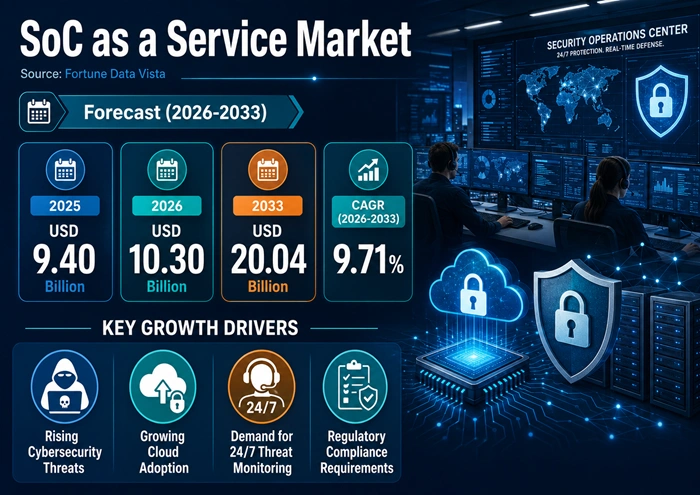
The global SoC as a service market size is valued at USD 9.40 billion in 2025 and is predicted to increase from USD 10.30 billion in 2026 to approximately USD 20.04 billion by 2033, growing at a CAGR of 9.71% from 2026 to 2033.
This strong expansion reflects the rising need for organizations of all sizes to access professional-grade security monitoring and threat detection without building expensive in-house infrastructure. Growing cyberattack sophistication, expanding cloud adoption, and tightening regulatory compliance requirements are together pushing demand for outsourced security operations center services across both large enterprises and smaller businesses.
AI Impact on the SoC as a Service Industry
Artificial Intelligence Is Quietly Transforming How Security Teams Detect and Respond to Modern Cyber Threats
Artificial intelligence is beginning to play a meaningful role in reshaping how outsourced security operations centers identify and neutralize threats. Machine learning algorithms embedded in modern SOC platforms are now capable of analyzing enormous volumes of network traffic and log data in real time, flagging suspicious patterns that would take human analysts far longer to detect manually. This capability is significantly shortening the time between initial threat detection and containment, which matters enormously for organizations facing increasingly fast-moving ransomware and phishing campaigns.
Beyond detection speed, AI is improving the accuracy of threat classification within SOC as a service platforms, reducing the number of false alarms that traditionally overwhelmed security analysts and caused alert fatigue. Providers are increasingly using generative AI tools to automate incident summaries and recommended response actions, freeing up human analysts to focus on the most complex and high-priority security events. The broader integration of AI into behavioral analytics also supports better anomaly detection across endpoint and cloud environments, an area that has become central to how modern security teams defend against insider threats and sophisticated attackers.
Growth Factors
Rising Cyber Threat Volume, Skills Shortages, and Cost Efficiency Are Converging to Accelerate Adoption
The primary engine driving the SoC as a service market forward is the sharp rise in cyberattack frequency and complexity across nearly every industry. Organizations are facing a growing volume of ransomware, phishing, and supply chain attacks that require round-the-clock monitoring, and many companies simply lack the resources to staff an internal security operations center capable of providing this level of coverage. This growing threat landscape creates a direct and expanding need for outsourced security monitoring that can scale quickly without heavy upfront investment.
At the same time, the global shortage of skilled cybersecurity professionals is pushing more organizations toward managed security services rather than trying to build internal teams from scratch. The widespread adoption of cloud-based infrastructure that requires specialized monitoring expertise, the development of subscription-based pricing models that make enterprise-grade security accessible to smaller businesses, and the emergence of integrated threat intelligence sharing across client networks are all expanding the addressable market. Regulatory pressure around data protection in regions like Europe and North America is further driving institutional adoption of professionally managed security monitoring.
Market Outlook
Expanding Cloud Adoption, Regulatory Pressure, and SME Uptake Are Setting the Stage for Sustained Long-Term Growth
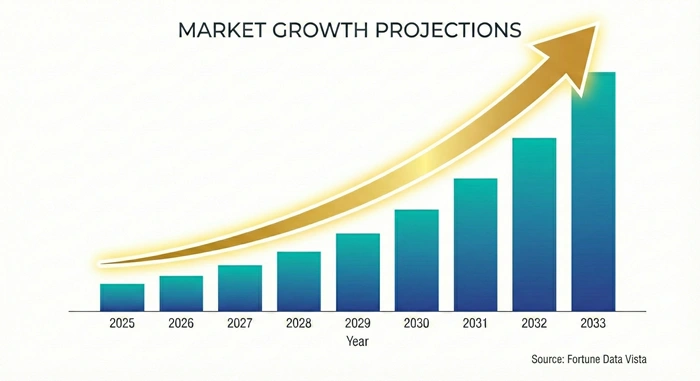
The SoC as a service industry is positioned for sustained long-term growth driven by several converging technological and regulatory factors. As more business-critical operations move to cloud and hybrid infrastructure, the complexity of securing these environments continues to rise, making outsourced expertise increasingly attractive compared to maintaining costly in-house security teams. This structural shift toward managed security represents a significant and durable source of demand for established providers and emerging specialized vendors alike.
Small and mid-sized enterprises will be an important source of growth through 2033, since these organizations often lack the budget for dedicated internal security teams but face the same regulatory and threat pressures as larger companies. Countries across Asia Pacific and Latin America are seeing rapid digital transformation alongside rising cyberattack activity, which is expanding demand for affordable, subscription-based security monitoring services. Providers that invest early in scalable, AI-enhanced platforms suited to smaller organizational budgets are likely to capture a disproportionate share of this expanding demand within the SoC as a service market.
Expert Speaks
-
"Security operations have become too complex and fast-moving for most organizations to manage entirely in-house. Our clients increasingly view outsourced monitoring as a strategic necessity rather than a cost-saving shortcut." — CEO, NTT Corporation
-
"The shortage of skilled cybersecurity talent means managed detection and response services are no longer optional for companies serious about protecting their networks. Demand from mid-market businesses has grown faster than we anticipated." — CEO, Fortinet Inc.
-
"AI-driven automation is reshaping how quickly our security operations centers can identify and contain threats. This is fundamentally changing the value proposition we can offer to enterprise clients." — CEO, Check Point Software Technologies
Key Report Takeaways
-
North America leads the global SoC as a service market, holding approximately 38% market share in 2025, supported by advanced cybersecurity infrastructure, strong regulatory compliance requirements, and heavy enterprise investment in outsourced threat monitoring
-
Asia Pacific is the fastest-growing region, expected to expand at a CAGR of around 15% through 2033, fueled by rapid digital transformation, rising cyberattack activity, and growing cloud adoption across India and Southeast Asia
-
Large enterprises represent the dominant customer base, relying heavily on SoC as a service providers to supplement internal security teams and manage complex, multi-cloud environments
-
Threat detection and remediation applications contribute the most to overall demand, reflecting rising urgency around proactive threat management rather than reactive incident response
-
Managed SIEM and log management remains the most widely adopted service type, prized for its central role in continuous monitoring and regulatory compliance reporting
-
Cloud security services will grow the fastest among security type segments, holding close to 29% market share with a CAGR near 13% through the forecast period, driven by accelerating enterprise migration to hybrid and multi-cloud infrastructure
Market Scope
| Parameter | Details |
|---|---|
| Market Size by 2033 | USD 20.04 Billion | Market Size by 2026 | USD 10.30 Billion | Market Size by 2025 | USD 9.40 Billion | Market Growth Rate from 2026 to 2033 | CAGR of 9.71% | Dominating Region | North America | Fastest Growing Region | Asia Pacific | Segments Covered | Service Type, Security Type, Organization Size, Deployment Mode, End User, Region | Regions Covered | North America, Europe, Asia Pacific, Latin America, Middle East & Africa |
Market Dynamics
Drivers Impact Analysis
Rising Cyber Threat Sophistication and Skills Shortages Are Emerging as the Two Most Powerful Forces Propelling This Market Forward
| Driver | (≈) % Impact on CAGR Forecast | Geographic Relevance | Impact Timeline |
|---|---|---|---|
| Rising frequency and complexity of cyberattacks | ~35% | Global, strongest in North America, Europe | Short to long-term |
| Global shortage of skilled cybersecurity professionals | ~28% | Global | Medium to long-term |
| Growing enterprise migration to cloud and hybrid infrastructure | ~20% | Global, led by Asia Pacific, North America | Short to medium-term |
| Tightening data protection and compliance regulations | ~17% | Europe, North America | Medium to long-term |
The rising frequency and sophistication of cyberattacks is without question the single most powerful demand driver in the SoC as a service market. Ransomware campaigns, phishing schemes, and supply chain attacks have grown dramatically in scale over the past few years, and organizations across nearly every sector now recognize that continuous, round-the-clock monitoring is essential rather than optional. This growing threat environment is pushing even mid-sized businesses that previously relied on basic antivirus protection to seek professional-grade security monitoring services.
The global shortage of skilled cybersecurity professionals is the second critical driver shaping the SoC as a service market. Building and staffing an internal security operations center requires specialized talent that is difficult and expensive to recruit, particularly for smaller organizations competing against large enterprises for the same limited talent pool. This matters commercially because outsourced providers can spread specialized expertise across many clients simultaneously, offering a level of coverage that would be financially impractical for most individual companies to replicate internally. As cloud adoption accelerates globally, procurement of managed security monitoring services continues to climb steadily.
Restraints Impact Analysis
Data Privacy Concerns and Integration Complexity Continue to Present Real-World Barriers to Full Market Penetration
| Restraint | (≈) % Impact on CAGR Forecast | Geographic Relevance | Impact Timeline |
|---|---|---|---|
| Data privacy and third-party access concerns | ~38% | Global, notable in regulated industries | Short to medium-term |
| Integration complexity with existing legacy IT systems | ~30% | Global | Short to long-term |
| High cost of premium managed security packages | ~20% | Emerging markets, small businesses | Medium-term |
| Limited trust in outsourced providers among certain industries | ~12% | Global | Ongoing |
The most significant structural restraint in the SoC as a service market is the concern many organizations have about granting third-party providers access to sensitive internal data and network systems. Highly regulated industries like banking, healthcare, and government agencies often face strict internal policies or legal requirements limiting how much security monitoring can be outsourced, which slows adoption even when the cost benefits are clear. This creates a persistent hesitation among certain client segments that providers must overcome through stronger data protection guarantees and compliance certifications.
Integration complexity with existing legacy IT systems remains a persistent technical challenge for many prospective clients. Organizations running older infrastructure often find that connecting outsourced monitoring tools to their existing systems requires significant upfront configuration work, which can delay onboarding and increase perceived costs. While cloud-native platforms are helping reduce some of this friction, the combination of data privacy concerns and integration complexity still limits universal adoption among organizations operating in highly regulated or technically fragmented environments.
Opportunities Impact Analysis
SME Market Penetration and AI-Driven Automation Represent the Most Commercially Significant Growth Opportunities
| Opportunity | (≈) % Impact on CAGR Forecast | Geographic Relevance | Impact Timeline |
|---|---|---|---|
| Expansion of affordable service packages for small and mid-sized businesses | ~40% | Global, led by Asia Pacific, Latin America | Medium to long-term |
| Growth of AI-driven automated threat detection and response | ~35% | Global | Short to medium-term |
| Integration of managed cloud security across multi-cloud environments | ~25% | Global | Long-term |
The expansion of affordable, subscription-based service packages tailored specifically for small and mid-sized businesses represents one of the most commercially attractive opportunities in the SoC as a service sector. These smaller organizations face the same cyber risks as large enterprises but typically lack the budget for dedicated internal security teams, creating a large and currently underserved customer base. Providers that can deliver simplified, cost-effective monitoring solutions without sacrificing detection quality stand to capture significant new revenue as awareness of cyber risk spreads deeper into the small business community.
The growing use of AI-driven automation for threat detection and incident response is opening substantial commercial opportunity for providers willing to invest in advanced platform capabilities. As automated tools take over routine monitoring and initial threat triage, providers can serve more clients with the same analyst headcount, improving margins while maintaining service quality. Companies that can deliver reliable, AI-enhanced detection at competitive price points will find significant commercial opportunity as demand accelerates across both established and emerging markets.
Segment Analysis
By Service Type: Managed SIEM and Log Management
Managed SIEM Services Lead the Service Type Landscape, Driven by Central Role in Continuous Compliance Monitoring
Managed SIEM and log management services hold the dominant position in the SoC as a service market, accounting for approximately 40% of the total service type segment in 2025. This dominance is deeply rooted in the essential role these services play in continuous security monitoring and regulatory compliance reporting, which remains a top priority for organizations across financial services, healthcare, and government sectors. In high-income markets like the United States, Germany, and the United Kingdom, enterprises have standardized their compliance workflows around managed SIEM platforms, creating stable, recurring subscription revenue. Leading companies such as NTT, Fortinet, and Check Point continue to dominate procurement in these markets through well-established platform ecosystems and long-standing enterprise relationships.
North America is emerging as the strongest region for managed SIEM adoption, supported by strict regulatory frameworks and a mature enterprise cybersecurity culture that treats continuous monitoring as a baseline requirement rather than a premium feature. The region's dense concentration of financial institutions and healthcare providers, combined with active investment in cloud security infrastructure, is generating significant institutional demand for managed SIEM platforms. Arctic Wolf Networks and Trustwave have strengthened their regional presence through enterprise partnerships and managed service contracts. The broader shift toward AI-enhanced log analysis is also being led by this segment, with automated correlation tools gaining traction among security teams managing large data volumes.
By Security Type: Cloud Security
Cloud Security Services Are Reshaping Demand Patterns, Commanding Strong Growth Across the SoC as a Service Market
Cloud security services account for approximately 29% of the total security type segment in 2025, reflecting the accelerating enterprise migration toward hybrid and multi-cloud infrastructure. With organizations increasingly distributing workloads across multiple cloud providers, securing these complex environments has become a foundational and expanding demand driver across virtually every regional SoC as a service market. Enterprises maintain growing procurement relationships with security providers to ensure consistent monitoring across cloud platforms, and this segment operates at a CAGR meaningfully above the overall market average, supported by continued cloud adoption across nearly every industry vertical.
Asia Pacific is a standout growth region for cloud security demand, expanding rapidly as businesses across India, China, and Southeast Asia accelerate their digital transformation initiatives. Recurrent cyberattacks targeting cloud infrastructure in the region have forced enterprises to scale up cloud-specific security monitoring dramatically, and regional providers have expanded their capabilities in parallel to meet growing demand. Companies like NTT and Lumen Technologies have deepened their presence in the region through local data center partnerships and cloud provider integrations. Endpoint security, while a mature and widely adopted segment, remains an important category due to continued growth in remote work arrangements that expand the attack surface organizations must monitor.
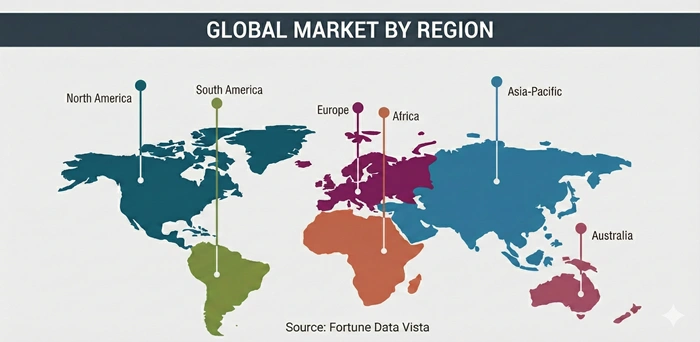
Regional Insights
North America
North America's Advanced Cybersecurity Infrastructure and Strong Regulatory Compliance Make It the Global Market Leader
North America holds the dominant position in the global SoC as a service market with approximately 38% market share in 2025 and continues to expand steadily through 2033. The United States drives the majority of regional demand, supported by a highly developed cybersecurity vendor ecosystem, strong regulatory compliance requirements across financial and healthcare sectors, and rapid enterprise adoption of managed detection and response platforms. Key companies with strong North American market presence include Fortinet, Check Point, Arctic Wolf Networks, and Trustwave, all of which maintain extensive enterprise client relationships and direct sales infrastructure across the region.
Canada also contributes meaningfully to regional growth, with organizations there increasingly adopting managed security services to address rising ransomware activity targeting mid-sized businesses. Enterprises across the region are increasingly adopting cloud-native monitoring platforms that integrate seamlessly with existing infrastructure investments, reducing onboarding friction for new clients. The combination of strong regulatory pressure, high per-enterprise cybersecurity spending, and a mature managed services vendor landscape ensures North America's leadership position in the SoC as a service market remains firmly intact through 2033.
Asia Pacific
Asia Pacific Is the Fastest-Growing Region for SoC as a Service, Powered by Rapid Digital Transformation and Rising Cyber Threats
Asia Pacific is expected to register the fastest CAGR in the global SoC as a service market through 2033, growing at approximately 15% as businesses across the region accelerate cloud adoption and digital transformation initiatives. India stands out as a particularly important growth market, driven by expanding IT infrastructure, rising cyberattack targeting of local businesses, and growing awareness among enterprises that outsourced monitoring is more cost-effective than building internal capabilities from scratch. Companies like NTT and regional cybersecurity specialists are expanding their Asia Pacific presence to capture growing institutional demand.
China and Southeast Asian markets also contribute significantly to regional growth, both bringing rapidly expanding digital economies that require scalable security monitoring solutions. Local and international providers are increasingly competing to serve the region's growing base of mid-sized enterprises that previously lacked access to enterprise-grade security tools. The combination of rising cyber risk awareness, expanding cloud infrastructure investment, and improving provider accessibility ensures Asia Pacific will remain the fastest-growing region within the SoC as a service market through the forecast period.
Customization Available for This Report
Region-Wise and Country-Wise Customization Ensures Every Client Gets Insights Tailored to Their Exact Market Focus
This report offers comprehensive region-wise and country-wise customization, providing tailored market insights, trends, competitive analysis, and opportunity assessments specific to your geography of interest.
Our team can deliver a fully customized version of this report for any of the following regions and countries, providing deep-dive market analysis, demand forecasting, regulatory landscape review, and competitive intelligence specific to the selected market and SoC as a service keyword combination:
North America
-
U.S. — Detailed analysis of enterprise cybersecurity spending, managed detection adoption, and compliance-driven procurement trends
-
Canada — Insights into ransomware exposure among mid-sized businesses and managed security adoption
-
Mexico — Growing enterprise cybersecurity investment and outsourced monitoring adoption
Europe
-
U.K. — Regulatory-driven adoption of managed SOC services and financial sector procurement patterns
-
Germany — Advanced cybersecurity manufacturing landscape, GDPR-driven compliance demand, and enterprise adoption rates
-
France — Growing cyber insurance requirements and managed security service adoption
-
Italy — Rising ransomware activity and expanding demand for outsourced monitoring
-
Rest of Europe — Emerging cybersecurity markets across Eastern Europe and the Baltics
Asia Pacific
-
China — Rapid digital economy growth, government-funded cybersecurity infrastructure, and domestic provider competitiveness
-
India — Expanding IT infrastructure, rising cyberattack exposure, and affordable managed security adoption
-
Japan — Advanced enterprise cybersecurity adoption and regulatory pathway analysis
-
South Korea — Cybersecurity export industry and institutional procurement
-
Australia — Growing enterprise cloud security investment and compliance-driven adoption
-
Rest of Asia Pacific — Country-level analysis covering Thailand, Vietnam, Indonesia, and Malaysia
Latin America
-
Brazil — Growing enterprise cybersecurity market and expanding managed service adoption
-
Argentina — Early-stage managed security market development
-
Rest of Latin America — Colombia, Mexico, Peru, and Chile country-level SoC as a service market sizing
Middle East & Africa
-
UAE — Advanced cybersecurity adoption, Vision-aligned digital investments, and managed monitoring growth
-
Saudi Arabia — Industrial modernization, cybersecurity infrastructure investment, and enterprise procurement
-
Rest of MEA — Sub-Saharan Africa cybersecurity access expansion and managed service adoption
Top Key Players
-
NTT Corporation (Japan)
-
Fortinet Inc (United States)
-
Check Point Software Technologies Ltd (Israel)
-
Cloudflare Inc (United States)
-
Arctic Wolf Networks Inc (United States)
-
Trustwave Holdings Inc (United States)
-
Thales Group (France)
-
Airbus Cybersecurity (France)
-
Lumen Technologies Inc (United States)
-
Kaseya Inc (United States)
-
Rapid7 Inc (United States)
-
Secureworks Corp (United States)
Recent Developments
-
In 2025, Thales launched an advanced generative AI capability aimed at enhancing detection capabilities within security operations centers, combining AI technologies with operator expertise to broaden monitored systems
-
In 2025, NTT expanded its global cybersecurity strategy to strengthen SOC solutions and threat management capabilities across multiple technology domains for enterprise clients
-
In 2026, Fortinet introduced enhanced AI-driven threat correlation tools within its managed security platform, aimed at reducing false positives for mid-market clients
-
In 2025, Arctic Wolf Networks expanded its managed detection and response offerings to serve smaller enterprise clients seeking affordable, subscription-based monitoring
-
In 2026, Check Point Software Technologies strengthened its cloud security portfolio through new integrations designed to simplify multi-cloud monitoring for enterprise customers
Market Trends
The SoC as a Service Market Is Rapidly Shifting Toward AI-Automated Detection and Flexible Subscription Models That Match Evolving Enterprise Needs
Two of the most consequential trends reshaping the SoC as a service landscape are the growing use of AI-driven automation and the shift toward flexible, tiered subscription pricing models. AI-powered platforms that automatically triage and prioritize security alerts are replacing manual review processes in well-equipped security operations centers, reducing analyst workload and improving response times significantly. This trend is lowering the effective cost per client for providers while improving service quality, which is helping expand access to smaller organizations that previously found managed security services too expensive.
The second major trend is the growing customization of service packages to match the specific needs and budgets of different client segments, moving away from one-size-fits-all enterprise contracts. Providers are increasingly offering modular services that let smaller businesses start with basic monitoring and expand coverage as their needs grow, opening entirely new market segments among startups and mid-sized companies that previously had no access to professional-grade security monitoring. At the same time, deeper integration between SoC as a service platforms and cloud provider security tools is creating a new layer of value for enterprises running complex multi-cloud environments.
Segments Covered in the Report
By Service Type
-
Managed SIEM and Log Management
-
Vulnerability Scanning and Assessment
-
Threat Detection and Remediation
By Security Type
-
Endpoint Security
-
Network Security
-
Cloud Security
By Organization Size
-
Small and Mid-Sized Enterprises
-
Large Enterprises
By Deployment Mode
-
Cloud-Based
-
On-Premise
By End User
-
BFSI
-
Healthcare
-
Retail and E-Commerce
-
Government and Public Sector
-
IT and Telecom
By Region
-
North America (U.S., Canada, Mexico)
-
Europe (U.K., Germany, France, Italy, Rest of Europe)
-
Asia Pacific (China, India, Japan, South Korea, Australia, Rest of Asia Pacific)
-
Latin America (Brazil, Argentina, Rest of Latin America)
-
Middle East & Africa (UAE, Saudi Arabia, Rest of MEA)
❝ Built for Every Level — From Startups to Industry Giants ❞
Here Is Exactly How This Report Works for You
-
For tier 1 enterprises, investors, and high-level decision-makers, this report delivers competitor revenue analysis, detailed revenue source breakdowns, geopolitical risk assessments, and supply-demand dynamics that enable confident capital allocation, M&A targeting, and strategic market entry or expansion decisions in the SoC as a service space
-
For tier 2 and tier 3 companies, mid-level businesses, and startups, this report provides a practical roadmap of the most commercially viable segments, regional opportunities, and technology investment priorities, helping you compete effectively against established players and identify white spaces before they become crowded
-
For all decision-makers across the value chain, this report explains exactly how regulatory shifts, cybersecurity talent shortages, cloud migration trends, and competitor positioning are converging to shape market direction through 2033, giving you the intelligence framework to make proactive, evidence-based decisions rather than reactive ones
Frequently Asked Questions:
Answer: The global SoC as a service market was valued at USD 9.40 billion in 2025 and is projected to reach USD 20.04 billion by 2033. This growth is driven by rising cyberattack activity and increasing enterprise reliance on outsourced security monitoring.
Answer: The primary drivers of the SoC as a service market include rising cyberattack frequency and a global shortage of skilled cybersecurity professionals. Growing enterprise migration to cloud infrastructure is further accelerating adoption of managed monitoring services.
Answer: North America currently dominates the SoC as a service market with approximately 38% market share, supported by advanced cybersecurity infrastructure. Asia Pacific is the fastest-growing region, driven by rapid digital transformation and rising cyber threats.
Answer: Managed SIEM and log management account for approximately 40% of the service type segment, reflecting their central role in compliance monitoring. Cloud security services are also growing rapidly due to accelerating multi-cloud adoption.
Answer: Leading players in the SoC as a service market include NTT, Fortinet, Check Point Software Technologies, Cloudflare, and Arctic Wolf Networks. These companies compete through broad service portfolios, AI-enhanced platforms, and continuous investment in automated threat detection.