
Solid State Drive Market Overview
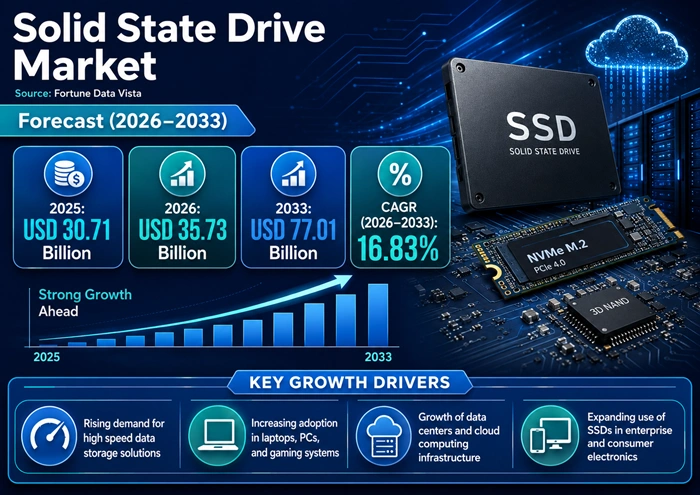
The global solid state drive market size is valued at USD 30.71 billion in 2025 and is predicted to increase from USD 35.73 billion in 2026 to approximately USD 77.01 billion by 2033, growing at a CAGR of 16.83% from 2026 to 2033. This rapid expansion is fueled by the widespread adoption of NVMe-based storage across hyperscale data centers, AI training infrastructure, edge computing deployments, and next-generation consumer electronics, collectively transforming flash storage into a mission-critical technology layer across virtually every industry.
AI Impact on the Solid State Drive Industry
Generative AI and Machine Learning Workloads Are Fundamentally Reshaping the Demand Curve for High-Performance Flash Storage — Creating a New Era of Growth for the Solid State Drive Market*
Artificial intelligence has become one of the most powerful demand accelerators in the solid state drive market. Large language model training and inference workflows require continuous, high-throughput data access at sub-millisecond latency — something only NVMe-based flash storage can reliably deliver. Hyperscale operators including major cloud platforms are increasingly deploying local NVMe SSD tiers rather than relying on network-attached storage, significantly reducing I/O bottlenecks that once capped AI pipeline performance. The direct result is that solid state drive procurement has become a line item in AI infrastructure budgets alongside GPUs and networking hardware.
Beyond model training, AI is also being embedded within the drives themselves. Storage controllers now incorporate machine learning-based wear leveling, predictive failure analytics, and dynamic firmware optimization that extend drive lifespan and maintain consistent read/write speeds even under sustained enterprise workloads. AI-powered design tools are also helping storage engineers simulate thermal behavior and controller performance before physical tape-out, shortening product development cycles for next-generation SSD platforms. These advancements are pushing the performance ceiling of flash storage higher each year, reinforcing the long-term growth outlook for the solid state drive industry.
Growth Factors
Explosive Data Center Expansion, PCIe Gen5 Adoption, and the Global Transition Away from Legacy Hard Disk Drives Are the Core Engines Propelling Solid State Drive Market Growth Through 2033*
The single most significant growth factor in the solid state drive market is the ongoing mass migration of enterprise and hyperscale storage infrastructure from spinning hard disk drives to NVMe flash. This transition is accelerating because the performance gap between SSDs and HDDs has become commercially untenable for modern workloads — AI inference, real-time analytics, video streaming, and containerized cloud applications all demand storage that responds in microseconds, not milliseconds. NVMe over PCIe Gen5 now delivers sequential read speeds exceeding 10 GB/s, making it the de facto standard for new data center builds and server refresh cycles across North America, Europe, and Asia-Pacific.
On the consumer and edge side, growth is being driven by the convergence of gaming, content creation, and always-connected mobile computing. PC gamers and creative professionals are upgrading to 2 TB and 4 TB drives as game file sizes exceed 200 GB and 4K video production requires fast local scratch storage. Simultaneously, edge computing in 5G networks and autonomous vehicles is creating entirely new solid state drive demand vectors. Telecom operators are caching content at 5G base stations using local NVMe flash, reducing backhaul traffic and latency. Electric vehicle manufacturers and autonomous driving platforms are embedding terabyte-class SSDs for real-time inference and over-the-air software update management — uses that simply did not exist five years ago.
Market Outlook
The Solid State Drive Market Is Set to Nearly Double by 2033 — With Enterprise Data Centers, Edge Computing, and AI Infrastructure Leading the Next Phase of Adoption*
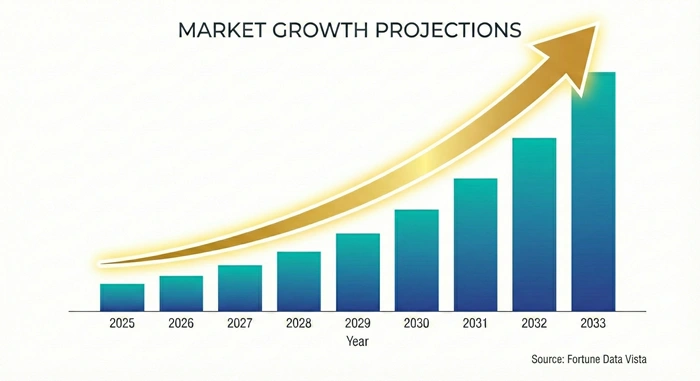
The solid state drive market outlook through 2033 is defined by structural demand growth across every end-use segment. The market is expected to reach USD 77.01 billion by 2033, reflecting a CAGR of 16.83% over the forecast period. Enterprise and data center server deployments will be the fastest-growing end-user category, with cloud giants, telecom operators, and financial institutions committing multi-year capital expenditure to flash-based storage infrastructure. EDSFF form factors — particularly E1.S and E3.S modules — are expected to replace conventional U.2 and 2.5-inch drives in most new data center builds by 2028, dramatically improving rack density and cooling efficiency.
From a technology standpoint, QLC NAND is expected to reach near-TLC performance levels within the forecast window, enabling cost-effective high-capacity deployments for cold storage, content delivery, and backup applications. PCIe Gen6 is already in sampling stages and will begin commercial deployment around 2027–2028, further extending the performance advantage of NVMe over all competing storage technologies. Meanwhile, computational storage devices — which embed processing logic directly in SSD controllers — are expected to enter mainstream enterprise deployments by 2030, allowing on-drive SQL filtering and encryption that offload CPU cycles and reduce network movement of sensitive data. These compounding technology improvements ensure the solid state drive market remains one of the most dynamic segments in the global semiconductor and hardware industry.
Expert Speaks
-
"We are at a pivotal moment where storage is no longer just an infrastructure cost — it is a competitive differentiator. Our investments in NVMe and PCIe Gen5 SSD infrastructure directly enable faster AI model deployment and real-time analytics at scale. Companies that treat solid state storage as a strategic asset rather than a commodity will have a measurable advantage in data-driven decision-making over the next decade." — CEO, Samsung Electronics Co., Ltd.
-
"The transition from hard disk drives to flash storage in enterprise environments is not a gradual evolution — it is a wholesale replacement cycle that is happening right now. We are seeing our hyperscale and data center customers accelerate SSD procurement significantly as they build out AI training clusters and expand cloud storage capacity. The performance and power efficiency improvements in next-generation NVMe drives are making the business case undeniable." — CEO, Western Digital Corporation
-
"Our data shows that storage I/O latency remains one of the most underappreciated bottlenecks in AI pipeline performance. Organizations investing in high-performance flash storage adjacent to GPU clusters are seeing substantial improvements in model training throughput and inference responsiveness. The solid state drive industry is entering its most important decade — demand from AI, edge, and automotive applications will sustain robust growth well into the 2030s." — CEO, Micron Technology, Inc.
Key Report Takeaways
-
Asia-Pacific leads the global solid state drive market with approximately 46.73% revenue share in 2025, anchored by dominant NAND flash manufacturing operations in South Korea, Japan, and Taiwan, as well as strong consumption from China's rapidly expanding hyperscale data center sector.
-
Asia-Pacific is also the fastest-growing region, projected to expand at a CAGR of approximately 18.67% through 2033, driven by infrastructure digitization, rising data consumption, and government-led AI and smart city initiatives across China, India, and Southeast Asia.
-
Enterprise and data center server customers represent the fastest-growing end-user segment, advancing at a CAGR of 18.72%, as hyperscalers and cloud operators replace hard disk drive arrays with NVMe flash to support AI, big data, and real-time analytics workloads.
-
The PCIe/NVMe interface segment contributes the most to overall solid state drive market revenue, capturing 62.34% market share in 2025, as organizations across all industries migrate away from SATA and SAS interfaces to meet modern performance requirements.
-
Triple-Level Cell (TLC) NAND is the most widely deployed technology, holding a 58.56% revenue share in 2025, offering the best balance of cost, performance, and endurance for the majority of commercial and enterprise applications.
-
The EDSFF form factor module segment is the fastest-growing future segment, forecast to expand at a CAGR of 18.12% through 2033, capturing a growing share of hyperscale data center builds where rack density and cooling efficiency are primary procurement criteria; EDSFF is expected to eclipse U.2 for new deployments before 2029.
Market Scope
| Parameter | Details |
|---|---|
| Market Size by 2033 | USD 77.01 Billion | Market Size by 2026 | USD 35.73 Billion | Market Size by 2025 | USD 30.71 Billion | Market Growth Rate from 2026 to 2033 | CAGR of 16.83% | Dominating Region | Asia-Pacific | Fastest Growing Region | Asia-Pacific | Segments Covered | By Interface, By Form Factor, By Technology (NAND Type), By Storage Capacity, By End-User, By Sales Channel, By Region | Regions Covered | North America, Europe, Asia-Pacific, Latin America, Middle East & Africa |
Market Dynamics
Drivers Impact Analysis
AI-Driven Data Center Expansion and Accelerating NVMe Enterprise Adoption Are the Two Most Consequential Demand Drivers Sustaining Solid State Drive Market Growth Through 2033*
| Driver | ≈ % Impact on CAGR Forecast | Geographic Relevance | Impact Timeline |
|---|---|---|---|
| Rising demand from AI/ML data center workloads | ~+4.2% | Global — concentrated in North America and Asia-Pacific hyperscale hubs | Medium-term (2–4 years) |
| Accelerating NVMe adoption across enterprise storage arrays | ~+3.1% | Global — early adoption in North America and European enterprise segments | Short-term (≤2 years) |
| Rapid growth of edge computing nodes in 5G and IoT | ~+2.8% | Asia-Pacific and North America 5G infrastructure; global IoT deployments | Medium-term (2–4 years) |
| Mainstreaming of PCIe 5.0 and EDSFF form factors | ~+3.5% | North America and Asia-Pacific data centers; European enterprise | Short-term (≤2 years) |
| Government green-data policies favoring flash over HDDs | ~+1.4% | Europe, North America, China | Long-term (≥4 years) |
The solid state drive market is receiving its strongest demand signals from the explosive growth in AI infrastructure investment. Hyperscale data centers now treat NVMe flash as essential infrastructure — comparable in strategic importance to GPU clusters and high-speed networking. Generative AI clusters require continuous streaming of terabyte-scale model parameters from local flash storage, and each generation of large language models increases this demand substantially. This is translating directly into massive SSD procurement cycles at companies like Microsoft Azure, Amazon Web Services, and Alibaba Cloud, which collectively represent hundreds of thousands of SSD units per quarter and are reshaping the entire supply-demand balance in the solid state drive industry.
Enterprise NVMe adoption is reinforcing this growth at a broader scale. NVMe has crossed the 60% shipment threshold for enterprise storage arrays, and NVMe-over-Fabrics is displacing SAS and Fibre Channel by delivering significantly higher throughput at comparable reliability and lower total cost of ownership. Organizations that once planned to hold SATA-based storage for five-year depreciation cycles are now scrapping those drives years ahead of schedule to capture the performance benefits of PCIe Gen4 and Gen5 SSDs. This is creating an accelerated replacement cycle that contributes meaningfully to the solid state drive market growth trajectory well beyond baseline demand.
Restraints Impact Analysis
NAND Price Volatility, Supply Chain Geographic Concentration, and Thermal Management Challenges Are the Primary Factors Moderating Solid State Drive Market Growth Rates*
| Restraint | ≈ % Impact on CAGR Forecast | Geographic Relevance | Impact Timeline |
|---|---|---|---|
| High ASP volatility due to NAND bit oversupply | ~-2.7% | Global — acute in regions dependent on spot-market procurement | Short-term (≤2 years) |
| Supply-chain concentration risk in NAND wafer manufacturing | ~-1.8% | Global — acute in Taiwan and South Korea dependent regions | Medium-term (2–4 years) |
| Thermal management challenges in ultrathin client devices | ~-1.2% | Global — concentrated in consumer laptop and mobile workstation segments | Short-term (≤2 years) |
| Growing security-certification costs for enterprise drives | ~-0.6% | North America and European enterprise and government procurement | Long-term (≥4 years) |
One of the most persistent challenges for the solid state drive market is the volatility of NAND flash pricing. Quarterly NAND prices have historically swung by as much as 35% in a single year, compressing OEM margins and creating procurement uncertainty for enterprise buyers. Periods of oversupply — triggered by aggressive wafer starts from major fabs — push consumer and commercial SSD prices down sharply, which hurts smaller manufacturers lacking vertical integration. While price declines can stimulate volume demand in some segments, they simultaneously erode revenue totals and make long-term financial planning challenging for market participants across the value chain.
The concentration of NAND manufacturing capacity in a handful of facilities across Taiwan, South Korea, and Japan represents a structural vulnerability that is difficult to resolve quickly. Taiwan and South Korea alone account for approximately 68% of global NAND output, meaning that geopolitical disruptions, natural disasters, or trade policy shifts in these regions can have immediate ripple effects across the global solid state drive supply chain. While the US CHIPS and Science Act and the EU Chips Act are funding domestic fab construction, none of these new facilities are expected to reach meaningful NAND production volumes before 2027 at the earliest. Until geographic diversification matures, this concentration risk will remain a moderate restraining force on the solid state drive market.
Opportunities Impact Analysis
Emerging Market Digitization, QLC Technology Maturation, and Automotive/Edge Deployments Are the Three Most Compelling Untapped Growth Opportunities in the Solid State Drive Market*
| Opportunity | ≈ % Impact on CAGR Forecast | Geographic Relevance | Impact Timeline |
|---|---|---|---|
| Untapped enterprise and consumer demand in emerging markets | ~+35% of opportunity pool | Asia-Pacific, Latin America, Middle East | Mid to long-term |
| QLC NAND cost parity enabling mass-market high-capacity drives | ~+28% of opportunity pool | Global — hyperscale and consumer segments | Near to mid-term |
| Automotive and industrial embedded storage expansion | ~+22% of opportunity pool | North America, Europe, Asia-Pacific automotive hubs | Mid to long-term |
| Computational storage devices reducing CPU dependency | ~+15% of opportunity pool | North America, Europe enterprise and data center segments | Long-term |
Emerging markets represent a significant untapped growth frontier for the solid state drive market. Countries across South and Southeast Asia, the Middle East, and Latin America are undergoing rapid digital infrastructure buildout, with governments investing in cloud data centers, smart city platforms, and broadband expansion programs. As enterprise SSD adoption rates in these markets still lag well behind developed economy benchmarks, the headroom for growth is substantial. India's enterprise SSD purchases alone grew by over 32% in a single year, reflecting the pace of digital transformation now underway in previously underpenetrated markets.
The automotive sector offers another structurally expanding demand opportunity. Modern electric vehicles and autonomous driving platforms embed multi-terabyte SSDs for onboard inference, sensor data logging, and over-the-air software updates — applications that require both high performance and extreme reliability across wide temperature ranges. This is a premium segment with significantly higher ASPs than consumer drives, and it is growing at pace with global electric vehicle adoption. Computational storage — where SSD controllers incorporate processing logic to run SQL filters, encryption, and compression on-drive — is also moving toward commercialization, with the NVMe 2.0 standard providing a formal framework for these capabilities. These converging opportunities give the solid state drive market multiple parallel growth vectors beyond the core data center and consumer replacement cycles.
Segment Analysis
By Interface: PCIe/NVMe
PCIe/NVMe Continues to Redefine What Enterprise Storage Performance Means — and Its Dominance in the Solid State Drive Market Is Still Expanding*
The PCIe/NVMe interface segment is the clear revenue leader in the solid state drive market, capturing approximately 62.34% of global revenue in 2025 and advancing at a CAGR of 17.03% through 2033. NVMe's architecture — built natively for flash storage rather than adapted from rotational disk protocols — delivers substantially lower CPU overhead, higher queue depth, and significantly greater throughput compared to SATA or SAS alternatives. Enterprise buyers across financial services, cloud computing, media and entertainment, and healthcare are standardizing on NVMe as the default storage interface for all new server and storage array deployments. Asia-Pacific is the fastest-growing region for NVMe adoption, driven by aggressive hyperscale data center expansion in China, South Korea, and India, where cloud platforms are deploying NVMe-first architectures at scale. Key players leading this segment include Samsung Electronics (South Korea), SK Hynix (South Korea), and Micron Technology (USA).
The transition to PCIe Gen5, which doubles the bandwidth ceiling compared to Gen4, has further accelerated NVMe's commercial momentum in the solid state drive market. Dell Technologies, HPE, and Lenovo have all standardized Gen5 NVMe as the default storage option in their latest server product lines, with SATA ports available only through special-order configurations. The NVMe 2.0 specification, ratified in 2025, added zoned namespace support and formal computational storage commands, extending NVMe's applicability into edge storage, automotive, and AI-specific deployments. As PCIe Gen6 sampling begins around 2027, NVMe will remain firmly at the center of storage product roadmaps for the foreseeable future, further consolidating its dominant share in the global solid state drive market. SATA, by contrast, has declined below 25% of shipments and continues to lose position as legacy hardware reaches end-of-life refresh cycles.
By Technology: TLC and QLC NAND
TLC NAND Holds the Largest Market Share While QLC Is the Fastest-Growing Flash Technology — Together They Define the Future Cost-Performance Structure of the Solid State Drive Market*
Triple-Level Cell NAND maintained a commanding 58.56% revenue share in the solid state drive market in 2025, reflecting its established position as the best all-around choice for performance, endurance, and cost across consumer, commercial, and enterprise deployments. TLC offers the right balance of write endurance and per-gigabyte cost for the majority of use cases — from corporate laptop boot drives to enterprise database volumes — which is why it remains the default choice for most mainstream SSD product lines. Asia-Pacific dominates TLC NAND manufacturing, with Samsung (South Korea), SK Hynix (South Korea), and Kioxia (Japan) collectively controlling the majority of global TLC output. These manufacturers are currently pushing 200-layer-plus stacking processes to reduce die cost per bit while improving performance characteristics at the controller level.
Quad-Level Cell NAND is the fastest-growing flash technology segment, advancing at a CAGR of approximately 18.12% through 2033, as engineering advances narrow the gap with TLC endurance. Micron's 232-layer QLC process now delivers approximately 600 TBW for a 2 TB drive — roughly 90% of entry-level TLC endurance — while offering a 30% cost reduction per gigabyte for read-heavy workloads like content delivery, cold storage archiving, and AI dataset caching. Hyperscalers including major cloud platforms are actively deploying QLC-based SSDs for cold and warm storage tiers, with QLC's lower cost profile making multi-exabyte flash deployments economically viable for the first time. North America leads QLC enterprise adoption, with Pure Storage and Micron working together on G9 QLC NAND deployments targeting hyperscale power efficiency improvements. As PLC (Penta-Level Cell) NAND moves from pilot to limited commercialization toward the end of the forecast period, QLC will serve as the bridge technology that makes the solid state drive market truly mass-market for high-capacity applications.
Regional Insights
Asia-Pacific
Asia-Pacific Is Both the Dominant and Fastest-Growing Region in the Solid State Drive Market — Powered by NAND Manufacturing Supremacy and Explosive Domestic Demand Growth*
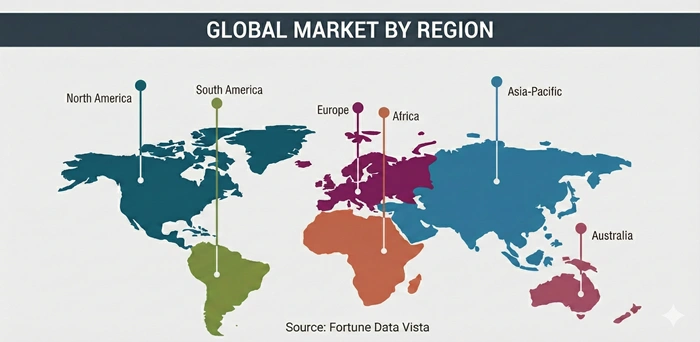
Asia-Pacific commands approximately 46.73% of global solid state drive market revenue in 2025, with a CAGR of 18.67% through 2033 — the highest growth rate of any region. The region's dominance is structural: South Korea, Japan, and Taiwan are home to the world's largest NAND flash fabrication facilities, operated by Samsung Electronics, SK Hynix, Kioxia, and YMTC (China), which together account for roughly 75% of global bit output. This manufacturing proximity gives Asia-Pacific SSD companies a fundamental cost and supply advantage that is difficult for competitors in other regions to match. Within the region, China is the single largest consumption market, driven by Alibaba Cloud, Tencent, and Baidu's massive AI infrastructure investments, with China alone deploying over 1.2 exabytes of flash for domestic AI training activities.
Beyond China, India is emerging as a high-growth consumption market for the solid state drive industry, with enterprise SSD purchases growing more than 32% year-over-year as Digital India government initiatives drive bank modernization, e-government platforms, and healthcare digitization. Japan, South Korea, and Australia represent mature markets with strong enterprise SSD penetration and growing demand for automotive and industrial applications. Key regional players include Samsung Electronics (South Korea), SK Hynix / Solidigm (South Korea), Kioxia Holdings (Japan), and YMTC (China), alongside growing contract manufacturers in Taiwan including Phison Electronics and Silicon Motion Technology, both of which supply SSD controllers to a wide range of OEM and consumer drive brands globally.
North America
North America Remains the Second-Largest Revenue Generator in the Solid State Drive Market — Anchored by Hyperscale Cloud Operators, Leading Chip Manufacturers, and the World's Largest Enterprise IT Sector*
North America held approximately 37.80% of global solid state drive market revenue in 2025, with the United States serving as the dominant contributor by a wide margin. The region benefits from the concentration of the world's largest hyperscale cloud operators — AWS, Microsoft Azure, and Google Cloud — each procuring hundreds of thousands of SSDs per quarter to support expanding AI and cloud computing infrastructure. The US is also home to major SSD and NAND technology developers including Micron Technology, Western Digital, and Seagate Technology, which supply both domestic and global markets. North America's CAGR through 2033 is projected at approximately 15.8%, reflecting a market that is large but highly active, with ongoing replacement cycles and greenfield AI data center construction driving sustained growth.
The region is further supported by the US CHIPS and Science Act, which is funding domestic semiconductor manufacturing expansion at companies including Micron Technology, which has committed USD 15 billion toward a new NAND fab in New York slated for initial operations by 2028. This investment will reduce North America's current over-dependence on Asian NAND supply chains and strengthen the region's strategic resilience. Canada is also seeing growth in enterprise SSD demand as its financial services and government cloud sectors modernize storage infrastructure. Together, North American market participants — including system integrators, cloud hyperscalers, and enterprise storage vendors — form the world's most commercially developed SSD ecosystem outside of Asia-Pacific.
Top Key Players
-
Samsung Electronics Co., Ltd. (South Korea)
-
Western Digital Corporation (United States)
-
Micron Technology, Inc. (United States)
-
SK Hynix Inc. / Solidigm (South Korea)
-
Kioxia Holdings Corporation (Japan)
-
Seagate Technology Holdings plc (United States)
-
Kingston Technology Corporation (United States)
-
Intel Corporation (United States)
-
ADATA Technology Co., Ltd. (Taiwan)
-
NetApp, Inc. (United States)
-
Phison Electronics Corporation (Taiwan)
-
Silicon Motion Technology Corporation (Taiwan)
-
Transcend Information, Inc. (Taiwan)
-
Corsair Memory, Inc. (United States)
-
YMTC (Yangtze Memory Technologies Co., Ltd.) (China)
Recent Developments
-
In June 2025, Kioxia announced the LC9 Series NVMe SSD with an industry-leading 245.76 TB capacity, built on PCIe 5.0 and the company's 8th-generation BiCS FLASH technology, specifically engineered for data-heavy AI training and enterprise hyperscale environments.
-
In August 2025, SanDisk unveiled a 256 TB UltraQLC NVMe SSD using BiCS8 QLC NAND technology, designed for cloud and enterprise customers that require extremely high storage density at reduced power consumption, with commercial shipments anticipated in 2026.
-
In November 2024, Micron Technology launched the 6550 ION, a 60 TB solid-state drive using the E3.S form factor with PCIe Gen 5 support and 12 GB/s throughput at only 20 watts, targeting large-scale AI, content delivery, and cloud storage workloads.
-
In January 2025, Lenovo agreed to acquire Infinidat, broadening its high-end enterprise storage portfolio and opening new cross-selling opportunities into hyperscale data center contracts across North America and Europe.
-
In January 2025, Pure Storage and Micron expanded their collaborative partnership around Micron's G9 QLC NAND platform, jointly targeting hyperscale power efficiency improvements and demonstrating significant total cost of ownership reductions for flash-heavy cloud deployments.
Market Trends
The Global Solid State Drive Market Is Being Reshaped by Two Defining Forces: The Rise of EDSFF Rack-Scale Architecture and the Integration of Computational Intelligence Directly Into Storage Hardware*
The most transformative trend currently reshaping the solid state drive market is the mainstream adoption of EDSFF form factor drives in hyperscale data centers. The E1.S, E1.L, and E3.S module formats allow significantly more drives per rack unit compared to traditional U.2 or 2.5-inch configurations, which reduces floor space costs and cooling complexity per petabyte of storage. Major cloud operators including Meta, Alibaba, and Microsoft have already committed to EDSFF-based procurement as their primary data center storage format, with Meta's Open Rack V3 specification mandating E3.S drives and Alibaba shifting 80% of its annual SSD procurement to EDSFF in 2025. This transition is forcing hardware manufacturers and storage integrators to redesign chassis, cable management, and thermal systems around the new form factor, creating a significant infrastructure refresh wave that is both a market driver and a competitive battleground.
The second major trend is the commercialization of computational storage devices, where SSD controllers now incorporate processing logic capable of running SQL filters, encryption, compression, and data reduction functions directly on the drive — without sending data to the host CPU. The NVMe 2.0 specification, ratified in 2025, formally standardized computational storage commands and telemetry interfaces, giving software developers a stable foundation to build on-drive applications. For enterprises processing extremely large datasets — financial institutions running real-time risk analytics, genomics companies sequencing patient data, or cloud providers serving AI inference — computational SSDs can meaningfully reduce CPU utilization and network bandwidth while accelerating query response times. These two trends together are moving the solid state drive market from a pure hardware commodity toward a higher-value, solution-oriented segment that commands premium pricing and stronger customer retention.
Segments Covered in the Report
-
By Interface
-
SATA
-
PCIe/NVMe
-
SAS
-
-
By Form Factor
-
2.5-inch
-
M.2
-
U.2
-
PCIe Add-in Card
-
EDSFF (E1.S, E1.L, E3.S)
-
Other Form Factors
-
-
By Technology (NAND Type)
-
SLC (Single-Level Cell)
-
MLC (Multi-Level Cell)
-
TLC (Triple-Level Cell)
-
QLC (Quad-Level Cell)
-
Other NAND Types
-
-
By Storage Capacity
-
Up to 500 GB
-
500 GB – 1 TB
-
1 TB – 2 TB
-
Above 2 TB
-
-
By End-User
-
Client Electronics (Laptops, Desktops, Gaming Consoles)
-
Enterprise/Data Center Servers
-
Industrial and Embedded Systems
-
Automotive
-
Others (Healthcare, Government)
-
-
By Sales Channel
-
Direct/OEM
-
Distribution and Resellers
-
Online Retail
-
-
By Region
-
North America (US, Canada, Mexico)
-
Europe (Germany, UK, France, Italy, Spain, Russia, Rest of Europe)
-
Asia-Pacific (China, Japan, South Korea, India, Australia, ASEAN, Rest of Asia-Pacific)
-
Latin America (Brazil, Argentina, Rest of Latin America)
-
Middle East & Africa (UAE, Saudi Arabia, South Africa, Rest of MEA)
-
"Built for Every Level — From Startups to Industry Giants"
Here Is Exactly How This Report Works for You
-
This report provides every level of business — from early-stage startups validating their product-market fit to Fortune 500 enterprises planning multi-year capital allocation — with precise market intelligence on the solid state drive market, including competitor revenue breakdowns, revenue source analysis, supply-demand dynamics, and the impact of geopolitical risk factors such as US-China trade policy, CHIPS Act funding timelines, and Taiwan Strait supply chain vulnerabilities, equipping decision-makers to act with confidence rather than guesswork.
-
For tier 2 and tier 3 manufacturers, distributors, and channel partners, this report identifies white space opportunities by segment, interface type, and geography — showing exactly where underpenetrated demand exists, which customer segments competitors are targeting, and how pricing dynamics differ between direct OEM channels and online retail, enabling smaller players to make targeted growth decisions without the cost of independent primary research.
-
Investors and high-level executives will find the full report's geopolitical scenario modeling, technology adoption roadmap analysis, and competitive positioning matrix invaluable for evaluating M&A targets, assessing new market entry risk, and understanding how macroeconomic shifts — including semiconductor trade restrictions, fab subsidy outcomes, and cloud capex cycles — will impact SSD revenue trajectories across the 2026–2033 forecast period.
Frequently Asked Questions:
Answer: The global solid state drive market is expected to reach approximately USD 77.01 billion by 2033, growing at a CAGR of 16.83% from 2026 to 2033. This growth reflects rising demand from AI data centers, enterprise storage modernization, and consumer electronics upgrades.
Answer: The solid state drive market is primarily driven by accelerating enterprise and hyperscale NVMe adoption, the rise of AI and machine learning workloads requiring ultra-low-latency flash storage, and the ongoing global replacement of legacy hard disk drives. Edge computing and automotive embedded storage applications are adding additional growth dimensions beyond traditional IT environments.
Answer: Asia-Pacific is both the dominant and fastest-growing region in the solid state drive market, holding approximately 46.73% of global revenue in 2025 and projected to expand at an 18.67% CAGR through 2033. The region's dominance is anchored by its concentration of NAND flash manufacturing capacity and surging domestic data center demand.
Answer: In the solid state drive market, TLC NAND currently holds the largest share at 58.56% due to its well-established balance of performance, endurance, and cost across consumer and enterprise use cases. QLC NAND is the fastest-growing flash technology at an 18.12% CAGR, approaching TLC endurance levels while offering a 30% lower cost per gigabyte — making it increasingly viable for hyperscale cold storage and content delivery applications.
Answer: The global solid state drive market is led by vertically integrated NAND manufacturers including Samsung Electronics, SK Hynix/Solidigm, Micron Technology, Kioxia Holdings, and Western Digital, which collectively control approximately 75% of global NAND output. Other significant market participants include Kingston Technology, ADATA, Seagate Technology, and emerging Chinese manufacturer YMTC, which is competing aggressively in price-sensitive domestic and export markets.