
Surge Protection Devices Market Overview
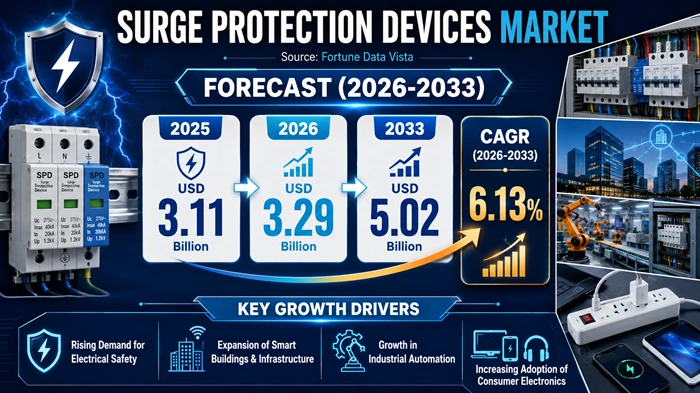
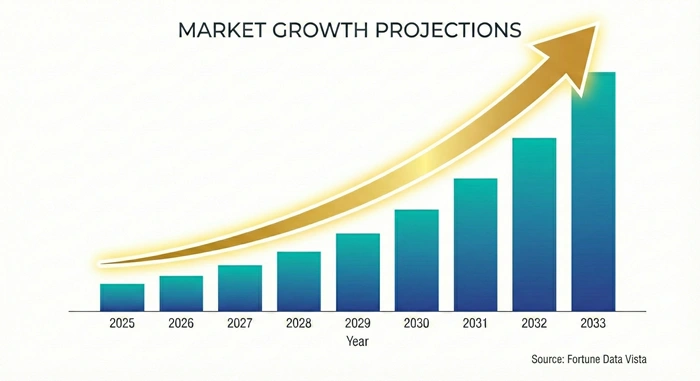
The global surge protection devices market size is valued at USD 3.11 billion in 2025 and is predicted to increase from USD 3.29 billion in 2026 to approximately USD 5.02 billion by 2033, growing at a CAGR of 6.13% from 2026 to 2033.
Surge protection devices safeguard electrical systems and sensitive electronic equipment from voltage spikes caused by lightning strikes, grid switching, and other transient disturbances. These devices are installed across residential, commercial, and industrial buildings, ranging from simple plug-in strips to sophisticated hard-wired panel systems protecting entire electrical distribution networks. Rising instances of extreme weather events, growing dependence on sensitive electronic equipment, and stricter electrical safety codes are together fueling steady, sustained demand for surge protection across nearly every building type and industry segment.
AI Impact on the Surge Protection Devices Industry
How Smart Diagnostics and IoT-Enabled Monitoring Are Transforming Surge Protection Device Reliability and Maintenance
Artificial intelligence and IoT connectivity are gradually transforming how surge protection devices are monitored and maintained across commercial and industrial installations. Smart surge protection systems can now continuously track their own health status, transmitting real-time diagnostic data to facility managers about remaining protection capacity and potential component degradation before a device fails completely. This predictive capability is particularly valuable for critical infrastructure like data centers, where an undetected surge protection failure could expose expensive server equipment to catastrophic damage during the next power event.
Beyond diagnostics, machine learning algorithms are being used to analyze historical surge event data and identify patterns that help facility managers understand their specific electrical risk profile, informing better decisions about where to invest in additional protection layers. Manufacturers are increasingly building this intelligence directly into their commercial and industrial product lines, moving away from passive protection devices toward connected systems that actively communicate their status. As this smart monitoring capability becomes more standard across the industry, companies in the surge protection devices market are using these features to justify premium pricing while helping customers avoid costly unplanned equipment failures.
Growth Factors
Rising Extreme Weather Events, Growing Electronic Equipment Sensitivity, and Stricter Building Codes Are the Three Most Influential Growth Drivers
The increasing frequency of extreme weather events, including more intense lightning activity linked to broader climate variability, is one of the most powerful growth factors sustaining demand for surge protection across residential and commercial buildings. As lightning-related power surges become more frequent in many regions, property owners and facility managers are increasingly recognizing surge protection as essential infrastructure rather than an optional add-on, particularly in areas with a documented history of storm activity.
Growing dependence on sensitive electronic equipment across virtually every sector represents a second major driver, as modern buildings house increasingly delicate and expensive electronics, from data center servers to smart home systems and industrial automation controls. A single unprotected power surge can destroy this equipment instantly, making surge protection a critical risk-management investment for facility operators. Combined with stricter electrical safety codes in many countries that increasingly mandate surge protection installation in new construction and renovation projects, these factors continue reinforcing durable, long-term demand growth across the global surge protection devices market.
Market Outlook
The Surge Protection Devices Market Is Positioned for Steady Growth Through 2033 as Smart Infrastructure Expansion Continues
The long-term outlook for surge protection remains positive and stable, reflecting the fundamental and ongoing need to protect valuable electrical infrastructure regardless of broader economic cycles. As data center construction continues expanding globally to support growing cloud computing and artificial intelligence workloads, demand for robust, multi-layered surge protection systems is expected to grow correspondingly, since these facilities cannot tolerate even brief unplanned downtime caused by power quality issues. This trend is likely to favor manufacturers capable of delivering high-capacity, mission-critical protection solutions alongside their standard commercial and residential product lines.
Looking further ahead, continued expansion of renewable energy infrastructure, smart grid modernization, and 5G network deployment is expected to create substantial new demand for specialized surge protection equipment designed for these emerging applications. Growing regulatory emphasis on electrical safety standards across both developed and developing markets will also continue supporting steady adoption growth. These dynamics point toward a surge protection devices market that will maintain reliable, consistent growth through 2033 as a foundational component of modern electrical infrastructure.
Expert Speaks
-
"Protecting critical infrastructure from power quality disruptions has never been more important, and our continued investment in advanced surge protection technology reflects the growing complexity of modern electrical systems." — CEO, Schneider Electric SE.
-
"As data centers and industrial facilities become increasingly dependent on continuous power quality, we see strong and durable demand for our surge protection and power management solutions across every region we serve." — CEO, Eaton Corporation.
-
"Smart, connected surge protection is becoming the new standard for commercial and industrial customers who want to prevent costly equipment failures before they happen." — CEO, ABB Ltd.
Key Report Takeaways
-
North America leads the surge protection devices market with an estimated 38% revenue share in 2025, supported by strict building codes, a high concentration of data centers, and frequent lightning activity across large parts of the region.
-
Asia Pacific is the fastest-growing region, projected to expand at a CAGR near 8% through 2033, driven by rapid urbanization, expanding power infrastructure investment, and growing 5G network deployment across China, India, and Japan.
-
Industrial facilities represent the largest customer base, relying on surge protection to safeguard valuable manufacturing equipment and automation systems from power quality issues.
-
Commercial applications contribute significantly to overall demand, driven by growing investment in building automation and IT infrastructure requiring reliable power protection.
-
Hard-wired surge protection devices remain the most widely used type, valued for their role as the first line of defense in buildings and industrial facilities.
-
The plug-in surge protection segment is projected to grow fastest going forward, expected to hold a growing market share by 2033 while expanding at a CAGR near 7.7% during the forecast period.
Market Scope
| Parameter | Details |
|---|---|
| Market Size by 2033 | USD 5.02 Billion | Market Size by 2026 | USD 3.29 Billion | Market Size by 2025 | USD 3.11 Billion | Market Growth Rate from 2026 to 2033 | CAGR of 6.13% | Dominating Region | North America | Fastest Growing Region | Asia Pacific | Segments Covered | By Type, By Standard, By Voltage, By End Use, By Region | Regions Covered | North America, Europe, Asia Pacific, Latin America, Middle East & Africa |
Market Dynamics
Drivers Impact Analysis
Rising Extreme Weather Events and Growing Data Center Investment Are the Most Commercially Significant Drivers of Market Growth
| Driver | (≈) % Impact on CAGR Forecast | Geographic Relevance | Impact Timeline |
|---|---|---|---|
| Increasing frequency of lightning-related extreme weather events | ~34% | Global, led by North America and Asia Pacific | Short to long-term |
| Growing data center and IT infrastructure investment | ~29% | North America, Europe, Asia Pacific | Short to medium-term |
| Stricter electrical safety codes mandating surge protection installation | ~23% | North America, Europe | Medium-term |
| Rising 5G network deployment requiring specialized protection equipment | ~14% | Asia Pacific, North America | Medium to long-term |
The increasing frequency of lightning-related extreme weather events remains one of the most powerful drivers sustaining demand across the surge protection devices market, as property owners and facility managers increasingly treat surge protection as essential rather than optional infrastructure. This growing risk awareness is translating into stronger adoption across both new construction and retrofit projects globally.
Growing data center and broader IT infrastructure investment is a second significant driver, as these facilities require robust, multi-layered surge protection to prevent catastrophic equipment damage from even brief power quality disruptions. Combined with stricter electrical safety codes increasingly mandating surge protection installation and rising 5G network deployment requiring specialized protection equipment, these drivers together sustain steady, long-term demand growth across the global surge protection devices landscape.
Restraints Impact Analysis
High Initial Installation Costs and Limited Consumer Awareness Are the Two Primary Constraints Limiting Faster Market Growth
| Restraint | (≈) % Impact on CAGR Forecast | Geographic Relevance | Impact Timeline |
|---|---|---|---|
| High upfront cost of comprehensive, multi-layer surge protection systems | ~33% | Latin America, MEA, parts of Asia Pacific | Short to medium-term |
| Limited consumer awareness of surge protection benefits in emerging markets | ~30% | Latin America, MEA | Medium-term |
| Availability of low-cost, low-quality alternative products | ~22% | Global | Short-term |
| Slower construction activity in certain developed markets | ~15% | Europe | Short-term |
The high upfront cost of comprehensive, multi-layer surge protection systems remains a meaningful barrier for cost-sensitive residential and small commercial customers, particularly in emerging economies where surge protection is not yet mandated by local building codes. This cost sensitivity often results in property owners forgoing adequate protection until after experiencing a costly equipment failure.
Limited consumer awareness of the risks associated with power surges in several emerging markets further restrains broader adoption of quality surge protection products. The continued availability of low-cost, low-quality alternative products in price-sensitive markets also creates competitive pressure that can undermine overall product safety standards. These restraints do not reverse the underlying growth trend but do moderate the pace of adoption within the surge protection devices market in certain price-sensitive regional segments.
Opportunities Impact Analysis
Smart Grid Modernization and Renewable Energy Infrastructure Expansion Represent the Most Significant Untapped Growth Opportunities
| Opportunity | (≈) % Impact on CAGR Forecast | Geographic Relevance | Impact Timeline |
|---|---|---|---|
| Expansion of smart grid modernization and renewable energy infrastructure | ~37% | Global | Medium to long-term |
| Growing IoT-enabled predictive monitoring integration | ~33% | North America, Europe | Short to medium-term |
| Rising infrastructure investment in emerging economies | ~30% | Asia Pacific, Latin America, MEA | Medium to long-term |
The expansion of smart grid modernization and renewable energy infrastructure presents a significant opportunity for surge protection manufacturers, as solar installations, wind farms, and electric vehicle charging infrastructure all require specialized surge protection equipment designed for their unique voltage characteristics. Companies that develop tailored solutions for these emerging applications are well positioned to capture substantial new revenue as clean energy investment accelerates globally.
Growing integration of IoT-enabled predictive monitoring into surge protection products represents a second major opportunity, allowing manufacturers to differentiate their offerings through value-added diagnostic capabilities that reduce customer downtime risk. Rising infrastructure investment across emerging economies in Asia Pacific and Latin America also creates significant expansion opportunities as urbanization and power grid modernization accelerate, positioning early-moving companies to capture a growing share of the global surge protection devices market.
Segment Analysis
By Type
Hard-Wired Surge Protection Devices Dominate While Plug-In Devices Expand Rapidly Across Consumer Electronics Applications
Hard-wired surge protection devices hold the largest share of the surge protection devices market, accounting for roughly 65% of total type-based revenue in 2025, as these devices serve as the primary line of defense installed at electrical panels in buildings and industrial facilities. This dominant position reflects their comprehensive, whole-building protection capability compared to point-of-use alternatives, making them the preferred choice for new construction and major electrical retrofits. North America leads this segment given its strict building codes increasingly mandating panel-level surge protection, and leading companies operating here include Eaton, Schneider Electric, and Siemens, each maintaining substantial market share through established electrical distribution equipment portfolios.
Plug-in surge protection devices, meanwhile, are expected to grow at a CAGR near 7.7% through 2033, driven by rapid advancement in connected consumer electronics and growing smart home product adoption. Asia Pacific is the primary growth region for this segment, as rising middle-class populations across China and India increasingly purchase consumer electronics requiring point-of-use surge protection. Companies such as CyberPower Systems and Tripp Lite maintain strong positions serving this growing consumer-focused segment, reinforcing the broader surge protection devices market's dual-track growth pattern across both hard-wired and plug-in product categories.
By End Use
Industrial Applications Anchor the Largest Share While Commercial Facilities Represent the Fastest-Growing End-Use Segment
Industrial facilities account for the largest share of surge protection devices market revenue, holding close to 43% of total end-use revenue in 2025, as these facilities depend on surge protection to safeguard valuable manufacturing equipment and automation systems from costly power quality disruptions. This segment's dominant position reflects the substantial financial risk industrial operators face from unplanned equipment damage and production downtime caused by unprotected power surges. Europe leads specialized industrial surge protection deployment given its advanced manufacturing base, with companies including Siemens and ABB maintaining strong positions serving industrial customers across the region.
Commercial facilities represent the fastest-growing end-use segment, expected to expand at a CAGR near 8.1% through 2033, driven by rising investment in building automation systems and IT infrastructure requiring reliable power protection. This segment is showing particularly strong growth momentum across Asia Pacific, where rapid commercial construction and data center expansion continue driving incremental surge protection demand. Companies such as Legrand and Littelfuse have built strong positions supplying surge protection equipment to commercial building developers, reinforcing steady demand growth across both leading end-use categories within the global surge protection devices market.
Regional Insights
North America
Strict Building Codes and High Data Center Concentration Keep North America at the Top of the Surge Protection Devices Market
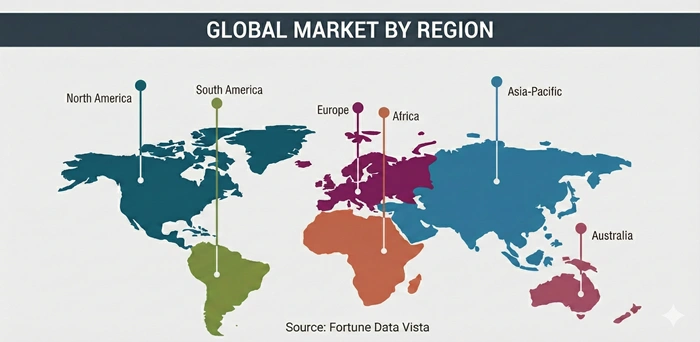
North America commands the largest share of the global surge protection devices market, holding close to 38% of total revenue in 2025 with a regional CAGR near 6% through 2033. Strict building codes increasingly mandating surge protection installation, a high concentration of data centers requiring advanced protection systems, and frequent lightning activity across large parts of the region keep demand consistently strong throughout North America. Leading companies such as Eaton and Schneider Electric, both maintaining significant United States operations, dominate surge protection equipment contracts across major industrial, commercial, and data center customers.
The region's mature regulatory environment, combined with substantial ongoing investment in data center construction to support cloud computing and artificial intelligence workloads, further reinforces this leadership position within the broader electrical safety equipment landscape. Large industrial and commercial facility operators routinely integrate comprehensive, multi-layer surge protection into new construction and major renovation projects. This combination of regulatory rigor, infrastructure investment, and weather-related risk exposure ensures North America remains the anchor region for surge protection devices market revenue generation over the coming years.
Asia Pacific
Rapid Urbanization and Expanding Power Infrastructure Investment Make Asia Pacific the Fastest-Growing Region
Asia Pacific is the fastest-growing region in the surge protection devices market, projected to expand at a CAGR near 8% through 2033 while currently holding a meaningful share of global revenue. Rapid urbanization, significant investments in power infrastructure modernization, and growing 5G network deployment across China, India, Japan, and South Korea are together driving this accelerated regional growth. Companies such as Delta Electronics in Taiwan and various regional electrical equipment manufacturers are scaling operations rapidly to meet surging demand for both industrial and consumer surge protection products.
Growing government investment in smart grid infrastructure, combined with expanding middle-class populations purchasing consumer electronics and smart home products, continues to widen the region's addressable opportunity for surge protection manufacturers. Japan, South Korea, and Australia are also contributing meaningfully through mature electrical infrastructure and growing focus on data center power quality standards. As local manufacturing capacity expands further and regional building codes gradually strengthen, Asia Pacific is expected to narrow its overall revenue gap with North America over the coming several years within the broader surge protection devices market.
Customization Available for This Report
Region-wise and country-wise customized reports are available for organizations seeking deeper geographic insight into the surge protection devices market. Our research team can tailor market analysis, competitive intelligence, trends, and growth opportunities specifically for any of the regions and countries listed below, offering detailed information aligned to your selected market and keyword combination.
North America
-
U.S., Canada, Mexico — detailed building code analysis, data center demand trends, and competitive positioning
Europe
-
U.K., Germany, France, Italy, Rest of Europe — industrial safety regulations, manufacturing trends, and key player analysis
Asia Pacific
-
China, India, Japan, South Korea, Australia, Rest of Asia Pacific — power infrastructure investment, 5G deployment, and local manufacturer analysis
Latin America
-
Brazil, Argentina, Rest of Latin America — emerging construction growth and market entry opportunities
Middle East & Africa
-
UAE, Saudi Arabia, Rest of MEA — infrastructure investment trends and regional distribution partnerships
Top Key Players
-
Eaton Corporation plc (United States)
-
Schneider Electric SE (France)
-
Siemens AG (Germany)
-
ABB Ltd. (Switzerland)
-
Emerson Electric Co. (United States)
-
Littelfuse Inc. (United States)
-
Legrand SA (France)
-
General Electric Company (United States)
-
Leviton Manufacturing Co. Inc. (United States)
-
CyberPower Systems Inc. (United States)
-
Tripp Lite (United States)
-
Delta Electronics Inc. (Taiwan)
-
Mersen SA (France)
Recent Developments
-
In 2025, Eaton expanded its surge protection product line with new smart diagnostic features designed for commercial and industrial customers seeking predictive maintenance capabilities.
-
In 2025, Schneider Electric strengthened its power quality portfolio through enhanced surge protection solutions tailored for data center and renewable energy applications.
-
In 2025, ABB introduced upgraded surge protection devices designed specifically for electric vehicle charging infrastructure and solar installation applications.
-
In 2026, Siemens deepened investment in connected surge protection technology, integrating IoT-enabled monitoring across its industrial electrical distribution product line.
-
In 2026, Littelfuse expanded its surge protection manufacturing capacity to meet growing demand from data center and 5G infrastructure customers globally.
Market Trends
Smart Grid Modernization and IoT-Enabled Diagnostics Are Reshaping the Surge Protection Devices Landscape
One of the clearest trends shaping the industry is the growing integration of IoT-enabled monitoring capabilities into surge protection devices, allowing facility managers to track device health remotely and receive advance warning before a protection failure occurs. This is replacing the traditional approach of passive, unmonitored surge protection with connected systems that actively communicate operational status, particularly across data center and industrial applications where unplanned downtime carries significant financial consequences.
A second notable trend is the growing demand for specialized surge protection equipment designed for renewable energy and 5G network infrastructure, reflecting the broader global shift toward decentralized power generation and next-generation telecommunications networks. As these emerging applications continue expanding rapidly across both developed and developing markets, this trend is reinforcing sustained long-term demand growth across the global surge protection devices market.
Segments Covered in the Report
By Type
-
Hard Wired
-
Plug-In
By Standard
-
Type 1
-
Type 2
-
Type 3
By Voltage
-
Low Voltage
-
Medium Voltage
-
High Voltage
By End Use
-
Residential
-
Commercial
-
Industrial
By Region
-
North America (U.S., Canada, Mexico)
-
Europe (U.K., Germany, France, Italy, Rest of Europe)
-
Asia Pacific (China, India, Japan, South Korea, Australia, Rest of Asia Pacific)
-
Latin America (Brazil, Argentina, Rest of Latin America)
-
Middle East and Africa (UAE, Saudi Arabia, Rest of MEA)
❝ Built for Every Level — From Startups to Industry Giants ❞
Here Is Exactly How This Report Works for You
-
For tier 1 electrical equipment manufacturers and institutional investors, this report delivers granular competitor revenue analysis across Eaton, Schneider Electric, and ABB, alongside geopolitical and supply chain risk assessment supporting confident investment and capacity expansion decisions.
-
For tier 2, tier 3 companies, regional manufacturers, and mid-level distributors, this report identifies the highest-growth end-use segments and most commercially accessible regional markets, offering an evidence-based roadmap for entering or expanding within the surge protection devices market.
-
For all decision-makers across the electrical safety equipment value chain, this report translates complex supply-demand shifts and evolving regulatory requirements into clear, actionable strategic intelligence supporting stronger product development and go-to-market decisions through 2033.
Frequently Asked Questions:
Answer: The surge protection devices market was valued at USD 3.11 billion in 2025. It is projected to reach approximately USD 5.02 billion by 2033 at a CAGR of 6.13%.
Answer: North America leads the surge protection devices market with roughly 38% revenue share. Strict building codes and high data center concentration support this position.
Answer: Asia Pacific is the fastest-growing region in the surge protection devices market. Rapid urbanization and expanding power infrastructure investment are driving this growth.
Answer: Eaton, Schneider Electric, and ABB are top companies in the surge protection devices market. They lead through strong industrial and commercial product portfolios.
Answer: Hard-wired surge protection devices are the most widely used type in the surge protection devices market. Plug-in devices form the fastest-growing type segment.