
Sustainable Finance Market Overview
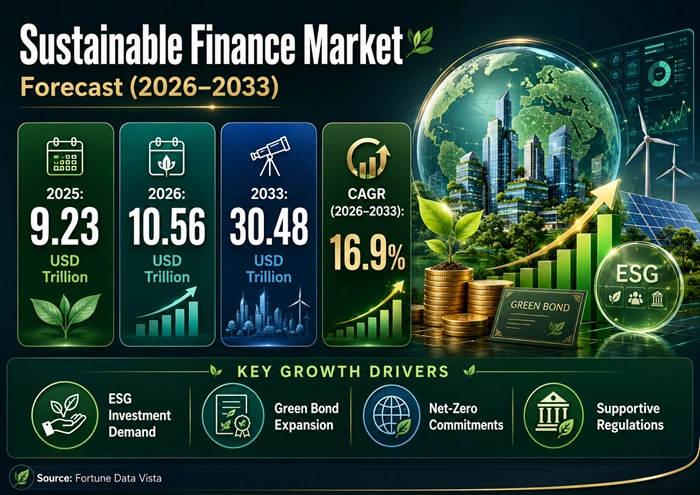
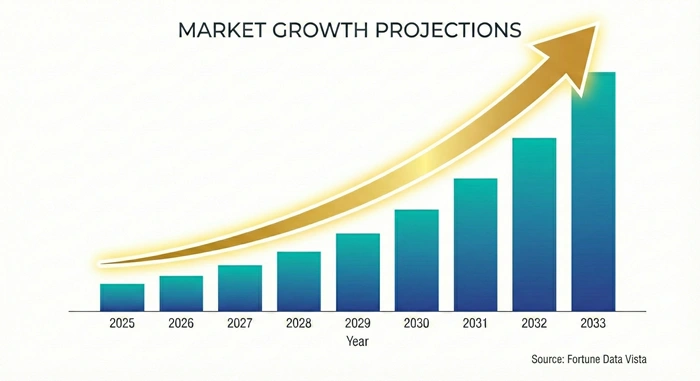
The global sustainable finance market size is valued at USD 9.23 trillion in 2025 and is predicted to increase from USD 10.56 trillion in 2026 to approximately USD 30.48 trillion by 2033, growing at a CAGR of 16.9% from 2026 to 2033.
Sustainable finance refers to the integration of environmental, social, and governance (ESG) criteria into financial decision-making — spanning green bonds, social bonds, ESG equity funds, sustainability-linked loans, and impact investing instruments that direct capital toward projects and companies delivering measurable positive outcomes alongside financial returns. The convergence of climate policy urgency, institutional investor ESG mandates, regulatory disclosure requirements, and growing awareness of long-term climate-related financial risk is driving the sustainable finance market from a niche responsible investing category into the mainstream of global capital markets. With governments, central banks, and corporate issuers all deepening their commitment to ESG-aligned financing, this market is evolving at a pace that is reshaping the entire architecture of global finance.
AI Impact on the Sustainable Finance Industry
Artificial Intelligence Is Transforming the Sustainable Finance Market by Revolutionizing ESG Data Analytics, Greenwashing Detection, Climate Risk Modeling, and the Automation of Sustainable Investment Portfolio Management
Artificial intelligence is becoming one of the most powerful enabling technologies in the sustainable finance industry. The challenge of processing the enormous and highly heterogeneous volume of ESG data — spanning corporate sustainability reports, regulatory filings, satellite imagery of industrial sites, supply chain emissions disclosures, news sentiment analysis, and real-time climate risk indicators — was previously beyond the practical capacity of human analysts and traditional data management systems. AI-powered ESG analytics platforms are now capable of ingesting and synthesizing these diverse data streams in real time, delivering more accurate, timely, and granular sustainability assessments of companies and investment portfolios than any previous methodology. Firms including MSCI, Refinitiv (LSEG), Bloomberg, and a growing ecosystem of ESG fintech startups are deploying natural language processing, satellite data analysis, and machine learning models to build ESG intelligence products that are becoming essential infrastructure for institutional investors, asset managers, and corporate treasurers operating in the sustainable finance market.
AI is also playing an increasingly critical role in climate risk modeling and stress testing — two capabilities that regulators and institutional investors are making core requirements of financial risk management. Physical climate risk models that assess the financial exposure of real asset portfolios to flooding, extreme heat, wildfire, and sea level rise require the integration of climate science, geospatial data, and financial valuation models at a scale and complexity that only AI can manage effectively. Transition risk models that assess how policy scenarios, carbon pricing mechanisms, and technology transitions affect the valuation of energy, materials, and transportation sector assets are equally complex. Central banks — including the Bank of England, the European Central Bank, and the People's Bank of China — are incorporating AI-driven climate scenario analysis into mandatory financial stability assessments, creating powerful institutional demand for sophisticated AI-powered sustainable finance analytics tools that is expanding the market's technology services revenue layer.
Growth Factors
Regulatory ESG Disclosure Mandates, the Rapid Scaling of Green Bond Issuance, and Institutional Investor Net-Zero Commitments Are the Three Most Powerful Structural Drivers Accelerating the Sustainable Finance Market
The single most powerful structural growth driver of the sustainable finance market is the global expansion of mandatory ESG disclosure and sustainable finance regulatory frameworks. The European Union's Sustainable Finance Disclosure Regulation (SFDR), the EU Taxonomy for Sustainable Activities, the Corporate Sustainability Reporting Directive (CSRD), and the International Sustainability Standards Board (ISSB) standards are collectively creating a new global baseline of corporate ESG transparency that was not previously required or standardized. As companies are compelled to report detailed, audited sustainability data, the quality of information available to sustainable finance investors improves dramatically — reducing the due diligence cost of ESG investing and increasing investor confidence in sustainability claims. This regulatory-driven transparency improvement is the single most important enabler of continued market growth because it addresses the greenwashing risk that has historically been the most frequently cited barrier to institutional sustainable finance allocation.
The explosive growth of green, social, and sustainability bond issuance is the second major structural driver of sustainable finance market expansion. Annual global green bond issuance has grown from under $50 billion per year in 2015 to hundreds of billions per year in recent years, with sovereign issuers including Germany, France, the United Kingdom, Japan, India, and numerous emerging market governments establishing regular green bond programs that provide high-credit-quality, labeled sustainable finance instruments to meet institutional investor demand. Corporate green bond programs — from automotive manufacturers financing electric vehicle transition to utilities funding renewable energy capacity — are deepening the supply of investable sustainable debt instruments. Sustainability-linked bonds and loans — which tie the cost of financing to the issuer's achievement of specific, measurable ESG performance targets — are further expanding the range of sustainable finance transaction types, bringing sectors that cannot easily issue use-of-proceeds green bonds into the sustainable finance ecosystem.
Market Outlook
The Sustainable Finance Market Is Entering Its Most Commercially Significant Growth Phase as Climate Finance Needs Scale, Institutional ESG Mandates Deepen, and Emerging Market Green Infrastructure Demand Creates a Multi-Decade Investment Opportunity
The long-term outlook for the sustainable finance market is one of exceptional, multi-decade growth driven by the enormous and growing financing requirements of the global energy transition. The International Energy Agency estimates that achieving net-zero emissions by 2050 requires cumulative clean energy investment exceeding $130 trillion — the majority of which must be mobilized through private capital markets using sustainable finance instruments. This means the sustainable finance market's trajectory through 2033 and far beyond is not primarily a function of investor sentiment or market cycle dynamics — it is structurally embedded in the physical requirements of replacing fossil fuel energy infrastructure with renewable alternatives, electrifying transportation and industrial processes, and building climate adaptation infrastructure across developing and developed economies alike. The gap between current sustainable finance flows and what the energy transition requires ensures that demand for sustainable finance capital substantially exceeds supply for the foreseeable future — creating a persistently strong market environment for all participants in the sustainable finance value chain.
Emerging markets are becoming an increasingly critical growth frontier for the sustainable finance market. While Europe and North America have dominated sustainable capital flows historically, the largest climate finance needs and the highest marginal returns on green infrastructure investment are concentrated in developing economies across Asia, Africa, Latin America, and the Middle East. The development of local-currency green bond markets, the expansion of multilateral development bank blended finance programs, and the growth of sustainability-linked sovereign debt instruments in emerging markets are all expanding the geographic breadth of the sustainable finance market. The growing role of China as both the world's largest green bond issuer and a major financier of overseas green infrastructure through the Belt and Road Initiative is particularly significant — positioning Asia Pacific to become the dominant region in global sustainable finance flows by the end of the forecast period.
Expert Speaks
-
"BlackRock believes that climate risk is investment risk, and the transition to a net-zero global economy represents the greatest investment opportunity in history. Our sustainable finance capabilities — spanning ESG integration, green bond portfolios, impact investing, and climate-focused equity and alternatives — are growing rapidly because our clients globally understand that the companies and economies that lead the sustainability transition will deliver the strongest long-term returns," — Larry Fink, Chairman & CEO, BlackRock, Inc.
-
"At JPMorgan Chase, our commitment to sustainable finance is grounded in our belief that supporting the clean energy transition and promoting equitable economic growth are both the right thing to do and excellent long-term business. We have committed to facilitate more than $2.5 trillion in sustainable finance through 2030 — and the depth of client demand we are seeing across green bonds, ESG-linked loans, and sustainability advisory services confirms that this market is growing faster and more broadly than most market participants anticipated even five years ago," — Jamie Dimon, Chairman & CEO, JPMorgan Chase & Co.
-
"Goldman Sachs has been at the forefront of sustainable finance for more than a decade, and what has changed most profoundly in recent years is the breadth of client demand. Five years ago, sustainable finance conversations were driven primarily by values-aligned investors. Today, we are having sustainability-linked financing discussions with virtually every major corporate client because ESG performance is increasingly tied to the cost of capital — and our clients understand that," — David Solomon, Chairman & CEO, Goldman Sachs Group, Inc.
Key Report Takeaways
-
Europe leads the global sustainable finance market, accounting for approximately 40–44% of total global sustainable capital flows in 2025, anchored by the world's most comprehensive sustainable finance regulatory framework — including the EU Taxonomy, SFDR, CSRD, and the European Green Deal — which together create the deepest and most liquid ESG investment ecosystem globally, supported by Germany, France, the UK, the Netherlands, and Sweden as the region's largest sustainable bond issuers and ESG investment hubs.
-
Asia Pacific is the fastest-growing region in the sustainable finance market, projected to register a CAGR of approximately 20–22% from 2026 to 2033, driven by China's world-leading green bond issuance volumes, India's rapidly expanding renewable energy investment pipeline, Japan's ambitious green transition financing programs, and the rapid development of sustainable finance frameworks in South Korea, Australia, and Southeast Asia.
-
Institutional investors — including pension funds, sovereign wealth funds, and insurance companies — are the dominant investor type, accounting for approximately 65–70% of total sustainable finance capital allocation globally, as fiduciary duty interpretations increasingly include climate risk management as a core requirement, and major institutional mandates from CalPERS, the Norwegian Government Pension Fund, and Japanese GPIF are directing trillions of dollars into ESG-screened and sustainable investment strategies.
-
Green bonds are the largest transaction type segment in the sustainable finance market, capturing approximately 50–55% of total sustainable debt issuance in 2025, as the labeled use-of-proceeds structure of green bonds provides investors with clear accountability for how capital is deployed — making them the preferred instrument for both sovereign and corporate issuers seeking to attract dedicated sustainability-focused capital at competitive rates.
-
The utilities and power sector is the largest industry vertical in the sustainable finance market, contributing approximately 28–32% of total issuance, driven by the enormous capital requirements of renewable energy capacity buildout — solar, wind, battery storage, and grid infrastructure — that collectively represent the largest single use-of-proceeds category across green bond and sustainability-linked loan markets globally.
-
Sustainability-linked bonds and loans represent the fastest-growing transaction type segment, expected to grow at a CAGR of approximately 20–24% from 2026 to 2033, with their market share rising from approximately 15–18% in 2025 toward 22–25% by 2033, as issuers across diverse industries including real estate, food and beverage, healthcare, and financial services — which cannot easily deploy use-of-proceeds green instruments — adopt sustainability-linked structures that tie financing costs to measurable ESG performance milestones.
Market Scope
| Parameter | Details |
|---|---|
| Market Size by 2033 | USD 30.48 Trillion | Market Size by 2026 | USD 10.56 Trillion | Market Size by 2025 | USD 9.23 Trillion | Market Growth Rate from 2026 to 2033 | CAGR of 16.9% | Dominating Region | Europe | Fastest Growing Region | Asia Pacific | Segments Covered | Investment Type, Transaction Type, Industry Vertical, Investor Type, Financial Instrument | Regions Covered | North America, Europe, Asia Pacific, Latin America, Middle East & Africa |
Market Dynamics
Drivers Impact Analysis
Mandatory ESG Disclosure Regulations, the Accelerating Net-Zero Transition Financing Requirement, and Deep Institutional Investor ESG Integration Are the Three Most Commercially Powerful Forces Driving the Sustainable Finance Market
| Driver | ≈ % Impact on CAGR Forecast | Geographic Relevance | Impact Timeline |
|---|---|---|---|
| Mandatory ESG disclosure and sustainable finance regulation | ~30% | Europe, North America, Asia Pacific | Ongoing through 2033 |
| Net-zero transition financing requirements across economies | ~28% | Global | Ongoing, Long-Term |
| Institutional investor ESG mandate and net-zero commitment expansion | ~22% | Europe, North America, Asia Pacific | Ongoing |
| Sovereign and supranational green bond issuance growth | ~12% | Europe, Asia Pacific, MEA | Near to Long-Term |
| Growth of sustainable finance in emerging markets | ~8% | Asia Pacific, Latin America, MEA | Near to Long-Term |
The regulatory dimension of the sustainable finance market is perhaps the most structurally significant growth driver in the industry's history. The European Union's regulatory architecture — encompassing the SFDR which requires asset managers to disclose how they integrate sustainability risks, the EU Taxonomy which defines a science-based classification of environmentally sustainable economic activities, and the CSRD which mandates detailed sustainability reporting from large European and internationally active companies — is setting a global standard that is being replicated with variation across the UK, Japan, Singapore, Canada, and now increasingly the United States. As these frameworks mature and expand, the volume of verified, comparable ESG information available to investors increases, the cost of sustainable investment due diligence falls, and the addressable investment universe within the sustainable finance market grows as more companies and instruments achieve credible sustainable classification. This regulatory-driven virtuous cycle is one of the most durable growth mechanisms available in any major financial market.
The scale of climate transition financing required is a structural market driver of a magnitude that dwarfs previous sustainable finance growth episodes. Meeting the Paris Agreement targets requires not just the replacement of existing fossil fuel energy infrastructure with clean alternatives — it requires the simultaneous construction of entirely new electric grid systems, energy storage capacity, clean hydrogen production and distribution infrastructure, industrial process decarbonization equipment, and climate adaptation infrastructure including coastal flood defenses, water management systems, and heat-resilient urban infrastructure. Every one of these investment categories represents large-scale, long-duration financing needs that are ideally matched with the characteristics of green bonds, sustainability-linked loans, and ESG equity funds. This alignment between the structural requirements of the energy transition and the natural form of sustainable finance instruments is ensuring that demand for sustainable capital will grow for decades regardless of short-term ESG sentiment fluctuations.
Restraints Impact Analysis
Greenwashing Risk, Lack of Global ESG Standard Harmonization, Political Backlash Against ESG in Certain Markets, and Data Quality Inconsistencies Are the Primary Restraints Limiting the Sustainable Finance Market's Full Growth Potential
| Restraint | ≈ % Impact on CAGR Forecast | Geographic Relevance | Impact Timeline |
|---|---|---|---|
| Greenwashing risk and credibility concerns | ~35% | Global | Ongoing |
| Fragmented global ESG standards and reporting inconsistency | ~28% | Global | Near to Medium-Term |
| Political and regulatory backlash against ESG in certain markets | ~22% | North America, parts of Europe | Near to Medium-Term |
| High cost and complexity of ESG data collection and verification | ~15% | Developing Markets, SMEs | Ongoing |
Greenwashing — the practice of marketing financial instruments or investment strategies as environmentally sustainable without adequate substantiation — remains the single most damaging credibility risk facing the sustainable finance market. High-profile regulatory investigations into the ESG claims of major asset managers, the restatement of ESG fund classifications under SFDR, and media scrutiny of green bond use-of-proceeds and sustainability-linked loan target ambition levels have all contributed to periodic erosion of investor confidence in sustainable finance labeling. Even where greenwashing is not intentional, the absence of globally standardized, independently verified ESG metrics makes it genuinely difficult to assess and compare the actual sustainability impact of different financial instruments — creating a market environment in which the reputational risk of being associated with greenwashing allegations can deter both issuers and investors from engaging with labeled sustainable finance instruments.
The political dimension of ESG has emerged as an important market restraint, particularly in the United States where politically motivated anti-ESG legislation at the state level and anti-ESG rhetoric at the federal level have created a more cautious environment for institutional ESG investment program expansion. Several large state pension funds have withdrawn from major ESG investment coalitions under political pressure, and some asset managers have adopted lower-profile approaches to ESG integration to avoid political controversy. While the underlying economic and climate risk rationale for sustainable finance remains sound and is not fundamentally impacted by political rhetoric, the reputational and legal risks associated with prominent ESG commitment in politically contested environments are creating meaningful near-term headwinds for sustainable finance market growth in the United States specifically.
Opportunities Impact Analysis
Nature-Based Finance, Transition Finance for Emerging Markets, Digital Green Bond Infrastructure, and Biodiversity Credit Markets Are Opening Major New Growth Pathways for the Sustainable Finance Market
| Opportunity | ≈ % Impact on CAGR Forecast | Geographic Relevance | Impact Timeline |
|---|---|---|---|
| Nature-based solutions finance and biodiversity investment | ~30% | Global, Fastest in Latin America, SEA | Medium to Long-Term |
| Transition finance for hard-to-abate sectors and emerging markets | ~28% | Asia Pacific, Latin America, MEA | Near to Long-Term |
| Digital sustainable finance infrastructure (tokenized green bonds, blockchain) | ~22% | Europe, North America, Asia Pacific | Medium to Long-Term |
| Social and SDG-linked finance expansion | ~20% | Developing Markets, Europe | Near to Long-Term |
Nature-based finance — encompassing investment in biodiversity conservation, natural carbon sinks, sustainable forestry, regenerative agriculture, and ocean health preservation — represents one of the most commercially significant new frontiers in the sustainable finance market. The recognition that nature provides ecosystem services with economic value estimated in the tens of trillions of dollars annually, combined with the growing scientific consensus that biodiversity loss represents a material financial risk comparable to climate change, is driving the development of new financial instruments including biodiversity credits, natural capital bonds, and conservation finance funds. The Taskforce on Nature-related Financial Disclosures (TNFD) framework — modeled on the climate-focused TCFD — is providing the conceptual architecture for integrating nature risks into corporate reporting and investment decision-making, creating a pathway for nature-based finance to achieve the kind of institutional adoption that climate finance has seen over the past decade.
The tokenization of sustainable finance instruments on blockchain infrastructure represents a transformative opportunity to improve market efficiency, reduce issuance costs, enhance transparency, and expand retail investor access to green bonds and ESG investment products. Pilot programs for tokenized green bonds have been conducted by the World Bank, the European Investment Bank, and the Hong Kong Monetary Authority — demonstrating that blockchain-based issuance can reduce settlement time from days to minutes, enable fractional ownership that dramatically lowers minimum investment thresholds, and provide immutable on-chain records of use-of-proceeds deployment that directly address greenwashing concerns. As digital asset infrastructure matures and regulatory frameworks for tokenized securities develop, the sustainable finance market stands to benefit from a structural improvement in market accessibility and transparency that could materially accelerate retail participation and global emerging market access.
Segment Analysis
By Transaction Type
Green Bonds Lead the Sustainable Finance Market While Sustainability-Linked Instruments Represent the Fastest-Growing Transaction Category Powered by Cross-Sector ESG Performance Incentive Adoption
Green bonds are the largest and most established transaction type in the sustainable finance market, accounting for approximately 50–55% of total labeled sustainable debt issuance in 2025 and growing at a CAGR of approximately 15.5% from 2026 to 2033. The labeled green bond market benefits from the clearest investor familiarity, the deepest secondary market liquidity, and the most established use-of-proceeds verification and reporting standards — making it the preferred sustainable debt instrument for first-time issuers and the most straightforward product for institutional investors building labeled sustainable fixed-income portfolios. Europe is the dominant region for green bond issuance volume, where sovereign issuers from Germany, France, Italy, the UK, and the Netherlands alongside supranational agencies including the European Investment Bank and the Council of Europe Development Bank consistently place the world's largest single green bond transactions. Leading banks structuring and distributing European green bonds include BNP Paribas, HSBC, Deutsche Bank, Société Générale, and Crédit Agricole CIB — all of which have built dedicated sustainable capital markets desks with deep issuer and investor relationships.
Asia Pacific is the fastest-growing region for green bond market development within the sustainable finance market, propelled by China's continued status as the world's largest single-country green bond issuer, India's rapidly expanding green bond program anchored by the sovereign green bond framework established by the Government of India in 2023, and Japan's growing corporate and municipal green bond market backed by the government's Green Innovation Fund. The sustainable finance market in Asia is also witnessing the emergence of ASEAN-region green bond frameworks that are creating standardized labeling and disclosure requirements across Singapore, Malaysia, Thailand, Indonesia, and Vietnam — building the regional market infrastructure needed to channel international institutional capital into Southeast Asian green infrastructure.
By Investor Type
Institutional Investors Dominate Sustainable Finance Market Capital Allocation While Retail ESG Fund Adoption Represents the Fastest-Growing Investor Category Driven by Values-Aligned Millennial and Gen Z Investor Demand
Institutional investors — including pension funds, insurance companies, sovereign wealth funds, endowments, and foundations — are the dominant force in the sustainable finance market, accounting for approximately 65–70% of total sustainable capital allocation in 2025 and growing at a CAGR of approximately 16.0% from 2026 to 2033. The fiduciary imperative to manage long-duration climate risk, combined with formal net-zero investment commitments from major institutions including Norway's Government Pension Fund Global (the world's largest sovereign wealth fund), CalPERS, APG (Netherlands), and Nest (UK), is directing trillions of dollars of institutional capital into green bonds, ESG equity funds, and sustainable infrastructure assets. North America and Europe dominate institutional sustainable finance allocation, where BlackRock, Vanguard, State Street Global Advisors, PIMCO, and Amundi — the world's largest asset managers — have all integrated ESG considerations as a standard component of their investment process across the majority of their managed assets.
Retail investor participation in the sustainable finance market is the fastest-growing investor category, projected to grow at a CAGR of approximately 20–22% from 2026 to 2033, as the demographic shift of wealth toward millennials and Generation Z — investor cohorts that show significantly higher rates of ESG values alignment than preceding generations — accelerates adoption of sustainable investment products through digital investment platforms, ESG robo-advisors, and retail ESG ETFs. Europe leads retail sustainable finance growth through the SFDR framework, which requires fund managers to clearly disclose the ESG characteristics of retail investment products and enables investors to make informed, values-aligned investment choices. Companies including Robinhood, eToro, Betterment, and Wealthsimple are incorporating ESG investment options into their digital investment platforms, democratizing access to sustainable finance products that were previously available only through institutional channels.
Regional Insights
Europe
Europe Leads the Global Sustainable Finance Market as the World's Most Comprehensively Regulated and Deeply Institutionalized Sustainable Capital Market, Driven by the European Green Deal and the World's Most Advanced ESG Regulatory Framework
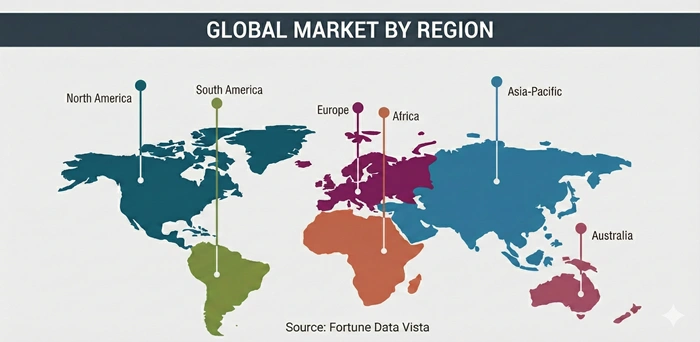
Europe holds the largest share of the global sustainable finance market, accounting for approximately 40–44% of total global sustainable capital flows in 2025 and projected to grow at a CAGR of approximately 15.5–17% from 2026 to 2033. The European Union's regulatory ecosystem — comprising the EU Taxonomy, SFDR, CSRD, and the European Green Deal's €1 trillion climate investment target — has created the world's deepest institutional infrastructure for sustainable capital allocation, making Europe the global standard-setter for sustainable finance market development. Germany, France, the UK, the Netherlands, and Sweden are the region's dominant green bond issuance hubs, while Frankfurt, London, Paris, and Amsterdam compete as leading sustainable finance capital market centers. Key institutions shaping the European sustainable finance market include the European Investment Bank (EIB) — the world's largest multilateral green bond issuer — alongside commercial banking leaders BNP Paribas, HSBC, Deutsche Bank, Barclays, and ING, all of which have made substantial commitments to sustainable finance structuring, distribution, and balance sheet deployment.
The CSRD's rollout — which is expanding mandatory sustainability reporting requirements to tens of thousands of European and internationally operating companies — is creating a step-change improvement in the quality and standardization of corporate ESG data across Europe, directly addressing the information quality limitation that has historically constrained the scale of evidence-based sustainable finance allocation. This regulatory development is expected to be particularly powerful for the sustainable finance market in unlocking capital for smaller issuers, mid-cap companies, and supply chain sustainability improvement programs that lack the resources for voluntary sustainability reporting but will now be required to meet CSRD standards. Europe's sustainable finance market is expected to surpass USD 13 trillion by 2033, maintaining its global leadership position even as Asia Pacific grows at a faster rate.
Asia Pacific
Asia Pacific Is the Fastest-Growing Region in the Sustainable Finance Market, Powered by China's World-Leading Green Bond Volumes, India's Renewable Energy Investment Pipeline, and Rapidly Expanding ASEAN Sustainable Finance Frameworks
Asia Pacific is the fastest-growing regional market in the global sustainable finance market, projected to expand at a CAGR of approximately 20–22% from 2026 to 2033, with its share of global sustainable capital flows currently at approximately 30–34% in 2025 and growing rapidly. China is the dominant force in Asian sustainable finance, where the People's Bank of China's Green Bond Endorsed Projects Catalogue and the China Green Bond Standards Committee's alignment with international standards have enabled Chinese entities — including policy banks, state-owned enterprises, and an increasing number of private corporations — to issue at a scale that makes China the world's largest green bond market by cumulative issuance. India is the most dynamically growing sustainable finance market in the region, where the government's sovereign green bond program, the Securities and Exchange Board of India's green bond disclosure framework, and the enormous capital requirements of India's 500 GW renewable energy target by 2030 are creating a multi-trillion-rupee sustainable finance pipeline that is attracting growing international institutional investment.
Japan's sustainable finance market is growing strongly through the government's Green Innovation Fund, corporate transition finance frameworks, and the issuance of climate transition bonds that recognize Japan's specific industrial structure challenges in moving away from fossil fuels. South Korea's green new deal and K-ETS carbon trading expansion are supporting sustainable bond market development. The sustainable finance market across the ASEAN bloc — Singapore, Malaysia, Thailand, Vietnam, Indonesia, and the Philippines — is one of the most exciting emerging growth frontiers globally, with the ASEAN Green, Social, and Sustainability Bond Standards providing a regional framework that is attracting green infrastructure capital for Southeast Asia's enormous clean energy transition needs. Key regional players driving Asia Pacific sustainable finance growth include HSBC Asia, Standard Chartered, DBS Bank, Mitsubishi UFJ Financial Group, and the Asian Development Bank.
Report Customization: Region-Wise and Country-Wise Insights
This Report Is Available with Full Geographic Customization — Providing Asset Managers, Investment Banks, Sustainable Finance Platforms, Corporate Treasurers, and ESG Investors with Precise, Country-Level Sustainable Finance Market Intelligence Tailored to Their Strategic Objectives
This report on the sustainable finance market is available with complete region-wise and country-wise customization, enabling financial institutions, impact investors, green bond issuers, ESG data providers, and policy advisory firms to access precisely targeted market intelligence for their geographies of interest. Whether the goal is to evaluate the regulatory framework for green bond issuance in a specific country, assess institutional ESG allocation trends in a target market, or map the competitive landscape for sustainable finance advisory services in a rapidly growing emerging market, our research team delivers fully tailored analysis built around your geography and commercial priorities.
Customized reports are available for the following regions and countries, each providing in-depth sustainable finance market sizing, instrument issuance analysis, investor demand mapping, regulatory framework review, competitive landscape assessment, and growth opportunity identification specific to that geography:
North America
-
U.S. — State-level anti-ESG legislation impact, municipal green bond market, federal climate infrastructure financing, BlackRock/Vanguard/Goldman sustainable finance competitive positioning, and retail ESG fund adoption trends
-
Canada — Canadian Sustainable Finance Action Council framework, pension fund ESG mandate analysis, green bond market development, and indigenous reconciliation-linked social bond emergence
-
Mexico — Mexican Stock Exchange sustainability platform, green bond issuance by state-owned energy enterprises, and multilateral development bank sustainable finance pipeline
Europe
-
U.K. — Post-Brexit UK Green Taxonomy development, FCA sustainability disclosure requirements, London as sustainable finance hub, NatWest and Barclays green finance leadership, and UK Infrastructure Bank green lending analysis
-
Germany — KfW Development Bank green bond program, corporate transition finance, Bundesbank climate stress testing, and German sovereign green bond market leadership
-
France — Caisse des Dépôts sustainable infrastructure, French sovereign green bond program, BNP Paribas and Crédit Agricole sustainable capital markets, and Paris as ESG investment center
-
Italy — Italian sovereign green bond market, Cassa Depositi e Prestiti sustainable finance, and Italian bank ESG transition lending analysis
-
Rest of Europe — Nordic sustainable bond market leadership, Dutch pension fund ESG mandate scale, Swiss sustainable finance hub analysis, and Eastern European EU Taxonomy alignment
Asia Pacific
-
China — PBOC green bond catalogue, state bank sustainable lending, Chinese corporate ESG bond market, carbon trading and sustainability linkage, and Belt and Road green standards
-
India — RBI green bond framework, SEBI ESG disclosure requirements, sovereign green bond program, renewable energy sector sustainable finance, and Indian impact investing ecosystem
-
Japan — Government Green Innovation Fund, MUFG and Nomura sustainable finance, transition bond market, J-Credit green scheme, and corporate ESG bond issuance analysis
-
South Korea — K-ESG guideline, Korean New Deal green financing, Samsung and POSCO sustainability bond market, and financial regulator ESG framework
-
Australia — ASFI sustainable finance roadmap, Australian sovereign green bond debut, superannuation fund ESG mandate, and climate disclosure regulatory development
-
Rest of Asia Pacific — ASEAN sustainable finance framework, Singapore as regional ESG hub, MAS green finance taxonomy, and Southeast Asian renewable energy bond pipeline
Latin America
-
Brazil — Brazilian green bond market, Amazon sustainable finance, agribusiness sustainability-linked loans, B3 sustainability framework, and BNDES green finance programs
-
Argentina — Sovereign sustainable finance challenges, provincial green bond issuance, and IMF-linked climate conditionality in Argentine financing programs
-
Rest of Latin America — Chilean green bond leadership in Latin America, Colombian sustainable debt market, and Andean Development Corporation sustainable finance programs
Middle East & Africa
-
UAE — Dubai Sustainable Finance Working Group, UAE Net Zero 2050 strategy financing, Abu Dhabi green bond market, and sovereign wealth fund ESG transition
-
Saudi Arabia — Saudi Vision 2030 green infrastructure financing, NEOM sustainable bond requirements, Saudi Aramco transition finance, and PIF ESG investment commitment
-
Rest of MEA — African Development Bank green bond programs, South African green bond market, Egyptian sovereign green bond, and sub-Saharan Africa sustainable development financing
Top Key Players
-
BlackRock, Inc. (United States)
-
Vanguard Group, Inc. (United States)
-
State Street Global Advisors (United States)
-
JPMorgan Asset Management (United States)
-
Goldman Sachs Asset Management (United States)
-
BNP Paribas Asset Management (France)
-
Amundi Asset Management (France)
-
HSBC Holdings plc (United Kingdom)
-
UBS Asset Management (Switzerland)
-
Deutsche Bank AG (Germany)
-
Citigroup Inc. (United States)
-
Bank of America Securities (United States)
-
Allianz Global Investors (Germany)
-
Schroders plc (United Kingdom)
-
Nordea Asset Management (Sweden)
Recent Developments
-
2025 — BlackRock, Inc. launched its dedicated Climate Finance Partnership — a blended finance initiative co-managed with multilateral development bank partners — targeting $1 billion in first-close capital commitments to deploy sustainable infrastructure investments in emerging markets across Asia, Africa, and Latin America, combining concessional public capital with commercial institutional investor returns to address the financing gap for clean energy transition in developing economies.
-
2024 — JPMorgan Chase expanded its sustainable finance structuring and advisory capabilities with the launch of a dedicated Transition Finance Group that specializes in designing sustainability-linked loan and bond structures for hard-to-abate industrial sectors including steel, cement, chemicals, and shipping — segments that represent some of the largest financing opportunities in the sustainable finance market but require more complex, sector-specific instrument design than traditional green bond issuance.
-
2025 — BNP Paribas completed its status as the world's leading bookrunner for green, social, and sustainability bonds for the fourth consecutive year, closing over €120 billion in labeled sustainable bond transactions including landmark sovereign green bond issuances for France and several European sovereign first-time issuers, alongside a growing portfolio of transition bond structures for European industrial clients pursuing net-zero transformation strategies.
-
2024 — Amundi Asset Management launched its second vintage climate-focused private equity fund targeting €3 billion in commitments from European institutional investors, focusing on climate transition infrastructure and cleantech growth equity investments across Europe and Asia Pacific — reinforcing Amundi's position as the leading European-headquartered asset manager in the expanding private market sustainable finance category.
-
2024–2025 — HSBC Holdings completed a significant expansion of its sustainable finance business in Asia Pacific, doubling its regional sustainable bond origination and distribution team across Singapore, Hong Kong, India, and Australia, and establishing a dedicated ASEAN sustainable finance center of excellence in Singapore to support the rapid growth in regional green bond issuance driven by Southeast Asian government and corporate issuers responding to growing institutional ESG investment demand.
Market Trends
The Convergence of Transition Finance Frameworks and Nature-Based Capital Market Development Are the Two Most Commercially Transformative Trends Reshaping the Strategy, Product Landscape, and Geographic Reach of the Sustainable Finance Market
The most consequential structural trend reshaping the sustainable finance market is the development of credible transition finance frameworks for hard-to-abate sectors that cannot easily adopt green bond use-of-proceeds structures. Sectors including steel, cement, aviation, shipping, petrochemicals, and coal-dependent power generation represent the largest components of global greenhouse gas emissions — but they also require the largest volumes of transition investment precisely because decarbonizing them is difficult and expensive. The emergence of sector-specific transition finance taxonomies — developed by the Climate Bonds Initiative, the Asian Development Bank's Sustainable Finance Initiative, and national regulatory bodies in Japan and Singapore — is beginning to provide the credible classification framework that institutional investors need to deploy capital into industrial decarbonization at scale. As these frameworks gain regulatory endorsement and market acceptance, transition finance will become one of the most significant new growth areas within the sustainable finance market, channeling capital into sectors that have historically been excluded from ESG investment universes.
The integration of biodiversity and nature-related financial risk into mainstream sustainable finance frameworks is the second defining trend that will shape the market through 2033. The TNFD framework's formal launch and the growing adoption of nature-related risk disclosure by major financial institutions are beginning to shift biodiversity from a peripheral ESG consideration to a core component of financial risk assessment and sustainable investment strategy. The Kunming-Montreal Global Biodiversity Framework's commitment to protecting 30% of the planet's land and oceans by 2030 — alongside the $200 billion per year nature finance mobilization target embedded in that agreement — is creating a clear policy mandate that will drive the development of new financial instruments including biodiversity credits, natural capital bonds, and conservation investment funds within the sustainable finance market.
Segments Covered in the Report
-
By Investment Type
-
Equity Funds (ESG Equity Funds, Impact Equity Funds, Green Infrastructure Equity)
-
Fixed-Income Funds (Green Bond Funds, Social Bond Funds, ESG Credit Funds)
-
Mixed and Multi-Asset Allocation (ESG Multi-Asset Funds, Balanced Sustainable Portfolios)
-
-
By Transaction Type
-
Green Bonds
-
Social Bonds
-
Sustainability Bonds
-
Sustainability-Linked Bonds
-
ESG Investing (Equity and Fixed Income)
-
Impact Investing
-
Others (Blue Bonds, Transition Bonds, Catastrophe Bonds)
-
-
By Industry Vertical
-
Utilities and Power (Renewable Energy, Grid Infrastructure)
-
Transport and Logistics (Electric Mobility, Sustainable Aviation, Shipping)
-
Chemicals and Materials (Green Chemistry, Circular Materials)
-
Food Beverage and Agriculture (Regenerative Agriculture, Sustainable Food Systems)
-
Public Sector and Government (Sovereign Green Bonds, Municipal Bonds)
-
Financial Institutions (Bank Green Bonds, Sustainable Lending)
-
Real Estate (Green Buildings, Sustainable Real Estate Investment Trusts)
-
Healthcare
-
Others
-
-
By Investor Type
-
Institutional Investors (Pension Funds, Sovereign Wealth Funds, Insurance Companies, Endowments)
-
Retail Investors
-
High-Net-Worth Individuals and Family Offices
-
-
By Financial Instrument
-
Loans and Credit Facilities (Green Loans, Sustainability-Linked Loans)
-
Equity and Funds
-
Bonds and Fixed Income
-
Others (Carbon Credits, Blended Finance Structures)
-
-
By Region
-
North America (U.S., Canada, Mexico)
-
Europe (U.K., Germany, France, Italy, Rest of Europe)
-
Asia Pacific (China, India, Japan, South Korea, Australia, Rest of Asia Pacific)
-
Latin America (Brazil, Argentina, Rest of Latin America)
-
Middle East & Africa (UAE, Saudi Arabia, Rest of MEA)
-
❝ Built for Every Level — From Startups to Industry Giants ❞
Here Is Exactly How This Report Works for You
-
Tier 1 global asset managers, investment banks, and institutional investors will find this report indispensable for tracking the competitive positioning and sustainable finance revenue trajectories of the world's largest financial institutions, understanding how the evolving regulatory landscape across the EU, UK, US, and Asia Pacific is reshaping sustainable capital allocation strategies, and identifying which instrument types, industry verticals, and emerging market geographies offer the highest-growth sustainable finance deployment opportunities through 2033 — intelligence that translates directly into product development, client advisory, and capital deployment decisions.
-
For mid-market sustainable finance advisors, green bond structuring boutiques, ESG data and ratings providers, and fintech companies building sustainable finance infrastructure, this report delivers granular analysis of how geopolitical fragmentation of ESG standards — including the US-EU divergence on sustainable finance taxonomy design, China's unique green bond classification system, and emerging market sustainability reporting capacity constraints — is creating both competitive differentiation opportunities and market access challenges that demand precisely calibrated go-to-market strategies tailored to each major geography.
-
Startups developing sustainable finance technology platforms, nature-based solution investment vehicles, biodiversity credit marketplaces, or tokenized green bond infrastructure will gain from our detailed mapping of where the sustainable finance market's largest institutional gaps exist, which regulatory catalysts are expected to unlock new instrument categories and investor segments, and how the world's largest sustainable finance players are evaluating strategic acquisitions and technology partnerships to build competitive advantage in the fastest-growing financial market of the coming decade.
Frequently Asked Questions:
Answer: The global sustainable finance market was valued at USD 9.23 trillion in 2025 and is projected to grow from USD 10.56 trillion in 2026 to approximately USD 30.48 trillion by 2033, at a CAGR of 16.9%. This strong growth trajectory is driven by the expanding global green bond market, deepening institutional ESG investment mandates, and the enormous capital requirements of the global net-zero energy transition.
Answer: The primary growth drivers of the sustainable finance market include mandatory ESG disclosure regulations — particularly the EU Taxonomy and SFDR — that are improving data quality and investor confidence in sustainable investment claims, and the enormous financing requirements of the global energy transition that require sustainable capital at scales that consistently exceed current market supply. The deepening integration of ESG criteria by institutional investors, the rapid scaling of sovereign green bond programs globally, and the growth of sustainability-linked instruments that expand the sustainable finance market beyond traditional green bond issuers are also significant structural growth catalysts.
Answer: Europe leads the global sustainable finance market with approximately 40–44% of total sustainable capital flows in 2025, anchored by the world's most advanced sustainable finance regulatory framework and the deepest institutional ESG investment infrastructure. Asia Pacific is the fastest-growing region, projected to expand at a CAGR of 20–22% from 2026 to 2033, driven by China's world-leading green bond issuance volumes, India's renewable energy financing pipeline, and rapidly developing ASEAN sustainable finance frameworks.
Answer: Greenwashing refers to the practice of overstating or misrepresenting the environmental or social credentials of a financial instrument or investment strategy — a risk that has historically undermined investor confidence in the credibility of sustainable finance labeling. The sustainable finance market is actively combating greenwashing through mandatory ESG disclosure regulations, independent third-party verification of green bond use-of-proceeds, and AI-powered ESG analytics platforms that cross-reference sustainability claims against actual environmental outcomes — progressively reducing the information asymmetry that enables greenwashing.
Answer: Green bonds are the largest and most established instrument in the sustainable finance market, accounting for approximately 50–55% of total labeled sustainable debt issuance globally, as their clear use-of-proceeds structure and established verification standards make them the most investor-friendly sustainable finance instrument for both institutional and increasingly retail capital allocation. The green bond market has grown from under $50 billion in annual issuance to hundreds of billions of dollars per year, with sovereign issuers, supranational agencies, and corporate borrowers across every major economy now participating — making green bonds the cornerstone of the global sustainable finance market's growth architecture.