
Thermochromic Materials Market Overview
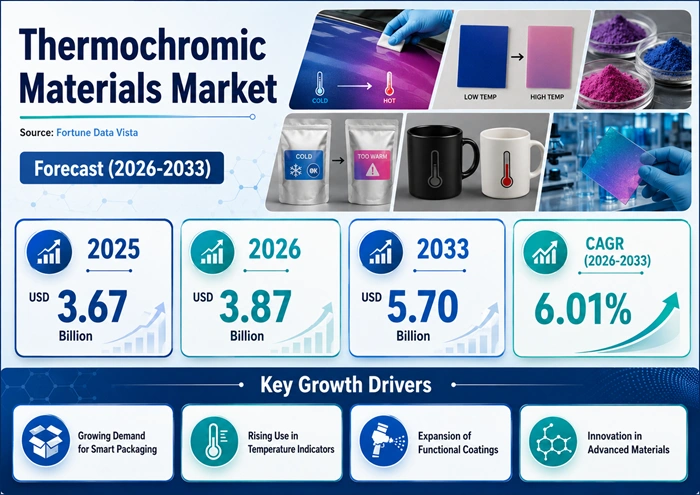
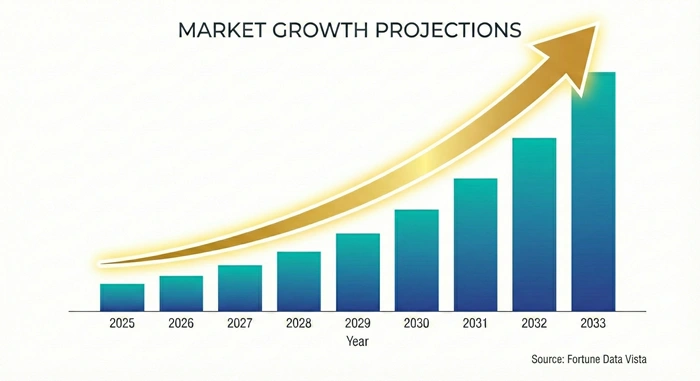
The global thermochromic materials market size is valued at USD 3.67 billion in 2025 and is predicted to increase from USD 3.87 billion in 2026 to approximately USD 5.70 billion by 2033, growing at a CAGR of 6.01% from 2026 to 2033.
Thermochromic materials — including liquid crystals, leuco dyes, and related specialty compounds — change color reversibly or irreversibly in response to temperature variations, enabling a wide range of functional applications from smart packaging and temperature-indicating labels to automotive coatings, medical devices, and functional textiles. Rising demand for intelligent packaging solutions, expanding anti-counterfeiting applications, growing adoption in the healthcare sector, and increasing consumer preference for interactive and visually dynamic products are all driving steady commercial growth in the temperature-sensitive materials category throughout the forecast period.
AI Impact on the Thermochromic Materials Industry
AI-Powered Material Formulation Design, Precision Manufacturing Quality Control, and Intelligent Supply Chain Optimization Are Accelerating Innovation and Operational Efficiency Across the Thermochromic Materials Market
Artificial intelligence is beginning to reshape the thermochromic materials market in meaningful ways — particularly in the domain of new material formulation and product development. AI-driven computational chemistry platforms can analyze vast molecular datasets to predict how modifications to leuco dye or liquid crystal compositions will affect color transition temperature, activation sharpness, durability, and substrate compatibility — significantly shortening the R&D cycles that traditionally require years of iterative laboratory experimentation. Specialty chemical companies and research institutions are increasingly using these AI-assisted design tools to develop customized thermochromic formulations that meet precise temperature range, color palette, and performance lifetime specifications demanded by packaging, automotive, and medical device customers — accelerating time-to-market for new product configurations.
In manufacturing, AI-powered vision inspection systems are improving quality control across thermochromic ink, pigment, and film production lines by detecting formulation inconsistencies, color uniformity deviations, and activation threshold irregularities at production speeds that human quality inspection cannot match. These systems use machine learning models trained on thousands of reference samples to identify subtle batch-to-batch variations that could affect end-product performance — ensuring the consistent color transition behavior that premium thermochromic material customers require. For supply chain operations, AI-driven demand forecasting tools are helping thermochromic material distributors and manufacturers optimize inventory positioning across seasonal and industry cycle fluctuations — reducing working capital tied up in slow-moving inventory while maintaining the supply reliability that packaging converters and specialty printer customers demand.
Growth Factors
The Rapid Expansion of Smart and Active Packaging Applications and the Growing Anti-Counterfeiting and Product Authentication Demand Are the Two Strongest Structural Growth Drivers in the Thermochromic Materials Market
The rapid expansion of intelligent and active packaging — particularly temperature-indicating labels on food, beverage, pharmaceutical, and cold chain logistics applications — is the most commercially impactful structural driver in the thermochromic materials market. Consumers, retailers, and regulatory bodies are increasingly demanding packaging that provides real-time temperature exposure evidence for perishable products — enabling a product's entire cold chain journey from manufacturer to consumer to be tracked and verified through visible color change indicators. Major food and beverage brands including Budweiser, Coors Light, and various premium ready-to-drink products have already deployed thermochromic ink labels that indicate optimal serving temperature — creating a commercially proven template that is being adopted across an expanding range of product categories as packaging converters make thermochromic printing more economically accessible.
The growing global emphasis on anti-counterfeiting and product authentication is the second structural driver creating consistent demand growth for temperature-sensitive materials. Thermochromic color change features — particularly reversible liquid crystal-based elements that activate at specific temperatures and deactivate when removed from heat — are incorporated into security labels, tax stamps, currency authentication features, and brand protection seals across pharmaceuticals, premium spirits, luxury goods, and government documents. The difficulty of replicating precisely calibrated thermochromic activation temperatures and color sequences without access to the original formulation makes these features effective deterrents against counterfeiting — driving adoption across industries where product authentication is a significant commercial and regulatory priority, particularly in markets where counterfeit goods pose serious consumer safety or brand value risks.
Market Outlook
The Thermochromic Materials Market Outlook Through 2033 Is Defined by Smart Textile Innovation, Building-Integrated Thermochromic Window and Coating Applications, and Emerging Healthcare Temperature Monitoring Uses
Smart textiles incorporating thermochromic materials represent one of the most commercially exciting emerging application vectors for the thermochromic materials market over the forecast period. Fashion brands, sportswear manufacturers, and military apparel developers are investing in thermochromic fabric treatments that create garments capable of displaying dynamic color patterns in response to body temperature variations — delivering novelty, functionality, and performance differentiation that commands premium pricing in the consumer and professional clothing markets. Companies including Chromatic Technologies Inc. and OliKrom SA are developing textile-grade thermochromic formulations with improved wash durability, UV resistance, and substrate adhesion that are expanding the practical commercial viability of thermochromic fabric applications beyond short-lived novelty garments into durable performance apparel.
Building and construction applications — including thermochromic window glazings, smart coatings, and energy-regulating architectural films that reduce solar heat gain during hot weather — represent a growing mid-to-long-term commercial opportunity for thermochromic material producers. Energy efficiency regulations in Europe and North America are driving architectural specification of smart glazing and adaptive building envelope technologies, and thermochromic materials offer a passive, no-power-required solar regulation mechanism that is attractive for sustainable building certification programs. As formulation stability, weathering resistance, and manufacturing scale economics for thermochromic architectural coatings improve through ongoing R&D investment, this application category is expected to generate growing material procurement volumes from the construction sector throughout the latter years of the forecast period.
Expert Speaks
-
"The smart packaging revolution is creating one of the most exciting growth periods in the history of specialty chemical innovation. Consumer demand for interactive, informative, and visually engaging packaging is accelerating adoption of temperature-sensitive materials across beverages, food, healthcare, and logistics — and we believe the companies that can deliver consistent, cost-effective, and application-ready thermochromic solutions will capture the largest share of this expanding commercial opportunity." — CEO, Avery Dennison Corporation
-
"Thermochromic and color-changing materials are moving from novelty features to functional necessities across multiple industries simultaneously. The cold chain integrity, anti-counterfeiting, and consumer engagement applications for temperature-sensitive materials are each individually compelling — and collectively they represent a sustained demand growth trajectory that we find highly strategically attractive as we continue to invest in our specialty materials portfolio." — CEO, 3M Company
-
"The intersection of sustainability, smart functionality, and consumer experience is defining the next generation of packaging innovation — and thermochromic materials sit squarely at that intersection. As food safety requirements become more stringent globally, temperature-indicating packaging solutions that give consumers and retailers transparent evidence of cold chain compliance are transitioning from differentiating features to category standard expectations across the premium food and beverage market." — CEO, Sealed Air Corporation
Key Report Takeaways
-
Asia Pacific leads the global thermochromic materials market with approximately 38–39% revenue share in 2025, driven by the region's position as the world's largest packaging manufacturing hub, its massive food and beverage industry scale, rapidly expanding pharmaceutical packaging requirements, and significant investment in thermochromic material production capacity by Chinese and Japanese specialty chemical manufacturers — supported by strong domestic demand from the region's enormous consumer goods and e-commerce packaging markets
-
North America is the fastest-growing regional market, projected to expand at approximately 6.84% CAGR through 2033, driven by accelerating smart packaging adoption across the premium food and beverage sector, growing pharmaceutical cold chain compliance requirements, robust anti-counterfeiting label demand, and increasing R&D investment from specialty chemical companies developing next-generation thermochromic formulations for automotive, construction, and healthcare applications
-
Leuco dyes dominate the type segment with approximately 56–57% revenue share in 2025, driven by their cost-effectiveness, wide color range versatility, compatibility with standard printing processes, and established commercial adoption in packaging and security label applications — while liquid crystals are the fastest-growing type at approximately 7.12% CAGR, driven by their precise temperature transition properties and growing adoption in medical, pharmaceutical, and high-precision quality indication applications
-
Inks and coatings lead the form segment with approximately 44–45% revenue share in 2025, reflecting their direct compatibility with conventional flexographic, offset, and screen printing processes used by packaging converters — while thermochromic films are the fastest-growing form at approximately 7.38% CAGR, driven by growing smart window, architectural glazing, and flexible electronics packaging applications
-
Packaging leads the application segment with approximately 33–34% revenue share in 2025, encompassing temperature-indicating food and beverage labels, pharmaceutical cold chain compliance packaging, and beverage cans and bottles with serving temperature indicators — while the construction application is the fastest-growing at approximately 7.81% CAGR, driven by thermochromic smart window and energy-regulating building coating adoption in sustainability-focused architectural projects
-
Food and beverage leads the end-use industry segment with approximately 29–30% revenue share in 2025, driven by the high commercial visibility of thermochromic beverage label applications and growing cold chain integrity requirements across perishable food products globally — while healthcare is the fastest-growing end-use industry at approximately 8.07% CAGR, driven by temperature-sensitive pharmaceutical packaging, patient monitoring applications, and hospital supply chain management systems using thermochromic temperature indicators
Market Scope
| Parameter | Details |
|---|---|
| Market Size by 2033 | USD 5.70 Billion | Market Size by 2026 | USD 3.87 Billion | Market Size by 2025 | USD 3.67 Billion | Market Growth Rate from 2026 to 2033 | CAGR of 6.01% | Dominating Region | Asia Pacific | Fastest Growing Region | North America | Segments Covered | Type, Form, Application, End Use Industry, Region | Regions Covered | North America, Europe, Asia Pacific, Latin America, Middle East & Africa |
Market Dynamics
Drivers Impact Analysis
Smart Packaging Demand Across Food, Beverage, and Pharmaceutical Sectors and Anti-Counterfeiting Label Adoption Across Premium Consumer Goods Are the Two Strongest Commercial Catalysts Driving the Thermochromic Materials Market
| Driver | ≈ % Impact on CAGR Forecast | Geographic Relevance | Impact Timeline |
|---|---|---|---|
| Smart and active packaging adoption across food, beverage, and pharmaceutical sectors | ~34% | Global, strongest in North America, Europe, and Asia Pacific | Long-term |
| Anti-counterfeiting and product authentication label demand | ~27% | Global, highest enforcement priority in Europe and North America | Medium to long-term |
| Cold chain compliance requirements driving temperature indicator adoption | ~22% | Global, accelerating in emerging pharmaceutical supply chains | Medium to long-term |
| Consumer engagement and interactive packaging design trends | ~11% | North America, Europe | Short to medium-term |
| Smart textile and wearable technology application development | ~6% | North America, Europe, Asia Pacific | Long-term |
The smart packaging driver is particularly powerful because it operates across multiple simultaneous demand channels — food safety regulations mandating temperature monitoring, brand owner decisions to differentiate products through interactive packaging, and retailer requirements for supply chain transparency are all independently creating demand for thermochromic packaging solutions. Each of these demand channels is growing, and they are reinforcing rather than competing with each other — making the smart packaging application category a uniquely durable and multi-dimensional growth driver for the thermochromic materials market. The expansion of e-commerce grocery delivery and direct-to-consumer pharmaceutical shipping is further amplifying cold chain temperature indicator demand, as package recipients rely increasingly on temperature-sensitive labels to assess product integrity upon delivery rather than being able to evaluate freshness through a retail shelf encounter.
The anti-counterfeiting driver is structurally growing due to the expanding global trade in counterfeit goods — estimated to exceed USD 500 billion annually across all product categories. Brand owners in premium spirits, luxury consumer goods, pharmaceuticals, and electronics are seeking harder-to-replicate authentication features that can be cost-effectively integrated into existing packaging and label production processes without requiring significant workflow changes. Thermochromic security features — particularly those using proprietary leuco dye formulations calibrated to non-standard activation temperatures — provide a commercially practical and visually intuitive authentication mechanism that brand protection managers increasingly specify as part of multilayer authentication strategies. The growing regulatory enforcement of pharmaceutical track-and-trace requirements in the U.S., EU, China, and India is further accelerating thermochromic indicator adoption in pharmaceutical packaging as manufacturers seek cost-effective temperature exposure evidence solutions for serialized product shipments.
Restraints Impact Analysis
High Raw Material Costs and Formulation Complexity Limiting Price Competitiveness Against Conventional Packaging Materials and Durability Limitations in Harsh Environmental Conditions Restraining Broader Application Adoption
| Restraint | ≈ % Impact on CAGR Forecast | Geographic Relevance | Impact Timeline |
|---|---|---|---|
| High production cost compared to conventional materials limiting price-sensitive market penetration | ~38% | Emerging markets, small and medium packaging operators | Medium to long-term |
| Durability limitations under UV exposure, washing, and chemical contact | ~30% | Textile, construction, and outdoor application segments | Medium to long-term |
| Complex formulation stability and shelf life challenges | ~20% | Global | Short to medium-term |
| Regulatory restrictions on certain chemical components in food contact and healthcare applications | ~12% | North America, Europe | Short to medium-term |
The cost premium of thermochromic inks, pigments, and coatings relative to conventional printing materials remains the most commercially significant adoption barrier in the thermochromic materials market — particularly in price-sensitive packaging segments where material cost per unit is a primary procurement criterion. Standard thermochromic ink can cost 5–15 times more per kilogram than conventional printing ink, making the economics of thermochromic packaging most favorable for premium product categories where the brand differentiation and consumer engagement value justifies the incremental material cost. In commodity food packaging and low-margin consumer goods categories, this cost differential remains a meaningful barrier that limits adoption to specific product lines or packaging components — slowing what could otherwise be much faster market penetration.
Durability limitations — particularly the degradation of thermochromic color transition performance under prolonged UV exposure, repeated washing cycles, and contact with cleaning chemicals — restrict the practical commercial viability of these materials in outdoor architectural coatings, durable consumer textile, and industrial applications where long-term performance stability is a fundamental requirement. While formulation advances are progressively improving the environmental stability of both leuco dye and liquid crystal thermochromic systems, the performance gap between thermochromic materials and conventional stable colorants in demanding service environments continues to limit the market's penetration into high-durability application categories that could otherwise represent significant volume opportunities.
Opportunities Impact Analysis
Growing Healthcare Temperature Monitoring Applications and the Emerging Smart Building Energy Management Use Case Are the Two Highest-Value Commercial Growth Opportunities in the Thermochromic Materials Market
| Opportunity | ≈ % Impact on CAGR Forecast | Geographic Relevance | Impact Timeline |
|---|---|---|---|
| Healthcare temperature monitoring, pharmaceutical packaging, and patient care applications | ~44% | North America, Europe, Asia Pacific | Medium to long-term |
| Smart building and architectural thermochromic window and coating applications | ~36% | Europe, North America | Long-term |
| Emerging market cold chain expansion driving temperature indicator adoption | ~20% | Asia Pacific, Latin America, MEA | Medium to long-term |
Healthcare applications represent the highest-value near-term growth opportunity in the thermochromic materials market due to the combination of volume scale, regulatory-driven adoption compulsion, and premium pricing tolerance that characterizes pharmaceutical and medical device packaging procurement. Vaccines, biologics, blood products, and many specialty pharmaceuticals require strict temperature-controlled storage and distribution — and thermochromic indicators that visually confirm cold chain integrity provide a cost-effective compliance tool for pharmaceutical manufacturers, distributors, and healthcare providers managing complex global and domestic supply chains. The COVID-19 pandemic's spotlight on vaccine cold chain management created enduring awareness of temperature integrity as a patient safety issue — driving lasting increases in healthcare supply chain temperature indicator specification that continue to benefit thermochromic material suppliers.
The smart building opportunity — while longer in realization timeline — represents a potentially transformational scale opportunity for thermochromic material producers if performance and cost metrics continue improving. Buildings account for approximately 40% of global energy consumption, and passive solar management through thermochromic glazing and coatings that automatically reduce solar heat gain in summer while maximizing solar warming in winter could contribute meaningfully to building energy efficiency without active mechanical systems. European Green Deal energy performance requirements, LEED and BREEAM certification criteria supporting smart glazing specification, and rising energy costs amplifying the economic case for passive energy management are all creating favorable policy and commercial conditions for thermochromic building material adoption — positioning thermochromic producers who invest in architecture-grade formulation development now to capture a significant market opportunity as this application category matures.
Segment Analysis
By Type
Leuco Dyes Lead with Over 56% Revenue Share While Liquid Crystals Are the Fastest-Growing Type at 7.12% CAGR as Precision Temperature Indication Applications Expand Across Healthcare and High-Value Packaging in the Thermochromic Materials Market
Leuco dyes hold the dominant position in the thermochromic materials market by type, accounting for approximately 56–57% of total type revenue in 2025. Their commercial leadership reflects multiple practical advantages that make them the default choice for the large-volume packaging and security label applications that drive the majority of thermochromic material consumption globally — including low cost per unit of activated color area, compatibility with standard flexographic and screen printing equipment, a wide range of available activation temperatures from below -10°C to above 70°C, and the ability to formulate reversible or irreversible color change behaviors depending on application requirements. Asia Pacific is the largest and most active regional market for leuco dye consumption, where major Chinese and Japanese specialty chemical manufacturers including Matsui International, NewColorChem, and DIC Corporation produce substantial volumes of leuco dye-based thermochromic ink and pigment concentrates serving the region's enormous packaging and printing industries.
Liquid crystals are growing at the fastest CAGR of approximately 7.12% within the type segment through 2033, driven by the precise, reproducible temperature transition characteristics that liquid crystal formulations provide — enabling applications where specific narrow-range temperature indication accuracy is commercially essential. Healthcare and pharmaceutical packaging are the primary growth drivers for liquid crystal thermochromic adoption, where materials must reliably indicate exposure above precisely defined thresholds — such as 2°C, 8°C, or 25°C — without false triggers or missed activations that could compromise product safety decisions. Europe is the fastest-growing region for liquid crystal thermochromic adoption, where pharmaceutical packaging compliance requirements under EU Good Distribution Practice guidelines are driving specification of high-precision temperature indicators by major pharmaceutical manufacturers including Roche, Novartis, and Sanofi that demand the activation accuracy that liquid crystal systems provide.
By Application
Packaging Leads with Over 33% Application Revenue Share While Construction Is the Fastest-Growing Application at 7.81% CAGR as Smart Building and Energy Management Material Demand Expands in the Thermochromic Materials Market
Packaging holds the commanding application position in the thermochromic materials market at approximately 33–34% of total application revenue in 2025. The sheer scale of global packaging consumption — spanning food, beverage, pharmaceutical, cosmetics, and logistics applications — combined with the growing commercial adoption of temperature-indicating features across multiple packaging segments makes packaging by far the largest end-use context for thermochromic material consumption. North America leads the packaging application market by value, where major beverage brands' thermochromic label programs, pharmaceutical cold chain compliance requirements, and the active innovation investment by specialty chemical companies including Chromatic Technologies Inc. (CTI) and Landsberg Orora collectively drive the region's packaging thermochromic material procurement activity.
Construction is growing at the fastest CAGR of approximately 7.81% within the application segment through 2033, driven by the progressive adoption of thermochromic smart window glazings and energy-regulating architectural coatings in sustainability-focused building projects across Europe and North America. The European building renovation wave — targeting energy efficiency upgrades in the EU's existing building stock under Green Deal and Energy Performance of Buildings Directive requirements — is creating growing specification opportunities for thermochromic glazing films and coatings that contribute to passive solar management and building energy performance ratings. Companies including ChromoGenics AB (Sweden) and SageGlass (Saint-Gobain) are among those developing commercially viable thermochromic and electrochromic architectural glazing solutions, with thermochromic coatings attracting growing interest as a lower-cost passive alternative to electrochromic systems that require power supply and electronic control infrastructure.
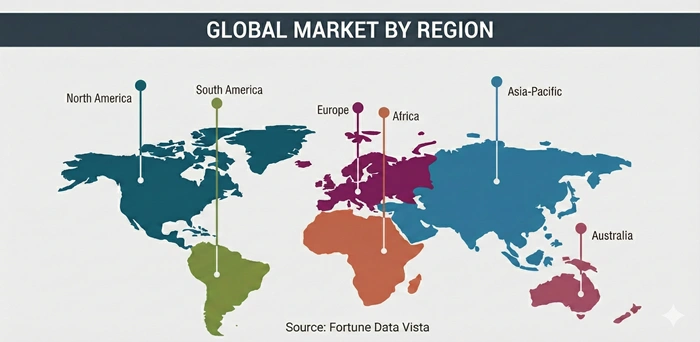
Regional Insights
Asia Pacific
Asia Pacific Commands Approximately 38–39% of Global Thermochromic Materials Revenue, Anchored by World-Leading Packaging Manufacturing Scale, Major Specialty Chemical Production Capacity, and Massive Consumer Goods Industry Demand
Asia Pacific holds approximately 38–39% of global thermochromic materials market revenue in 2025, growing at a regional CAGR of approximately 5.73% through the forecast period. China is the dominant national market within the region — hosting both the world's largest packaging manufacturing industry and significant domestic thermochromic material production capacity at companies including Matsui International, NewColorChem, and multiple domestic specialty chemical producers that serve the region's enormous food, beverage, and consumer goods packaging sector. Japan's advanced specialty chemical industry — with companies including DIC Corporation and Pilot Corporation contributing formulation expertise in leuco dye and thermochromic ink development — provides the region with strong domestic technology supply capability alongside competitive international export positioning in specialty thermochromic products.
India, South Korea, and Australia represent the region's secondary growth markets, each driven by distinct demand catalysts. India's rapidly growing pharmaceutical industry and expanding cold chain logistics infrastructure are creating growing demand for temperature indicator labels and packaging materials. South Korea's advanced electronics and cosmetics packaging sectors generate consistent demand for precision thermochromic printing solutions for product differentiation and authentication applications. The region's massive e-commerce sector — led by Alibaba, JD.com, and Flipkart — is generating growing demand for temperature-sensitive packaging indicators for food and healthcare product delivery, creating a structural long-term consumption growth driver that operates independently of traditional retail packaging demand channels.
North America
North America Is the Fastest-Growing Region in the Thermochromic Materials Market at 6.84% CAGR, Driven by Premium Beverage Packaging Innovation, Pharmaceutical Cold Chain Compliance, and Active R&D Investment in Next-Generation Temperature-Sensitive Formulations
North America is projected to grow at the highest regional CAGR of approximately 6.84% through 2033 within the thermochromic materials market, establishing it as the most commercially dynamic growth region for temperature-sensitive specialty materials. The United States market is anchored by the commercial success of Chromatic Technologies Inc. (CTI) — the world's leading developer of thermochromic printing solutions — whose proprietary leuco dye inks and cold-activated packaging technologies are deployed in hundreds of millions of beverage labels, promotional labels, and product authentication applications for major consumer goods brands annually. The FDA's progressive cold chain monitoring requirements for pharmaceutical and biological product distribution are creating growing institutional demand for temperature-indicating packaging solutions from major pharmaceutical manufacturers and healthcare distributors operating across the U.S. supply chain.
Canada's growing pharmaceutical manufacturing sector and Mexico's rapidly expanding export-oriented food and beverage packaging industry are contributing additional North American thermochromic material demand growth — diversifying the regional revenue base beyond the U.S. market's premium consumer goods applications. The strong venture capital and corporate R&D investment environment in the United States is supporting a robust pipeline of next-generation thermochromic material innovation — including bio-based leuco dye formulations with improved environmental profiles, flexible electronics-integrated thermochromic displays, and construction-grade thermochromic coatings with enhanced weathering durability — that positions North American material developers to expand into adjacent application categories throughout the forecast period.
Customization Available for This Report
This report offers comprehensive region-wise and country-wise customization, delivering tailored market intelligence on thermochromic materials demand dynamics, application-specific adoption trends, regulatory compliance frameworks, competitive landscape analysis, and end-use industry growth patterns specifically aligned to your selected geography and market focus.
Customized versions of this report are available for each region and country listed below, offering detailed insights for specialty chemical manufacturers, packaging converters, pharmaceutical companies, brand protection managers, and investors targeting the smart materials and functional coatings sector:
North America
-
U.S. — FDA cold chain compliance regulatory framework, smart packaging innovation trends, premium beverage label market analysis, anti-counterfeiting label demand, and competitive vendor landscape
-
Canada — Health Canada pharmaceutical packaging standards, cold chain temperature monitoring requirements, specialty chemical market analysis, and competitive market dynamics
-
Mexico — COFEPRIS regulatory framework, export-oriented food and beverage packaging thermochromic demand, and market entry opportunity assessment
Europe
-
U.K. — MHRA pharmaceutical packaging standards, brand protection label demand, smart packaging innovation investment, and competitive market landscape
-
Germany — BAuA regulatory standards, automotive and construction thermochromic application analysis, major packaging brand demand, and competitive vendor dynamics
-
France — ANSES regulatory framework, luxury goods authentication label demand, smart packaging innovation, and competitive market landscape
-
Italy — Italian luxury and food industry authentication packaging demand, regulatory standards, and market opportunity analysis
-
Rest of Europe — Nordic sustainable building material innovation, Eastern European packaging industry thermochromic adoption, and emerging market opportunity analysis
Asia Pacific
-
China — NMPA pharmaceutical packaging standards, domestic thermochromic chemical producer landscape, packaging industry demand analysis, and competitive dynamics
-
India — FSSAI and CDSCO regulatory standards, pharmaceutical cold chain expansion impact, packaging sector thermochromic demand, and market opportunity assessment
-
Japan — MHLW regulatory standards, advanced specialty chemical producer analysis, premium consumer goods packaging demand, and competitive landscape
-
South Korea — MFDS regulatory framework, electronics and cosmetics packaging thermochromic demand, and competitive market analysis
-
Australia — TGA regulatory standards, cold chain logistics thermochromic indicator demand, and market opportunity assessment
-
Rest of Asia Pacific — Southeast Asian packaging industry growth and thermochromic material adoption opportunity analysis
Latin America
-
Brazil — ANVISA regulatory framework, pharmaceutical and food packaging cold chain demand, and commercial opportunity assessment
-
Argentina — ANMAT regulatory standards, packaging industry thermochromic adoption trends, and market development analysis
-
Rest of Latin America — Emerging cold chain packaging market development and thermochromic indicator demand opportunity analysis
Middle East & Africa
-
UAE — Dubai food safety standards, premium packaging and anti-counterfeiting demand, healthcare supply chain thermochromic adoption, and competitive market landscape
-
Saudi Arabia — SFDA regulatory requirements, pharmaceutical cold chain standards, Vision 2030 manufacturing investment, and market opportunity analysis
-
Rest of MEA — Emerging pharmaceutical and food packaging temperature indicator demand and market opportunity assessment
Top Key Players
-
Chromatic Technologies Inc. — CTI (United States)
-
Matsui International Company Inc. (Japan)
-
NewColorChem Ltd. (United Kingdom)
-
OliKrom SA (France)
-
SpotSee (United States)
-
DIC Corporation (Japan)
-
LCR Hallcrest LLC (United States)
-
Chameleon International Inc. (United States)
-
Color Change Corporation (United States)
-
Sflex LLC (United States)
-
Pölysack Flexible Packaging Ltd. (Israel)
-
ChromoGenics AB (Sweden)
-
Coatings & Compounds Corp. (United States)
-
Flint Group (Luxembourg)
-
Shenzhen Kunzhan Pigment Co. Ltd. (China)
Recent Developments
-
In April 2026, Chromatic Technologies Inc. announced the commercial launch of its EcoChroma product line — a range of bio-based leuco dye thermochromic inks formulated from partially renewable raw materials and designed to meet increasing brand owner requirements for reduced environmental footprint in specialty packaging inks, with initial commercial deployment in premium beverage label applications for several major U.S. and European food and beverage brands
-
In January 2026, OliKrom SA secured a strategic investment from a leading European specialty chemical venture fund to accelerate the commercialization of its structural color-based thermochromic materials platform — which uses nano-structured photonic architectures rather than conventional dye chemistry to produce durable, highly saturated thermochromic effects suitable for automotive coatings and high-durability consumer product applications requiring multi-year color stability
-
In October 2025, Matsui International Company Inc. expanded its thermochromic pigment production capacity at its Japanese manufacturing facility to address growing demand from Asia Pacific packaging and textile customers — with the expansion specifically targeting the pharmaceutical temperature indicator label and functional apparel application segments that have shown the strongest order volume growth across the company's Asia Pacific customer base in recent years
-
In August 2025, NewColorChem Ltd. announced a strategic partnership with a major European pharmaceutical packaging converter to co-develop customized liquid crystal thermochromic indicators meeting EU GDP temperature monitoring specifications for cold chain pharmaceutical products — with the partnership targeting growing EU regulatory requirements for temperature-controlled medicines packaging compliance that are driving specification of high-precision thermochromic indicators across the European pharmaceutical supply chain
-
In June 2025, LCR Hallcrest LLC launched an expanded range of precision liquid crystal thermochromic films for medical device and patient monitoring applications — including temperature strips for fever monitoring, neonatal patient temperature assessment, and clinical equipment surface temperature indication — with the launch aligned to growing healthcare provider demand for affordable, non-electronic temperature monitoring tools that deliver reliable clinical temperature information without requiring battery power or electronic infrastructure
Market Trends
Two Defining Trends Are Reshaping the Thermochromic Materials Market: The Transition Toward Bio-Based and Environmentally Sustainable Thermochromic Formulations and the Growing Integration of Thermochromic Features into Multi-Function Smart Packaging Systems
The transition toward bio-based, sustainable thermochromic formulations is one of the most commercially significant trend shifts shaping the thermochromic materials market in the near term. Brand owners, packaging converters, and consumer goods companies facing growing pressure from retail customer sustainability procurement policies, EU packaging regulation updates, and consumer environmental awareness are increasingly seeking thermochromic ink and pigment suppliers that can demonstrate reduced solvent content, bio-based raw material content, and compatibility with recyclable or compostable packaging substrates. Companies that lead in developing and commercializing sustainable thermochromic chemistry are gaining preferential positioning in procurement evaluations at sustainability-focused brand owners — creating a meaningful competitive advantage that is reshaping supplier selection across European and North American smart packaging markets.
The integration of thermochromic elements into comprehensive multi-function smart packaging systems — combining temperature indication with QR code authentication, NFC tag connectivity, and digital engagement features in unified packaging designs — is the second major trend driving premium market segment growth. Brand owners are increasingly viewing smart packaging as a connected consumer engagement channel rather than purely a functional or regulatory compliance tool — making thermochromic features most commercially impactful when they are part of broader digital-physical packaging experiences. Packaging technology companies including Avery Dennison and CCL Industries are developing integrated smart label platforms that combine thermochromic printing with digital connectivity — enabling temperature data to trigger digital consumer communications, supply chain alerts, and brand engagement content simultaneously, creating multi-dimensional value propositions that justify the incremental material investment across premium food, beverage, and healthcare packaging applications.
Segments Covered in the Report
By Type
-
Leuco Dyes
-
Reversible Leuco Dye Formulations
-
Irreversible Leuco Dye Indicators
-
-
Liquid Crystals
-
Cholesteric Liquid Crystal Systems
-
Microencapsulated Liquid Crystal Coatings
-
-
Others
-
Perovskites, Metal Oxide, and Emerging Novel Thermochromic Compounds
-
By Form
-
Inks and Coatings
-
Flexographic and Screen Printing Thermochromic Inks
-
Surface Coating and Spray Application Formulations
-
-
Pigments
-
Microencapsulated Thermochromic Pigment Concentrates
-
Powder Pigments for Plastics and Masterbatch Applications
-
-
Films
-
Thermochromic Laminating Films and Smart Window Films
-
Flexible Thermochromic Display Films
-
-
Others
-
Thermochromic Fibers, Yarns, and Specialty Compound Formats
-
By Application
-
Packaging
-
Food and Beverage Temperature-Indicating Labels
-
Pharmaceutical Cold Chain Compliance Packaging
-
-
Printing
-
Security Printing and Anti-Counterfeiting Labels
-
Promotional and Interactive Print Applications
-
-
Textiles
-
Functional Apparel and Fashion Thermochromic Fabrics
-
Military and Technical Textile Applications
-
-
Medical Devices
-
Clinical Temperature Monitoring Strips and Indicators
-
Medical Device Surface Temperature Indication
-
-
Automotive
-
Interior Surface Coatings and Trim Applications
-
Paint and Finish Temperature Response Features
-
-
Construction
-
Thermochromic Smart Window Glazings and Films
-
Energy-Regulating Architectural Coatings
-
-
Others
-
Electronics, Toys, and Consumer Product Applications
-
By End Use Industry
-
Food and Beverage
-
Healthcare
-
Apparel and Textiles
-
Automotive
-
Building and Construction
-
Others (Electronics, Security, Consumer Goods)
By Region
-
North America (U.S., Canada, Mexico)
-
Europe (U.K., Germany, France, Italy, Rest of Europe)
-
Asia Pacific (China, India, Japan, South Korea, Australia, Rest of Asia Pacific)
-
Latin America (Brazil, Argentina, Rest of Latin America)
-
Middle East and Africa (UAE, Saudi Arabia, Rest of MEA)
❝ Built for Every Level — From Startups to Industry Giants ❞
Here Is Exactly How This Report Works for You
-
For tier 1 specialty chemical corporations, global packaging companies, pharmaceutical manufacturers, and institutional investors targeting the smart materials and functional coatings sector, this report delivers granular competitor revenue analysis for CTI, Matsui International, OliKrom, NewColorChem, and emerging material developers — alongside comprehensive regulatory intelligence covering EU pharmaceutical cold chain packaging mandates, FDA temperature monitoring compliance requirements, brand protection regulatory drivers, and sustainability packaging regulation impacts that are collectively reshaping competitive positioning and market share dynamics within the thermochromic materials market through 2033
-
For tier 2 and tier 3 specialty ink producers, packaging converters, label manufacturers, and mid-size chemical companies evaluating thermochromic material opportunities, this report maps the highest-growth application segments including healthcare temperature monitoring, construction smart glazing, smart textiles, and sustainable bio-based formulations — with detailed market sizing, competitive landscape analysis, and regional demand intelligence that enables precise identification of commercial opportunity gaps and investment priorities aligned to the market's fastest-growing demand vectors
-
For all decision-makers across the thermochromic materials value chain — from product development chemists and commercial directors at specialty chemical companies to private equity investors and corporate strategy executives at diversified materials businesses — this report translates complex signals including sustainability packaging regulation evolution, pharmaceutical cold chain compliance mandates, building energy efficiency policy investment, and consumer smart packaging adoption trends into actionable strategic intelligence supporting superior formulation investment, application development, geographic expansion, and technology partnership decisions through 2033
Frequently Asked Questions:
Answer: The global thermochromic materials market was valued at USD 3.67 billion in 2025 and is projected to reach approximately USD 5.70 billion by 2033, growing at a CAGR of 6.01% from 2026 to 2033. This growth is driven by expanding smart packaging applications, growing anti-counterfeiting demand, pharmaceutical cold chain compliance requirements, and emerging construction and healthcare sector applications for temperature-sensitive materials.
Answer: Thermochromic materials are specialty compounds — primarily leuco dyes and liquid crystals — that reversibly or irreversibly change color in response to temperature variations, enabling visible temperature indication without electronic sensors or power supply. Leuco dyes transition between colorless and colored states through thermally driven molecular structural changes, while liquid crystals shift through a spectrum of colors as their ordered molecular arrangement responds to temperature — with both types available in microencapsulated formats compatible with standard printing and coating processes.
Answer: Asia Pacific leads the global thermochromic materials market with approximately 38–39% revenue share in 2025, driven by the region's massive packaging manufacturing scale, major specialty chemical production capacity, and enormous consumer goods industry demand. North America is the fastest-growing regional market at approximately 6.84% CAGR through 2033, powered by premium beverage packaging innovation, pharmaceutical cold chain compliance investment, and active R&D in next-generation thermochromic formulations by leading U.S. companies including Chromatic Technologies Inc.
Answer: The primary applications driving thermochromic materials demand include temperature-indicating food and beverage packaging labels, pharmaceutical cold chain compliance indicators, anti-counterfeiting and brand authentication security labels, clinical temperature monitoring strips for healthcare settings, and emerging smart building window glazing and energy-regulating coating applications. The packaging application holds the largest share at approximately 33–34% of total revenue, while construction is the fastest-growing application at approximately 7.81% CAGR as thermochromic smart glazing adoption accelerates in sustainability-focused architectural projects.
Answer: The primary restraints limiting faster growth in the thermochromic materials market include the significantly higher cost of thermochromic inks and pigments compared to conventional printing materials — making adoption economics most favorable in premium product applications — and durability limitations under UV exposure and repeated washing that restrict viability in demanding outdoor and textile applications. Regulatory restrictions on certain chemical components in food contact and healthcare applications also require ongoing formulation development investment to ensure compliance with increasingly stringent material safety standards in key end-use markets across North America and Europe.