
Ultrasound Probe Disinfection Market Overview
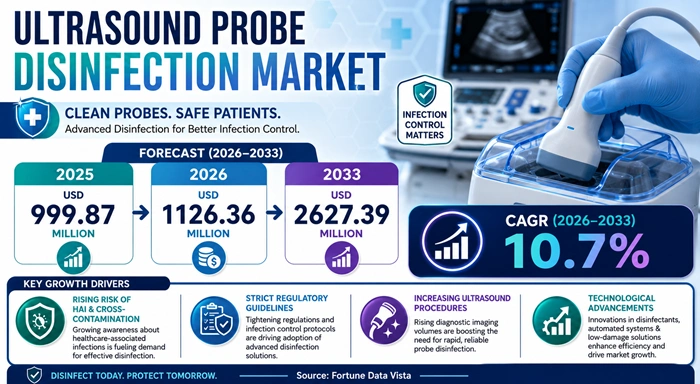
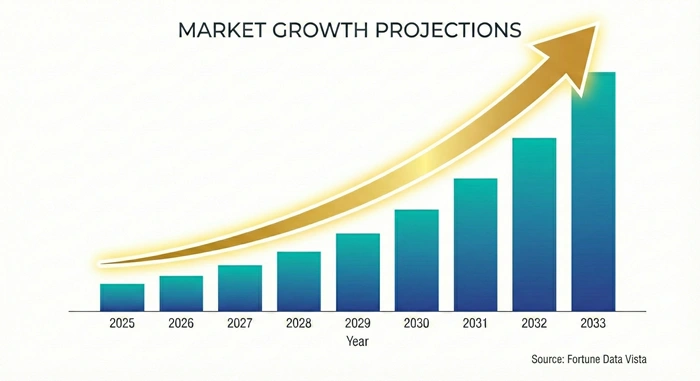
The global ultrasound probe disinfection market size is valued at USD 999.87 million in 2025 and is predicted to increase from USD 1126.36 million in 2026 to approximately USD 2627.39 million by 2033, growing at a CAGR of 10.7% from 2026 to 2033.
This robust expansion is being driven by the rising global burden of healthcare-associated infections (HAIs), tightening infection control regulations, growing utilization of ultrasound across multiple clinical specialties, and increasing adoption of automated probe disinfection systems that replace inconsistent manual workflows with validated, reproducible results. The probe disinfection and reprocessing sector has evolved from a largely overlooked compliance obligation into a strategically important component of hospital infection prevention programs globally.
AI Impact on the Ultrasound Probe Disinfection Industry
Artificial Intelligence and Connected Monitoring Technologies Are Transforming Compliance Tracking, Workflow Optimization, and Predictive Maintenance Across Ultrasound Probe Disinfection Systems*
Artificial intelligence is beginning to play a meaningful and growing role in the ultrasound probe disinfection market, particularly in the areas of compliance monitoring, workflow intelligence, and automated system performance optimization. AI-enabled probe tracking platforms now integrate with hospital information systems and infection control databases to log every disinfection cycle in real time, flag missed or incomplete reprocessing events, and generate compliance audit trails that satisfy regulatory and accreditation requirements. These smart systems reduce the reliance on manual documentation — which has historically been a major source of compliance gaps in healthcare facilities — and create a continuous, verifiable record of probe hygiene status that is accessible to infection control teams, department heads, and hospital administrators.
Beyond compliance tracking, machine learning algorithms are being applied to predict maintenance needs and performance deviations in automated probe disinfection systems — enabling proactive servicing before system failures disrupt clinical workflows. Some manufacturers are also developing AI-powered image analysis tools that detect probe surface damage or residual contamination after disinfection cycles, adding a critical quality verification layer that was previously impossible with manual inspection methods. As hospital networks increasingly digitize their infection prevention infrastructure and adopt integrated clinical workflow platforms, the commercial opportunity for AI-enriched ultrasound probe disinfection solutions will expand substantially through 2033, creating meaningful differentiation opportunities for technology-forward suppliers.
Growth Factors
Rising Healthcare-Associated Infection Rates, Expanding Ultrasound Utilization Across Clinical Specialties, and Tightening Global Regulatory Standards for Medical Device Reprocessing Are Powering Consistent Market Growth*
The primary growth driver shaping the ultrasound probe disinfection market is the sustained global urgency around preventing healthcare-associated infections. Ultrasound probes — particularly endocavitary transducers used in gynecological, urological, transesophageal, and intraoperative procedures — are classified as semi-critical or critical devices that require rigorous high-level disinfection or sterilization between patient uses. Studies have documented multiple outbreak clusters directly linked to inadequate probe reprocessing, involving pathogens such as carbapenem-resistant Enterobacteriaceae (CRE), Pseudomonas aeruginosa, and human papillomavirus (HPV). These documented infection events have generated intense regulatory attention and have accelerated hospital adoption of validated automated disinfection systems that eliminate the variability inherent in manual chemical disinfection. The global cost burden of HAIs — estimated to exceed USD 28 billion annually in the United States alone — creates powerful financial incentives for healthcare organizations to invest in reliable, automated probe disinfection infrastructure.
The explosive growth in diagnostic and interventional ultrasound utilization across multiple clinical specialties represents a second powerful structural growth driver. Ultrasound is now used routinely in cardiology, obstetrics, radiology, emergency medicine, urology, musculoskeletal imaging, anesthesiology, and point-of-care settings — dramatically expanding the number and diversity of probes in clinical use that require regular reprocessing. The increasing adoption of point-of-care ultrasound (POCUS) — particularly in emergency departments, intensive care units, and outpatient settings — is creating new and distributed probe disinfection requirements across clinical environments that were not traditionally equipped with formal reprocessing workflows. This broad-based expansion of ultrasound utilization is generating sustained incremental demand for both automated disinfection instruments and high-volume chemical disinfectant consumables across all major global markets.
Market Outlook
Automation Adoption, Regulatory Harmonization, and the Global Expansion of Healthcare Infrastructure Are Positioning the Ultrasound Probe Disinfection Market for Steady Long-Term Growth Through 2033*
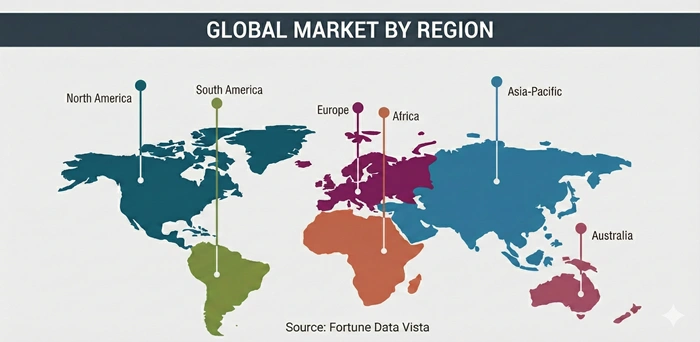
The outlook for the ultrasound probe disinfection market through 2033 is consistently positive, supported by structural healthcare investment trends, tightening regulatory compliance requirements, and ongoing technological innovation in automated disinfection platforms. North America continues to lead the global market, benefiting from stringent FDA and CDC guidelines on medical device reprocessing, high ultrasound procedure volumes, and the presence of leading technology suppliers. Europe is the second-largest market, driven by harmonized EU Medical Device Regulation (MDR 2017/745) requirements and a mature hospital procurement infrastructure. Asia Pacific is the fastest-growing region, as rapidly expanding healthcare infrastructure in China, India, Japan, and Southeast Asia creates both growing ultrasound procedure volumes and new compliance obligations for probe reprocessing.
Looking ahead, the single-use probe cover and disposable consumables segment is expected to grow at an above-average rate as infection control teams seek supplementary barrier protection for probe surfaces, particularly in high-volume and high-risk procedure environments. Ultraviolet (UV-C) disinfection technology is also gaining commercial traction as a fast, chemical-free alternative for surface and semi-critical probe disinfection — particularly for external probes used in emergency and point-of-care settings where turnaround time is critical. Manufacturers who combine automated hardware, IoT-enabled compliance monitoring, validated disinfectant chemistries, and comprehensive staff training support into integrated disinfection ecosystem solutions will be strongly positioned to capture premium market opportunities and long-term institutional supply contracts as the ultrasound probe disinfection market continues to mature and expand globally.
Expert Speaks
-
"At GE HealthCare, we recognize that infection prevention is not a peripheral concern — it is central to patient safety and clinical confidence in ultrasound imaging. We are committed to developing solutions that make high-level probe disinfection easier, faster, and more reliably compliant, so that healthcare providers can focus on patient care without compromising on safety standards." — Peter Arduini, President & CEO, GE HealthCare
-
"Ecolab's science-based approach to infection prevention encompasses the full continuum of clinical environments — from operating rooms to imaging suites. The growing adoption of automated probe disinfection systems reflects the healthcare industry's maturation in understanding that manual processes alone are insufficient for consistent, verifiable compliance with today's infection control standards, and we are proud to support that transition." — Christophe Beck, CEO, Ecolab Inc.
-
"STERIS has long understood that the reprocessing of medical devices — including ultrasound transducers — is one of the most risk-sensitive steps in the clinical care pathway. Our investments in automated, validated probe disinfection technologies reflect our commitment to helping hospitals eliminate preventable infections through solutions that combine scientific rigor with real-world workflow practicality." — Daniel Carestio, President & CEO, STERIS plc
Key Report Takeaways
-
North America leads the global ultrasound probe disinfection market with approximately 38.5% revenue share in 2026, underpinned by stringent FDA, CDC, and Joint Commission guidelines on medical device reprocessing, high per-capita ultrasound procedure volumes, and the presence of the world's largest and most mature base of automated probe disinfection system installations across hospitals and ambulatory care centers.
-
Asia Pacific is the fastest-growing regional market, projected to expand at a CAGR of approximately 13.4% from 2026 to 2033, driven by rapid healthcare infrastructure expansion in China and India, growing awareness of HAI risks, increasing government investment in hospital infection control programs, and rising ultrasound procedure volumes across diverse clinical specialties in the region.
-
Hospitals and diagnostic imaging centers are the largest end-user segment, accounting for approximately 62.4% of global market revenue in 2025, reflecting the high concentration of ultrasound procedures, endocavitary transducer usage, and infection control compliance obligations in acute and secondary care hospital settings globally.
-
High-Level Disinfection (HLD) is the dominant disinfection method, holding approximately 58.7% of global market share in 2025, driven by the mandatory HLD requirements for all semi-critical probes that contact mucous membranes, and by regulatory guidance from the FDA, CDC, and ECRI Institute mandating validated HLD processes for endocavitary and endorectal transducers.
-
Automated Disinfection Systems (instruments segment) are the dominant and fastest-growing product category, holding approximately 54.2% revenue share in 2025 and expected to grow at a CAGR of 12.1% from 2026 to 2033, as healthcare facilities replace manual soaking and manual disinfectant wipe protocols with validated, cycle-logged automated platforms that eliminate human error and satisfy regulatory audit requirements.
-
UV-C Disinfection Technology is the fastest-growing technology segment, projected to grow at a CAGR of approximately 15.8% from 2026 to 2033, fueled by its zero-chemical residue profile, rapid cycle times compatible with high-volume procedure environments, and growing acceptance for external probe surface disinfection across emergency, point-of-care, and cardiac ultrasound applications.
-
Ambulatory care centers are the fastest-growing end-user segment, expected to expand at a CAGR of approximately 13.6% from 2026 to 2033, as the shift toward outpatient diagnostic imaging and the proliferation of community-based ultrasound clinics create new compliance-driven demand for compact, user-friendly automated probe disinfection solutions outside traditional hospital settings.
Market Scope
| Parameter | Details |
|---|---|
| Market Size by 2033 | USD 2627.39 Million | Market Size by 2026 | USD 1126.36 Million | Market Size by 2025 | USD 999.87 Million | Market Growth Rate from 2026 to 2033 | CAGR of 10.7% | Dominating Region | North America | Fastest Growing Region | Asia Pacific | Segments Covered | By Product, By Method, By Technology, By End User, By Distribution Channel | Regions Covered | North America, Europe, Asia Pacific, Latin America, Middle East & Africa |
Market Dynamics
Drivers Impact Analysis
Surging Healthcare-Associated Infection Prevention Priorities, Expanding Ultrasound Procedure Volumes, and Evolving Regulatory Mandates Are the Three Principal Forces Accelerating Demand in the Ultrasound Probe Disinfection Market*
| Driver | ≈ % Impact on CAGR Forecast | Geographic Relevance | Impact Timeline |
|---|---|---|---|
| Rising HAI prevention focus & infection control compliance | ~36% | Global — especially North America, Europe | Short to Long Term |
| Expanding ultrasound utilization across clinical specialties | ~28% | Global | Short to Long Term |
| Tightening regulatory mandates for medical device reprocessing | ~20% | US, EU, Japan, Australia | Short to Medium Term |
| Transition from manual to automated probe disinfection workflows | ~10% | North America, Europe, Asia Pacific | Short to Medium Term |
| Growth of point-of-care ultrasound (POCUS) in non-traditional settings | ~6% | North America, Europe | Medium to Long Term |
The foundational driver of the ultrasound probe disinfection market is the global priority assigned to preventing healthcare-associated infections in clinical settings. Ultrasound probes — particularly endocavitary and transesophageal transducers — pose a documented patient safety risk when inadequately disinfected between procedures. Multiple regulatory agencies, professional societies, and accreditation bodies including the FDA, CDC, AIUM, ECRI Institute, and The Joint Commission have issued guidelines, safety communications, and inspection protocols specifically addressing ultrasound probe reprocessing standards. Each new guidance document or regulatory enforcement action generates a measurable uptick in hospital procurement of validated probe disinfection systems, driving sustained market growth across both established and emerging healthcare markets.
The progressive adoption of automated disinfection systems — replacing manual chemical soaking protocols — is a secondary but increasingly powerful driver that is reshaping the commercial structure of the ultrasound probe disinfection market. Automated systems such as Nanosonics' Trophon EPR and Germitec's Chronos UV-C platform offer validated cycle documentation, reduced chemical exposure for staff, faster turnaround times, and superior lot-to-lot consistency compared to manual methods. As healthcare procurement teams increasingly factor total cost of ownership, regulatory audit readiness, and staff safety into purchasing decisions, the value proposition of automated disinfection platforms is becoming compelling enough to justify the higher upfront capital investment compared to consumables-only manual approaches.
Restraints Impact Analysis
High Capital Cost of Automated Disinfection Systems, Variability in Regulatory Enforcement Across Markets, and Persistent Adherence Gaps in Manual Protocol Compliance Represent the Key Constraints on Market Growth*
| Restraint | ≈ % Impact on CAGR Forecast | Geographic Relevance | Impact Timeline |
|---|---|---|---|
| High upfront cost of automated disinfection system procurement | ~42% | Emerging markets, smaller facilities | Short to Medium Term |
| Inconsistent regulatory enforcement across healthcare markets | ~30% | Latin America, MEA, parts of Asia Pacific | Short to Long Term |
| Staff adherence gaps and training challenges with new protocols | ~18% | Global — especially decentralized care settings | Short to Medium Term |
| Chemical compatibility constraints between probes and disinfectants | ~10% | Global | Short to Medium Term |
The high capital expenditure required for automated ultrasound probe disinfection systems represents one of the most significant barriers to widespread adoption, particularly among smaller hospitals, community clinics, and healthcare providers in low- and middle-income countries. Premium automated platforms from suppliers such as Nanosonics, Germitec, and CS Medical LLC carry per-unit costs that can be prohibitive for facilities with limited capital budgets or low ultrasound procedure volumes. While the total cost of ownership case for automation is compelling over a multi-year horizon, the upfront procurement barrier continues to constrain adoption in cost-sensitive healthcare segments and regions where infection control investment competes with other capital priorities.
Inconsistent regulatory enforcement across global healthcare markets is a second meaningful restraint. While North America, Western Europe, and Japan maintain rigorous, well-enforced guidelines for medical device reprocessing, enforcement in many emerging markets across Latin America, the Middle East, and sub-Saharan Africa remains limited and inconsistent. In these markets, facilities frequently continue to use inadequately validated manual disinfection methods or lower-specification chemical disinfectants without facing meaningful regulatory consequences — limiting the commercial opportunity for premium automated systems and slowing the overall pace of market maturation. Chemical compatibility limitations — where certain disinfectant chemistries cause probe material degradation over repeated use cycles — also represent a technical constraint that affects procurement decisions and can complicate protocol standardization in multi-brand probe environments.
Opportunities Impact Analysis
Expansion Into Emerging Healthcare Markets, UV-C Technology Adoption, Point-of-Care Ultrasound Growth, and Single-Use Probe Cover Innovation Are Creating High-Value Growth Pathways for the Ultrasound Probe Disinfection Market*
| Opportunity | ≈ % Impact on CAGR Forecast | Geographic Relevance | Impact Timeline |
|---|---|---|---|
| Rapid healthcare infrastructure expansion in Asia Pacific & MEA | ~35% | China, India, Brazil, GCC Countries | Short to Long Term |
| UV-C disinfection technology adoption for POCUS & external probes | ~28% | North America, Europe, Asia Pacific | Short to Medium Term |
| Single-use probe covers & consumables for supplementary protection | ~20% | Global | Short to Medium Term |
| Digital compliance monitoring & IoT-integrated disinfection systems | ~17% | North America, Europe | Medium to Long Term |
The most immediately significant growth opportunity in the ultrasound probe disinfection market lies in the rapid expansion of healthcare infrastructure and infection control investment across Asia Pacific, the Middle East, and Africa. Government-funded hospital construction programs, expanding health insurance coverage, and rising per-capita healthcare spending in China, India, Saudi Arabia, and the UAE are creating a fast-growing installed base of ultrasound equipment that generates corresponding demand for probe reprocessing solutions. As regulatory authorities in these regions strengthen their medical device reprocessing guidelines in alignment with international standards, the addressable market for both automated disinfection systems and validated chemical disinfectant consumables will expand substantially.
The rapid proliferation of point-of-care ultrasound across emergency medicine, critical care, and primary care settings represents a second transformative opportunity. POCUS devices are increasingly being used by non-radiologist clinicians in high-turnover environments such as emergency departments and bedside ICU care — settings where fast, practical probe disinfection between patients is critical but where traditional reprocessing rooms are often inaccessible. UV-C automated disinfection platforms, which offer rapid cycle times of 90–120 seconds without chemical handling requirements, are particularly well suited to these time-sensitive environments. Manufacturers that develop compact, cart-mountable, and workflow-integrated UV-C disinfection solutions for POCUS applications will find significant adoption opportunities across the North American and European emergency and critical care markets.
Segment Analysis
By Product: Automated Disinfection Systems (Instruments)
Automated Probe Disinfection Systems Dominate the Market, Delivering Validated, Regulatory-Compliant, and Workflow-Efficient High-Level Disinfection That Manual Chemical Methods Cannot Consistently Replicate*
The automated disinfection systems segment leads the ultrasound probe disinfection market by product, holding approximately 54.2% of global revenue in 2025. This dominance reflects the healthcare industry's growing recognition that manual chemical soaking protocols — while lower in upfront cost — introduce unacceptable variability in disinfection efficacy, inadequate documentation for regulatory compliance, and staff chemical exposure risks that automated systems eliminate entirely. Leading platforms in this segment include Nanosonics' Trophon EPR and Trophon2, which use hydrogen peroxide vapor to achieve validated high-level disinfection of transducer surfaces without requiring manual operator steps beyond probe insertion. Germitec's Chronos platform uses UV-C irradiation for rapid, chemical-free disinfection — a growing preference particularly in emergency and point-of-care environments. North America is the dominant region for automated system adoption, accounting for approximately 39% of global instrument revenue, with Nanosonics, CIVCO Medical Solutions, CS Medical LLC, and Advanced Sterilization Products (ASP) holding the most significant installed base positions among U.S. and Canadian healthcare facilities.
Asia Pacific is the fastest-growing region for automated disinfection instrument adoption, expanding at a CAGR of approximately 13.9% from 2026 to 2033, driven by the rapid build-out of tertiary hospital infrastructure in China and India and growing regulatory pressure to align with international infection control standards. Japan, Australia, and South Korea also represent important adoption markets where leading international suppliers have established direct sales and service presence. The instruments segment is projected to grow at a CAGR of 12.1% from 2026 to 2033, outpacing the consumables segment, as first-time automated system installations in emerging markets and upgrade cycles in mature markets drive capital equipment demand throughout the forecast period.
By Method: High-Level Disinfection (HLD)
High-Level Disinfection Dominates the Global Ultrasound Probe Disinfection Market by Method, Anchored by Mandatory Regulatory Requirements for Semi-Critical Endocavitary Probe Reprocessing Across All Major Healthcare Markets*
High-Level Disinfection holds the largest share of the ultrasound probe disinfection market by method, contributing approximately 58.7% of global revenue in 2025. This commanding position is determined by regulatory mandates rather than discretionary choice — all semi-critical medical devices that contact mucous membranes, including endovaginal, endorectal, transesophageal, and intracavitary ultrasound probes, must undergo validated HLD between patient uses according to FDA guidance, CDC recommendations, and equivalent international standards. The major HLD chemistries in use — hydrogen peroxide, ortho-phthalaldehyde (OPA), peracetic acid, and glutaraldehyde — each carry distinct efficacy, compatibility, and safety profiles that influence healthcare facility selection decisions. Hydrogen peroxide-based systems, particularly Nanosonics' Trophon vapor technology and Ecolab's Acecide platform, have gained significant market share by combining validated HLD efficacy with superior staff safety credentials and minimal probe material impact compared to glutaraldehyde and OPA alternatives. Companies including STERIS plc, Tristel plc, and Soluscope SA are key players serving the HLD method segment across North American and European markets.
Europe is a particularly important market for the HLD method segment, with countries such as Germany, France, the UK, and the Benelux region maintaining strict enforcement of medical device reprocessing regulations under the EU MDR and national health authority guidelines that mandate validated HLD for all semi-critical ultrasound probes. The HLD segment is projected to grow at a CAGR of approximately 10.4% from 2026 to 2033, with the transition from manual soaking-based HLD workflows to automated, closed-system HLD platforms representing the most significant growth driver within the method. The introduction of new chemical formulations with faster contact times, lower environmental impact, and improved probe compatibility is also supporting sustained consumable volume growth within this segment — particularly in high-volume procedure environments such as obstetrics, cardiology, and gastroenterology departments that perform large numbers of endocavitary procedures daily.
Regional Insights
North America: The Global Market Leader Driven by Stringent Regulation and High Ultrasound Utilization
North America Dominates the Global Ultrasound Probe Disinfection Market with the Largest Revenue Share, Supported by the World's Most Rigorous Medical Device Reprocessing Regulations, Advanced Healthcare Infrastructure, and Comprehensive Infection Control Programs*
North America holds the dominant position in the global ultrasound probe disinfection market, commanding approximately 38.5% of global revenue in 2026 and expected to maintain a CAGR of 9.8% through 2033. The United States drives the vast majority of North American demand, underpinned by extensive FDA Safety Communications on ultrasound transducer reprocessing, active CDC infection control guidelines, and Joint Commission inspection protocols that specifically audit probe disinfection compliance. Key market leaders in the region include Nanosonics (via its strong Trophon platform installed base), Advanced Sterilization Products (ASP), STERIS plc, Ecolab Inc., CIVCO Medical Solutions, CS Medical LLC, and Metrex Research — collectively serving the majority of U.S. and Canadian hospitals, imaging centers, and ambulatory surgical centers. The region benefits from a mature healthcare procurement infrastructure, well-established group purchasing organizations (GPOs) that facilitate large-scale system procurement, and a sophisticated clinical education ecosystem that drives awareness of probe-related infection risks among healthcare professionals.
Canada contributes meaningfully to North American market growth, with Health Canada and provincial infection control programs increasingly aligning with U.S. standards for ultrasound probe reprocessing. The region is also at the forefront of digital compliance monitoring adoption, with a growing number of North American health systems integrating automated disinfection platforms with electronic health record systems and infection surveillance dashboards to create end-to-end documentation of probe reprocessing compliance. As point-of-care ultrasound utilization continues to expand across emergency medicine, primary care, and procedural specialties throughout North America, the installed base of probes requiring regular, validated reprocessing will continue to grow — sustaining robust demand for both capital equipment and high-volume consumable replenishment throughout the forecast period.
Asia Pacific: The Fastest-Growing Region Reshaping the Global Demand Landscape
Asia Pacific Is Emerging as the Most Dynamic Growth Market for Ultrasound Probe Disinfection, Fueled by Rapid Hospital Expansion, Rising Infection Control Awareness, and Strengthening Regulatory Standards Across China, India, Japan, and Southeast Asia*
Asia Pacific is the fastest-growing regional market in the ultrasound probe disinfection industry, projected to expand at a CAGR of approximately 13.4% from 2026 to 2033, outpacing all other global regions significantly. The region accounts for approximately 22% of global market share in 2026 and is expected to substantially increase its share over the forecast period as healthcare infrastructure investment accelerates and infection control compliance requirements tighten. China is the dominant force within Asia Pacific, accounting for approximately 38% of regional revenue in 2025, driven by massive government investment in tertiary hospital construction, a rapidly expanding ultrasound procedure volume base, and growing enforcement of National Health Commission guidelines on medical device reprocessing. Key companies active in the region include Nanosonics (which has made Asia Pacific expansion a strategic priority), STERIS plc, Ecolab's Asia Pacific operations, and GE HealthCare's regional disinfection product offerings.
India and Japan represent two distinct but equally important growth vectors within the Asia Pacific ultrasound probe disinfection market. India is experiencing accelerating growth as a rapidly expanding healthcare system drives high ultrasound procedure volumes and as regulatory bodies align increasingly with international reprocessing standards. Japan and Australia maintain mature, regulation-compliant markets with high per-facility ultrasound utilization and strong institutional commitment to infection prevention — making them important revenue markets even if growth rates are more moderate than in emerging markets. Southeast Asian markets including Indonesia, Thailand, and Vietnam are at an earlier stage of regulatory development but are expected to contribute growing demand as hospital quality accreditation programs drive formal infection control investment. The combination of large untapped facility bases, strengthening regulatory frameworks, and rising awareness of HAI prevention makes Asia Pacific the most strategically important growth region for ultrasound probe disinfection market participants over the 2026–2033 forecast period.
Top Key Players
-
Nanosonics Limited (Australia)
-
STERIS plc (United States)
-
Ecolab Inc. (United States)
-
Advanced Sterilization Products (ASP/Fortive) (United States)
-
Tristel plc (United Kingdom)
-
Germitec SA (France)
-
CIVCO Medical Solutions (United States)
-
CS Medical LLC (United States)
-
Metrex Research, LLC (United States)
-
Soluscope SA (France)
-
Schülke & Mayr GmbH (Germany)
-
Virox Technologies Inc. (Canada)
-
Parker Laboratories, Inc. (United States)
-
Getinge AB (Sweden)
-
GE HealthCare (United States)
Recent Developments
-
In March 2026, Nanosonics Limited reported that its global installed base reached approximately 37,000 Trophon units across North America, Europe, and Asia Pacific, and announced plans for continued geographic expansion in under-penetrated markets across Asia Pacific and Latin America, reinforcing its position as the world's leading automated high-level disinfection platform for ultrasound probes.
-
In January 2026, STERIS plc launched its next-generation Prolystica HP Concentrate formulation for automated probe disinfection systems — a hydrogen peroxide-based chemistry designed to deliver superior material compatibility with a broader range of transducer surface materials, addressing a key clinical concern about probe longevity and disinfectant-related degradation in high-frequency reprocessing environments.
-
In October 2025, Tristel plc expanded its distribution partnership network across Southeast Asia, securing new commercial agreements with medical device distributors in Malaysia, Thailand, and Vietnam, as part of its strategy to accelerate penetration of the rapidly growing Asia Pacific ultrasound probe disinfection market with its chlorine dioxide-based wipe and foam disinfection chemistries.
-
In August 2025, Ecolab Inc. announced the extension of its infection prevention portfolio with a new range of Oxy-1 disinfectant soaking solutions specifically optimized for semi-critical ultrasound probe reprocessing — offering a peracetic acid-free formulation with improved material safety credentials, targeting hospitals seeking alternatives to traditional OPA and glutaraldehyde HLD chemistries.
-
In May 2025, Germitec SA secured CE Mark approval for its expanded Chronos Connect digital compliance monitoring system, which integrates UV-C disinfection cycle data with hospital-wide infection surveillance platforms via an HL7-compatible digital interface — a significant product development that positions Germitec as a leading innovator in connected, data-driven ultrasound probe disinfection management.
Market Trends
Digital Compliance Integration, UV-C Technology Expansion, and the Shift Toward Closed-System Automated Reprocessing Are the Three Defining Market Trends Reshaping the Ultrasound Probe Disinfection Industry Through 2033*
The most transformative trend reshaping the ultrasound probe disinfection market is the integration of digital compliance monitoring and IoT connectivity into automated reprocessing systems. Healthcare facilities are facing increasing pressure from regulatory bodies, accreditation organizations, and patient safety advocates to demonstrate documented, verifiable compliance with probe reprocessing standards for every procedure performed. Modern automated disinfection platforms are now designed to connect with hospital information management systems, transmitting cycle completion data, disinfectant concentration readings, probe identification, and operator credentials directly into electronic infection control records. This shift toward connected disinfection infrastructure is fundamentally changing how healthcare organizations manage reprocessing compliance — transitioning from reactive audit preparation to real-time, continuous compliance assurance.
A second defining trend is the accelerating commercial adoption of UV-C ultraviolet disinfection technology as a practical, chemical-free complement or alternative to traditional chemical HLD for appropriate probe categories. UV-C systems offer compelling advantages in high-volume and time-sensitive clinical environments — including near-instantaneous cycle times, zero chemical handling or disposal requirements, no risk of chemical residue on probe surfaces, and low maintenance demands. While UV-C technology is currently applied primarily to external probe surface disinfection rather than full high-level disinfection for semi-critical endocavitary probes, growing clinical evidence supporting its efficacy for specific pathogens and application contexts is expanding its accepted use cases. Manufacturers including Germitec, Esterilizacion Industries, and several emerging technology companies are investing actively in next-generation UV-C platforms designed to meet the most rigorous healthcare facility disinfection standards, signaling continued rapid growth for this technology segment within the broader ultrasound probe disinfection market through 2033.
Segments Covered in the Report
-
By Product:
-
Instruments / Automated Disinfection Systems
-
Consumables
-
Disinfectant Wipes
-
Disinfectant Soaking Trays
-
Probe Covers & Sheaths
-
Disinfectant Solutions & Chemicals
-
-
-
By Method:
-
High-Level Disinfection (HLD)
-
Intermediate-Level Disinfection
-
Low-Level Disinfection
-
-
By Technology:
-
Chemical Disinfection
-
Hydrogen Peroxide
-
Ortho-Phthalaldehyde (OPA)
-
Glutaraldehyde
-
Peracetic Acid
-
-
Thermal Disinfection
-
Ultraviolet (UV-C) Disinfection
-
Automated Ultrasound Probe Disinfection Systems
-
-
By End User:
-
Hospitals & Diagnostic Imaging Centers
-
Ambulatory Care Centers
-
Clinics & Maternity Centers
-
Academic & Research Institutes
-
Others
-
-
By Distribution Channel:
-
Direct Sales / Tenders
-
Distributors & Dealers
-
Online Channels
-
-
By Region:
-
North America (U.S., Canada, Mexico)
-
Europe (Germany, UK, France, Italy, Spain, Rest of Europe)
-
Asia Pacific (China, India, Japan, Australia, South Korea, Rest of Asia Pacific)
-
Latin America (Brazil, Argentina, Rest of Latin America)
-
Middle East & Africa (GCC Countries, South Africa, Rest of MEA)
-
"Built for Every Level — From Startups to Industry Giants"
Here Is Exactly How This Report Works for You
-
For Tier 1 medical device companies, institutional investors, and senior healthcare executives, this report delivers comprehensive competitor revenue analysis, market share benchmarking, and a detailed assessment of how geopolitical factors — including post-COVID infection control policy shifts, EU MDR compliance timelines, and U.S. hospital capital procurement cycles — are reshaping competitive strategy and supply chain dynamics in the ultrasound probe disinfection market, providing your leadership team with the intelligence required to make confident investment and market entry decisions.
-
For Tier 2 and Tier 3 medical device manufacturers, regional distributors, and mid-market healthcare companies, this report provides precise segment-level revenue forecasts, technology adoption rate data, and end-user procurement behavior analysis that reveal exactly where the fastest-growing application and geographic opportunities exist within the probe disinfection space — enabling you to align product development priorities and distribution investments with the highest-growth demand pockets in the market.
-
For startups, emerging disinfection technology companies, hospital procurement teams, and new market entrants, this report delivers actionable regulatory landscape intelligence across key global markets, detailed competitive positioning maps of existing players by product and geography, and a clear analysis of underserved clinical segments and facility types — giving your team the strategic foundation to secure early customer relationships, attract investor confidence, and build a differentiated and defensible position in the rapidly expanding ultrasound probe disinfection market.
Frequently Asked Questions:
Answer: The global ultrasound probe disinfection market is valued at USD 999.87 million in 2025 and is projected to reach USD 2627.39 million by 2033. It is expected to grow at a CAGR of 10.7% from 2026 to 2033, driven by rising infection control compliance requirements and expanding ultrasound utilization globally.
Answer: The key drivers include the global focus on preventing healthcare-associated infections, expanding clinical utilization of ultrasound across specialties, and mandatory regulatory requirements for validated probe reprocessing. The shift from manual to automated disinfection systems is also accelerating market growth as healthcare facilities seek improved compliance documentation and workflow efficiency.
Answer: North America leads the ultrasound probe disinfection market with approximately 38.5% revenue share in 2026, supported by stringent FDA and CDC reprocessing guidelines and advanced infection control infrastructure. Asia Pacific is the fastest-growing region at a projected CAGR of 13.4% from 2026 to 2033, fueled by rapid hospital expansion in China, India, and Southeast Asia.
Answer: High-Level Disinfection (HLD) dominates with approximately 58.7% of global revenue in 2025, as regulatory mandates require HLD for all semi-critical endocavitary ultrasound probes. Hydrogen peroxide-based automated systems are the fastest-growing HLD technology due to their superior staff safety profile and validated cycle documentation capabilities.
Answer: Key players include Nanosonics Limited, STERIS plc, Ecolab Inc., Advanced Sterilization Products (ASP), Tristel plc, Germitec SA, CIVCO Medical Solutions, CS Medical LLC, and Metrex Research. These companies compete on validated disinfection efficacy, probe compatibility, automated workflow integration, digital compliance monitoring, and geographic distribution strength.