
Water Chillers Market Overview
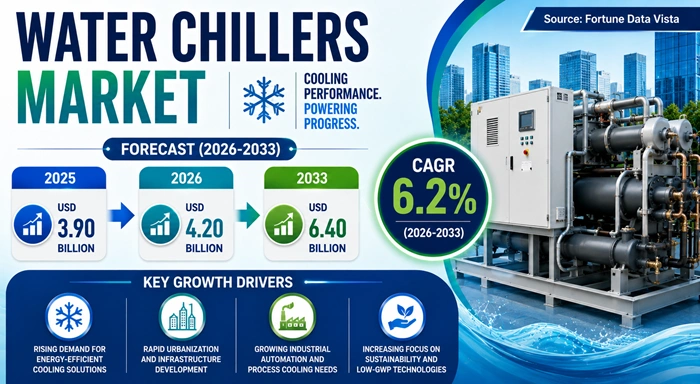
The global water chillers market size is valued at USD 3.90 billion in 2025 and is predicted to increase from USD 4.20 billion in 2026 to approximately USD 6.40 billion by 2033, growing at a CAGR of 6.2% from 2026 to 2033.
The rising global demand for energy-efficient industrial cooling, combined with rapid expansion of commercial infrastructure, is driving steady growth in the water chillers market. Water chillers — which remove heat from process water through vapor-compression or absorption refrigeration cycles — have become critical components in HVAC systems, food processing units, pharmaceutical manufacturing, and data center operations. As climate patterns shift and urban centers expand, businesses worldwide are investing more heavily in advanced cooling technologies that deliver both operational efficiency and environmental compliance.
AI Impact on the Water Chillers Industry
Artificial Intelligence Is Transforming How Water Chillers Are Monitored, Maintained, and Optimized Across Global Industrial and Commercial Installations
Artificial intelligence is playing an increasingly important role in the water chillers industry, particularly through predictive maintenance and real-time performance optimization. AI-powered sensors embedded in chiller systems can detect early signs of component wear, refrigerant loss, or efficiency drop — reducing unplanned downtime and lowering total operational costs. Leading manufacturers have begun integrating machine learning algorithms into their chiller control units to automatically adjust compressor loads, water flow rates, and refrigerant cycles based on ambient temperature data and building occupancy patterns.
Beyond maintenance, AI is enabling the development of smart chiller networks that communicate with building energy management systems (BEMS) to optimize the entire cooling ecosystem. Cloud-connected chillers can now log and analyze performance data from thousands of units simultaneously, giving facility managers real-time dashboards and actionable insights. This digital evolution is making the water chillers industry more service-oriented, with manufacturers shifting from one-time product sales to long-term performance monitoring contracts — a model that improves revenue predictability while enhancing customer satisfaction.
Growth Factors
A Combination of Rising Urbanization, Industrial Expansion, and Energy Efficiency Regulations Is Creating Robust Demand for Water Chilling Systems Across Multiple End-Use Sectors
The most powerful driver pushing growth in the water chillers market is the unprecedented wave of commercial construction and industrial capacity addition happening across developing economies. Countries across Asia Pacific, the Middle East, and Latin America are building hospitals, data centers, shopping malls, and manufacturing plants at scale — all of which require reliable and high-capacity cooling infrastructure. The increasing density of urban populations has also accelerated HVAC upgrades in existing buildings, where older systems are being replaced with energy-efficient water-cooled alternatives.
Simultaneously, strict environmental regulations mandating the phase-out of high-GWP (Global Warming Potential) refrigerants are pushing manufacturers to innovate and upgrade their product lines. Governments in North America and Europe have tightened refrigerant standards under frameworks like the Kigali Amendment to the Montreal Protocol, compelling end users to adopt next-generation chillers that use low-GWP refrigerants such as R-1234ze and R-32. This regulatory pressure, combined with increasing electricity costs, is accelerating the transition to high-efficiency centrifugal and magnetic bearing chillers across the commercial and industrial sectors.
Market Outlook
The Water Chillers Market Is Positioned for Sustained Long-Term Growth as Global Cooling Demand Intensifies Alongside Industrial Modernization and Climate Resilience Investments
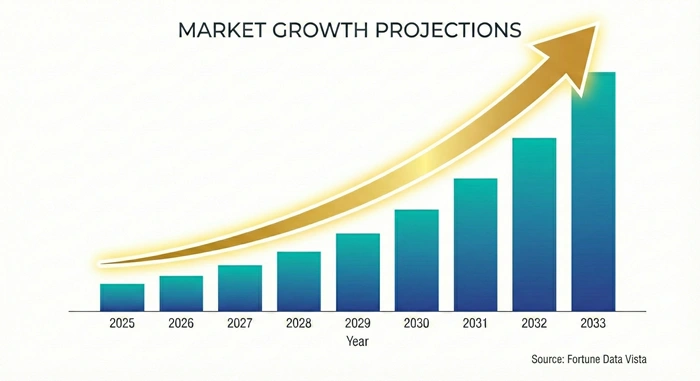
The long-term outlook for the water chillers market remains firmly positive. As global average temperatures continue rising and heat wave events grow more frequent, the need for reliable building cooling and process temperature control is becoming a baseline requirement for industrial operations. This is particularly evident in emerging markets where the gap between current cooling infrastructure and actual cooling demand is widest. Investments in smart city development and green building certifications such as LEED and BREEAM are directly stimulating demand for advanced water chilling systems that meet performance and sustainability criteria simultaneously.
In addition to thermal comfort applications, the explosive growth of the data center industry globally is creating a powerful secondary demand engine for water chillers. Hyperscale data centers operated by cloud providers require precise and continuous cooling, with water-based systems preferred for their superior thermal efficiency compared to air-based alternatives. The pharmaceutical and biotechnology sectors are also contributing to market growth, as drug manufacturing processes demand strict temperature control environments that only high-precision industrial water cooling systems can reliably provide.
Expert Speaks
-
"The shift toward smarter, more connected cooling infrastructure is not just a trend — it's a fundamental operational necessity. We are seeing our clients prioritize chiller efficiency as a direct lever to reduce their carbon footprint while controlling energy spend." — Trane Technologies CEO Dave Regnery, commenting on the accelerating demand for high-efficiency HVAC systems globally.
-
"Carrier's investment in next-generation water cooling technologies reflects our conviction that demand for reliable, energy-smart climate control will only strengthen as urbanization and industrial development continue across Asia and the Middle East." — Carrier Global CEO David Gitlin, addressing the company's strategic positioning in sustainable cooling solutions.
-
"Johnson Controls is committed to helping our customers decarbonize their buildings and plants. Water-cooled systems represent one of the highest-impact tools in that journey, delivering real energy savings that align with corporate ESG goals." — Johnson Controls CEO George Oliver, speaking at an industry forum on smart building technologies.
Key Report Takeaways
-
North America dominates the water chillers market, holding the largest regional share of approximately 34% in 2026, driven by a mature commercial infrastructure base, stringent energy efficiency standards, and widespread HVAC retrofitting activity in large commercial buildings.
-
Asia Pacific is the fastest-growing region, expanding at a CAGR above 7.5% from 2026 to 2033, fueled by large-scale industrialization in China and India, rapid data center construction, and surging urban development that demands modern cooling infrastructure.
-
Industrial end users are the largest consumer segment of water chillers globally, accounting for over 40% of total demand in 2026, owing to their need for continuous, high-capacity process cooling in sectors such as petrochemicals, food & beverage, and pharmaceuticals.
-
The commercial application segment contributes the highest revenue share among applications, driven by the rapid growth of commercial office spaces, hotels, hospitals, and shopping centers — all of which rely on central chiller systems for HVAC.
-
Water-cooled chillers are the most widely deployed chiller type, representing approximately 47% of global installations in 2026, favored for their higher coefficient of performance (COP) and suitability for large-scale commercial and industrial cooling loads.
-
The centrifugal chiller sub-segment is projected to grow fastest within the product type category, expected to achieve a market share of approximately 28% by 2033 at a CAGR of 7.1% from 2026 to 2033, as magnetic bearing and oil-free centrifugal designs deliver superior energy efficiency for large commercial HVAC applications.
Market Scope
| Parameter | Details |
|---|---|
| Market Size by 2033 | USD 6.40 Billion | Market Size by 2026 | USD 4.20 Billion | Market Size by 2025 | USD 3.90 Billion | Market Growth Rate from 2026 to 2033 | CAGR of 6.2% | Dominating Region | North America | Fastest Growing Region | Asia Pacific | Segments Covered | Type, Application, Cooling Capacity, Refrigerant Type, End User | Regions Covered | North America, Europe, Asia Pacific, Latin America, Middle East & Africa |
Market Dynamics
Drivers Impact Analysis
Surging Energy Efficiency Mandates and Rapid Expansion of Industrial and Commercial Infrastructure Are the Strongest Demand Catalysts Propelling the Water Chillers Market Forward
| Driver | ≈ % Impact on CAGR Forecast | Geographic Relevance | Impact Timeline |
|---|---|---|---|
| Rising commercial & industrial construction | ~28% | Global, highest in Asia Pacific | Short to Long-Term |
| Stringent energy efficiency regulations | ~22% | North America, Europe | Medium to Long-Term |
| Growing data center cooling demand | ~18% | Global, highest in North America & Asia | Short to Long-Term |
| Phase-out of high-GWP refrigerants | ~16% | North America, Europe | Medium-Term |
| Expansion of pharmaceutical manufacturing | ~10% | Asia Pacific, North America | Medium-Term |
| Rising urbanization and HVAC retrofits | ~6% | Latin America, Middle East | Long-Term |
The water chillers market is primarily driven by the accelerating global construction of commercial and industrial facilities that depend on centralized cooling. Hospitals, manufacturing plants, and large office complexes in rapidly urbanizing regions like Southeast Asia and the Middle East require high-capacity chiller systems right from the commissioning stage, making industrial water cooling demand structurally tied to macroeconomic development cycles. Countries like India, Vietnam, and Saudi Arabia are seeing record-level commercial project pipelines that directly translate into strong chiller procurement volumes.
Energy efficiency legislation is acting as a powerful secondary accelerator. The U.S. Department of Energy's periodic updates to minimum energy efficiency standards for commercial HVAC equipment, combined with the EU's Ecodesign Directive, are pushing facility operators to retire aging equipment and invest in modern water chilling systems. Each new standard revision has historically triggered a wave of upgrade spending that temporarily accelerates market growth — and another cycle of such updates is expected before 2028, which should sustain market momentum through the mid-forecast period.
Restraints Impact Analysis
High Capital Investment Requirements and Complex Maintenance Protocols Continue to Limit Broader Adoption of Water Chilling Systems Among Small and Mid-Scale End Users
| Restraint | ≈ % Impact on CAGR Forecast | Geographic Relevance | Impact Timeline |
|---|---|---|---|
| High initial capital cost | ~-30% | Developing economies | Short to Medium-Term |
| Complex installation & maintenance | ~-22% | SME segment globally | Medium-Term |
| Availability of alternative cooling technologies | ~-18% | Residential & light commercial | Short-Term |
| Water scarcity concerns for water-cooled units | ~-15% | Middle East, South Asia | Long-Term |
| Skilled technician shortage | ~-15% | Latin America, Africa | Medium to Long-Term |
The primary restraint facing the water chillers market is the significantly high upfront capital cost associated with the purchase, installation, and commissioning of centralized chiller systems. For small and medium-sized enterprises (SMEs), the total installed cost of a commercial water chiller — including piping, cooling towers, pumps, and controls — can be prohibitively expensive, pushing them toward less efficient but more affordable split AC or packaged unit alternatives. This capital barrier is especially pronounced in price-sensitive markets across Africa, Southeast Asia, and Latin America.
Maintenance complexity further compounds adoption challenges. Water chiller systems require regular inspection of refrigerant circuits, condenser water quality management, and calibration of sophisticated electronic control systems — tasks that demand certified HVAC technicians. In regions where a trained refrigeration workforce is scarce, operational risk increases substantially. This forces facility managers in those geographies to budget heavily for third-party service contracts, increasing lifecycle costs and reducing the attractiveness of the investment for lower-budget operators.
Opportunities Impact Analysis
Growing Investments in Green Building Certification, Smart Cooling Technologies, and Emerging Market Infrastructure Development Are Unlocking New Revenue Avenues for Chiller Manufacturers
| Opportunity | ≈ % Impact on CAGR Forecast | Geographic Relevance | Impact Timeline |
|---|---|---|---|
| Green building & LEED-certified construction | ~26% | Global | Medium to Long-Term |
| Smart chiller integration with BMS/AI | ~24% | North America, Europe, Asia Pacific | Short to Long-Term |
| Data center expansion (hyperscale) | ~22% | USA, China, India, Europe | Short to Long-Term |
| District cooling networks | ~16% | Middle East, Southeast Asia | Medium-Term |
| Emerging economies infrastructure growth | ~12% | Africa, South Asia | Long-Term |
The rapid global expansion of hyperscale and edge data centers presents one of the most compelling near-term growth opportunities for chiller manufacturers. Cloud computing adoption, AI workload processing, and the global rollout of 5G infrastructure are creating unprecedented cooling load requirements inside data facilities. Water chillers — particularly free-cooling and adiabatic variants — are increasingly specified as the primary cooling solution in these facilities due to their ability to handle dense heat loads with high energy efficiency ratios. Companies like Carrier and Johnson Controls are actively developing purpose-built chiller packages for data center applications to capture this accelerating demand.
The global momentum around green building certification programs is creating a parallel opportunity stream. Developers targeting LEED Platinum, BREEAM Excellent, or equivalent certifications are required to demonstrate HVAC energy performance that often necessitates high-efficiency water-cooled chiller systems. As sustainability-linked financing for real estate becomes mainstream, developers are increasingly willing to absorb the higher upfront cost of premium chiller systems because these costs can be offset by lower energy operating expenses and better property valuations.
Segment Analysis
By Type: Water-Cooled Chillers
Water-Cooled Chillers Lead Global Installations Due to Superior Energy Efficiency and Suitability for Large Commercial and Industrial Cooling Loads Across Key Markets
Water-cooled chillers represent the dominant product segment within the water chillers market, accounting for approximately 47% of global market share in 2026. These systems use condenser water loops coupled with cooling towers to reject heat, enabling them to achieve significantly higher coefficients of performance (COP) compared to air-cooled alternatives — typically ranging from 5.0 to 7.0 COP versus 2.8 to 4.5 for air-cooled units. The higher efficiency translates directly into long-term energy cost savings that justify the higher capital investment for large-scale commercial and industrial facilities. The segment is projected to grow at a CAGR of approximately 6.5% from 2026 to 2033, driven by surging demand from commercial real estate, hospitals, and large industrial plants across Asia Pacific and North America. In North America, leading companies like Carrier Corporation (USA), Trane Technologies (USA), and York — a brand of Johnson Controls (USA) — dominate the water-cooled chiller supply landscape, leveraging established service networks and technology portfolios.
The Asia Pacific region is the fastest-growing geography for water-cooled chillers, with China and India collectively accounting for over 35% of new installations in the region. Rapid hotel construction, expansion of pharmaceutical manufacturing campuses, and data center deployment are the primary demand drivers. Chinese manufacturers such as Gree Electric Appliances (China) and Midea Group (China) have significantly scaled their water-cooled chiller offerings to compete with multinational players on price while progressively improving product efficiency ratings. The combination of government-mandated building energy codes and utility incentives for high-efficiency cooling equipment is accelerating the transition from older air-cooled units to water-cooled chiller systems in commercial retrofits across Tier 1 and Tier 2 cities in China and India.
By Application: Industrial Cooling
Industrial Cooling Applications Account for the Largest Revenue Share as Process-Intensive Sectors Continue to Expand Manufacturing Capacity Globally
The industrial cooling application segment holds the largest share within the water chillers market, representing approximately 41% of total application-based revenue in 2026. Industries such as plastics and rubber processing, chemical manufacturing, metalworking, food and beverage production, and pharmaceutical synthesis require precise and sustained temperature control for their production processes, making water chillers indispensable assets within their plant infrastructure. Unlike HVAC cooling, which can tolerate minor temperature fluctuations, industrial process cooling demands consistent temperature accuracy to ensure product quality, yield consistency, and equipment longevity. The industrial cooling segment is expected to grow at a CAGR of approximately 6.8% from 2026 to 2033, making it not only the largest but also among the fastest-growing application segments. Key companies driving this segment include Daikin Industries (Japan), Mitsubishi Electric (Japan), and Bosch Thermotechnology (Germany), which have strong footholds in process cooling applications across European and Asian industrial zones.
Asia Pacific leads industrial cooling adoption, particularly in China, India, South Korea, and Japan, where dense manufacturing clusters require large-scale, reliable chiller networks to maintain continuous production cycles. In India, the rapid expansion of the pharmaceutical sector under the government's Production Linked Incentive (PLI) scheme is creating significant procurement activity for high-precision industrial chillers. In the food and beverage sector, stricter quality regulations and rising consumer demand for processed and packaged products are compelling manufacturers to upgrade their cooling infrastructure with modern, energy-efficient water chiller systems. This combination of regulatory compliance needs and productivity optimization goals is keeping industrial cooling demand consistently robust across the forecast period.
Regional Insights
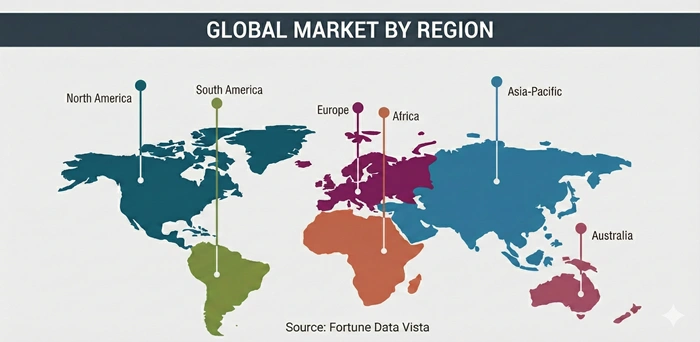
North America: The Dominant Market Region
North America's Mature Commercial Infrastructure, Stringent Energy Standards, and Active Retrofit Investment Cycle Position It as the Global Leader in Water Chiller Demand
North America holds the largest share of the global water chillers market, accounting for approximately 34% of total market revenue in 2026, and is expected to maintain a steady CAGR of approximately 5.4% through 2033. The United States is the single largest national market within the region, driven by a large installed base of commercial buildings that require periodic HVAC system upgrades, an active data center construction pipeline, and federally mandated minimum efficiency standards that accelerate the replacement of older, less efficient chiller units. The commercial office, healthcare, and hospitality sectors are the leading end-user categories driving procurement in this geography. Key players dominating the North American water chillers market include Carrier Corporation (USA), Trane Technologies (USA), Johnson Controls — YORK brand (USA), and Daikin Applied Americas (USA), which collectively account for a dominant share of commercial installations across the region.
Canada is also contributing meaningfully to regional demand, particularly in provinces undergoing significant industrial expansion and cold storage facility development. Mexico's growing manufacturing sector — especially automotive, electronics, and food processing — is driving industrial chiller procurement, with the country expected to register one of the fastest growth rates within the North American sub-region. The U.S. Environmental Protection Agency (EPA) and Department of Energy (DOE) continue to update minimum energy efficiency standards under the Energy Policy Act, creating recurring equipment replacement cycles that sustain market activity and benefit premium chiller segment manufacturers.
Asia Pacific: The Fastest Growing Region
Asia Pacific Is Emerging as the Engine of Global Water Chiller Demand Growth, Powered by Industrial Expansion, Urban Infrastructure Investment, and Data Center Proliferation
Asia Pacific is the fastest-growing regional segment in the water chillers market, projected to expand at a CAGR of approximately 7.5% from 2026 to 2033, significantly outpacing the global average. The region's rapid urbanization, industrial capacity addition, and government-led infrastructure programs across China, India, Southeast Asia, and the Middle East fringe countries are collectively generating enormous demand for centralized cooling systems. China alone accounts for over 28% of total Asia Pacific water chiller demand, driven by its massive commercial real estate pipeline, expanding pharmaceutical manufacturing sector, and the government's ongoing push for building energy efficiency under national green development policies. Regional leaders in the market include Daikin Industries (Japan), Mitsubishi Electric (Japan), Gree Electric Appliances (China), Midea Group (China), and Blue Star Limited (India), which are aggressively expanding their industrial and commercial chiller product lines to capture growing local demand.
India presents one of the most exciting growth stories within Asia Pacific. With the government's "Make in India" initiative and large-scale investments in pharmaceutical parks, IT campuses, and commercial real estate, demand for water chillers in India is growing faster than the regional average. The data center sector in India is expected to add significant cooling capacity through 2033, creating robust demand for water-based chiller systems. Southeast Asian markets including Vietnam, Indonesia, and Thailand are also experiencing accelerating construction activity in manufacturing zones and hotel developments, further strengthening the regional growth trajectory for water cooling solutions.
Top Key Players
-
Carrier Global Corporation (United States)
-
Trane Technologies plc (United States)
-
Johnson Controls International plc — YORK (United States)
-
Daikin Industries, Ltd. (Japan)
-
Mitsubishi Electric Corporation (Japan)
-
LG Electronics Inc. (South Korea)
-
Gree Electric Appliances Inc. (China)
-
Midea Group Co., Ltd. (China)
-
Blue Star Limited (India)
-
Thermax Limited (India)
-
Bosch Thermotechnology GmbH (Germany)
-
Smardt Chiller Group Inc. (Canada)
Recent Developments
-
In 2025, Carrier Global announced a strategic acquisition of a European HVAC technology firm to strengthen its portfolio of low-GWP refrigerant chillers, accelerating its compliance roadmap with EU F-Gas regulations and expanding its presence in the European commercial HVAC market.
-
In 2025, Trane Technologies launched its new Sintesis Excellence air-cooled screw chiller series featuring R-1234ze refrigerant, claiming up to 35% improvement in seasonal energy efficiency ratio (SEER) compared to its predecessor products, targeting large commercial and industrial customers globally.
-
In 2026, Daikin Industries completed the expansion of its chiller manufacturing facility in India's Maharashtra industrial zone, increasing annual production capacity by 40% to meet surging domestic and export demand across the South and Southeast Asian markets.
-
In 2025, Johnson Controls signed a multi-year performance contracting agreement with a leading U.S. hospital network to retrofit centralized chiller plants across 18 facilities, expected to deliver over 30% energy savings and reduce carbon emissions by an estimated 12,000 metric tons annually.
-
In 2026, Midea Group introduced a new AI-integrated magnetic bearing centrifugal chiller product line targeting data center customers in China and Southeast Asia, positioning the company to compete directly with premium Western brands on efficiency metrics.
Market Trends
Transition to Low-GWP Refrigerants and Integration of IoT-Enabled Smart Monitoring Are the Two Most Transformative Technology Trends Reshaping the Water Chillers Market Through 2033
The most significant technological trend reshaping the water chillers market is the accelerating shift toward low-GWP refrigerants. Regulatory pressure from the Kigali Amendment and national-level F-Gas regulations in Europe and North America has made the transition away from HFCs like R-410A and R-134a an urgent priority for chiller manufacturers. Next-generation refrigerants such as R-1234ze, R-32, and R-454B are being actively integrated into new chiller product lines, and major manufacturers have committed to phasing out high-GWP refrigerant models from their commercial portfolios by 2027–2028. This refrigerant transition is not only reshaping product development roadmaps but also driving a significant replacement wave as facility operators upgrade compliant chiller systems ahead of regulatory deadlines.
The second defining trend is the rapid integration of Internet of Things (IoT) connectivity and predictive analytics capabilities into commercial and industrial chiller units. Modern smart chillers now come embedded with sensor arrays, edge computing modules, and cloud connectivity that enable continuous performance monitoring, automated fault detection, and AI-driven efficiency optimization. Building operators can access real-time chiller performance dashboards through mobile apps and integrate chiller data directly into their building energy management systems (BEMS). This transition toward "Chiller-as-a-Service" business models — where manufacturers offer performance guarantees and remote monitoring subscriptions alongside equipment sales — is adding a recurring revenue dimension to the market that is attracting strong investment interest from both incumbents and new technology entrants.
Segments Covered in the Report
By Type:
-
Air-Cooled Water Chillers
-
Water-Cooled Chillers
-
Absorption Chillers
-
Screw Chillers
-
Centrifugal Chillers
By Application:
-
Commercial
-
Industrial
-
Residential
-
Healthcare
-
Data Centers
By Cooling Capacity:
-
Below 100 TR
-
100–500 TR
-
Above 500 TR
By Refrigerant Type:
-
R-134a
-
R-410A
-
R-1234ze
-
R-32
-
Others
By End User:
-
HVAC & Building Automation
-
Food & Beverage
-
Pharmaceutical & Biotechnology
-
Chemical Processing
-
Power Generation
By Region:
-
North America (U.S., Canada, Mexico)
-
Europe (Germany, U.K., France, Italy, Rest of Europe)
-
Asia Pacific (China, India, Japan, South Korea, Rest of Asia Pacific)
-
Latin America (Brazil, Argentina, Rest of Latin America)
-
Middle East & Africa (UAE, Saudi Arabia, Rest of MEA)
❝ Built for Every Level — From Startups to Industry Giants ❞
Here Is Exactly How This Report Works for You
-
Decision-makers at Tier 1 companies, mid-level enterprises, and investors will gain precise revenue forecasts by segment, region, and application — enabling confident capital allocation, market entry planning, and competitive benchmarking against the top players shaping the water chillers market through 2033.
-
Whether you are a startup assessing a niche cooling technology opportunity or a large corporation tracking supply-demand imbalances, refrigerant transition timelines, and competitor revenue sources, this report delivers the actionable intelligence you need to mitigate risk and accelerate growth.
-
The full version of this report equips you with geopolitical risk analysis across key manufacturing and demand regions, a detailed competitive intelligence section profiling revenue streams and expansion strategies of leading companies, and a procurement trend analysis that helps you make smarter sourcing and investment decisions in a rapidly evolving global cooling market.
Frequently Asked Questions:
Answer: The water chillers market is valued at USD 3.90 billion in 2025 and is projected to grow to USD 6.40 billion by 2033. The market is expected to expand at a CAGR of 6.2% from 2026 to 2033, driven by industrial expansion and rising energy efficiency requirements.
Answer: North America currently leads the water chillers market, holding approximately 34% of global revenue in 2026. This dominance is driven by a mature commercial infrastructure base, strict energy efficiency mandates, and an active HVAC retrofit cycle in large-scale facilities.
Answer: The primary growth drivers include rapid commercial and industrial construction, stringent environmental regulations mandating refrigerant transitions, and the surging cooling demands of hyperscale data centers. Rising urbanization across Asia Pacific and Latin America is also creating substantial new demand for water chilling systems.
Answer: Water-cooled chillers represent the dominant product type, accounting for approximately 47% of global market share in 2026. Their superior energy efficiency and suitability for large cooling loads make them the preferred choice for commercial and industrial end users.
Answer: The water chillers market is undergoing a significant technology transformation driven by the shift to low-GWP refrigerants and the integration of IoT-based smart monitoring systems. AI-powered predictive maintenance and cloud-connected chiller performance platforms are becoming standard features in new commercial and industrial chiller product lines.