
31 May, 2026 Author: Fortune Data Vista
A High-Growth Market at a Critical Crossroads
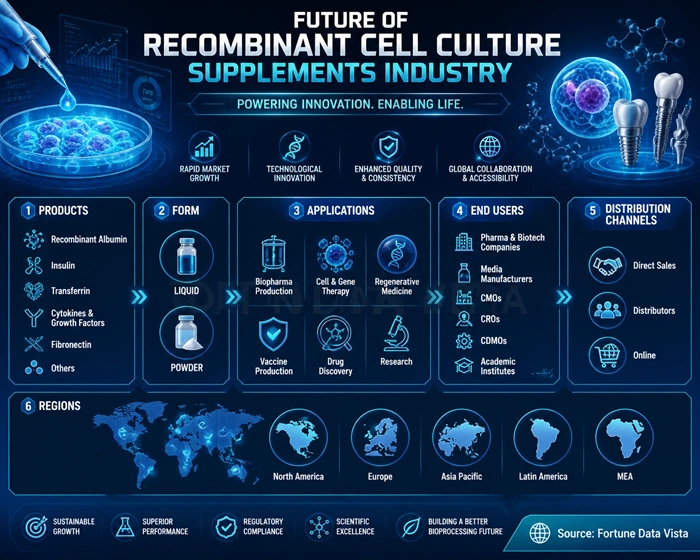
The global recombinant cell culture supplements market, valued at USD 964.61 million in 2025, is projected to grow from USD 1,084.46 million in 2026 to approximately USD 2,626.93 million by 2033, reflecting a robust CAGR of 12.3% across the forecast period. These specialized, genetically engineered media additives — including recombinant albumin, insulin, transferrin, and cytokines — are fast becoming indispensable across biopharmaceutical manufacturing, regenerative medicine, and advanced cell therapy development.
The market surge is being fueled by an intersection of powerful forces: a booming pipeline of cell and gene therapies, landmark industry investments, and a rapidly evolving geopolitical landscape that is reshaping supply chains globally.
Gene & Cell Therapy Pipelines Propel Demand
A PhRMA January 2026 report confirmed that 438 cell and gene therapies are currently under development in the United States alone, placing unprecedented demand on high-performance, animal-free cell culture environments. Recombinant supplements provide the essential growth factors and cytokines needed for the precise ex vivo expansion of human cells used in CAR T-cell therapies and gene-edited products.
In a significant clinical milestone reported by Reuters and eCancer in April 2026, a new KIR-CAR T-cell therapy (SynKIR-110) demonstrated promising efficacy in solid tumors — including ovarian cancer, mesothelioma, and cholangiocarcinoma — with 44% disease stabilization and no dose-limiting toxicities in Phase I trials. Such advances directly translate into higher demand for precision-grade recombinant supplements that support complex cell manipulation workflows.
Strategic Billions: Lonza, Sartorius, and Thermo Fisher Double Down
Key market players are making landmark capital commitments to scale cell culture capabilities. Lonza Group AG announced on January 28, 2026, that its 2025 capital expenditures reached CHF 1.3 billion, with targeted investments enhancing its cell and gene therapy programs.
Sartorius AG invested EUR 442 million in 2025, which included the strategic acquisition of Mattek — a specialist in organoids and micro-tissues — signaling a major industry push toward 3D cell culture models that require customized recombinant supplements. Meanwhile, Thermo Fisher Scientific reported full-year 2025 revenues of USD 44.56 billion, underscoring its continued dominance across upstream bioprocessing and cell culture media supply.
Leading pharmaceutical companies have also committed over USD 370 billion to U.S. manufacturing and infrastructure over the next five years — investments that will directly accelerate demand for premium recombinant culture additives as the market scales from USD 1,084.46 million in 2026 toward USD 2,626.93 million by 2033.
US Pharmaceutical Tariffs: A Double-Edged Sword
The geopolitical dimension has added complexity to the market's outlook. President Trump's pharmaceutical tariffs, enacted in April 2026, are projected to disproportionately impact smaller biomanufacturers reliant on imported raw materials, including specialized recombinant growth factors sourced from Europe and Asia. According to BioProcess International, the tariffs are sparking industry-wide concerns about supply chain disruptions, elevated production costs, and delayed therapy timelines.
However, analysts note a silver lining: the tariff environment is accelerating U.S. domestic manufacturing investments in bioprocessing infrastructure, which could ultimately strengthen local supply of recombinant supplements and reduce long-term import dependence.
Asia-Pacific Emerges as the Fastest-Growing Region
While North America remains the dominant regional market, Asia-Pacific is the fastest-growing region, driven by surging biotechnology investments in China, Japan, South Korea, and Australia. With the global market set to more than double from USD 964.61 million in 2025 to USD 2,626.93 million by 2033, governments across Asia-Pacific are actively funding biopharmaceutical infrastructure, creating strong tailwinds for recombinant supplement suppliers looking to diversify beyond established Western markets.
Transition to Animal-Free, Chemically Defined Media Accelerates
A pivotal industry trend reshaping the competitive landscape is the widespread transition from serum-based to animal-free, chemically defined supplements. Protein-based and recombinant supplements already commanded 42.50% of the cell culture supplements market revenue share in 2024, driven by their superior consistency, safety, and scalability for therapeutic manufacturing.
This shift is being pushed by tightening regulatory standards across the US FDA, EMA, and other global agencies, which increasingly demand traceable, reproducible, and xeno-free culture environments for clinical-grade biologics and advanced therapies.
Conclusion
The recombinant cell culture supplements industry stands at a transformative junction in 2026. With the market valued at USD 964.61 million in 2025 and on a clear trajectory to reach USD 2,626.93 million by 2033 at a 12.3% CAGR, the growth story is compelling and well-supported. Backed by 438 advanced therapies in development, billions in infrastructure commitments from Lonza, Sartorius, and Thermo Fisher, and a geopolitical tariff environment compelling rapid supply chain realignment, stakeholders across North America, Europe, and Asia-Pacific who invest strategically in animal-free, high-purity recombinant solutions will be best positioned to lead the next wave of biopharmaceutical innovation.